
Toronto Real Estate: A Deep Dive into Current Market Dynamics and Future Outlook
The Toronto real estate market is a perennial topic of discussion, a complex ecosystem influenced by various economic factors, consumer sentiment, and supply-demand dynamics. Following a period of significant price adjustments and fluctuating activity, understanding the nuances of its current state and anticipating future trends is crucial for both buyers and sellers. This comprehensive analysis will explore the recent shifts, compare current conditions to historical data, and forecast potential trajectories for one of Canada’s most vibrant housing markets.
As of late last year, the Toronto real estate market experienced a challenging period marked by seven consecutive months of price declines, culminating in one of the slowest September markets on record. This downturn was largely influenced by constrained supply, or more accurately, a distinct lack thereof. September 2022 saw historically low numbers of new listings and active inventory, leading to fewer transactions and a reluctance among buyers to bid aggressively on the limited available properties. This created a stagnant environment where price discovery was difficult and market momentum was virtually non-existent.
Source: TRREB
Analyzing Last Year’s Market Performance
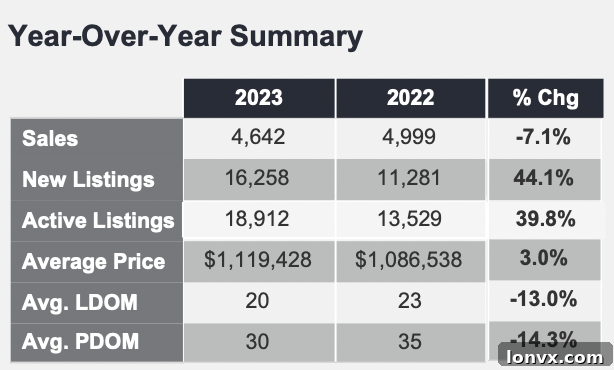
A closer look at the Toronto Regional Real Estate Board’s (TRREB) September Market Watch reveals telling insights. While year-over-year home sales experienced a decline, suggesting a challenging autumn market ahead, the average house price managed to climb by 3.0% within the same period. This seemingly contradictory data points to underlying complexities within the market. What stands out most prominently is the remarkable increase in the speed at which properties are transacting compared to the previous year. Both key metrics for Days On Market (DOM) showed significant improvement, ranging from 13% to 15%. This acceleration in sales velocity indicates that homes are selling considerably faster than they were in September of the prior year, signaling a potential shift in market dynamics.
This increased speed of transactions could be attributed to one of two primary factors, or a combination of both:
- Enhanced Buyer Motivation: Buyers may be feeling a greater sense of urgency, becoming more decisive in their offers, perhaps driven by fears of rising prices, potential interest rate hikes, or a desire to secure a property before further market shifts.
- Increased Seller Flexibility: Alternatively, sellers might be more motivated to accept offers, adapting their expectations to prevailing market conditions and demonstrating a greater willingness to negotiate or price their homes competitively to ensure a quicker sale.
Given that the average sale-to-list price ratio is currently hovering around 100%, it’s challenging to definitively pinpoint which factor is more dominant; it could very well be a delicate balance. However, the looming threat of increased borrowing costs could further erode buying power and impose sustained financial stress on households, potentially leading to more properties coming onto the market. We have already witnessed a substantial increase in supply, with new listings rising by 44.1% and active listings by 39.8%. This influx of inventory strongly suggests that supply will be the most critical theme shaping the Toronto real estate market moving forward. As previously discussed in our monthly reports, this evolving supply trend is accelerating the market’s transition towards a more favorable environment for buyers, tilting the scales away from the seller-dominated conditions seen in recent years.
The Importance of Context: September 2022 as an Anomaly
It’s crucial to apply a fair and balanced perspective when criticizing market performance by comparing it against anomalous months. September 2022, for instance, stands out as one of the most severely undersupplied markets in Toronto’s recorded history. Therefore, while it might be tempting to catastrophize and highlight a 44.1% increase in new listings or a 39.8% rise in active listings as alarming figures, these numbers become less daunting when understood within the context of 2022. That year represented an anomaly, unfolding amidst the most significant drop in housing prices Canada has ever experienced. Comparing current figures directly to such an exceptional low point can distort the perception of current market health.
Nonetheless, despite the contextual understanding of last year’s unique circumstances, September 2023 cannot be unequivocally described as a “good” month for Toronto’s real estate market. When evaluated against long-term trendlines, the current figures reveal that we are approximately 5% to 10% above where we should ideally be for new listings and about 18% to 22% above the long-term average for active listings. This indicates a higher level of supply than is typical over extended periods. While it’s easy to form conclusions based solely on month-over-month comparisons (which might suggest market strength) or year-over-year comparisons (which might suggest weakness), the most accurate and reliable assessment comes from analyzing the market within a long-term historical context. This perspective helps to filter out short-term volatility and provides a clearer picture of sustainable trends.
For further insights into the critical importance of selecting the right comparative data, we recommend exploring “How to Lie with Statistics,” a seminal work written by Darrell Huff in 1954. This accessible book provides an excellent introduction to statistics for the general reader and can be read in approximately an hour, offering valuable lessons on how data can be misinterpreted or manipulated.
The Price Floor: Segmented Market Performance
One of the most compelling revelations from TRREB’s September report concerned the performance of specific market segments. It highlighted a distinct strength in entry-level, ground-based products, which appear to be significantly outperforming the broader market for detached homes and condominiums. This divergence in performance across housing types offers a fascinating glimpse into the underlying resilience and vulnerabilities of the Toronto real estate landscape. Notably, non-detached and non-condo properties are demonstrating superior market performance:
- Detached Homes: These properties are selling, on average, at 100% of their asking price. While this indicates stability, it also shows a lack of aggressive bidding wars, suggesting a balanced market for this segment.
- Semi-Detached Homes: Showing robust demand, semi-detached properties are selling at an impressive average of 104% of their asking price, indicating competitive interest and a slight premium being paid by buyers.
- Townhouses: Similarly, townhouses are experiencing strong demand, selling at an average of 103% of their asking price. This segment, much like semi-detached homes, is clearly attracting motivated buyers.
- Condominiums: In contrast to other segments, condominiums appear to be facing a more challenging environment, selling at an average of 99% of their asking price. This suggests a more cautious market for condos, with less upward pressure on prices and potentially more room for negotiation.
This sustained strength in lower-end ground-based houses (excluding condos) holds significant implications for the overall market. It could be instrumental in cementing a crucial “price floor,” thereby fostering long-term sustainability in home values and potentially moderating aggressive price growth. If investors and first-time buyers continue to absorb the more affordably priced properties at the current pace, it could effectively cushion the impact of broader market price declines. This absorption helps to maintain a baseline level of demand and prevent a more drastic downward spiral.
Condominiums, however, emerge as the critical “x-factor” in this scenario. Should equity continue to erode in the condo market, it could severely limit the ability of existing condo owners to transition into larger properties like townhouses or semi-detached homes. This creates a ripple effect throughout the housing ladder. Conversely, one could apply the same logic to assume that buyers moving up from townhouses and semi-detached properties into detached homes could leverage their newfound equity to gradually support and stabilize the detached market. This interplay between housing segments is a fascinating phenomenon to observe. Townhouses, positioned squarely in the middle of the market between detached homes and condominiums, are increasingly playing a pivotal role as a key data point, offering crucial insights into the evolving trajectory of Toronto’s real estate market moving forward.
Recession Talk and its Impact on Real Estate Professionals
As the word “recession” becomes increasingly prevalent in economic discussions, particularly in the coming months, it’s worth noting that the real estate profession itself has been experiencing a form of recession for well over a year now. Real estate professionals have contended with drastically reduced incomes for the past 12 to 16 months. This significant decline is a direct consequence of the largest drop in home sales volume and house prices witnessed in recent memory, further compounded by a massive influx of new registrants entering the profession. The combination of dwindling transactions and heightened competition has created a challenging environment for agents.
As a result of these converging pressures, the current real estate market reflects a stark reality: an average of only 1.52 transactions per realtor on an annualized basis. Such a low transaction volume per professional underscores the intense competition and the demanding conditions facing those working in the industry. This environment necessitates greater resilience, adaptability, and a sharp focus on client service for real estate agents looking to thrive amidst these challenging economic headwinds.
Looking Ahead: Navigating Toronto’s Evolving Real Estate Landscape
The Toronto real estate market remains a dynamic and complex entity. While the past year brought significant adjustments and challenges, particularly for sellers in 2022, the market has shown signs of stabilization and segment-specific resilience. The key takeaway from recent data is the crucial role of supply, alongside the nuanced performance across different housing types. The strength in the lower-end ground-based market segments provides a potential foundation for stability, while the condo market’s performance will be a critical indicator for broader market health.
As we move forward, several factors will continue to shape the Toronto real estate narrative. Interest rate policies by the Bank of Canada, inflation rates, and the broader economic health of the region will undoubtedly influence affordability and buyer confidence. The ongoing balancing act between supply and demand, particularly in the mid-range and entry-level segments, will dictate price movements. For both prospective homeowners and seasoned investors, a keen understanding of these intricate market forces, coupled with a long-term perspective, will be essential for making informed decisions in Toronto’s ever-evolving real estate landscape.
Staying informed about these trends, understanding local market statistics, and consulting with experienced real estate professionals will be paramount for anyone looking to navigate this complex market successfully. The era of rapid, unchecked price appreciation may have tempered, but the underlying demand for housing in a vibrant city like Toronto ensures its real estate market will always present unique opportunities and challenges.