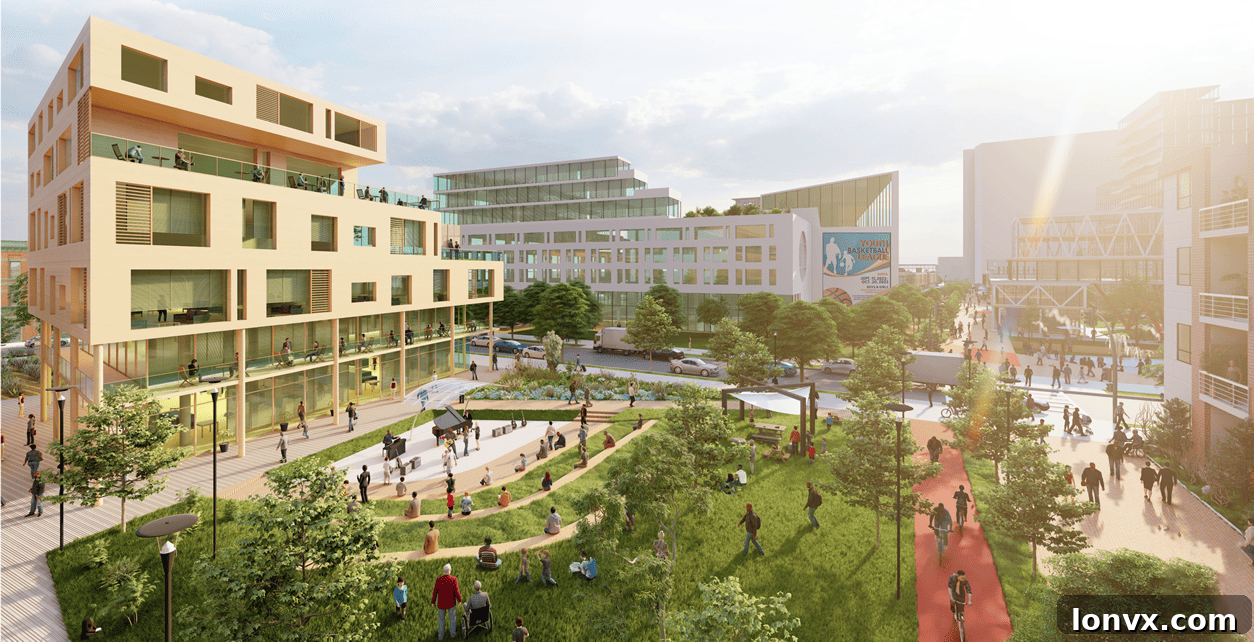
In a triumph of collaborative urban planning and design, a multidisciplinary team from Canadian and Singaporean universities, aptly named “Fusion,” has secured the top prize in the highly competitive 2021 Urban Land Institute (ULI) Gerald D. Hines Student Urban Design Competition. This prestigious global contest challenged 105 teams from 61 universities across Canada, the United States, and Singapore to devise a comprehensive redevelopment strategy for an eight-block neighborhood in Missouri. The Fusion team’s innovative and holistic approach for a downtown Kansas City East Village district ultimately captivated the judges, earning them the coveted top honor and a $50,000 prize.
The ULI Gerald D. Hines Student Urban Design Competition is renowned for pushing the boundaries of urban thought, inviting graduate students to craft visionary and economically viable design and development schemes for large-scale, real-world urban sites. Over an intense two-week period, teams are tasked with addressing complex urban challenges, from economic development and social equity to environmental sustainability and infrastructure. This year’s focus on Kansas City presented a unique opportunity to reimagine an existing urban fabric, demanding both creativity and practical foresight from the competing teams.
Meet the Visionaries: The Fusion Team Behind the Win
The victorious Fusion team brought together a diverse range of expertise from three prominent universities. Comprising Frances Grout-Brown and Leorah Klein from Ryerson University, Ruotian Tan and Chenyi Xu from the University of Toronto, and Yanlin (Lynn) Zhou from York University, the group exemplified the interdisciplinary collaboration essential for modern urban challenges. Their backgrounds spanned urban planning, architecture, urban design, and real estate, creating a dynamic synergy that proved instrumental in their success.
Before the competition’s “rapid-fire environment,” many of the team members were strangers. However, as Ruotian Tan (Master of Urban Design) noted, “Everyone has a different skill set but worked together smoothly.” Chenyi Xu (Master of Architecture) echoed this sentiment, emphasizing, “We became a very efficient team in a short time.” Leorah Klein (Master of Urban Planning) highlighted the exceptional team dynamic, crediting their openness to each other’s ideas, iterative design process, and shared commitment to pushing the project’s boundaries for their remarkable achievement. This seamless collaboration was clearly evident to the judges, who praised the team’s cohesive presentation and meticulously crafted plan.
Unveiling the Winning Vision: East Village’s Sustainable Transformation
The Fusion team’s award-winning plan, valued at an estimated $655 million, proposed a vibrant mixed-use, mixed-income redevelopment for the East Village neighborhood in downtown Kansas City. Far more than just a blueprint for buildings, their vision presented a transformative model for urban revitalization rooted in economic resilience, social equity, and environmental stewardship. The core of their strategy revolved around leveraging the region’s strong agricultural legacy to address pressing urban issues, particularly food insecurity and economic stagnation.
Food as a Catalyst for Economic and Community Growth
At the heart of Fusion’s plan was the innovative concept of using the food industry as a catalyst for comprehensive urban renewal. Recognizing the Kansas City neighborhood as a “food desert,” Ruotian Tan explained their intent to foster a vibrant local food system. The plan integrated a 165,000-square-foot incubator designed to stimulate economic growth through local culinary incubation and research-driven employment opportunities. This incubator would not only support emerging food businesses but also create a robust economic ecosystem centered around local food production and distribution.
To further combat food deserts and enhance community well-being, the team proposed an extensive network of community gardens. These gardens would not only provide fresh, accessible produce for residents but also create new agricultural jobs, fostering a stronger connection between the community and its food sources. This unique food-based approach was a standout feature, enabling economic resilience through small-scale food growth and distribution, a truly novel paradigm for urban neighborhood development.
Pioneering Sustainable and Resilient Urban Infrastructure
Environmental sustainability was another cornerstone of the Fusion plan. The team incorporated a range of green infrastructure solutions designed to mitigate the impacts of climate change and enhance the quality of life for residents. Key elements included:
- Rain Gardens and Tree Canopy: Strategically integrated rain gardens and an expansive tree canopy were designed to mitigate urban flooding and combat extreme heat, creating cooler, more comfortable microclimates throughout the neighborhood.
- Green Transportation Networks: A comprehensive network of bike lanes and multi-block pedestrian pathways was envisioned to reduce greenhouse gas emissions by encouraging active and sustainable modes of transportation. This promoted connectivity within the site and to surrounding areas, fostering a more pedestrian-oriented urban environment.
- Advanced Stormwater Management: Ruotian Tan and Chenyi Xu were responsible for developing an innovative underground stormwater management system for the entire site. This system, carefully designed based on existing topography, demonstrated a commitment to resilient infrastructure that addresses environmental challenges proactively.
Crafting Inclusive Communities: Housing and Public Spaces
Beyond economic and environmental considerations, the Fusion plan placed a strong emphasis on social equity and community building. The proposal included ambitious housing affordability targets, aiming to create a truly mixed-income community where diverse populations could thrive. Furthermore, public spaces were meticulously designed to foster social interaction and community cohesion.
Chenyi Xu, the architecture student on the team, played a pivotal role in designing individual buildings and the overall architectural language. He expressed particular pride in the community center he designed, featuring an open atrium. “In the words of the judges, the community centre is very much like a stadium,” Xu recounted, acknowledging Kansas City citizens’ passion for sports. “In fact, it is not a stadium, but the multi-functions it provides are better than the single function of the stadium.” This multi-functional approach ensured the community center would serve as a vibrant hub for a wide array of activities, far exceeding the scope of a single-purpose facility.
Jury’s Endorsement: Why Fusion Triumphed
Diana Reid, the ULI Hines jury chair, articulated the reasons behind Fusion’s decisive victory, stating, “Fusion stood out as it pushed a new paradigm for an urban neighbourhood based on the strong regional legacy of agriculture. Their financing plan and design enabled economic resilience through small-scale food growth and distribution, local culinary incubation and research-driven employment opportunities.”
Reid further elaborated on the holistic nature of their success: “Fusion’s food-based approach and focus on inclusive and sustainable growth created a complete vision of a new urban neighbourhood in East Village, including ambitious housing affordability targets, smart community partnerships, strong pedestrian and multi-modal transportation, and connectivity to and through the site.” This comprehensive praise underscored the team’s ability to weave together diverse urban challenges into a cohesive, innovative, and implementable solution.
A Synergy of Skills: The Team Behind the Success
The success of the Fusion team was a testament to their individual expertise and collective collaborative spirit. Each member focused on their area of specialization while contributing to the project’s overall continuity and supporting one another.
- Narrative and Vision (Leorah Klein & Frances Grout-Brown): Klein and Grout-Brown (Master of Urban Planning) were instrumental in conducting crucial research, developing a compelling narrative, and selecting the name “Fusion.” Klein noted that the name perfectly captured the essence of “disparate parts coming together to form something different,” also evoking “culinary fusion,” which was ideal for a food-centric plan. Their ability to communicate the plan’s intricate intentions to the judges was vital.
- Urban Design and Architecture (Ruotian Tan & Chenyi Xu): Tan (Master of Urban Design) and Xu (Master of Architecture) were the driving forces behind the urban design and architectural elements. Tan conceived the overall master plan, including the layout, density, and landscape strategies, while Xu focused on modeling, renderings, and the detailed design of individual buildings, notably the celebrated community center.
- Financial Feasibility (Yanlin (Lynn) Zhou): Yanlin (Lynn) Zhou (Master of Real Estate and Infrastructure) ensured the project’s financial viability. Her expertise in real estate and infrastructure allowed her to develop a robust financing plan, leveraging a mix of public and private funding, including land acquisition from the government at minimal cost, while ensuring attractive returns for investors. Zhou also contributed to market research for housing quantities and introduced the innovative idea of vertical gardens, further enhancing the plan’s sustainability and uniqueness.
As Grout-Brown highlighted, this cross-functional contribution from all five members imbued the project with a strong sense of continuity and coherence, which was crucial for its success.
Drawing Inspiration from Home and Beyond
While the Fusion plan was tailored specifically for the Kansas City site, the team drew inspiration from successful urban models closer to home. Leorah Klein mentioned that the pedestrian-friendly Distillery District and the pedestrian-oriented, mixed-income Regent Park neighborhood in Toronto served as valuable benchmarks, influencing design choices that prioritized walkability, community engagement, and social diversity.
The adaptability of the Fusion plan was also a point of discussion. Ruotian Tan believes that elements of the plan could be tweaked and applied to other urban locations facing similar challenges. However, Frances Grout-Brown pointed out potential roadblocks for implementation in Canada, particularly the high land values in certain areas. Conversely, Yanlin Zhou noted that the quicker approval processes and lower land values prevalent in Kansas City worked significantly in the project’s favor, demonstrating the contextual factors that influence urban development.
Beyond the Competition: Future Horizons for Urban Innovators
The ULI Hines Competition served as a powerful capstone to the academic careers of these aspiring urban professionals. All five team members are in their final year of master’s studies and are now embarking on exciting professional journeys. Ruotian Tan is pursuing a summer internship with aspirations of becoming a full-time urban designer. Frances Grout-Brown is contributing to Ryerson Community Housing Strategies on a part-time basis. Chenyi Xu hopes to join a local architectural firm, bringing his design talents to new projects. Leorah Klein has already launched her career in real estate development, working part-time as a development associate at Diamond Corp, a prominent developer of mixed-use communities in Toronto. Yanlin Zhou is starting an internship with a local developer, aiming for a full-time position after her summer semester.
The experience left a lasting impression on the team members, fostering both professional growth and personal connections. Klein expressed her hope for future collaborations within Toronto’s close-knit urban planning community: “The urban planning community in Toronto is relatively small. I feel and hope our paths will cross. We have an awesome dynamic team and I’d love to work together again.” Grout-Brown summarized the profound impact of their achievement, stating, “The competition was a great way to end our academic careers.”
The Fusion team’s victory in the 2021 ULI Gerald D. Hines Student Urban Design Competition stands as a testament to their ingenuity, collaborative spirit, and commitment to creating sustainable, equitable, and vibrant urban environments. Their innovative, food-centric approach to redeveloping Kansas City’s East Village provides a compelling blueprint for future urban revitalization efforts worldwide, demonstrating how a multidisciplinary vision can transform challenges into opportunities for growth and community flourishing.