
The Unmissable Link: How Top Toronto Schools Command Premium Home Prices
For countless young families, the quest for a home often begins and ends with one critical factor: proximity to a quality school. In a bustling metropolis like Toronto, this prioritization translates directly into real estate value, as a new report vividly illustrates just how much Torontonians are willing to invest to secure a spot within a desirable school zone.
Unpacking the “School Premium” in Toronto’s Housing Market
A recent deep dive by Wahi, a prominent real estate platform and brokerage, has shed light on the significant financial premium associated with living near Toronto’s highest-performing elementary schools. The analysis focused on median home prices during the third quarter of this year, specifically in neighborhoods boasting elementary schools that achieved an impressive score of nine or higher out of ten in the most recent annual Report Card on Ontario’s Elementary Schools, published by the respected Canadian think tank, the Fraser Institute.
The Fraser Institute’s report card provides a comprehensive assessment of academic performance, drawing heavily on data from the Education Quality and Accountability Office (EQAO), a provincial Crown agency responsible for standardized testing in Ontario. These EQAO assessments measure students’ literacy and numeracy skills, offering a crucial benchmark for school quality. While the average score for all schools sits around six, those achieving a nine or higher represent truly exceptional academic environments.
The findings revealed a striking scarcity of top-tier institutions: out of nearly 1,100 public, Catholic, and private elementary schools across the expansive Greater Toronto Area (GTA), only approximately 60 managed to secure a grade of at least 9.0 in the 2022-2023 school year. This limited supply of highly-rated schools, combined with relentless demand, creates a potent force in the local housing market.
A Tale of Two Neighbourhoods: Price Extremes in Top School Zones
Wahi’s analysis uncovered a dramatic spectrum of home prices within these coveted school zones, highlighting the diverse fabric of Toronto’s real estate landscape even among its most academically successful areas.
Urban Living on a Budget: The Church-Yonge Corridor
At the more accessible end of the price scale, the vibrant Church-Yonge Corridor emerged as the most affordable option. Homes near the esteemed St. Michael’s Choir School, which proudly boasts a perfect 10/10 rating, had a median price of $570,000. This relative affordability in such a prime school zone is largely attributable to the prevalence of condominiums, offering a gateway into a top-performing area for buyers with more constrained budgets. This downtown core neighborhood appeals to young professionals and small families seeking an urban lifestyle without compromising on educational quality, demonstrating that even in a competitive market, opportunities for a top school experience can exist at varying price points.
Elite Enclaves: Moore Park’s Million-Dollar Appeal
In stark contrast, the upscale midtown neighbourhood of Moore Park represented the pinnacle of luxury, with median home prices soaring to $3.2 million. This exclusive area is home to not just one, but two top-rated schools, a factor that undoubtedly contributes to its exorbitant property values. Moore Park is characterized by its tree-lined streets, large detached homes, and a sense of secluded tranquility, despite its central location. The lifestyle offered here, combined with access to exceptional education, cements its status as one of Toronto’s most desirable – and expensive – residential pockets.
The Dominance of the Million-Dollar Mark
The report underscores a pervasive trend: of the 63 neighborhoods identified with top-tier schools, a significant 41 commanded a median home price of at least $1 million. To put this into perspective, the GTA-wide median home price, based on recent data from a comparative third quarter, hovered around $905,000. This substantial difference illustrates a clear “school premium” – an additional cost buyers are willing to pay to access excellent educational opportunities for their children.
This widespread prevalence of seven-figure median prices in top school zones reinforces the notion that quality education is not just a desirable amenity but a powerful driver of property value, often pushing homes well beyond the average market rate in the wider GTA. Families are effectively making a long-term investment, not only in their children’s future but also in the potential appreciation of their real estate asset.
Expert Perspectives: Navigating the Complexities
Ryan McLaughlin, an economist at Wahi, acknowledged the intricate nature of quantifying this school-zone effect. “It’s difficult to say exactly how much school zones affect local home prices in the GTA, since so many factors are at play,” McLaughlin noted. He elaborated that property values fluctuate considerably due to a confluence of elements, including current market conditions, the types of homes available in a given neighborhood, access to public transit, proximity to amenities, and the overall economic climate.
However, McLaughlin was unequivocal about the observed correlation: “However, we did observe that in many neighbourhoods with a top school, the median home price was well above the GTA-wide median home price.” This observation suggests that while school quality isn’t the sole determinant, it acts as a powerful enhancer of property values, creating a distinct market segment where demand consistently outstrips supply, thus driving up prices.
The consistency of these findings across diverse neighborhoods, from high-rise dominated urban cores to sprawling suburban enclaves, speaks to the universal appeal of quality education as a primary consideration for family home buyers in the Greater Toronto Area.
Beyond the Price Tag: The Intrinsic Value of Top School Zones
The “school premium” is not merely a financial transaction; it represents an investment in a lifestyle and future. Families seeking homes in top school zones are often looking for more than just academic excellence. They are seeking vibrant communities, safer environments, and a network of like-minded families who prioritize education. These neighborhoods often feature better parks, community centers, and a stronger sense of local engagement, all of which contribute to a higher quality of life. The long-term benefits can extend beyond graduation, potentially influencing peer groups, university admissions, and even future career paths for children.
Furthermore, homes in these desirable school districts tend to retain their value more robustly and often appreciate at a faster rate, making them a sound long-term real estate investment. The consistent demand from incoming families ensures a steady market, offering a level of stability that can be particularly attractive in fluctuating economic times.
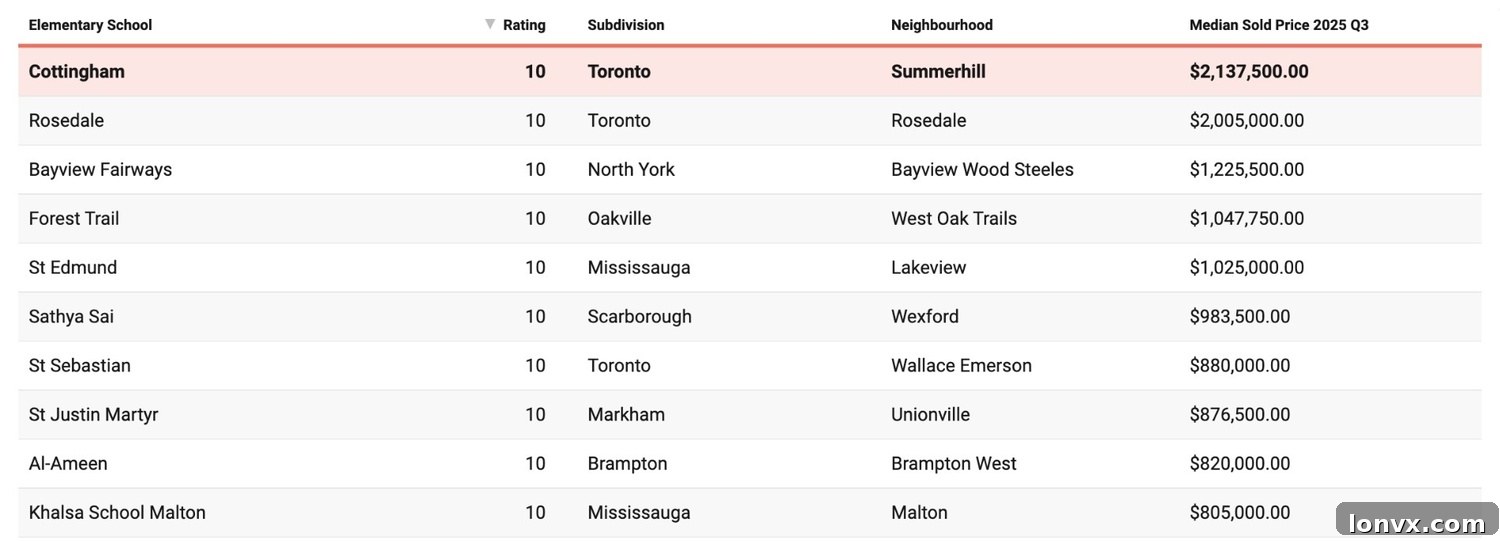
The top-rated Toronto elementary schools and the cost to live near them.
The Critical Caveat: Enrollment is Not Guaranteed
Proceed with Caution
Despite the allure of living near a top-rated school, Ryan McLaughlin issued a crucial warning for prospective buyers: “Living close to a top-rated school doesn’t guarantee your child can enrol.” This significant caveat is paramount for families making such substantial financial decisions based primarily on school access.
The reality in many burgeoning Toronto neighborhoods is that “increased density and population growth mean that in some neighbourhoods, newcomers will find local schools are already at capacity.” This means that even if a home is physically located within the designated catchment area of a highly-sought-after school, there might not be available spots for new students. Schools, particularly in rapidly developing areas, face immense pressure from population influx, leading to oversubscription.
This issue can manifest in several ways: school boards may implement lottery systems for enrollment, maintain lengthy waitlists, or even redirect students to other, sometimes less desirable, schools outside their immediate vicinity. In some extreme cases, temporary classrooms or portable units are introduced to accommodate overflow, which can impact the learning environment. For parents, this necessitates a rigorous due diligence process that extends beyond simply checking a school’s ranking or its proximity on a map.
Prospective buyers are strongly advised to contact the specific school board and the individual school directly to inquire about current enrollment figures, capacity limits, and policies for new registrants. Understanding the school’s specific catchment area rules, any potential for boundary changes, and the likelihood of securing a spot for their child is absolutely critical before committing to a home purchase. Failure to do so could lead to significant disappointment and potentially impact a child’s educational journey, despite the substantial investment in the home.
Strategic Considerations for Families in the Toronto Market
Navigating Toronto’s competitive real estate market with schools as a primary driver requires a strategic approach. Families should:
- Research Thoroughly: Look beyond academic rankings. Explore school culture, special programs, extracurricular activities, and parent reviews. Visit schools if possible and speak to current parents.
- Balance Priorities: While schools are crucial, consider other family needs such as budget constraints, commute times for parents, proximity to work or family, and access to other essential amenities like parks, recreation centers, and healthcare.
- Understand Catchment Areas: Verify the exact school catchment boundaries with the school board, as these can change. Do not rely solely on online maps from third-party sites.
- Plan for the Future: Consider the trajectory from elementary to secondary school. Is there a highly-rated secondary school in the same feeder pattern? What are the implications if school boundaries shift in the coming years?
- Consider Alternatives: Research private school options or specialized programs that might align with your child’s needs if public school enrollment proves challenging.
- Consult a Real Estate Expert: Work with a realtor who specializes in family homes and understands the nuances of school zones in the GTA. They can provide invaluable insights and guide your search.
Conclusion
The latest report from Wahi unequivocally confirms that a top-tier elementary school is a powerful magnet for Toronto’s home buyers, translating directly into significantly higher property values. While the dream of living near an academically excellent institution comes with a hefty price tag – often pushing homes into the million-dollar range – families are clearly willing to pay the premium for the perceived benefits of a superior education and a strong community.
However, the critical reminder that proximity does not guarantee enrollment serves as an essential guide for prospective buyers. The complex interplay of urban growth, school capacity, and ever-evolving catchment areas demands meticulous research and proactive engagement from parents. For those navigating Toronto’s dynamic real estate landscape, understanding both the immense value and the practical challenges associated with top school zones is key to making an informed and ultimately successful home purchase for their family’s future.