The Canadian housing market is navigating turbulent waters, grappling with a significant downturn primarily fueled by escalating global trade tensions. A recent comprehensive report from RBC Economics, authored by housing market expert Robert Hogue, paints a picture of diminishing buyer confidence and a notable cooling in economic prospects. This challenging environment has translated into a steep decline in resale activity and a pronounced softening of home prices across many of the nation’s major markets, with Southern Ontario and British Columbia bearing the brunt of this nationwide slide.
The Shadow of Economic Uncertainty on Housing
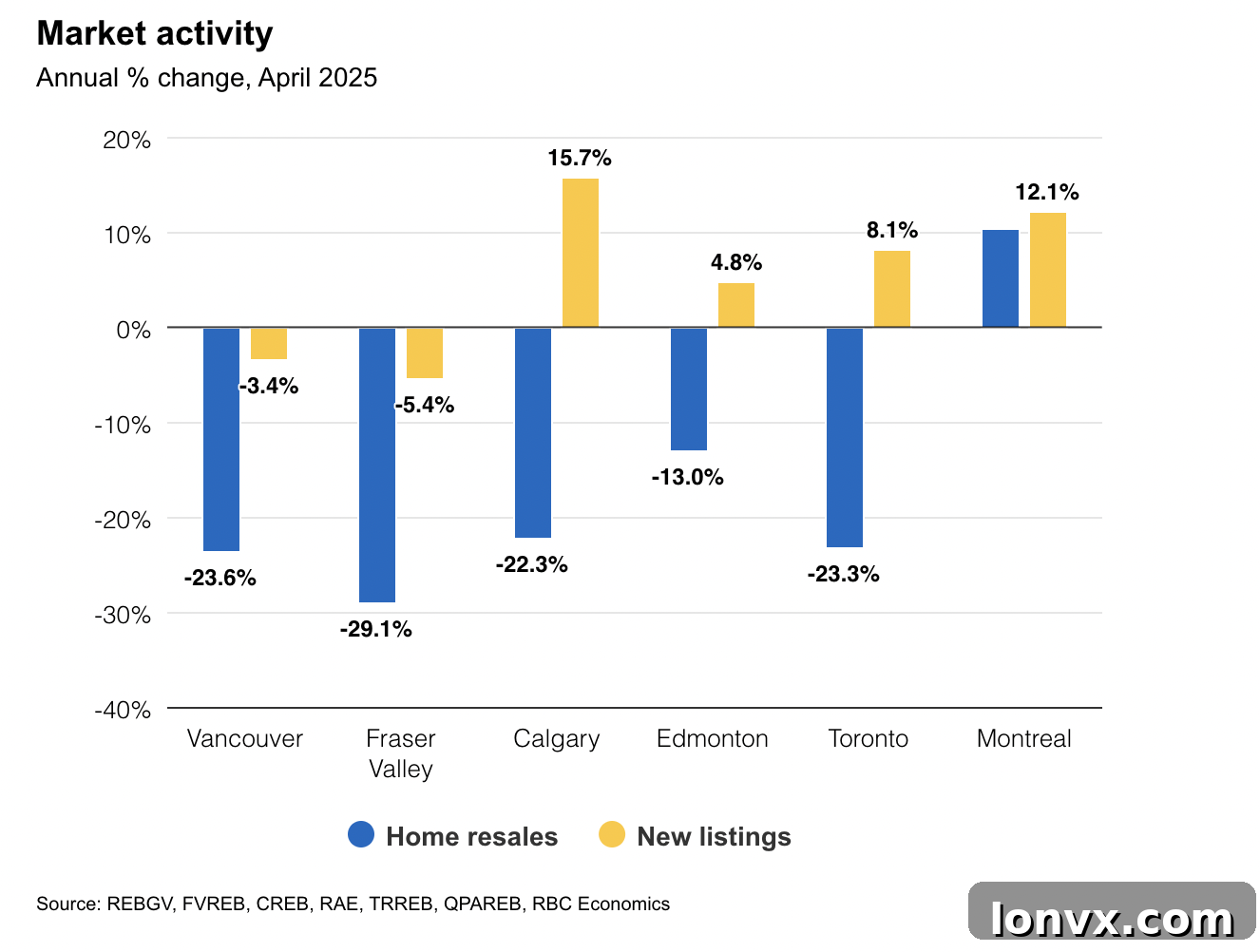
The specter of a global trade war, which has already cast a long shadow over various sectors of the economy, is now undeniably impacting the core of Canadian households – their homes. The month of April saw a dramatic year-over-year tumble in resale activity across crucial markets such as the Fraser Valley, Greater Vancouver, and the expansive Greater Toronto Area. Southern Ontario, in particular, experienced sales volumes reaching near-cycle lows, with Toronto recording its weakest April performance in three decades, an anomaly only surpassed by the unique circumstances of the 2020 pandemic shutdown. This significant reduction in transactions underscores a growing apprehension among potential buyers, who are increasingly adopting a wait-and-see approach amidst the prevailing economic fog.
The current market dynamic is characterized by a stark imbalance: buyers are retreating, while sellers, many of whom may have held off listing their properties in previous boom cycles, are now more inclined to enter the market. This divergence is inevitably leading to an accumulation of housing inventory, which in turn exerts downward pressure on prices. The composite MLS Home Price Index (HPI), a key indicator of housing value trends, registered further declines in April across several pivotal urban centers. This list includes Toronto, Hamilton, Kitchener-Waterloo in Ontario, and Vancouver and the Fraser Valley in British Columbia. Even Calgary, a market that had demonstrated remarkable resilience and stability for an extended period, recently reported its first year-over-year price drop in half a decade, signaling a widespread shift in market sentiment.
“Bargaining power has decisively shifted in the buyer’s favour in Vancouver, Fraser Valley, Toronto, and other southern Ontario markets,” asserts Robert Hogue in his insightful analysis. He emphasizes that consumer confidence remains acutely fragile, and the overall market outlook will likely remain murky and uncertain until there is a tangible easing of global trade tensions. This sentiment highlights the interconnectedness of international economic policies and local housing market performance, demonstrating how macro-level disputes can translate directly into micro-level anxieties for homebuyers and sellers.
Toronto: Navigating a Material Property Value Correction
The Greater Toronto Area (GTA) housing market is currently undergoing what analysts describe as a “material correction in property values.” Sales activity experienced an “exceptionally soft” April, marking the second consecutive month of subdued performance. Property values are consequently adjusting to this reduced demand. The composite HPI for Toronto saw a decline of 0.7 percent from March and a more substantial 4.4 percent drop – equivalent to approximately $49,000 – since December. The average home price in the region now hovers around $1.07 million, a figure that continues to fluctuate downwards.
According to Hogue, the influx of new listings is consistently outpacing the dwindling buyer demand, effectively tipping the scales in favor of purchasers to an extent not witnessed since the challenging market conditions of the early 1990s. This growing supply-demand imbalance gives buyers greater leverage, leading to increased negotiations and longer sales cycles. “We anticipate prices will continue to fall in the near term as sellers find themselves in fierce competition to finalize deals, all while overarching trade worries continue to suppress overall market sentiment,” Hogue elaborates. This challenging environment presents both hurdles for existing homeowners and potential opportunities for well-positioned buyers.
Vancouver: Empowering Buyers Amidst Increased Supply
In the highly competitive Vancouver real estate market, buyers are increasingly seizing control of the narrative. Despite a noticeable increase in available inventory, home resales remained “stable” at a two-year low in April. This dynamic signifies that while more properties are coming onto the market, the pace of sales is not keeping up, creating a more balanced, if not buyer-friendly, environment. As the supply of homes continues to expand, prospective buyers are presented with a wider array of choices, significantly bolstering their bargaining power during negotiations.
Consequently, home prices are visibly feeling the pressure. The composite HPI in Vancouver has registered declines for four consecutive months and is down 1.8 percent compared to April of the previous year (2024, as per the original content’s implied timeline which might be future-dated). Hogue projects that “buyers will undoubtedly continue to utilize their newfound power to extract price concessions from sellers in the months ahead—quite possibly at an accelerating pace.” This trend suggests that sellers in Vancouver may need to adjust their expectations further to meet the current market’s valuation.
Montreal: A Resilient, Yet Vigilant, Market
While no major Canadian market is entirely immune to national economic pressures, Montreal’s real estate sector has demonstrated a degree of resilience, holding relatively steady for the time being. After experiencing a sharp drop in home resales earlier in the year, activity has since stabilized. Furthermore, prices have continued to climb modestly, with single-family homes appreciating by 2.5 percent month-over-month and condos seeing a 1.1 percent increase. This steady growth, while not as explosive as previous boom periods, suggests a more fundamentally stable demand in the region.
Nevertheless, the tide in Montreal may be on the cusp of shifting. With new listings gradually increasing, buyers are progressively gaining more ground and negotiating room. RBC economists anticipate that the pace of price growth in Montreal will likely decelerate in the coming months as the market begins to rebalance. While its economic drivers and housing affordability (relative to Vancouver and Toronto) have provided a buffer, Montreal’s market participants should remain watchful of broader national and international economic shifts.
Calgary: A Rebalancing Act in the Prairies
Even Calgary, which has long been considered a standout performer among Canadian real estate markets, is now exhibiting signs of strain, as noted by Hogue. The robust momentum that carried the market into early 2025 has perceptibly faded over the last three months, culminating in resales hitting a five-year low in April. This slowdown marks a significant turning point for a city often characterized by its dynamic and responsive housing market, closely tied to the energy sector.
The steady stream of new construction has ensured that supply remains strong in Calgary. However, the overarching buyer uncertainty, stoked by broader economic concerns, is actively undermining price growth. April’s data revealed the first year-over-year decline in the HPI since 2020, dropping by 1.4 percent. RBC expects further “mild declines ahead as the re-balancing process continues.” This rebalancing implies a period of adjustment where supply and demand dynamics normalize, potentially leading to more sustainable growth in the long run after a brief correction.
Broader Economic Implications and the Path Ahead
A weakening housing market in Canada extends its impact far beyond just property values. It has significant broader economic implications, affecting consumer spending, construction sector employment, and overall GDP growth. When homeowners feel less wealthy due to declining property values, they tend to spend less, which can dampen retail sales and other economic activities. The construction industry, a major employer, also suffers from reduced demand for new homes, leading to potential job losses and decreased investment in future projects. This ripple effect underscores the housing market’s critical role as a bellwether for the Canadian economy.
Government and policy responses will be crucial in mitigating the ongoing downturn. Discussions around interest rate policies by the Bank of Canada, coupled with federal and provincial housing affordability initiatives, could play a role in stabilizing the market. However, such interventions often take time to materialize and show their full effect. The focus remains on achieving a ‘soft landing’ for the housing market, avoiding a sharp correction that could trigger wider financial instability.
This evolving market environment impacts different buyer and seller segments uniquely. First-time homebuyers, who previously struggled with affordability, might find new opportunities as prices adjust, assuming they can secure financing amidst higher interest rates. Investors, on the other hand, might pull back, waiting for more clarity, or seek distressed assets. Downsizers and up-sizers face a complex decision-making process, weighing the value of their current home against the cost of a new purchase in a declining market. Understanding these varied impacts is key to navigating the current climate.
Regional Bright Spots and the Lingering Cloud of Trade Uncertainty
Amidst the widespread cooling, a few regional markets across Canada appear to be holding their ground with greater resilience. “Prairie markets such as Edmonton, Saskatoon, and Regina, alongside some regions in Quebec, including Quebec City, and the Atlantic region like St. John’s, seem to be holding up relatively well at this point,” Hogue observes. These markets often benefit from different economic drivers, lower average housing costs, and potentially less direct exposure to the immediate impacts of international trade fluctuations compared to the highly globalized economies of Toronto and Vancouver.
However, Hogue issues a cautionary note: these regions are by no means immune to the broader chill emanating from the global trade war. While they have shown resilience thus far, overall market sentiment remains fragile, and any significant escalation of trade tensions could still impact these seemingly stable areas. The U.S. decision to defer additional tariffs in April provided a temporary glimmer of hope, offering some relief to the market. Yet, experts caution against expecting an immediate surge in housing activity. RBC firmly believes that the persistent specter of ongoing trade uncertainty will continue to act as a significant headwind, compelling many prospective buyers to remain on the sidelines and await greater clarity.
The Canadian housing market’s trajectory in the coming months will largely depend on the resolution of these global trade disputes and the subsequent restoration of economic confidence. Until then, a cautious approach is likely to dominate the decisions of both buyers and sellers across the nation, making professional guidance and thorough market research more critical than ever.