
The British Columbia Real Estate Association (BCREA) has released its highly anticipated latest housing forecast, offering a comprehensive and cautious outlook for the province’s dynamic real estate market. This forecast arrives at a critical juncture, as ongoing economic uncertainties, significantly influenced by lingering international trade tensions, continue to shape buyer and seller sentiment across the region. The report serves as a vital guide for stakeholders navigating the complex landscape of B.C. housing.
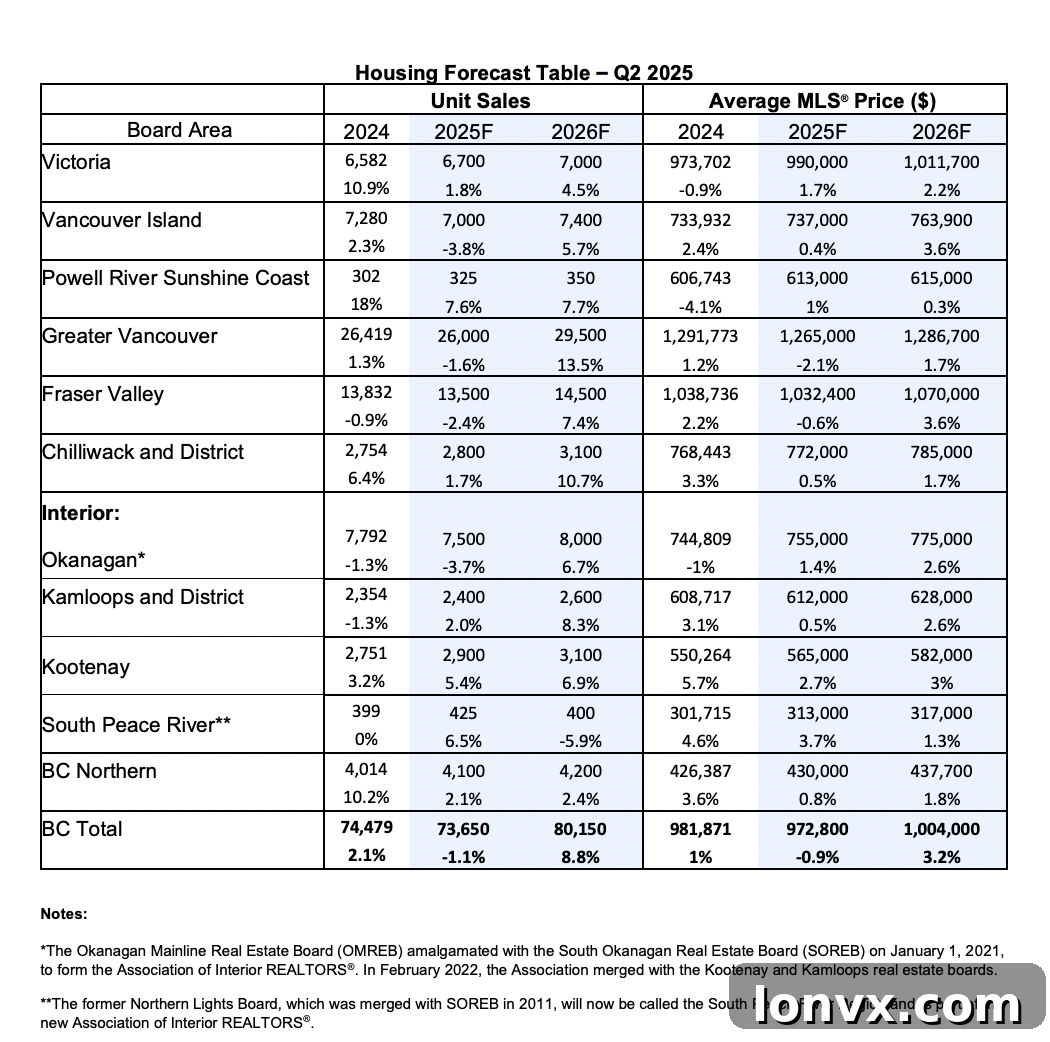
In its detailed second-quarter report, the provincial association projects a modest dip in home sales across British Columbia this year, with an anticipated decrease of 1.1 percent. This reduction would bring the total sales volume to approximately 73,650 units for the current year. However, the BCREA’s analysis is not without a silver lining; it confidently anticipates a robust rebound in the subsequent year, with sales projected to surge by a significant 8.8 percent. This forecast underscores a market grappling with immediate challenges while holding strong potential for future recovery.
Brendon Ogmundson, the Chief Economist at BCREA, articulates the prevailing sentiment, stating, “Hopes for a return to normalcy in the B.C. housing market were swiftly dashed this year, upended by a pointless and mutually destructive trade war.” This candid assessment highlights how external geopolitical factors have directly impacted domestic market confidence. Ogmundson further elaborates on a key market dynamic: “While there is significant pent-up demand in the market, uncertainty about the direction of the economy is holding that demand back.” This indicates that a substantial pool of potential buyers is ready to enter the market, but hesitations stemming from economic ambiguity are preventing them from committing to major investments like home purchases. This interplay of demand and uncertainty is a defining characteristic of the current B.C. real estate environment.
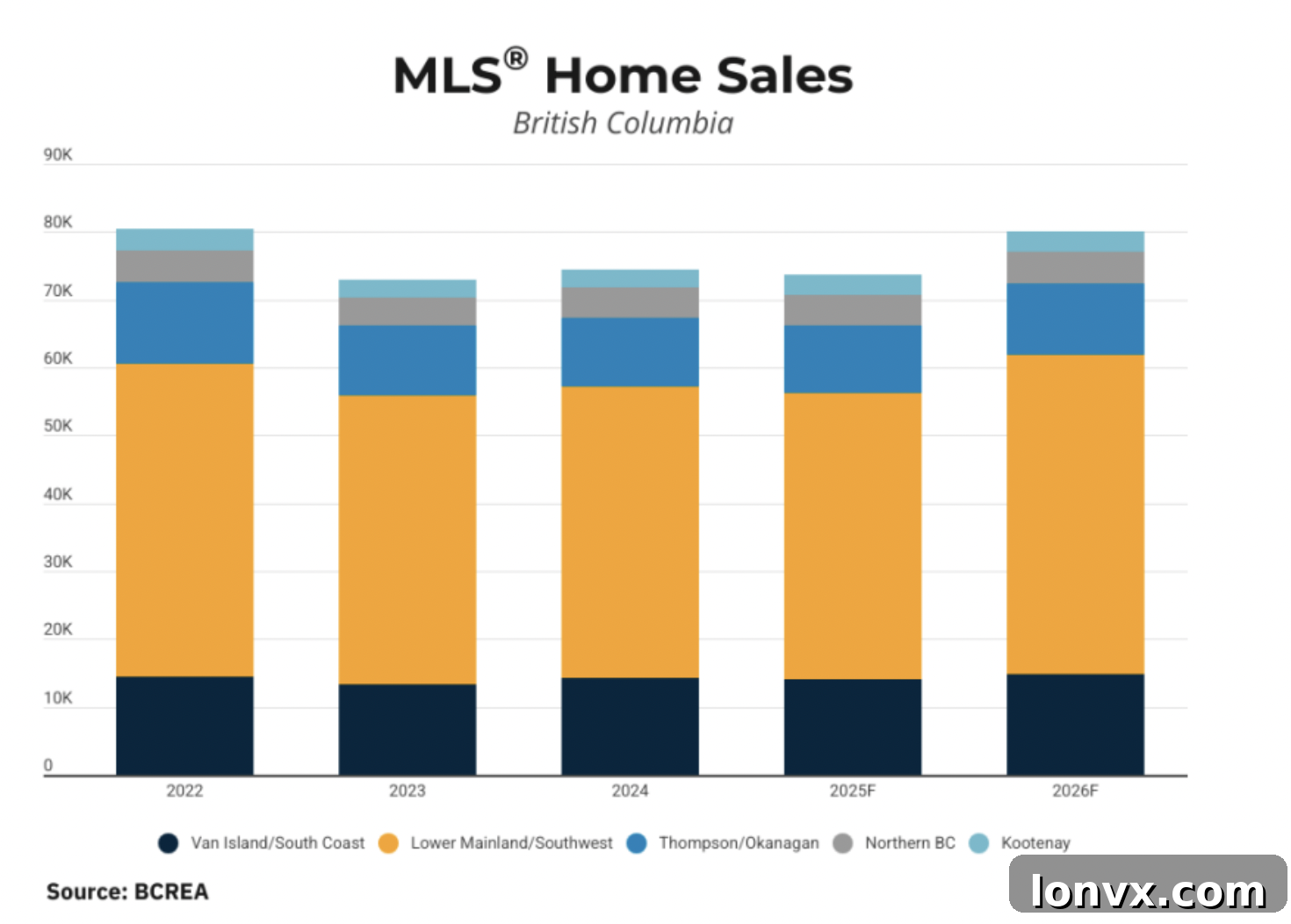
Inventory Levels Continue to Climb Across B.C. Housing Market
Despite a series of recent adjustments in interest rates by the Bank of Canada—which saw its overnight rate cut from 5 percent down to 2.75 percent over the past year—the BCREA report emphasizes that overall market confidence remains notably shaky. While lower borrowing costs typically stimulate buyer activity, the prevailing economic jitters appear to be overshadowing the positive impact of these rate reductions. This suggests that while affordability has improved marginally from a financing perspective, broader economic anxieties are maintaining a cautious approach among potential homebuyers and investors in the British Columbia housing market.
A significant trend identified in the forecast is the continued ascent of inventory levels across the province. For the first time in over a decade, resale listings are projected to average more than 40,000 units provincially. This substantial increase in available homes signals a shift from the tight supply conditions that characterized much of the recent past. This robust uptick in listings, combined with an existing surplus of unsold new construction properties, is anticipated to exert a mild downward pressure on prices in specific, localized markets. However, the BCREA cautions against a province-wide price slump, noting that average prices across British Columbia are largely expected to remain stable. This stability is largely attributed to a strategic and cautious approach adopted by many sellers, who are electing to wait out the current economic conditions rather than listing their properties at potentially reduced values. This dynamic creates a balanced environment where buyers have more choice, but sellers are not yet compelled to drastically cut prices.
The B.C. housing market is far from monolithic; its performance is highly variegated when examined on a regional basis. Each area within the province presents its unique set of challenges and opportunities, influenced by local economic drivers, demographic shifts, and affordability constraints. Understanding these regional nuances is crucial for both buyers and sellers seeking to make informed decisions in British Columbia’s diverse real estate landscape.
- Vancouver Island-Coast: This expansive region is poised for a mixed performance, reflecting its diverse sub-markets. While the capital city of Victoria is anticipated to experience a slight uptick in home sales, other areas along the island are projected to see a decline. This disparity often stems from the varied economic bases and demographic appeal of different communities within the region. Victoria, with its stable government employment and growing tech sector, often shows more resilience compared to smaller, more tourism-dependent or resource-reliant towns elsewhere on Vancouver Island. Factors such as local job markets, population growth, and specific supply-demand dynamics play a critical role in these localized trends.
- Lower Mainland (Greater Vancouver & Fraser Valley): As the economic heartland of British Columbia, the Lower Mainland continues to grapple intensely with persistent affordability issues. High property values, coupled with stringent mortgage qualification criteria, are making homeownership increasingly challenging for many residents. The forecast for this dense urban and suburban corridor predicts a minor dip in sales volume for 2025, suggesting that affordability barriers will continue to constrain market activity. However, a recovery is anticipated in 2026, driven potentially by easing interest rates, gradual improvements in economic confidence, and continued population growth, which consistently fuels demand in this sought-after region.
- Thompson-Okanagan: This popular interior region, known for its scenic beauty, wineries, and outdoor recreation, is forecast to experience a slight decline in home sales this year. This could be due to a combination of factors, including the impact of higher interest rates on recreational property purchases and a general cooling of buyer enthusiasm. Nevertheless, the region is expected to demonstrate a strong recovery in 2026. Its enduring appeal as a retirement destination, a growing hub for remote workers, and a desirable lifestyle location positions it well for future growth once economic uncertainties dissipate and consumer confidence strengthens.
- Northern B.C.: In contrast to some of the more volatile markets, Northern British Columbia stands out for its remarkable resilience in the face of broader economic challenges. The region, often underpinned by robust resource industries and government investments, is expected to maintain stable home sales throughout 2025. This stability highlights a less speculative market driven by fundamental economic activity and consistent local demand. Looking ahead, a slight growth in sales is anticipated for 2026, indicating a steady, albeit slower, upward trajectory for the Northern B.C. real estate market. Its affordability relative to the southern parts of the province also plays a crucial role in its consistent performance.
- Kootenay Region: The Kootenay region continues to be a strong performer, largely benefiting from more favorable affordability conditions compared to the provincial average. This attraction, combined with its lifestyle appeal for outdoor enthusiasts and those seeking a quieter pace of life, is fueling demand. The forecast projects a healthy increase in sales for this year, underscoring the region’s strong appeal to buyers looking for value and quality of life. The Kootenays exemplify how pockets of affordability can thrive even when the broader market experiences headwinds.
In summary, the BCREA’s latest housing forecast for British Columbia paints a detailed picture of a market in transition. While acknowledging the significant current economic headwinds, particularly those stemming from international trade disruptions and their ripple effects on global and local economies, the association underscores a prevailing sense of optimism for the medium to long term. As greater clarity emerges around critical economic and trade policies, and as central banks potentially further stabilize interest rates, gradual but consistent improvement and stability are strongly anticipated in the British Columbia housing market. The underlying demand for housing, coupled with the province’s attractive lifestyle and economic fundamentals, suggests a resilient market poised for a strategic recovery and sustained growth in the years to come.