
Canadian Real Estate Market Shifts: Vancouver and Toronto Exit ‘Bubble Risk’, Now ‘Overvalued’ – UBS Global Report 2023
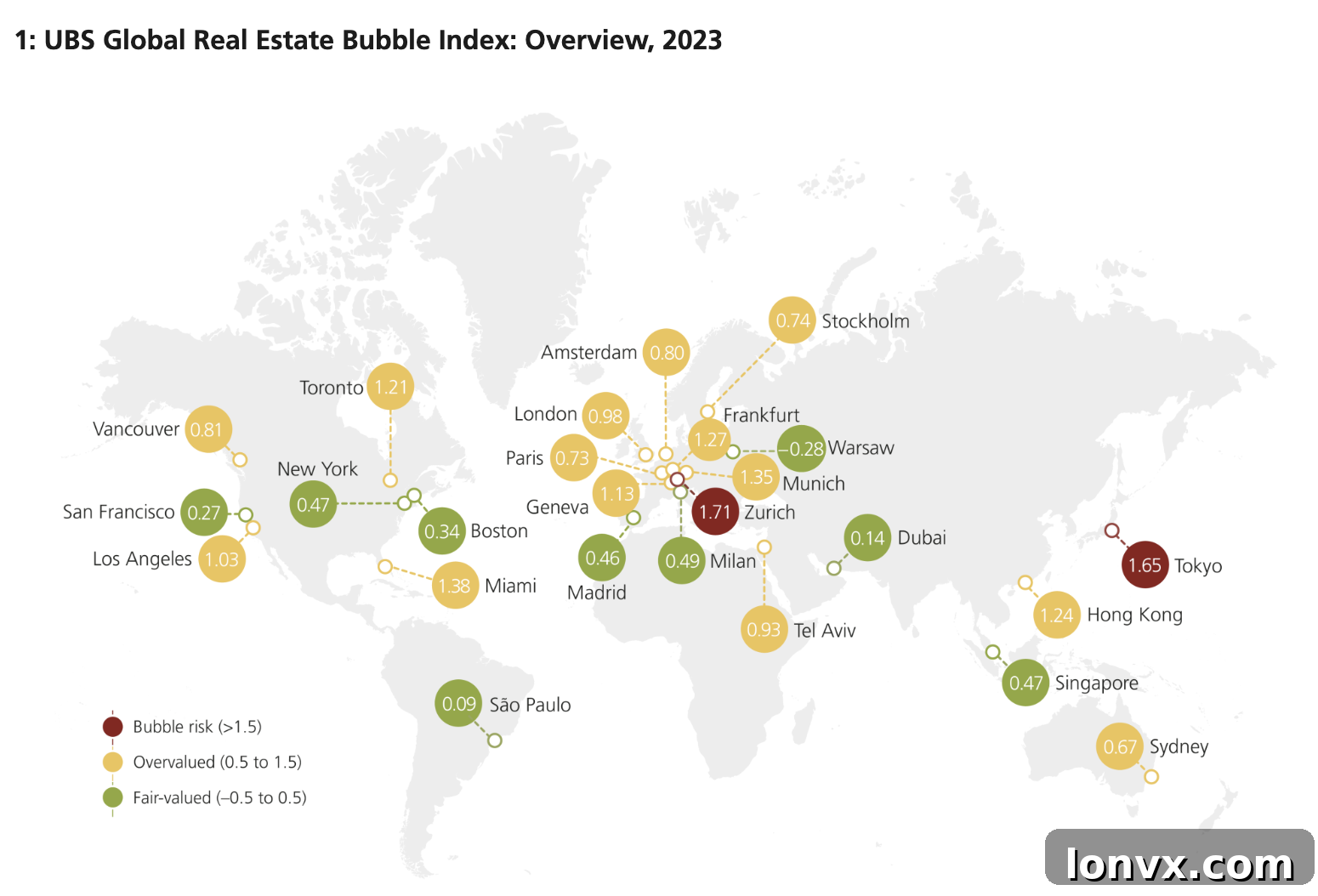
The latest edition of the UBS Global Real Estate Bubble Index for 2023 brings a significant update for Canada’s two most prominent and often scrutinized real estate markets: Vancouver and Toronto. According to this highly anticipated annual report, both cities have undergone a notable reclassification, moving out of the perilous “bubble risk” category and into the less severe, though still concerning, “overvalued” status. This shift signals a crucial period of market recalibration, indicating that while housing valuations remain high, the immediate and acute risk of a sudden, drastic market collapse has somewhat receded.
For years, Vancouver and Toronto have garnered international attention for their rapidly escalating property prices, often perceived as disconnected from fundamental economic indicators. The UBS Global Real Estate Bubble Index serves as a vital barometer, tracking the risk of housing bubbles across major global cities by analyzing various factors such as price-to-income and price-to-rent ratios, mortgage growth, and construction activity. A “bubble risk” designation implies a severe misalignment between asset prices and underlying economic realities, suggesting a high probability of a sharp market correction. The current reclassification to “overvalued” for these Canadian hubs suggests that the market, while still expensive, is experiencing a stabilization, driven by a complex interplay of economic forces.
Understanding the Nuance: From Bubble Risk to Overvalued
The distinction between a “bubble risk” and an “overvalued” market is critical. A housing market in “bubble risk” territory is characterized by unsustainable price growth fueled by speculative demand, easy credit, and psychological factors, often leading to a sharp and painful correction. In contrast, an “overvalued” market means that prices are elevated relative to historical averages or economic fundamentals (like income and rent), but the market dynamics might be less volatile, or the correction is already underway in a more controlled manner. For Vancouver and Toronto, this transition reflects a healthier, albeit still challenging, market environment than previously assessed.
This reclassification is not an indication that homes in these cities have suddenly become affordable. Rather, it suggests that the immediate, acute danger of a market crash has diminished. Valuations remain high, presenting ongoing challenges for first-time homebuyers and those seeking affordable housing. However, the report highlights that the speculative fervor and unsustainable growth observed in previous years have cooled, largely as a result of tighter monetary policies and other economic adjustments. This nuanced understanding is essential for both prospective homeowners and astute investors seeking to navigate the evolving Canadian real estate landscape.
Price Corrections and Stabilizing Forces: Interest Rates and Inflation
The UBS report attributes the sharp drop in housing market imbalances not solely to declining house prices but also significantly to inflation-driven income and rental growth. This means that while some nominal price adjustments have occurred, the overall improvement in market ratios has been bolstered by increases in average incomes and rental rates. These inflation-induced rises have effectively narrowed the gap between property values and what individuals can afford to earn or pay in rent, thereby reducing the perception of extreme overvaluation.
A primary driver behind this market recalibration has been the significant surge in financing costs. Central banks worldwide, including the Bank of Canada, have implemented aggressive interest rate hikes to combat persistent inflation. These hikes have directly translated into higher mortgage rates, substantially impacting borrowing capacity and cooling buyer demand. Following a period of rapid appreciation, which saw a sharp 10 percent jump in prices the previous year, annual price growth has effectively come to a standstill. This marks a decisive end to the exuberant, double-digit growth rates witnessed during the pandemic years and ushers in a new era of more tempered market activity.
Claudio Saputelli, head of real estate at UBS Global Wealth Management’s Chief Investment Office, provided crucial context: “In inflation-adjusted terms, prices are actually 5.0 percent lower now than in mid-2022. On average, the cities lost most of the real price gains made during the pandemic and are now close to mid-2020 levels again.” This statement is key, indicating that while nominal prices may appear somewhat resilient, the real purchasing power of homes has notably diminished. This real price correction is a fundamental factor in the reduction of perceived bubble risk and a move towards more sustainable valuations.
A Global Lens: How Canadian Markets Compare
The 2023 UBS Global Real Estate Bubble Index offers a valuable comparative perspective, placing the Canadian market trends within a broader international context. Interestingly, among the numerous global cities analyzed, only Zurich and Tokyo currently remain in the most severe “housing bubble risk” category. This distinction underscores that while Vancouver and Toronto face challenges, their market conditions are now considered less precarious than these two economic powerhouses.
Specifically, Toronto, which ranked among the cities with the highest risk scores in the previous year’s report, experienced a significant market adjustment. Its prices tumbled by an estimated 15 percent over the last four quarters. This sharp correction was influenced by a confluence of elevated market valuations and relatively short mortgage terms, which left borrowers more exposed to the rapid escalation of interest rates. Other major global cities, including Stockholm, Sydney, London, and Vancouver, also experienced considerable pressure, albeit to a slightly lesser extent than Toronto. These markets faced similar challenges stemming from high valuations and the swift increase in borrowing costs.
Conversely, the report notes that this downward trend was not universal across all global markets. Cities such as Madrid, New York, and Sao Paulo, which were previously categorized with moderate risk valuations, continued to experience modest yet steady price increases. This divergence highlights the localized nature of real estate dynamics, where varying economic conditions, monetary policies, and unique supply-demand balances dictate market performance, even amidst global economic shifts.
Inflation: A Paradoxical Ally in Reducing Market Risk
While often viewed as an economic burden, inflation played a surprisingly critical role in mitigating bubble risk within the global housing market. High inflation, by increasing nominal incomes and rental rates, can help to “normalize” key real estate metrics such as price-to-income and price-to-rent ratios. Essentially, as the cost of living and wages rise, previously inflated property prices appear less extreme when compared to current economic output. This process can reduce the perceived “overvaluation” of assets without requiring a sharp decline in their nominal market values.
However, the benefits of inflation in rebalancing the market come with significant trade-offs, particularly concerning housing affordability. Despite the positive impact of income growth and price corrections on affordability ratios, the actual amount of living space financially accessible to skilled service workers remains alarmingly low. The report reveals a stark reality: this crucial demographic can afford approximately 40 percent less living space than they could before the onset of the pandemic. This statistic underscores the enduring housing crisis, demonstrating that even with some market rebalancing, a substantial portion of the workforce continues to face immense challenges in securing adequate and affordable housing, especially in highly desirable urban centers.
The Evolving Canadian Real Estate Landscape: Vancouver and Toronto in Detail
The period between mid-2019 and mid-2022 was characterized by an unprecedented boom in the Canadian real estate market. Vancouver experienced a significant 25 percent increase in prices, while Toronto saw an even more dramatic nearly 35 percent surge. This rapid appreciation was fueled by a unique confluence of factors: historically low interest rates that made borrowing incredibly cheap, a heightened demand for larger living spaces as remote work became prevalent during the pandemic, and a considerable amount of speculative investment.
However, this period of rapid growth also led to a concerning rise in household leverage, as Canadians took on increasingly larger mortgages to keep pace with soaring property values. The turning point arrived with the aggressive global efforts to curb inflation, which led to a swift increase in financing costs and stricter mortgage stress test rates imposed by regulatory bodies. These measures collectively tightened the borrowing environment, effectively dampening buyer enthusiasm and initiating a necessary market correction. Consequently, both Vancouver and Toronto have experienced a correction of over 10 percent in inflation-adjusted terms since mid-2022, signifying a notable decrease in the real cost of housing.
Despite these corrections, the fundamental demand for living space in these dynamic cities remains robust. Factors such as sustained population growth, ongoing urbanization trends, and persistent limitations in housing supply continue to exert upward pressure. This enduring demand, coupled with the reduced purchasing power for homeownership due to higher rates, has triggered a significant shift in market dynamics: the pressure is now increasingly concentrated on the rental market. As more individuals find homeownership financially challenging or choose to delay purchases, the demand for rental properties intensifies, pushing rental prices higher and creating new, significant challenges for affordability within the rental sector.
The number of years a unit in each city needs to be rented out to pay for that unit.
From @UBS bubble index pic.twitter.com/ZxF0ot07hd
— Daniel Foch (@daniel_foch) September 21, 2023
Future Outlook and Implications for Stakeholders
The reclassification of Vancouver and Toronto from “bubble risk” to “overvalued,” as presented in the UBS report, indicates a potential path toward market stabilization, albeit at still elevated price points. For prospective homebuyers, this shift may signal a less frenzied environment compared to the intense bidding wars of previous years. However, affordability remains a significant hurdle. With mortgage rates likely to remain higher than pre-pandemic levels for the foreseeable future, securing financing will continue to be challenging, requiring larger down payments and robust income qualifications.
Investors must also adapt to this evolving landscape. The era of rapid, speculative-driven double-digit annual appreciation appears to be waning. Instead, a more sustainable investment strategy might involve focusing on long-term value appreciation, reliable rental income potential, and properties that demonstrate strong fundamentals in terms of location, amenities, and community growth. The intensifying pressure on the rental market could indeed present opportunities for investors interested in purpose-built rentals or multi-family dwellings, though navigating regulatory changes and tenant protections will be paramount for success.
Government policies will play a pivotal role in shaping the market’s trajectory. Continued efforts to increase housing supply, manage population growth effectively, and potentially introduce targeted measures to enhance affordability – such as first-time homebuyer incentives or rental subsidies – will be crucial. The intricate interplay between interest rates, inflationary pressures, and strategic policy decisions will undoubtedly continue to define the Canadian real estate experience for years to come.
Conclusion
The 2023 UBS Global Real Estate Bubble Index provides invaluable insights into the current state of Canadian real estate. While the move of Vancouver and Toronto out of the most critical “bubble risk” category offers some relief, their “overvalued” status underscores the ongoing challenge of achieving widespread affordability. The market corrections witnessed, driven by rising financing costs and the stabilizing effects of inflation on income and rent ratios, represent a necessary and healthy rebalancing. As fundamental demand for living space persists and market pressures increasingly shift towards the rental sector, all stakeholders—from policymakers and developers to individual homebuyers and savvy investors—must remain vigilant and adaptive. Understanding these profound shifts is paramount to making informed decisions and navigating the complexities of one of the world’s most dynamic and closely watched real estate markets effectively.
For a comprehensive understanding, you can read the full report here.