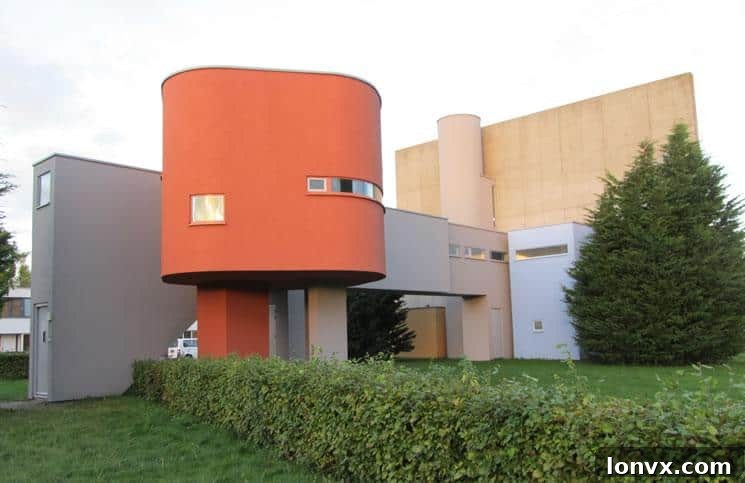
Wall House 2: A Postmodern Masterpiece Redefining Living in Groningen
Nestled in the tranquil residential neighborhood of Hoornse Meer in Groningen, the Netherlands, stands a structure that defies conventional notions of home. Wall House 2, a striking example of postmodern architecture, is not merely a building but a three-dimensional philosophical statement by the visionary American architect John Quentin Hejduk. Its bold design, characterized by an imposing concrete wall and a cluster of brightly colored, organically shaped modules, captivates and challenges visitors, inviting them to reconsider the very essence of dwelling.
The Visionary Architect: John Hejduk and the Concept of the Wall House
John Quentin Hejduk (1929-2000) was a pivotal figure in 20th-century architecture, renowned for his theoretical work and his profound influence on architectural education, particularly through his association with the Cooper Union in New York. A member of the “New York Five,” Hejduk’s work often explored themes of dwelling, time, and the human condition, often through deeply conceptual and poetic projects. His “Wall Houses” series, conceived in the early 1970s, represents a significant chapter in his exploration of architectural form and philosophy.
Wall House 2 was originally designed in 1973 for landscape architect A.E. Bye as a vacation home, intended for a picturesque site in Ridgefield, Connecticut. However, like many of Hejduk’s highly conceptual projects, it remained unbuilt for decades, existing primarily as drawings and models. Hejduk’s designs often pushed the boundaries of practicality, favoring artistic expression and intellectual inquiry over conventional functionality. This approach imbued his work with a timeless quality, ensuring that even his unrealized projects sparked ongoing architectural discourse.
The core idea behind the “Wall House” concept revolved around a monumental, load-bearing wall that bisects the living spaces, creating a stark division between “front” and “back,” “public” and “private,” or perhaps even “conscious” and “unconscious” realms. Hejduk saw the wall not merely as a structural element but as a psychological and experiential threshold, a fundamental component of human interaction with built space. As he famously wrote, “Life has to do with walls; we’re continuously going in and out, back and forth and through them. A wall is the quickest, the thinnest, the element we’re always transgressing.” This philosophical underpinning is palpable in every aspect of Wall House 2.
Groningen’s Bold Architectural Statement
The story of Wall House 2’s realization is as unique as its design. Decades after its initial conception, the city of Groningen, known for its progressive urban planning and cultural ambition, commissioned its construction. In the late 20th century, Groningen actively sought to position itself as a European hub for international postmodern architecture. This ambition led to the development of several iconic structures, including the renowned Groninger Museum, a vibrant, multi-colored complex that stands as another testament to the city’s adventurous spirit in design.
The decision to build Hejduk’s conceptual house in Hoornse Meer underscored Groningen’s commitment to architectural innovation and its willingness to embrace structures that challenged the status quo. The city saw Wall House 2 not just as a dwelling but as a cultural asset, a tangible manifestation of cutting-edge architectural thought that would attract attention and stimulate dialogue. The construction, completed in 2001, tragically occurred a year after Hejduk’s death, making Wall House 2 the only realized example of his “Wall Houses” series and a poignant posthumous tribute to his genius.
Anatomy of an Architectural Icon: Design and Experience
Wall House 2 is an undeniable visual spectacle. Its most prominent feature is the colossal concrete wall, measuring an impressive 18 meters high by 18 meters wide. This monumental slab is celebrated as arguably the largest single concrete pour in the Netherlands, a testament to the ambitious engineering required for its construction. Against this rigid, neutral backdrop, a series of vibrant, irregularly shaped modules appear to be playfully suspended or stacked. Each module boasts a distinct color—bright blue, sunny yellow, warm red—creating a dynamic and almost sculptural composition that contrasts sharply with the wall’s stoic presence.
The internal experience of Wall House 2 is as unconventional as its exterior. Visitors embarking on a tour, like the one described by local guide Titus Akkermans, immediately encounter the deliberate spatial disorientation Hejduk intended. The main entrance, a modest grey door, ushers one into a world where conventional flow is abandoned. Inside, stairs ascend to a long, elevated corridor. To reach different sections of the house—the living room, the bedroom, the kitchen—one must navigate back and forth along this corridor, often circling the central wall. As Akkermans explains, “Every time you want to reach another part of your house, you have to turn back, go through the wall again, come into another mindset, that’s what he meant to achieve.” This constant reorientation forces a conscious engagement with the architecture, making the journey through the house an integral part of its meaning.
The living room, situated on the second level, offers expansive views, while the intended bedroom on the ground floor provides a unique perspective. A sign inside reveals a fascinating detail: “The bed was originally positioned in such a way that the natural environment outside would be the first thing you saw when you awoke. There weren’t any curtains allowed in the front windows.” This speaks to Hejduk’s desire for an unmediated connection between the occupant and the surrounding landscape, integrating nature directly into the private sphere.
Functionality vs. Philosophy: A Home Beyond Convention
From a purely practical standpoint, Wall House 2 presents a myriad of challenges. As tour guides often point out, it features only a single bedroom, no garage, and limited storage space for everyday items like bicycles or equipment. “It’s not practical,” Akkermans notes, highlighting the reasons it remained unsold for a period and was considered unaffordable for most families. The design prioritizes artistic expression over utilitarian efficiency, prompting the common question: “What normal family can live in such a house?”
However, this perceived impracticality is precisely what elevates Wall House 2 from a mere dwelling to a work of art. Hejduk wasn’t designing for convenience; he was designing for an idea, an experience, a philosophical inquiry into space and human interaction. The house is a habitable sculpture, a physical manifestation of an architectural manifesto. Its unique design forces occupants and visitors alike to engage with their surroundings in a novel way, questioning assumptions about comfort, privacy, and the purpose of a home.
The Evolving Role of Wall House 2: A Cultural Hub
Given its unconventional nature, Wall House 2 has found a variety of uses beyond that of a traditional family home. It has transformed into a dynamic cultural venue, hosting occasional performances, art exhibitions, and serving as a temporary residency for aspiring artists and architects. This allows the building to continue its function as a catalyst for creative thought and artistic expression, aligning perfectly with Hejduk’s legacy of intellectual curiosity.
The house is also accessible to the public, attracting architecture enthusiasts and curious visitors from around the globe. It has even served as a polling station during elections, a charming anecdote that underscores its unexpected integration into local community life, despite its avant-garde status. This adaptability highlights its significance not just as a piece of architectural history but as a living, breathing space that continually finds new relevance.
Visiting This Architectural Landmark
Wall House 2 is featured prominently in local tourism brochures, a testament to its status as a must-see attraction in Groningen. While it operates more as a museum and cultural space than a private residence, it remains open to visitors who wish to experience Hejduk’s unique vision firsthand. Access is typically by appointment, ensuring a more personalized and insightful visit. With prior arrangement, the house opens its doors on weekdays to students, architects, and scholars, offering them a invaluable opportunity to study this singular structure up close.
Entrance to Wall House 2 is free, reflecting the city of Groningen’s commitment to making this architectural treasure accessible to all. Information on site is minimal, often limited to a simple plaque with text in Dutch and a photograph of the architect, emphasizing the building itself as the primary narrative. Visitors are encouraged to explore the space, absorb its atmosphere, and contemplate Hejduk’s profound statements on life, walls, and the continuous transgression of boundaries. This unique experience solidifies Wall House 2’s place as an enduring symbol of architectural innovation and a cornerstone of Groningen’s postmodern heritage.