
Canada’s housing shortage would likely look very different today if builders here had been able to respond to rising demand as quickly as their American counterparts, according to new research from the Canada Mortgage and Housing Corporation (CMHC).
The federal housing agency estimates that Canada could have built nearly 30% more homes between 2006 and 2024 if its housing supply had reacted to demand the way it does in the United States. At the same time, home prices could have been roughly 10% lower.
CMHC chief economist Mathieu Laberge’s analysis points to a combination of regulatory, geographic and demographic factors that have limited Canada’s ability to add housing in some of its fastest-growing markets.
Why Canada lags behind
One major difference between the two countries is how quickly builders can bring new housing projects to market. In many U.S. metropolitan areas, zoning and land-use rules are less restrictive, allowing construction to ramp up faster when demand increases. In Canada, especially in major cities, tighter regulations and longer rezoning processes can slow development and reduce the number of homes built.
Using CMHC’s Integrated Housing Model and research from the Organisation for Economic Co-operation and Development, analysts simulated what Canada’s housing outcomes might have been if supply had been as responsive as in the U.S. The simulations showed a material increase in housing starts and a noticeable reduction in prices.
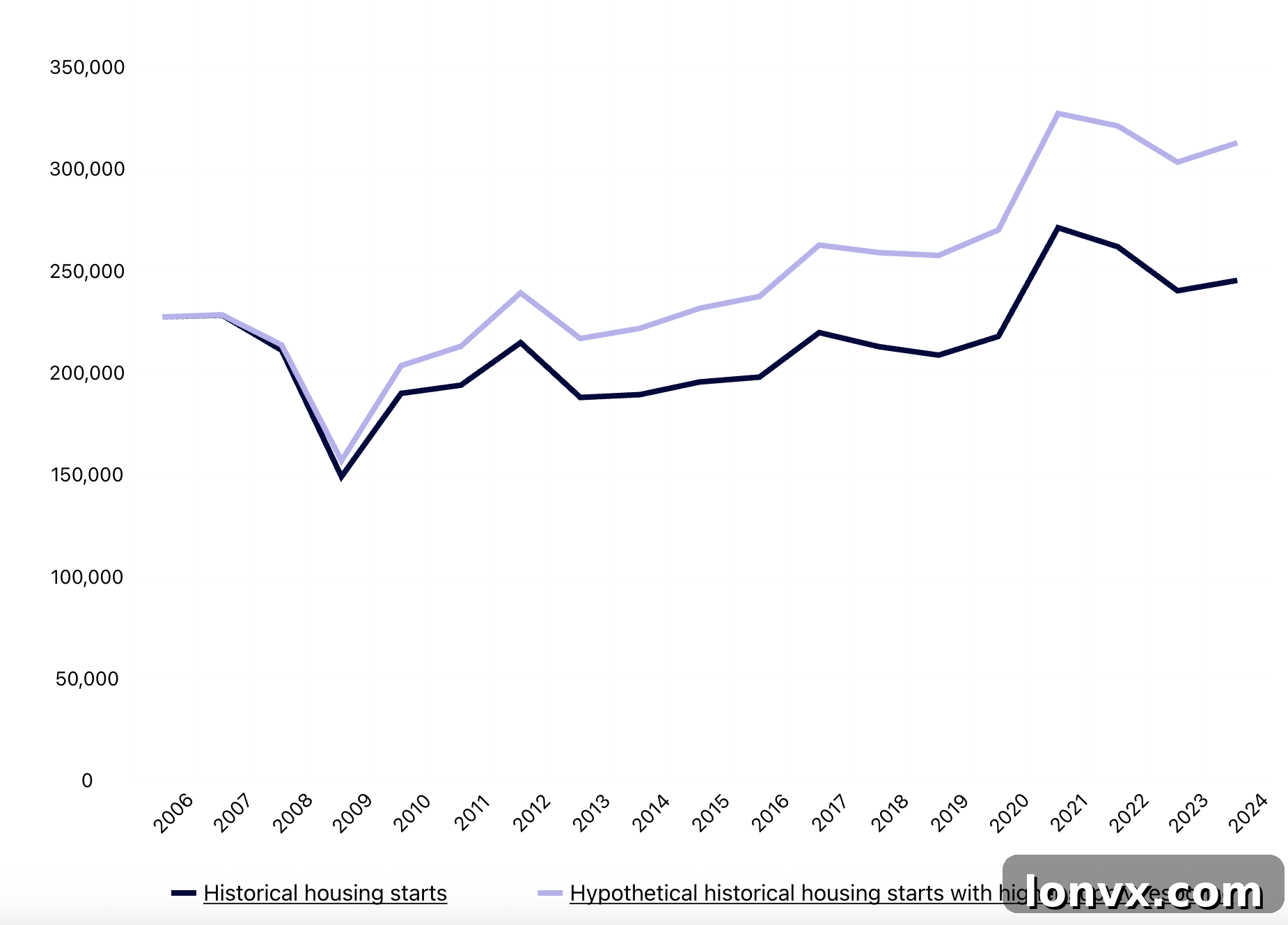
Source: CMHC
Previous research cited by CMHC has linked restrictive zoning and land-use policies to higher housing costs and fewer new homes, particularly in high-demand markets where rezoning approvals can be difficult to obtain.
Geography plays a role
Not all of Canada’s housing challenges stem from policy. The report highlights that many large Canadian cities face physical constraints that make development more difficult. Vancouver is boxed in by mountains and water, and Montreal sits largely on an island, limiting where growth can occur.
Those constraints contrast with many Prairie cities, where land is more abundant. Edmonton, for example, has historically recorded higher housing starts per capita than several other large Canadian centres.
Population distribution also shapes how the housing market functions. Unlike in the United States — where workers priced out of one city can often move to another large metro with similar job opportunities — Canadians face fewer realistic alternatives when housing costs rise in major centres. Someone priced out of New York might relocate to Chicago, Dallas, or Philadelphia; a worker priced out of Toronto has fewer comparable destinations, especially when housing costs in Vancouver are also high.
This concentration of people and jobs in a handful of cities can reduce the pressure on the housing industry to respond quickly to changing demand, the report argues.
Similar productivity challenges
The comparison is notable because Canada’s residential construction sector has experienced many of the same productivity challenges as the United States. Both countries have seen long-term declines in construction labour productivity, with only temporary improvements during the COVID-19 pandemic. Yet despite these shared productivity trends, the U.S. housing industry has generally been faster to increase construction when demand rises.
The findings suggest that structural factors — such as land-use policy, geography and population concentration — may matter more for housing outcomes than productivity differences alone.
Reforms may pay off over time
CMHC cautions that making Canada’s housing supply more responsive will not happen overnight. Still, the agency notes recent government initiatives that could improve housing outcomes over time.
One example is the Housing Accelerator Fund, launched in 2023 to help municipalities reduce red tape and speed up approvals for new housing. Several cities have already introduced measures to lower regulatory barriers to construction. CMHC also highlights the federal Build Canada Strong agenda, which includes investments in housing, infrastructure and economic development.
While the benefits of these reforms may take years to materialize, CMHC says that measures making it easier and faster to build homes could gradually improve affordability and help Canada’s housing market respond more effectively to future demand.