
Unpacking Canada’s 2024 Housing Market: Navigating Shifting Sands of Interest Rates and Affordability
The Canadian housing market has experienced a tumultuous period, marked by significant buyer uncertainty and dwindling affordability. This instability was largely triggered by the Bank of Canada’s aggressive series of interest rate hikes, which sent ripples across the national real estate landscape. While inventory levels across the country saw a return to more typical volumes, sales activity concurrently decelerated, signaling a cautious approach from prospective buyers.
However, as inflation figures show promising signs of cooling, economists are increasingly forecasting an end to further interest rate increases, with a strong possibility of rate reductions commencing next year. Zoocasa, a leading real estate platform, provides insightful analysis into what these anticipated shifts could mean for the intricate dynamics of the Canadian housing market in the coming year, offering a beacon of foresight for both buyers and sellers alike.
Home Prices Face Continued Downward Pressure, Yet Nuances Emerge
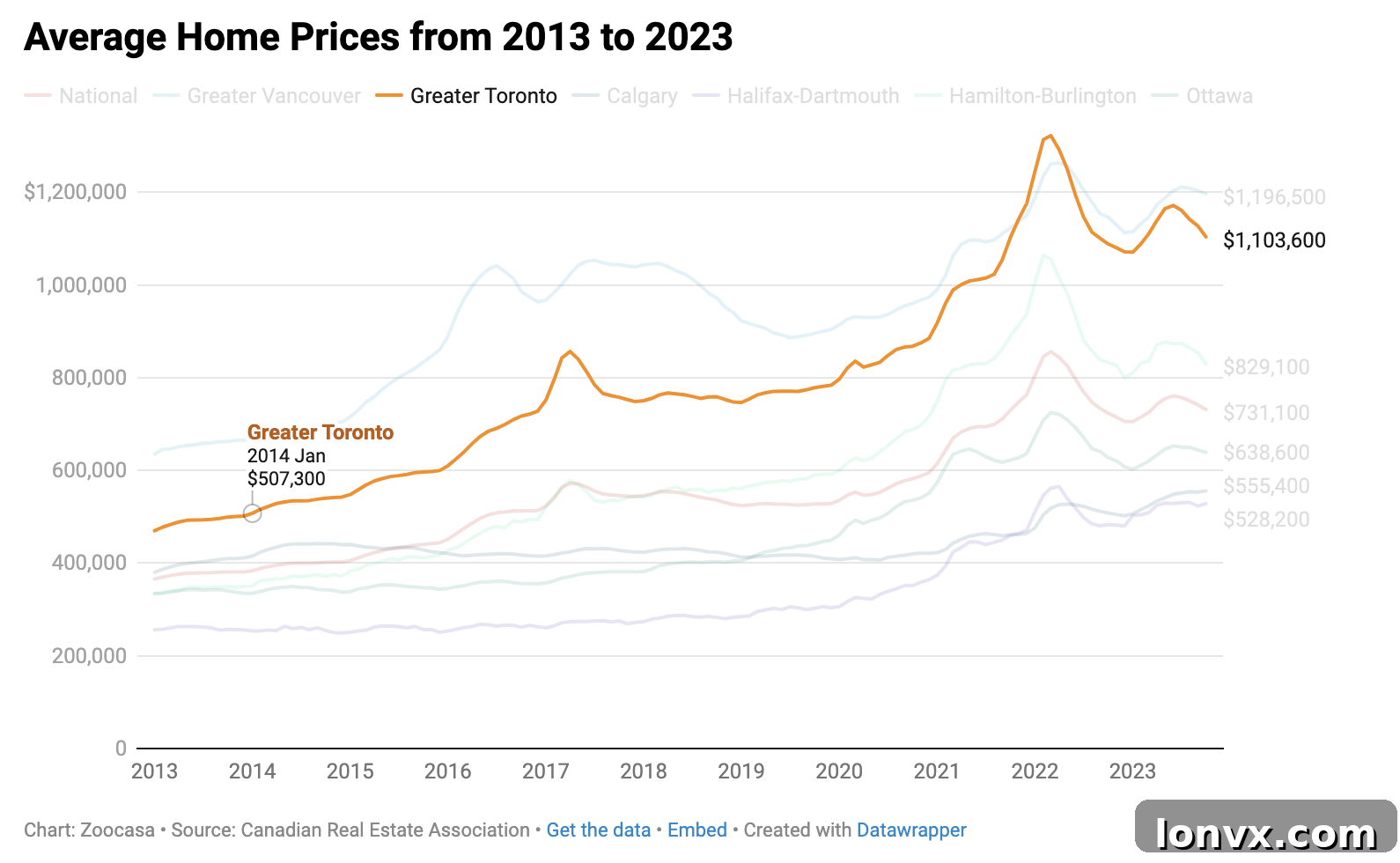
The latter half of the previous year witnessed many prospective buyers hitting the brakes on their purchasing plans. This sentiment was clearly reflected in the national data, with October registering a 3.4 percent month-over-month drop in sales. Concurrently, the national average home price declined for the fourth consecutive month, settling at $731,100.
Lauren Haw, Zoocasa’s broker of record and industry relations officer, succinctly explains the current market paradox: “There’s a notable chasm between the bid and ask prices for many property types. Sellers continue to hold out for prices that are quite high relative to what non-urgent and hesitant buyers are willing to commit.” This discrepancy suggests that for transactions to occur in 2024, sellers will largely need to adjust their expectations, aligning them more closely with buyers’ preferred pricing strategies.
Seller Expectations vs. Buyer Hesitancy: A Standoff
This dynamic often leads to a waiting game. Buyers who are downsizing, moving up, or are otherwise not under immediate pressure to transact are likely to postpone their purchases, opting to retain their current homes for longer. This strategic delay by a segment of buyers will undoubtedly contribute to maintaining downward pressure on prices, particularly evident in more discretionary market segments such as entry-level recreational properties and cottages. These non-essential properties, especially those that experienced speculative overvaluation during the pandemic boom, are predicted by Haw to witness the most significant price adjustments.
However, the market isn’t monolithic. Haw notes a critical distinction: “There will still be continued pressure for family homes situated in prime locations, which will likely keep prices buoyant for desirable detached homes nestled within excellent school districts.” This highlights a segmentation within the market, where demand for core, essential housing in coveted areas remains robust, insulating these properties from the broader downward trend.
The Far-Reaching Impact of High Interest Rates: A Lagged Effect
The full ramifications of the numerous interest rate increases by the Bank of Canada are far from over, exhibiting a lagged effect that can take several months, or even over a year, to manifest across all market segments. Carrie Lysenko, Zoocasa’s CEO, elaborates: “The Bank of Canada’s 10 rate hikes since March 2022 appear to be effectively achieving their primary objective of bringing inflation down. However, the comprehensive impact of these policy decisions has yet to be fully absorbed by the housing market and individual homeowners.”
The Looming Mortgage Renewal Shock
This critical insight means that even if interest rates remain stable or begin to decline as predicted, the cumulative effect of previous rate hikes will continue to unfold. A significant consequence of this delayed impact is the impending wave of mortgage renewals. Lysenko warns, “Every month that passes, a growing number of current homeowners will find their mortgages coming up for renewal at these significantly higher prevailing rates, a situation that could foreseeably lead to an increase in forced selling.”
To illustrate the potential financial strain, consider an example provided in the report: an average Toronto homebuyer in 2020 had a monthly mortgage payment of approximately $3,737, calculated at a highly competitive rate of 1.64 percent—one of the best rates available in September 2020. If that very same homebuyer is now due for renewal, their monthly mortgage payments could skyrocket to $4,499, based on the September 2023 rate of 5.24 percent. This represents a substantial increase of over $760 per month, or more than $9,100 annually, for the exact same property. Such a dramatic surge in carrying costs places immense pressure on household budgets, potentially forcing some homeowners to sell if they cannot absorb the increased financial burden.
The broader implications of this “mortgage shock” extend beyond individual households, potentially impacting overall market stability and inventory levels as more properties enter the market due to financial distress. This situation underscores the critical need for homeowners to proactively plan for their upcoming mortgage renewals and explore all available options.
Anticipating the Spring Market: A Potential Turning Point
Currently, home prices are following a typical seasonal trend, generally moving downward as winter approaches. This pattern is characteristic of the colder months, with price growth usually beginning to accelerate just before the advent of the spring market. Last year, for instance, the national average home price peaked at $855,800 in March, before reaching its lowest point of $705,600 in December. Despite this historical precedent, Lauren Haw cautions that the market may not have reached its definitive bottom just yet.
Latent Demand and Investor Re-entry: Fueling a Rapid Ascent
However, once that market bottom is firmly established and prices begin their upward trajectory, Haw anticipates a swift and vigorous ascent. “Once that bottom is hit and prices start to go back up, it will be a rapid ascent to the top as the latent demand for housing in urban cores race to get back in before prices peak again,” she explains. This latent demand comprises a significant pool of prospective buyers—including first-time homebuyers, those looking to upgrade or downsize, and individuals who have been patiently waiting on the sidelines for more favorable market conditions and interest rates.
As market confidence returns and prices stabilize then rise, investors are also highly likely to re-enter the market. Investors often seek to capitalize on perceived market bottoms, viewing them as opportune moments to acquire assets before significant capital appreciation occurs. Their return would further amplify demand, contributing to the speed of the market’s recovery and the upward pressure on prices. The interplay of this pent-up buyer demand and renewed investor interest could quickly transform the market sentiment from one of caution to one of urgency, creating a competitive environment similar to past periods of rapid growth.
Key Considerations for Navigating the 2024 Canadian Housing Market
The Canadian housing market in 2024 is shaping up to be a complex and dynamic environment. For potential buyers, patience and strategic timing will be paramount. Understanding that a potential “sweet spot” might emerge before prices embark on their rapid ascent could be crucial. Thorough financial planning, particularly in light of fluctuating interest rates and potential future cuts, will allow buyers to make informed decisions regarding affordability and mortgage options.
For sellers, realism regarding pricing is a key factor, especially for properties in less competitive segments. Understanding the nuanced demand for different property types and locations will enable them to set appropriate price points. Those not facing immediate urgency might consider waiting for the anticipated spring market resurgence, when buyer activity and potentially prices are expected to pick up.
Ultimately, navigating the Canadian real estate market in 2024 will require a keen understanding of evolving economic indicators, careful consideration of personal financial circumstances, and leveraging expert insights. The interplay of interest rate adjustments, affordability challenges, and shifts in buyer and seller psychology will define the market’s trajectory, making informed decisions more critical than ever.
For a comprehensive understanding and deeper dives into these predictions, read the full report from Zoocasa here.