In a surprising turn for the Greater Toronto Area (GTA) housing market, the anticipated boost from the Bank of Canada’s recent interest rate cut did little to ignite bidding wars. Contrary to expectations, the proportion of neighbourhoods experiencing overbidding declined for the third consecutive month in June, signaling a continued shift towards a more balanced market, and in many segments, a buyer’s advantage.
One Rate Cut Not Enough to Revitalize a Challenged Housing Market
The 25-basis-point reduction by the Bank of Canada, a move widely watched and hoped to inject vitality into the real estate sector, appears to have had a muted immediate effect. According to data compiled by Wahi, a prominent real estate platform, an analysis of 300 GTA neighbourhoods with at least five home sales in June revealed significant shifts in market behaviour. Only 27 percent of these neighbourhoods experienced transactions where homes sold above their asking price, a noticeable drop from 36 percent in May and 39 percent in April. This downward trend underscores a softening in buyer competition. Conversely, a substantial 71 percent of transactions were in underbidding territory, meaning homes sold below their initial asking price, with the remaining 2 percent selling precisely at asking.
Benjy Katchen, CEO of Wahi, articulated the market sentiment succinctly, stating, “One 25-basis-point rate cut is not enough to jolt more life into a housing market that faces affordability challenges and a pile-up of listings.” Katchen’s observation highlights two critical factors shaping the current landscape: persistent affordability concerns and a burgeoning supply of homes for sale. The data supports this, as there were approximately 24,000 active listings on the market last month—a figure not seen in several years. This surge in available inventory significantly reconfigures the power dynamic, moving it away from sellers and towards buyers. As Katchen further explains, “Buyers who are shopping have more selection than they have at any time in the past five years, so it’s no surprise that bidding competition is subdued.” This increased choice empowers buyers, allowing them more time to deliberate, negotiate, and ultimately secure properties at or below asking prices, rather than being swept into intense bidding wars that characterized previous market cycles.
The Persistent Challenge of Affordability in the GTA
Despite the recent interest rate cut, the fundamental issue of affordability continues to cast a long shadow over the GTA housing market. For years, escalating home prices, coupled with high borrowing costs, have made homeownership increasingly unattainable for many residents. Even a modest 25-basis-point reduction in interest rates, while psychologically positive, does not significantly alter the monthly mortgage payments for properties that often command seven-figure prices. Buyers are still contending with stringent stress tests, high down payment requirements, and the general inflationary pressures affecting everyday expenses. This financial squeeze means that even with more listings, many prospective buyers remain on the sidelines, either unable to qualify for mortgages or unwilling to stretch their budgets further in an uncertain economic climate. The disconnect between aspirations for homeownership and the harsh realities of the market contributes directly to the subdued bidding activity observed in June.
The Impact of Increased Housing Inventory
The significant increase in active listings—reaching levels not seen in half a decade—is a pivotal development. A higher supply of homes for sale fundamentally shifts the market from a seller’s advantage to one where buyers have more leverage. When inventory is scarce, multiple buyers often compete for the same property, driving prices up through bidding wars. However, when there are abundant options, buyers face less pressure. They can be more selective, conduct thorough due diligence, and negotiate terms, knowing that if one deal falls through, other properties are available. This expanded selection dilutes the intensity of competition, allowing homes to spend more time on the market and often leading to sales closer to or below the asking price. The accumulation of listings suggests that some sellers may be holding out for prices that are no longer supported by current market conditions, or that new listings are coming online faster than properties are being absorbed by buyers.
Varied Market Dynamics: Single-Family Homes vs. Condominiums
While the overall trend pointed to a decrease in overbidding across the GTA, a closer examination reveals nuanced differences between housing types. Historically, single-family homes have commanded more intense bidding activity due to their perceived scarcity, land value, and appeal to families seeking more space and privacy. Last month, however, the gap in bidding activity between single-family homes and condominiums continued to narrow, indicating a broader market cooling. For single-family homes, 39 percent of neighbourhoods were in overbidding territory in June, a notable decline from 53 percent in May. This suggests that even the traditionally hot single-family segment is experiencing a tempering of buyer enthusiasm and competition.
In the condominium market, seven percent of neighbourhoods—representing eight distinct areas across the GTA—experienced overbidding transactions. This figure is down from 11 percent in May. While the overall percentage is lower than that for single-family homes, the narrowing difference highlights a broader market adjustment. Condominiums often serve as a more accessible entry point into the GTA’s expensive housing market, appealing to first-time buyers, young professionals, and investors. The fact that a handful of condo-centric neighbourhoods still saw overbidding could point to specific pockets of demand, possibly driven by relative affordability compared to freehold properties, desirable locations with strong amenities, or unique unit types that remain highly sought after. This segmentation underscores that while the general tide may be receding, micro-markets within the GTA continue to exhibit unique patterns based on property type, location, and price point.
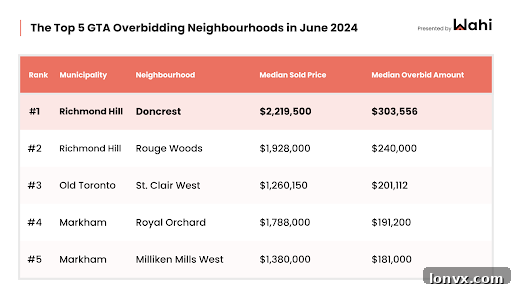
June’s Top 5 GTA Overbidding Neighbourhoods: York Region Leads the Way
Echoing patterns observed in May, the majority of the top five overbidding neighbourhoods in June were concentrated in the York Region. These areas included Doncrest, Rouge Woods, Royal Orchard, and Milliken Mills West. A common thread among these enduring hot spots is their generally lower price points when compared to areas that predominantly saw underbidding. This trend suggests that even in a cooling market, properties that offer relative affordability within the broader GTA context continue to attract competitive offers. Buyers seeking value, often families prioritizing access to good schools and community amenities, are likely driving demand in these specific York Region locales. The fierce competition in these areas, despite the wider market slowdown, demonstrates a resilience driven by accessible price points that cater to a segment of buyers still actively participating in the market.
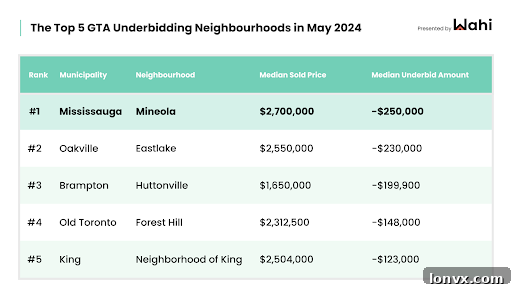
June’s Top 5 GTA Underbidding Neighbourhoods: Peel Region Emerges
Shifting focus to the other end of the spectrum, June’s top underbidding neighbourhoods revealed a geographical shift. Two prominent areas from the Peel Region—Mineola and Huttonville—featured on this list. This contrasts with May, which saw three pricier Oakville neighbourhoods dominate the top five underbidding spots. The appearance of Mineola and Huttonville, both known for their larger, more luxurious homes and higher price tags, indicates that the cooling trend is significantly impacting the upper echelons of the market. Buyers in these high-value segments are now empowered to negotiate more aggressively, leading to properties selling below their asking prices. This signals a correction in the luxury market, where heightened interest rates and economic uncertainties might be deterring a smaller pool of potential high-net-worth buyers. The shift from Oakville to specific Peel Region areas suggests that while the broader market correction is widespread, the specific luxury segments feeling the most pressure can vary month-to-month, influenced by micro-market supply and demand dynamics, as well as the unique characteristics of these high-end communities.
Navigating the Future: What’s Next for the GTA Housing Market?
The current state of the GTA housing market, characterized by increased listings and diminished bidding wars despite an interest rate cut, suggests a complex period of adjustment. Moving forward, potential buyers can likely expect more negotiation room and a less frantic pace, offering a welcome respite from the intense competition of previous years. For sellers, this environment necessitates a more realistic approach to pricing and presentation. Overpricing a property in a market with ample supply and fewer eager bidders can lead to extended listing times and eventual price reductions. Understanding local market trends and working closely with experienced real estate professionals will be crucial for both sides.
The influence of future Bank of Canada rate decisions will undoubtedly play a significant role. While one cut proved insufficient, a series of subsequent reductions could gradually restore buyer confidence and stimulate demand. However, the underlying affordability crisis, fueled by high housing costs and a competitive job market, will remain a fundamental challenge. Broader economic indicators, including inflation trends, employment rates, and consumer sentiment, will continue to shape the trajectory of the GTA housing market. This period of rebalancing might lead to a healthier, more sustainable market in the long run, but it requires adaptability and strategic decision-making from all participants.
In conclusion, June’s housing data for the GTA clearly demonstrates a market in transition. The dream of a quick rebound from a single interest rate cut was tempered by the twin forces of persistent affordability issues and a significant increase in available inventory. Buyers are now armed with more choices and stronger negotiating power, while sellers must adapt to evolving market realities. This shift, particularly visible in the declining overbidding percentages and the changing landscape of hot and cooling neighbourhoods, marks a pivotal moment for one of Canada’s most dynamic real estate markets.
Enjoying this article?
Get the latest REM articles in your inbox 3x week so you stay up to date on the latest in the Canadian real estate industry