
Embracing Diversity: Navigating Asian Heritage Month and Cultural Understanding in Canadian Real Estate
May marks Asian Heritage Month across North America, a crucial time for reflection, education, and celebration. In Canada, it’s an invaluable opportunity to acknowledge and appreciate the profound contributions Asian Canadians have made to the nation’s fabric, enriching its economy, culture, and social landscape. While Canada prides itself on multiculturalism, the journey towards true diversity, equity, and inclusion (DEI) is ongoing, especially when we recall darker chapters like the Japanese internment during WWII or the Komagata Maru incident. Despite significant progress, outdated racist stereotypes, pervasive cultural tropes, and stubborn misconceptions continue to surface, sometimes subtly, sometimes overtly, in various sectors of society. The dynamic and often competitive real estate industry is, unfortunately, not immune to these challenges.
Asian Heritage Month invites all Canadians to delve deeper into the rich tapestry of Asian cultures, histories, and achievements. It’s a period to celebrate the resilience, innovation, and diverse talents of Asian Canadians who have helped shape this country into what it is today. From pioneering entrepreneurs and groundbreaking scientists to celebrated artists and dedicated community leaders, the impact of Asian Canadians is undeniable. However, this celebration is also a reminder that work remains to dismantle systemic biases and foster an environment where everyone feels valued and respected, particularly within industries as foundational as real estate.
Confronting Anti-Asian Sentiment Amidst Metro Vancouver’s Housing Dynamics
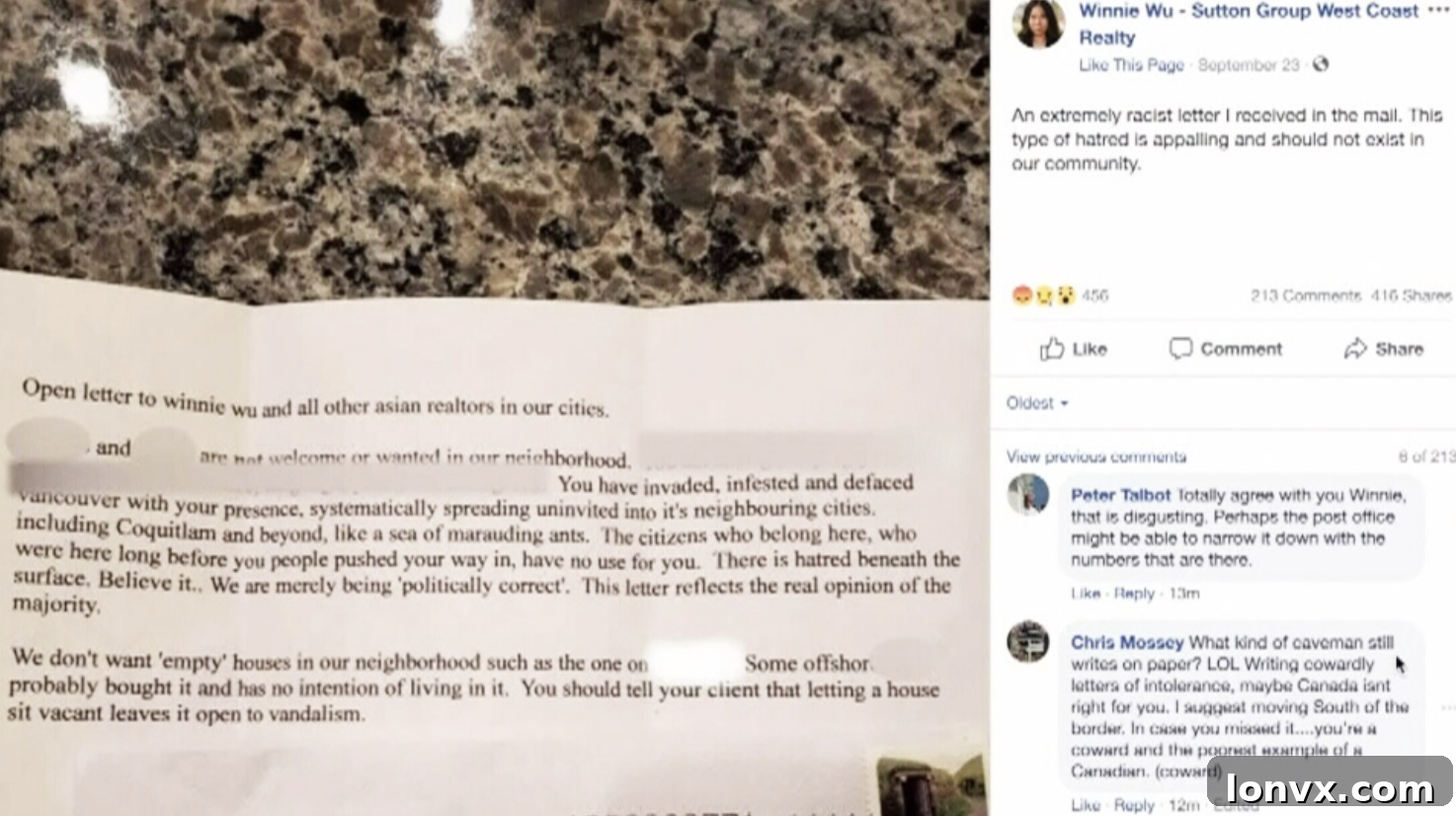
The intricate landscape of the Canadian real estate market, particularly in high-demand areas like Metro Vancouver, has regrettably become a breeding ground for xenophobic narratives. A disturbing incident in 2018 starkly highlighted this issue when an Asian realtor in British Columbia received a deeply offensive and threatening letter. This hateful correspondence unjustly blamed people of Asian descent for the region’s escalating housing crisis, a complex economic issue driven by multiple factors far beyond any single demographic. Such accusations, often rooted in prejudice, divert attention from the real systemic issues affecting housing affordability and supply.
As widely reported by CTV News, this “open letter to all Asian realtors” was explicitly sent to Winnie Wu’s realty office in Coquitlam, serving as a stark reminder of the prejudice that still lurks within communities. Incidents like these not only inflict personal harm and distress on individuals but also perpetuate a toxic environment, undermining the foundational principles of fairness, equality, and professional integrity within the real estate profession and society at large. They foster a climate of fear and suspicion, making it harder for Asian real estate professionals to conduct business and for Asian families to feel secure in their communities.
Source: CTVnews.ca
The unfortunate reality is that this anti-Asian sentiment seemed to intensify dramatically during the global COVID-19 pandemic. The early days of the pandemic saw a disturbing surge in hate crimes and discriminatory actions against Asian communities worldwide, and Canada was no exception. Despite clear evidence to the contrary, some narratives attempted to link the pandemic to specific ethnic groups, fueling prejudices that had real-world consequences for individuals and businesses, including those in the real estate sector. This period underscored how easily economic anxieties and global events can be weaponized against visible minorities, exacerbating pre-existing biases.
Expert Perspectives on Market Realities and Misconceptions
Sonia Wang, the esteemed managing broker of 1NE Collective Realty, offers crucial insights into the market’s behavior during this turbulent period. Having lived in Canada since 1998, she possesses a deep understanding of the country’s evolving social and economic landscape, giving her observations significant weight. Wang recounts her experience, which directly challenges prevailing misconceptions about foreign buyers driving the market during the pandemic:
“Something that was surprising to some was that during the pandemic, even with the travel restrictions, the market was going crazier than ever,” says Wang. “We saw it was mostly local Canadians that were buying and not actually foreigners, because no foreigners could even travel. This compelling observation fundamentally dispelled the myth that overseas investors were solely responsible for the market’s frenzy; rather, a confluence of local demand, historically low interest rates, and a re-evaluation of living spaces by Canadian residents were the significant, undeniable drivers. The market’s intensity stemmed from domestic dynamics, not an influx of external capital.”
This firsthand account from a respected industry leader underscores the importance of factual analysis over xenophobic assumptions. Wang’s insights are vital in debunking simplistic and often racially charged explanations for complex economic phenomena. The market’s dynamism was a result of intrinsic domestic economic forces, including increased household savings, government stimulus packages, and a renewed focus on home life, not an imaginary surge of foreign buyers. This perspective helps to reframe the conversation around housing affordability away from divisive blame and towards more constructive solutions.
Adding another layer of contemporary insight into the Canadian real estate market is Ryan Zhang, the managing broker at YouLive Realty. He sheds light on the post-pandemic market, particularly concerning the growing segment of newcomers to Canada. His brokerage utilizes advanced online tools to meticulously categorize and summarize client data, providing an evidence-based perspective on market trends that counters anecdotal assumptions.
“We use an online tool to summarize and categorize our data,” Zhang explains. “What we observe is a significant portion of our clients are newcomers to Canada. They are either actively seeking a new home for their families to settle into, embracing their new community, or they are exploring career opportunities in real estate, leveraging it as a pathway to gain invaluable knowledge about the industry and Canadian society. This demonstrates a deep commitment to their new lives here. Approximately 70 to 80 percent of our clientele are actively buying a home for themselves, not as speculative investments, but driven by a fundamental desire to establish roots, build equity, and contribute meaningfully to their new communities.”
Zhang’s observations highlight a crucial demographic shift and the vital, often overlooked, role real estate professionals play in helping new immigrants integrate and thrive. These newcomers are not just market participants; they are families building lives, pursuing careers, and contributing significantly to Canada’s economic vitality and cultural diversity. Dismissing or stereotyping them through broad, often negative generalizations ignores their diverse motivations, profound contributions, and the inherent desire to build a stable future in Canada.
Deconstructing Stereotypes: The Broad Spectrum of ‘Asian’ in Real Estate
The term “Asian” encompasses an incredibly vast and diverse array of cultures, languages, religions, and socio-economic backgrounds. Yet, in popular discourse and, unfortunately, sometimes within the real estate industry, this rich diversity is often flattened into monolithic stereotypes. With Statistics Canada projecting that immigrants from Asia will constitute between 55.7% and 57.9% of all immigrants by 2036, it is more critical than ever for the real estate industry to actively dismantle these harmful misrepresentations. Understanding the true meaning of being an Asian realtor, home buyer, or seller in Canada is paramount for fostering an equitable, inclusive, and thriving market that serves everyone.
One prevalent misconception Zhang addresses is the portrayal of Asian involvement in real estate solely through the lens of extreme wealth and luxury. Social media, in particular, often amplifies images of “super rich influencers,” some identifying as realtors, flaunting extravagant lifestyles—cocktail parties, opulent homes, and supercar shows. This curated image, while certainly existing for a small segment, is far from representative of the majority of Asian Canadians who work diligently, save prudently, and pursue homeownership or real estate careers with the same aspirations as any other Canadian.
“Super rich influencers you’ve seen, even some of them are realtors, on social media floating about their luxury lifestyle, cocktail parties, supercar shows … these are bad influences,” notes Zhang emphatically. “That’s not like most of the people we work with — the vast majority are hardworking individuals and families diligently building their lives, saving for homes, raising children, and investing responsibly in their futures. They are nurses, engineers, small business owners, teachers, and professionals from all walks of life, contributing to the economy and society.”
This stereotype not only generates unfair resentment but also obscures the reality of countless Asian Canadians who, like any other demographic, represent a broad spectrum of income levels, professions, and aspirations. It fosters an environment where success is unfairly attributed to illicit wealth rather than genuine hard work, smart financial planning, and dedication, thereby contributing to harmful anti-Asian sentiment and hindering genuine integration.
Another deeply ingrained misconception is the narrow belief that being an “Asian realtor” automatically implies being of Chinese descent. This reductive view dangerously ignores the immense demographic variety within the Asian diaspora in Canada. Asia is a continent of dozens of countries, hundreds of languages, and thousands of distinct cultures. To reduce this incredible diversity to a single ethnicity is not only inaccurate but also prevents a nuanced understanding of client needs and market dynamics. Both Ryan Zhang and Sonia Wang actively champion diversity within their respective brokerages, demonstrating a commitment to true representation and inclusivity.
Their teams boast members from a wide array of backgrounds, including individuals of Filipino, Korean, Vietnamese, and Indian heritage, alongside Canadian-born realtors of various ethnic origins. This intentional cultivation of diverse teams is not just a matter of political correctness; it is a strategic advantage that enriches the entire business operation, fostering a more robust, adaptable, and client-centric approach to real estate.
“It actually brings out different kinds of perspectives, which is a good thing for us to learn (from) because of cultural diversity,” shares Wang. “When you have team members from distinct cultural backgrounds, you gain a broader, deeper understanding of diverse client needs, communication styles, and subtle cultural nuances that might otherwise be missed. This allows us to serve our clients more effectively and empathetically, building stronger relationships based on trust and mutual respect. The simple truth is, ‘Asian’ doesn’t mean it’s only a certain group or ethnic background; it’s a vibrant mosaic of unique identities, each bringing valuable insights to the table.”
Such diversity within real estate teams fosters a more inclusive and understanding approach to client service. It helps in breaking down language barriers, navigating cultural expectations in complex transactions, and building trust with clients from various backgrounds, ultimately leading to better outcomes for everyone involved. It also reflects the true multicultural reality of Canada, making real estate services more accessible and relevant to all segments of the population.
Bridging Cultural Gaps: Innovating for a More Inclusive Industry
The theme for Asian Heritage Month in 2024, “Advancing Leaders Through Innovation,” resonates deeply within the real estate sector. Especially in Vancouver’s notoriously competitive market, this theme highlights critical opportunities for all real estate professionals to elevate the industry by embracing forward-thinking solutions and fostering a culture of innovation and inclusivity. The goal is not just to adapt to changing demographics but to proactively shape a future where cultural understanding is a foundational cornerstone of professional practice, driving growth and creating a more equitable market for all.
Ryan Zhang firmly believes that a significant part of the solution lies in effectively bridging the gap between different cultures. This isn’t merely about providing translation services; it’s about cultivating a deeper, more empathetic understanding of varying communication styles, decision-making processes, and underlying values that profoundly influence real estate transactions. It requires cultural competence that goes beyond surface-level interactions.
“What I’ve observed with some Asian cultures is that communication and negotiation often tend to be more nuanced, indirect, and well-rounded, focusing significantly on building long-term relationships and understanding unspoken needs,” Zhang elaborates. “In contrast, Western culture often appears very straightforward, direct, and overtly transaction-focused, valuing explicit agreements. Therefore, as real estate professionals, we kind of have to bridge them in the middle and find out the best, most respectful, and effective way to help our immigrant clients settle into their new homes. This might involve dedicating more time to thorough explanations of processes, understanding the collective role of family in significant financial decisions, or adapting negotiation tactics to align with cultural expectations, fostering greater trust and satisfaction.”
This bridging process involves ongoing cultural sensitivity training for agents, developing comprehensive multilingual resources, and intentionally cultivating a team that genuinely reflects the diversity of the client base. It also requires patience, empathy, and a profound willingness to learn from clients, recognizing that a “one-size-fits-all” approach simply does not work in Canada’s rich multicultural society. Successful real estate professionals in this environment are not just property experts; they are cultural navigators.
Sonia Wang also looks with great optimism towards future opportunities for Asian professionals in real estate, particularly for women. Her perspective highlights the stark contrast in professional environments between Canada and many Asian countries, where traditional gender roles can often limit career progression. Canada’s commitment to diversity presents a powerful platform for change.
“Back in Asia, there were often so many limitations that were put on female professionals — the pervasive glass ceiling, entrenched societal expectations, and traditional roles often restricted career advancement and leadership opportunities,” she adds. “However, Canadian culture is inherently more open and accepting of diversity, whether that’s ethnic background-wise or gender-wise. This creates an empowering environment where you have the incredible capacity to explore, innovate, and pursue your professional aspirations without the same historical or systemic constraints. It’s truly inspiring to see more women, particularly Asian-Canadian women, rising to leadership positions in this industry, bringing fresh perspectives and dynamic energy.”
This progressive outlook is not just about fairness; it’s about strategically tapping into a broader, more diverse pool of talent and leadership that can bring fresh perspectives, innovative strategies, and enhanced empathy to the real estate sector. Empowering diverse voices, especially women, strengthens the entire industry, ensures it remains relevant and responsive to an increasingly diverse clientele, and ultimately drives better economic and social outcomes for all Canadians.
As an Asian-Canadian woman myself (my maiden name being Barroso, of Filipino descent), witnessing women in powerful leadership positions, such as Sonia Wang, fills me with immense joy for the current advancements within the real estate industry. More importantly, it instills profound hope for what the future holds for all Asian-Canadian community members, regardless of whether they immigrated to Canada or were born here. Their success stories are not just individual triumphs but collective milestones for a more inclusive, equitable, and vibrant Canada, inspiring generations to come.
Ultimately, Asian Heritage Month serves as a powerful reminder that diversity is not just a buzzword; it is Canada’s undeniable strength. In the real estate industry, this translates to recognizing and celebrating the multifaceted contributions of Asian Canadians, actively challenging harmful stereotypes, and proactively working to bridge cultural divides through education, empathy, and innovation. By embracing genuine understanding and fostering an inclusive environment, the real estate sector can lead by example, building a more welcoming, fair, and prosperous environment for everyone who calls Canada home.
Photo source: Canada.ca
Enjoying this article?
Get the latest articles in your inbox 3x week so you stay up to date on the Canadian real estate industry.