
Canada’s Real Estate Market Recovers: Royal LePage Updates 2023 Price Forecast Amidst Shifting Dynamics
Following a robust and unexpected resurgence in market activity during the initial months of the year, Royal LePage has significantly revised its home price forecast for 2023. This updated outlook paints a picture of a Canadian housing market demonstrating greater resilience and a quicker path to recovery than previously anticipated, offering a renewed sense of cautious optimism across the industry.
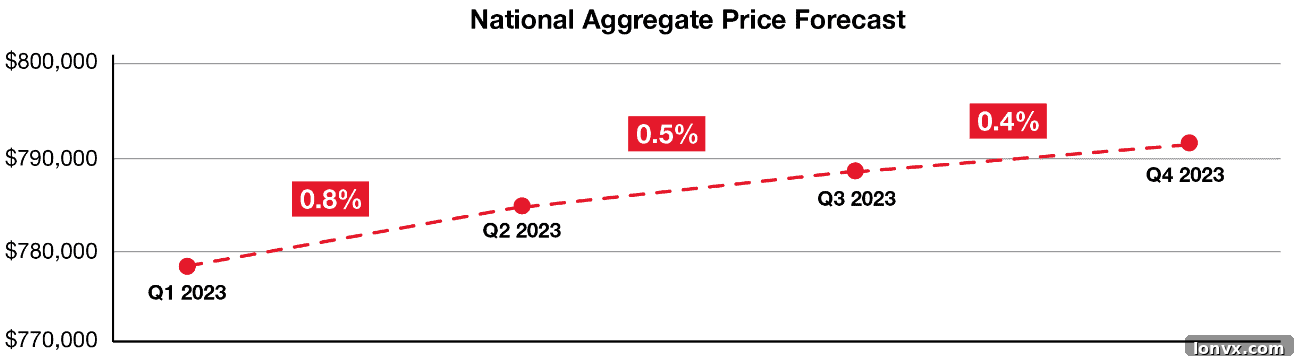
In its latest report, released on Thursday, Royal LePage now projects that the aggregate home price in Canada will see a 4.5 percent year-over-year increase by the fourth quarter of 2023. This revised prediction marks a substantial upward adjustment from the company’s December forecast, which had anticipated a one percent decline in the national aggregate home price compared to Q4 2022. The dramatic shift underscores the dynamic nature of the current real estate landscape and the powerful influence of changing economic sentiments.
Delving deeper into the short-term trajectory, Royal LePage expects home prices to continue their modest yet steady upward trend over the next nine months on a quarter-over-quarter basis. This sustained growth signals a return to more predictable market conditions after a period of significant volatility, providing a clearer horizon for both prospective buyers and sellers.
Phil Soper, CEO of Royal LePage, articulated the prevailing sentiment within the industry: “Emerging from a market correction, it is often challenging to accurately gauge the speed at which the market will regain its footing. As we observe market activity rebounding at a faster pace than initially projected, we are approaching the future with a sense of cautious optimism.” Soper further elaborated on the evolving market environment, stating, “While we are not forecasting monumental price appreciation this year, there is a distinct return to a greater sense of normalcy within the market, which is a welcome development for all participants.”
Source: Royal LePage
Canadian Housing Market Stages a Robust Recovery After Initial Downturn
The latest Royal LePage House Price Survey provided crucial insights into the market’s performance, indicating that national home prices in Canada experienced a 9.2 percent year-over-year decrease to an aggregate of $778,300 in the first quarter of 2023. This decline was a direct consequence of the aggressive interest rate hikes implemented by the Bank of Canada throughout 2022, which significantly cooled buyer demand and led to a temporary market recalibration.
However, the narrative began to shift dramatically within Q1 2023. Following the Bank of Canada’s pivotal decision to pause its series of interest rate hikes, the market responded swiftly and positively. This policy adjustment acted as a catalyst, prompting a noticeable surge in buyer confidence and activity, resulting in a 2.8 percent quarter-over-quarter increase in home prices. This turnaround signals a critical juncture for the Canadian housing market, moving from a period of correction to one of renewed growth.
“We have undeniably turned a significant corner, and the housing economy is once again expanding,” remarked Phil Soper. “This resurgence comes at an opportune moment for many prospective buyers who have diligently waited on the sidelines, patiently anticipating that prices would reach their lowest point before re-entering the market.”
Further analysis of property segments revealed that the national median price for a single-family detached home recorded a 10.7 percent year-over-year decline, settling at $808,700. Similarly, the median price for condominiums saw a 6.7 percent year-over-year decrease, reaching $571,700. Yet, the quarter-over-quarter data paints a more optimistic picture of recovery for these segments, with median prices rising by 3.4 percent for detached homes and 1.8 percent for condominiums, respectively. This intra-quarter growth highlights the immediate positive impact of stabilizing interest rates and returning buyer enthusiasm.
Soper emphasized the broader market sentiment, adding, “A sense of rationality and equilibrium is gradually being restored to the housing market. While it’s true that some aspiring homebuyers may still face challenges due to reduced borrowing capacity in this higher interest rate environment, our comprehensive market data clearly indicates that a significant number of individuals who had temporarily paused their home search to monitor price and interest rate movements have now actively resumed their home-buying plans.” This suggests that a crucial segment of demand was merely deferred, not permanently suppressed.
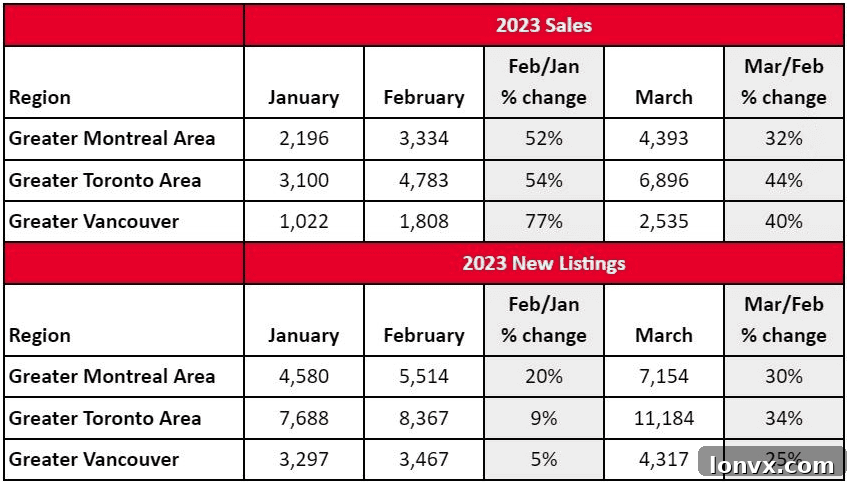
While the overall trend in sales volume has been steadily upward since the beginning of the year, a persistent challenge continues to loom large: the critically low number of available listings. This severe supply-demand imbalance remains a key factor in the market, exerting upward pressure on prices and limiting choices for eager buyers.
Source: Royal LePage
Soper further elaborated on the deepening crisis of housing inventory, stating, “We are currently grappling with an escalating problem that was once predominantly the burden of Canada’s major urban centers but is now increasingly being experienced in secondary and even tertiary markets across the country.” This geographical spread of the supply shortage highlights a systemic issue that impacts housing affordability and accessibility on a national scale.
He added a critical perspective on policy efforts: “While governments at various levels are indeed implementing policies specifically designed to alleviate this persistent problem, the pace of progress remains far from encouraging. Furthermore, fundamental challenges confronting developers — such as the significantly increased cost of building materials, rising labor expenses, and a chronic shortage of skilled tradespeople — continue to hinder construction and exacerbate the supply deficit.” These combined factors create a complex web of obstacles that prevent the market from adequately responding to robust buyer demand.
Public Policy and Its Influence on Canada’s Mortgage Landscape
The Royal LePage report also highlighted a significant public policy development: the Office of the Superintendent of Financial Institutions’ (OSFI) proposed adjustments to Canada’s stringent mortgage stress test. These proposed changes aim to impose more restrictive conditions on access to mortgage financing, primarily in an effort to enhance the stability of major banks and shield them against potential consumer defaults. This regulatory move reflects a cautious approach to financial risk management, particularly in a market that has experienced periods of rapid fluctuation.
However, Phil Soper voiced a strong caution against tightening lending restrictions, especially within the current economic climate where interest rates are already elevated and show potential signs of future decline. He argued that such a measure could paradoxically create more adverse effects than benefits for Canadian families and the broader housing market. Soper believes that overly stringent rules could inadvertently push a greater number of homebuyers into the less regulated B-lender market, where interest rates are typically higher and terms less favorable, thereby increasing financial vulnerability rather than reducing it.
“Despite a year marked by rapidly escalating interest rates, we observe that the incidence of Canadian homeowners failing to meet their financial obligations to institutions remains exceptionally low,” Soper stated, underscoring the resilience of borrowers. “Our banking sector has demonstrated commendable prudence in managing their mortgage portfolios, a factor greatly aided by Canada’s persistently low unemployment rates, which provide a stable income base for homeowners.” This data suggests that the existing stress test, combined with low unemployment, has largely been effective in preventing widespread defaults.
British Columbia’s Home Buyer Rescission Period: A Policy Under Scrutiny
Royal LePage also provided an assessment of British Columbia’s recently implemented Home Buyer Rescission Period, often referred to as a “cooling-off period.” This provincial legislation grants buyers a three-business-day window to rescind an offer after an Agreement of Purchase and Sale (APS) has been signed. The policy was designed with the commendable intention of offering buyers protection, allowing them to reconsider their decisions and potentially avoid rash commitments in a competitive market.
However, Royal LePage’s analysis suggests that the policy has not “proven to be useful” in its intended application. The report notes, “Few B.C. buyers are actually exercising their right to utilize the cooling-off period in the manner it was designed – that is, to provide them with an ‘out’ after an impulsive decision to purchase a property.”
Instead, the policy appears to be encountering significant challenges and exhibiting unintended consequences. “Unfortunately, we are witnessing instances where individuals are overtly misusing the program by submitting offers on multiple homes as they continue to shop around,” the report highlights. “This practice effectively locks up precious and limited housing inventory, treating it almost like clothing in a retail store.” The ramifications of this behavior are severe: it artificially inflates market demand, reduces genuine available supply for serious buyers, and creates frustration for sellers. Royal LePage concludes with a strong recommendation, stating, “This legislation, in its current form, is proving to be more detrimental than helpful, and therefore, it should either be substantially amended or altogether rescinded to restore fairness and efficiency to the market.”
Interest Rates: A Catalyst for Renewed Buyer Confidence
A pivotal moment for the Canadian real estate market occurred with the Bank of Canada’s recent decision to maintain its overnight lending rate at 4.5 percent. This move, following a series of aggressive hikes, signals a potential plateau in borrowing costs and has been widely interpreted as a crucial indication of returning economic stability. The central bank has also clearly indicated its intention to sustain this rate, provided that inflationary pressures continue to subside.
According to Phil Soper, “This specific announcement was the clear signal that countless Canadians had been eagerly awaiting. The Bank of Canada’s decision to hold the rate served as a definitive ‘green light’ that market stability is indeed returning, and its impact on buyer demand has been both swift and significantly positive.” The stabilization of interest rates removes a major layer of uncertainty that had previously deterred many potential buyers.
Reinforcing this observation, a recent survey conducted by Royal LePage revealed compelling insights into buyer behavior and sentiment. The survey found that one in four Canadians had been actively exploring options for a new home over the past year. However, the period of rapidly rising interest rates prompted 63 percent of these prospective buyers to temporarily postpone their home-buying aspirations. The recent rate hold has visibly shifted this dynamic: a significant 26 percent of those who had put their plans on hold now intend to resume their search this spring, demonstrating immediate renewed confidence. Furthermore, an additional 36 percent indicated their readiness to re-enter the market in the near future, specifically once the central bank demonstrates a sustained pause in rate hikes over several consecutive months. This data underscores the profound psychological and practical impact of interest rate stability on consumer decision-making in the housing market.
For a comprehensive understanding of these market trends, including detailed regional breakdowns and in-depth analysis, readers are encouraged to consult the full report from Royal LePage, titled “Canada’s Real Estate Market: Buyers are back, but where is the inventory?” which can be accessed here.