Canada is grappling with a profound housing crisis, characterized by a severe home supply shortage, escalating interest rates, and an ever-increasing cost of living. This confluence of factors has pushed homeownership out of reach for many Canadians, creating significant social and economic challenges across the country. The market is defined by fierce competition among buyers, largely due to fewer homes available for sale and a surge in interprovincial and international migration. These dynamics relentlessly drive up prices, making the dream of owning a home an elusive reality for a growing segment of the population.
The complexity of this issue means no single level of government can unilaterally provide a solution; it demands a concerted and collective effort from all political stakeholders. Recognizing this imperative, Zoocasa has compiled a detailed report on the proposals put forth by each major political party in Canada, outlining their distinct strategies for tackling the nation’s pressing housing challenges. This article expands upon these insights, offering a comprehensive look at the various approaches designed to foster a more accessible and affordable housing market for all Canadians.
Navigating Canada’s Housing Crisis: A Deep Dive into Political Solutions
The Canadian housing market has reached a critical juncture, marked by persistent unaffordability and a widening gap between housing demand and supply. For prospective homebuyers, soaring prices, coupled with the highest interest rates in decades, present formidable barriers. Renters also face immense pressure, with rents skyrocketing in urban centers and vacancy rates hitting historic lows. This crisis is not merely an economic issue; it impacts social mobility, individual well-being, and the overall stability of Canadian society. Understanding the policy responses from Canada’s leading political parties is crucial for charting a path forward, aiming to address both immediate affordability concerns and long-term supply deficits.
The Liberal Party’s Approach: Accelerating Supply and Supporting Homeowners
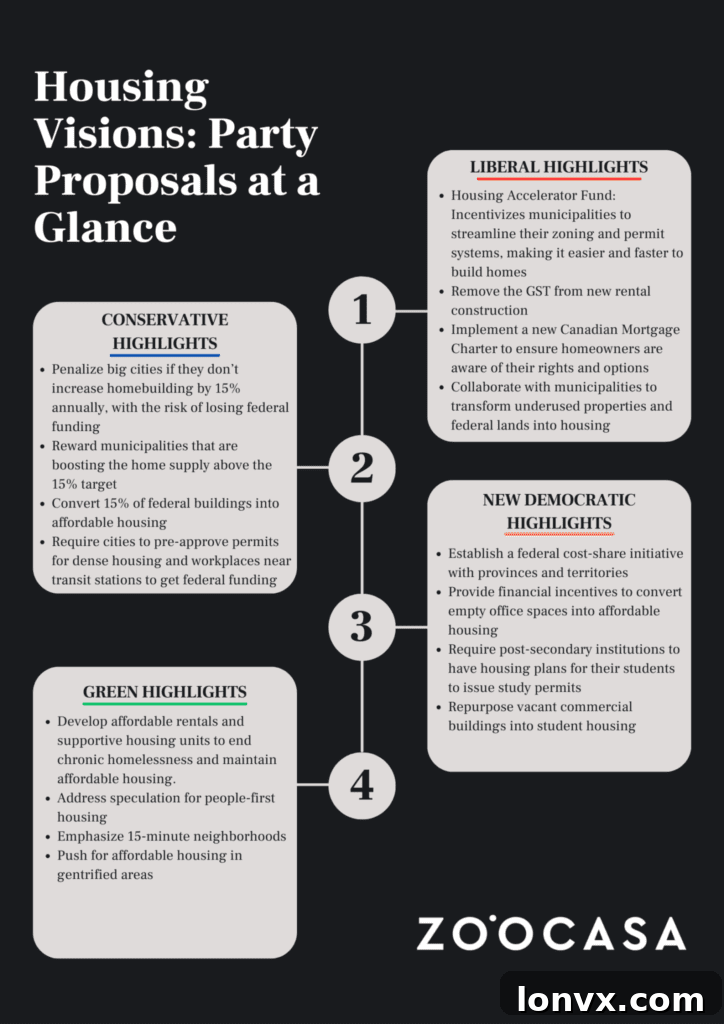
The Liberal Party, currently in power, has positioned itself as a champion of supply-side solutions, with a strong focus on stimulating new construction and supporting existing homeowners. Their flagship initiative, the Housing Accelerator Fund, is a substantial $4-billion program designed to incentivize municipalities to fast-track housing developments. This fund aims to reduce bureaucratic delays by encouraging streamlined zoning and permitting processes, directly addressing the often-cited problem of slow approval times. The ambitious goal is to facilitate the construction of 100,000 new middle-class homes by 2024-2025. Several key Ontario cities, including London, Vaughan, and Burlington, have already embraced this program, signifying a willingness at the municipal level to collaborate with federal efforts to boost housing starts and increase the housing stock.
Beyond direct funding for supply, the Liberals have also pledged to eliminate the Goods and Services Tax (GST) on new rental housing projects. This measure is intended to make it more financially viable for developers to construct purpose-built rental units, thereby increasing the overall rental stock and alleviating pressure on an overstretched rental market where demand far outstrips supply. Furthermore, the party proposes identifying and facilitating the conversion of vacant commercial and institutional properties into residential units, a creative solution aimed at maximizing existing urban infrastructure and reducing urban sprawl.
To aid homeowners grappling with the current economic climate, particularly those facing mortgage renewals at higher rates, the Liberal Party introduced the Canadian Mortgage Charter. This charter is designed to provide greater flexibility and relief measures for those experiencing mortgage stress. While specific details may evolve, the general intent is to ensure homeowners have access to options such as temporary mortgage payment deferrals, extended amortization periods, or adjusted payment schedules, preventing foreclosures and helping families remain in their homes during challenging times. This multi-pronged approach reflects the Liberals’ strategy of combining supply-side incentives with targeted support for both renters and homeowners, aiming for a more stable and accessible housing market.
The Conservative Party’s Strategy: Penalties, Incentives, and Deregulation
In stark contrast to the Liberal approach, the Conservative Party advocates for a more aggressive, market-driven strategy that leverages penalties and deregulation to spur homebuilding. Their plan aims to significantly boost the construction of new homes by imposing strict annual targets on municipalities. Specifically, cities that fail to meet a 15 percent annual increase in homebuilding risk facing direct financial consequences, including the potential loss of federal infrastructure funding. This punitive measure is designed to force municipal governments to reduce red tape and accelerate development approvals, tackling what the Conservatives identify as a major impediment to housing supply: municipal bureaucracy and NIMBYism.
The Conservatives also propose eliminating the GST, but their focus is specifically on affordable apartment housing. This initiative targets properties where rents are below the market median, aiming to make new, lower-cost rental units more financially attractive for developers to build and ensuring that tax relief translates into genuine affordability for renters. Their broader strategy involves a significant push to remove bureaucratic hurdles across the board, making it easier and faster to build homes. A key aspect of this includes mandating pre-approved permits for dense housing developments, particularly those located near public transit stations. This Transit-Oriented Development (TOD) strategy seeks to maximize land use in well-connected areas, creating more housing options while promoting sustainable urban planning and reducing commute times. The Conservative platform emphasizes reducing government interference and empowering the private sector to build more, faster, and more affordably by streamlining regulations and enforcing ambitious construction targets.
The New Democratic Party’s Vision: Prioritizing Affordability and Social Housing
The New Democratic Party (NDP) frames the housing crisis primarily through the lens of affordability and social equity, advocating for robust public investment and support for non-market housing solutions. A core tenet of their plan is the establishment of fast-start funds dedicated to building co-operative, social, and non-profit housing. These models are seen as crucial for creating housing that is permanently affordable, insulated from market fluctuations, and responsive to community needs. By investing in these sectors, the NDP aims to provide secure and affordable options for vulnerable populations and those priced out of the conventional market, moving away from purely profit-driven housing models.
Addressing the specific pressures faced by students, the NDP proposes repurposing vacant commercial or public buildings into student housing. This innovative approach seeks to alleviate the severe shortage of affordable accommodations near post-secondary institutions, which often leaves students struggling to find suitable and affordable places to live, sometimes resorting to precarious housing situations. Furthermore, the party advocates for a policy requiring post-secondary institutions themselves to develop comprehensive housing plans for international students as a condition for issuing study permits. This measure would place greater responsibility on educational bodies to ensure their international student intake aligns with available housing capacity, preventing further strain on local rental markets and ensuring student well-being.
To support these initiatives, the NDP suggests a collaborative student housing funding plan. This plan envisions contributions from the federal government, provincial and territorial governments, and educational institutions themselves, pooling resources to create a sustainable pipeline of affordable student accommodations. The NDP’s platform underscores a commitment to treating housing as a human right, with a focus on public and community-led solutions to ensure housing accessibility and affordability for all Canadians, particularly emphasizing those often overlooked by market-based solutions.
The Green Party’s Holistic Approach: People-First and Sustainable Communities
The Green Party approaches the housing crisis with a comprehensive “people-first” philosophy, linking housing affordability to broader social and economic issues, as well as environmental sustainability. A cornerstone of their strategy is the proposal for a guaranteed minimum income, arguing that by addressing poverty at its root, individuals will naturally be better equipped to afford housing. This fundamental income support is seen as a direct way to enhance affordability and reduce housing precarity across the country, providing a stable foundation for individuals to secure adequate shelter.
Central to the Green Party’s housing agenda is the ambitious goal of doubling the social housing stock in Canada. This reflects their belief in the fundamental right to safe, adequate, and affordable housing for all Canadians, regardless of income or background. Doubling the social housing supply would significantly expand access to non-market housing options, providing stability and security for low-income individuals and families, and reducing reliance on a volatile private rental market. This expansion would be achieved through investments in new builds and the acquisition and renovation of existing properties.
The Green Party of Ontario has further articulated specific targets that complement the federal platform. These include focusing on affordable housing solutions within gentrified areas, which often see long-term residents displaced due to rising costs, ensuring community stability. They also emphasize supporting renters on their path to homeownership through various mechanisms like rent-to-own programs, reducing housing speculation that artificially inflates prices through measures like anti-flipping taxes, and promoting the development of 15-minute neighbourhoods. The concept of a 15-minute neighborhood advocates for urban planning where essential services, workplaces, and recreational facilities are all accessible within a 15-minute walk or bike ride, reducing reliance on cars, fostering community, enhancing overall quality of life, and promoting environmental sustainability. The Green Party’s vision integrates housing solutions within a larger framework of social justice, environmental responsibility, and community well-being.
Beyond Party Lines: Common Themes and Remaining Challenges
While each political party presents a distinct vision, several common themes emerge in their approaches to Canada’s housing crisis. A general consensus exists around the need to increase housing supply, with variations in how to achieve this, whether through direct federal funding, municipal incentives, or deregulation. The elimination of GST on certain types of housing, particularly rentals, is another area of overlapping policy, albeit with different specific applications and targeting. All parties implicitly acknowledge that affordability is a critical component of the crisis, even if their methods for enhancing it differ significantly, ranging from income support to market adjustments.
Despite these proposed solutions, Canada’s housing landscape remains fraught with challenges. Persistent inflation continues to push up the cost of construction materials, while a national shortage of skilled labor further impedes the pace of new builds. Interest rate volatility adds another layer of uncertainty for both developers and potential homebuyers, affecting borrowing costs and investment decisions. These underlying economic factors, coupled with the complexities of land use and municipal governance, suggest that even with the most well-intentioned policies, a swift resolution to the crisis will be difficult to achieve. Tackling these systemic issues will require ongoing innovation and a flexible approach.
The Path Forward: A Collective Responsibility
Ultimately, addressing Canada’s multifaceted housing crisis demands more than the platform of any single political party. It requires sustained, collaborative efforts from federal, provincial, and municipal governments, working in concert with the private sector, non-profit organizations, and local communities. A comprehensive national housing strategy must integrate diverse perspectives, innovate with new building technologies, streamline regulatory processes, and ensure equitable access to housing resources for all Canadians. The solutions are complex and interconnected, requiring both short-term relief measures and long-term strategic planning.
The various proposals highlight different facets of the problem and potential solutions, from market-driven incentives to robust social safety nets. The ongoing debate around these strategies underscores the urgency and complexity of the issue, reflecting the diverse needs and priorities across the country. For Canada to build a truly sustainable and affordable housing future, a commitment to long-term planning, adaptability, and unwavering political will across the spectrum will be paramount, ensuring that every Canadian has a safe and affordable place to call home.
For a more in-depth analysis and the original report, you can refer to the full Zoocasa article on affordable housing solutions.
Enjoying this article?
Get the latest real estate insights and articles directly in your inbox so you stay up to date on the Canadian real estate industry.