
The Canadian housing market is once again at a pivotal juncture, grappling with shifting economic winds and evolving monetary policy. The Bank of Canada (BoC) recently initiated a series of rate cuts, lowering its benchmark rate for the second time in two months on July 24th. This decision, coupled with a concurrent drop in government bond yields, has driven current mortgage rates to their lowest levels in 17 months. On the surface, such a development might seem like a catalyst for a robust real estate market recovery, potentially igniting buyer confidence and stimulating sales activity. However, a deeper dive into historical precedents and current economic realities suggests a more nuanced and potentially challenging outlook for Canadian home prices.
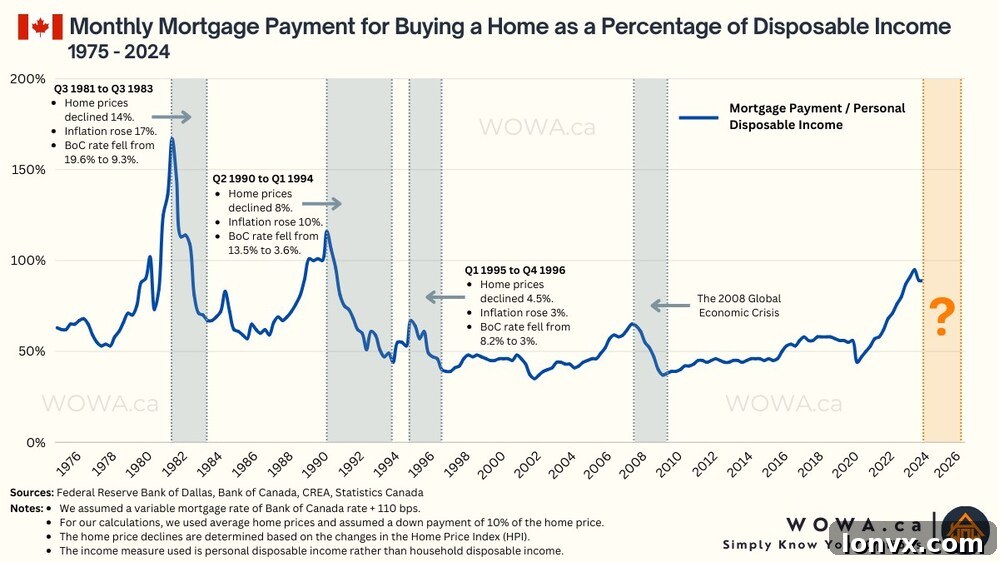
Recent analysis underscores the severe strain on housing affordability across the nation. WOWA Leads conducted a comprehensive study examining mortgage payments relative to income over the past five decades in Canada. Their findings paint a stark picture: mortgage payments for an average recently purchased property in Canada now consume a disproportionately large share, nearly all, of the average person’s disposable income. This alarming statistic highlights an unprecedented level of financial burden on homeowners and prospective buyers, creating an environment where even modest economic fluctuations can have profound effects on the stability of the housing market.
The current landscape of the Canadian housing market is highly fragmented, displaying significant regional disparities. Major metropolitan areas like Toronto and Vancouver are experiencing noticeable stagnation, characterized by slower sales and increasing inventory. In Toronto, for instance, the sales-to-new-listing ratio hovers around 35 percent, a clear indicator of a buyer’s market. This ratio suggests that for every 100 new listings, only 35 result in a sale within a typical timeframe, giving buyers considerably more leverage. Furthermore, inventory levels in the Greater Toronto Area (GTA) are approaching 25,000 units, a figure not seen since 2010. This surge in available properties puts downward pressure on home prices as sellers compete for a smaller pool of buyers.
Conversely, more affordable markets, particularly in cities like Montreal, Calgary, and Edmonton, are demonstrating robust growth and healthy activity. These regions, often benefiting from inter-provincial migration and a lower cost of living, continue to attract buyers seeking value and less financial strain. This divergence in market performance underscores the complex interplay of local economic conditions, population shifts, and the varying degrees of housing affordability across Canada. The national average masks these critical regional differences, making a blanket assessment of the market challenging.
Historically, the current level of housing unaffordability has only been witnessed twice before in Canada’s recent past: once around 1981 and again around 1990, with subsequent affordability peaks observed in 1995 and 2007, just prior to the global financial crisis. Examining these historical periods provides valuable insights into how the Canadian housing market responded to similar pressures, particularly when falling mortgage rates coincided with periods of extreme unaffordability. The patterns observed offer a crucial lens through which to anticipate potential future trajectories for Canadian home prices.
Q3 1981 to Q3 1983: Navigating Economic Headwinds
The early 1980s marked a period of intense economic volatility in Canada. The Bank of Canada’s benchmark rate reached an unprecedented high of 20.78 percent in August 1981, a measure taken to combat rampant inflation. This aggressively tight monetary policy severely impacted borrowing costs, freezing much of the real estate market. As the economy began to slow and inflationary pressures eased, the BoC embarked on a significant easing cycle, dropping the rate to 9.26 percent by July 1983. Despite this dramatic decrease in interest rates, which theoretically should have made mortgages more accessible, the home price index declined by a notable 14 percent during this period. Meanwhile, inflation, while moderating from its peak, still rose by 17 percent, further eroding purchasing power and real incomes. In Vancouver, a bellwether market, home prices experienced an even more precipitous fall, dropping by nearly 40 percent from early 1981 to mid-1982. This historical episode highlights a crucial disconnect: falling rates do not always translate into immediate or sustained recovery in property values, especially when broader economic conditions remain challenging.
Q2 1990 to Q1 1994: The Early 90s Recession
Canada entered a recession in the early 1990s, characterized by high unemployment and a cautious economic outlook. In response to these conditions and a desire to stimulate growth, the Bank of Canada initiated another period of significant rate cuts. The BoC rate fell sharply from 13.5 percent to a mere 3.6 percent over four years. This substantial reduction in borrowing costs, however, did not prevent a decline in home prices. During this period, national home prices fell by 8 percent, while inflation continued to rise by 10 percent. The Greater Toronto Area (GTA), a traditionally robust market, saw some of the most pronounced declines, with home prices dropping by a staggering 28 percent from April 1989 to August 1993. This downturn showcased how a combination of economic recession, job losses, and a perceived overvaluation could outweigh the positive impact of lower interest rates on housing affordability and demand. Buyers remained hesitant, anticipating further price declines and facing job uncertainty.
Q1 1995 to Q4 1996: A Period of Modest Correction
Following the early 1990s recession, Canada experienced another, albeit less severe, peak in housing unaffordability in the mid-1990s. The Bank of Canada responded by lowering its rate from 8.2 percent in March 1995 to 3 percent by November 1996. While this period saw a less dramatic decline compared to the previous decades, home prices still retreated by 4.5 percent nationally, and inflation rose by 3 percent. For example, the Vancouver housing market, which had experienced strong growth in the mid-90s, saw its home prices drop by 17 percent from August 1994 to October 1998. This period serves as a reminder that even moderate periods of unaffordability, combined with rate cuts, can still lead to price adjustments, indicating that market fundamentals and economic sentiment often override the immediate benefit of lower borrowing costs.
2007-2008 Global Financial Crisis: A Brief but Sharp Correction
The lead-up to the 2008 global financial crisis saw another peak in housing unaffordability in Canada, particularly in 2007. As the global economy teetered on the brink of collapse, central banks worldwide, including the Bank of Canada, took aggressive measures to prevent a deeper recession. The BoC rate plummeted from 4.25 percent in Q2 2008 to a historic low of 0.25 percent by Q1 2009. This drastic monetary easing, however, did not immediately prevent a housing market correction. During this intense period, Canadian home prices dropped by 9 percent. Unlike previous periods, the rebound was remarkably swift. Fueled by unprecedented monetary stimulus and relatively strong economic fundamentals post-crisis, home prices quickly recovered in 2009. This episode suggests that while a global economic shock can trigger price declines, the speed and nature of recovery can vary significantly depending on the underlying strength of the economy and the magnitude of policy response.
Why Home Prices Can Drop Even When Affordability Improves
The seemingly counterintuitive phenomenon of home prices declining amidst improving affordability, driven by lower interest rates, can be primarily attributed to a critical factor: the lag effect of previous rate hikes and subsequent economic deterioration. Understanding this lag is crucial for anticipating market movements.
Most Canadian mortgages are fixed-rate, typically for terms of three to five years. This means that the immediate impact of interest rate hikes is not universally felt across all homeowners. Instead, the full brunt of higher borrowing costs is experienced primarily during mortgage renewals. By the time many homeowners renew their fixed-rate mortgages, the Bank of Canada may have already peaked its rate cycle and even started implementing cuts. However, these renewed rates, while potentially lower than the peak, are still often significantly higher than their initial rates, leading to substantial increases in monthly payments. This “payment shock” can exert immense financial pressure on some homeowners, particularly those who stretched their budgets during periods of lower rates. For some, the only viable option becomes selling their property, contributing to increased supply in the market and potentially driving down prices.
Furthermore, a Bank of Canada rate cut is typically a signal that the economy is slowing down, or that it is at risk of a recession. Central banks cut rates to stimulate economic activity, often in response to dropping inflation, higher unemployment rates, and lower earnings for self-employed individuals and businesses. A slowing economy directly impacts housing demand. When job security is uncertain, consumer confidence wanes, and incomes stagnate or decline, prospective buyers become hesitant to make large financial commitments like purchasing a home. Higher unemployment is a particularly potent factor in decreasing home prices, as it reduces the pool of qualified buyers and can force existing homeowners, who have lost their jobs, to sell their properties quickly, often at a discount.
The cumulative effect of these factors creates a scenario where the lagged pain of previous high rates, combined with a weakening economic outlook, can depress home prices even as current mortgage rates begin to ease. The market needs time to absorb these changes, and the economic conditions that prompted the rate cuts often continue to influence buyer behavior and seller urgency.
What’s Next for Canada’s Housing Market?
The Canadian housing market continues to exhibit a complex and fragmented performance across the nation. While regions like Ontario, particularly the GTA, have seen home prices decline recently, provinces such as Quebec and Alberta are experiencing steady growth. This divergence is driven by a confluence of factors including local economic conditions, inter-provincial migration patterns, and varying degrees of affordability. Historically, periods of extreme unaffordability, such as the one Canada is currently experiencing, have tended to precede significant price corrections, often occurring after the peak of the interest rate cycle has passed.
Given the historical context and current economic indicators, it is plausible that the full impact of previously high interest rates on the market has yet to fully manifest. The lag effect, particularly for fixed-rate mortgage renewals, means that many homeowners are still facing, or will soon face, higher payments than their initial rates, regardless of recent BoC cuts. This continued financial pressure, combined with a potential slowing economy, suggests that we might see further price moderation in highly-priced markets like Ontario, especially the Greater Toronto Area and Greater Vancouver. These regions are more susceptible to downturns due to their higher price points and sensitivity to interest rate fluctuations. Conversely, more affordable markets in Alberta and Quebec could remain relatively stable, potentially even seeing continued growth, as they attract buyers seeking better value and benefit from differing economic drivers.
The path forward for Canada’s housing market is likely to be characterized by this regional divergence and a cautious approach from buyers and sellers alike. While lower mortgage rates may offer some relief, they cannot entirely counteract the deep-seated issues of affordability and the lingering effects of a prolonged period of high interest rates. The market is undergoing a rebalancing, and its ultimate trajectory will depend on the interplay of monetary policy, economic performance, and consumer confidence.
Enjoying this article?
Get the latest real estate articles in your inbox 3x week so you stay up to date on the latest in the Canadian real estate industry