
Canada’s Rental Housing Crisis: A Looming Shortfall and the Urgent Need for Purpose-Built Solutions
Canada is currently grappling with a profound and escalating rental housing crisis. Across the nation, prospective tenants face unprecedented challenges, including soaring rents, dwindling availability, and intense competition for limited units. A recent comprehensive report from RBC economists Robert Hogue and Rachel Battaglia underscores the critical need for a substantial increase in the supply of purpose-built rental housing to alleviate current pressures and adequately meet the demands of a rapidly growing population, both now and in the foreseeable future.
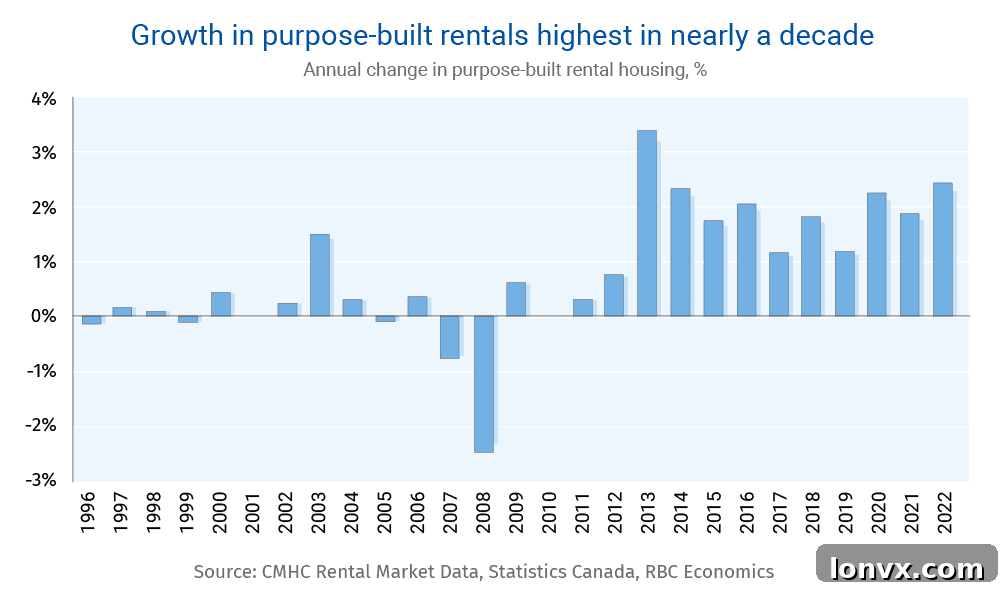
While the country witnessed a 2.4 percent growth in its rental housing stock last year, marking the fastest pace since 2014, this incremental increase pales in comparison to the surging demand. The record-breaking pace of apartment construction in 2022, though a welcome development amidst rising affordability challenges, has not been enough to bridge the widening gap. Furthermore, this growth has been notably uneven across different regions. Cities like Calgary and Ottawa-Gatineau experienced the most significant gains in purpose-built rental stock, while major urban centers such as Toronto and Montreal saw only minimal percentage increases, exacerbating their already tight markets.
This imbalance points to a systemic issue where construction efforts, despite their scale, are either misaligned with the areas of highest demand or simply insufficient to keep pace with the influx of new residents and changing housing needs. The consequences are far-reaching, impacting everything from individual household budgets to the broader economic stability of Canada’s most vibrant cities.
Intense Demand Fuels Unprecedented Rent Increases and Record Low Vacancy Rates
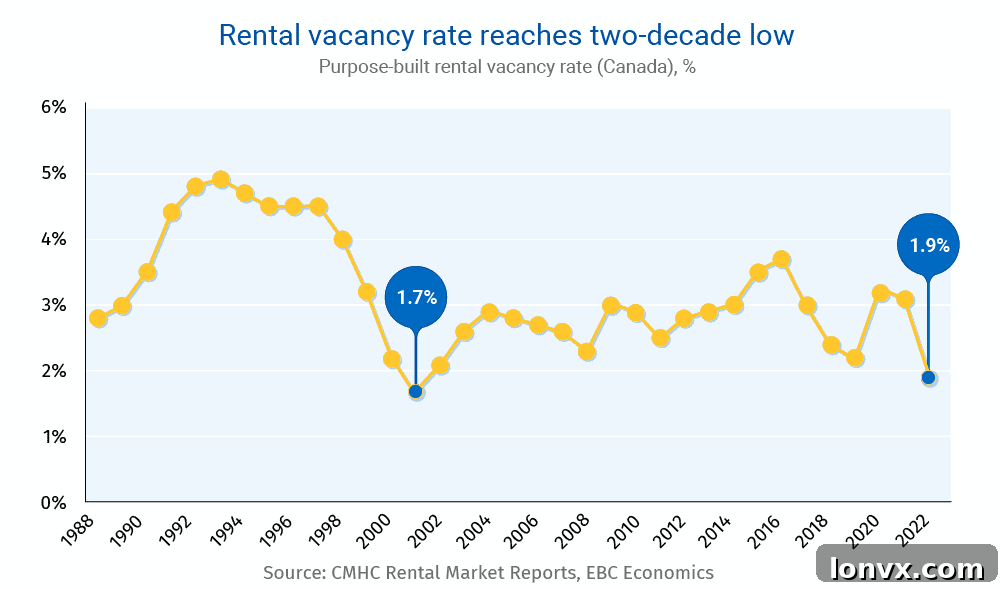
The core of Canada’s rental housing dilemma lies in the severe mismatch between supply and demand. Despite efforts to boost construction, the rental market is struggling significantly to keep up with the overwhelming need. This intense pressure has pushed the national rental vacancy rate to an alarming 1.9 percent last year – its lowest point in 21 years. This drastic decline, a staggering 120 basis points in just 12 months, represents the steepest single-year decrease recorded in over three decades, as highlighted by Hogue and Battaglia.
Such a critically low vacancy rate signifies a highly competitive environment where tenants often face bidding wars, limited options, and increased stress. For many, finding suitable and affordable housing has become an arduous, often disheartening, task. This lack of available units directly translates into unprecedented spikes in rental costs. In 2022, the average rent growth for a two-bedroom purpose-built unit surged by 5.6 percent nationally. However, this figure is merely an average, with many cities experiencing even more dramatic increases. Gatineau, for instance, saw rents jump by 9.1 percent, Toronto by 6.5 percent, and Calgary by 6.0 percent. These increases place immense financial strain on individuals and families, forcing many to dedicate a disproportionate share of their income to housing or to seek housing further from their workplaces and communities.
The factors driving this demand are multifaceted. Canada’s robust immigration targets, aimed at bolstering economic growth and addressing labor shortages, contribute significantly to population expansion, with many newcomers initially entering the rental market. Furthermore, rising interest rates and prohibitive home prices are pushing aspiring homeowners out of the purchasing market and into rentals, intensifying competition. Changing demographics, such as an increase in single-person households and a growing student population, also add to the demand for rental accommodation. These combined pressures create a perfect storm, making the search for an affordable place to live a formidable challenge for millions of Canadians.
The Tightening Grip of the Condo Rental Market and the Broadening Rental Housing Gap
Beyond purpose-built rentals, a closer examination of the rental condo market in some of Canada’s largest cities reveals an even more acute squeeze. Major urban centres like Ottawa-Gatineau, Toronto, and Calgary are experiencing some of the lowest condo rental vacancy rates in the country. This indicates an extremely intense level of competition, which inevitably adds further upward pressure on overall rents across all housing types. The condo market plays a crucial role in the rental ecosystem, often providing a more flexible and sometimes more premium option for tenants. When this segment tightens, it creates a ripple effect, pushing demand back towards the already strained purpose-built sector.
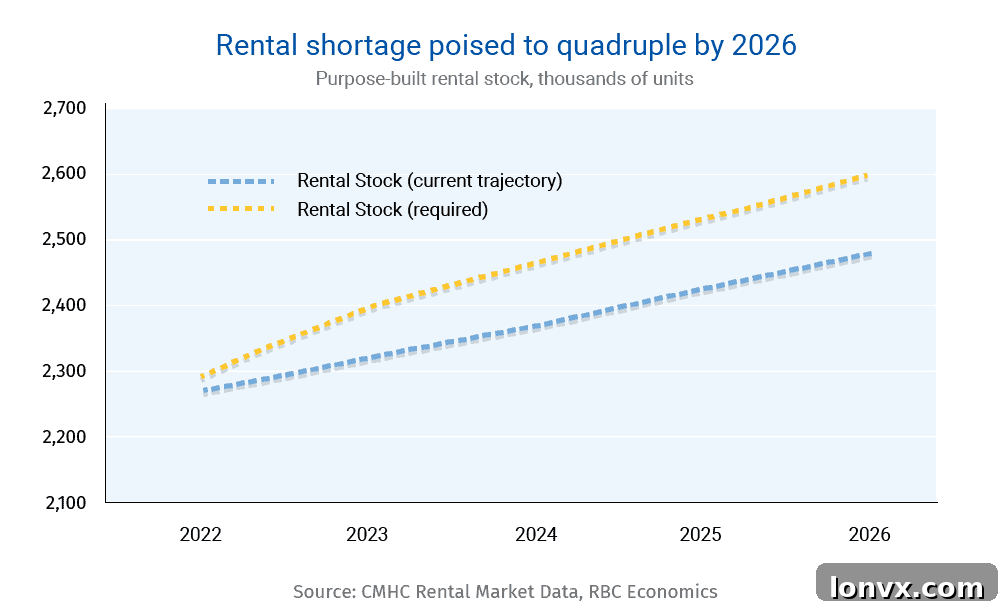
The RBC report meticulously highlights the severity of what economists term the “rental housing gap.” This critical metric represents the significant discrepancy between the projected rental housing stock, assuming the current rate of increase continues, and the actual rental stock required to achieve market balance and keep pace with future demand. In simpler terms, it’s the difference between what we’re building and what we desperately need. This gap is not merely a statistical anomaly; it’s a tangible measure of the housing insecurity many Canadians face, and it directly influences the trajectory of rent affordability and market stability.
The underlying reasons for the tightness in the condo rental market are complex. While some investor-owned condos serve as long-term rentals, others might be diverted to short-term rental platforms, or their owners might opt to sell in a strong sales market, further reducing the available rental pool. Regardless of the specific drivers, the combined pressure from both purpose-built and condo rental sectors paints a stark picture of a market under severe duress.
Canada’s Looming Rental Shortfall: Over 120,000 Units by 2026
The projections from RBC economists are sobering. They estimate that Canada currently faces a deficit of approximately 25,000 to 30,000 units in its purpose-built rental stock. This shortfall is not expected to remain static; rather, it is projected to expand exponentially over the next four years as demand continues to soar unabated. The report’s most alarming forecast indicates that Canada could be short more than 120,000 rental units by 2026. This figure represents a nearly fourfold increase from the estimated shortfall today, signaling a rapidly worsening crisis if current trends persist without significant intervention.
To achieve a balanced rental market characterized by stability and affordability, RBC economists assert that Canada will need to add an astonishing 332,000 units to its current rental stock between now and 2026. This target is not merely ambitious; it highlights the colossal scale of the challenge ahead. Meeting such a goal requires an unprecedented acceleration in construction and a concerted effort from all levels of government, private developers, and community stakeholders.
The challenges in achieving this target are manifold. The construction sector faces ongoing labor shortages, supply chain disruptions, and escalating material costs. Bureaucratic hurdles, including lengthy approval processes and complex zoning regulations, can significantly delay projects. Furthermore, local community opposition (often termed NIMBYism – “Not In My Backyard”) can impede the development of much-needed higher-density rental housing. Overcoming these obstacles will require innovative policies, streamlined processes, and a shared vision for a more adequately housed population.
Hogue and Battaglia acknowledge that while certain measures could offer some relief, they are unlikely to be sufficient on their own. These include converting commercial buildings into residential units, encouraging the conversion of existing condo units into long-term rentals, and adding secondary rental suites to existing homes. While these strategies contribute positively to the overall housing stock, their impact on a problem of this magnitude is limited by scale and practicality. Commercial conversions, for example, are often expensive and geographically restricted. Incentivizing condo owners to rent out units long-term competes with other market forces, and adding secondary suites, while valuable, typically offers smaller increases in overall unit numbers compared to large-scale developments.
The economists’ unequivocal conclusion is that the most effective and sustainable path to meet current and future demand, and to restore stability and affordability to the rental market, is to considerably grow the supply of purpose-built rental housing. This means investing in new, dedicated rental buildings designed for long-term tenancy, offering diverse unit types, and integrating into communities thoughtfully. This focused approach is seen as the cornerstone of any long-term solution.
Charting a Course for Rental Market Stability and Affordability
Canada’s rental housing crisis demands immediate and sustained action. The projections from RBC paint a stark picture of a worsening situation if the trajectory remains unchanged. The current deficit, coupled with the projected exponential growth in the shortfall, signals an urgent need for transformative policy and investment.
Addressing this monumental challenge will require a multi-pronged approach rooted in a commitment to increasing purpose-built rental supply. This includes, but is not limited to:
- Government Incentives: Implementing financial incentives for developers to build purpose-built rental housing, such as grants, low-interest loans, and tax breaks, to make projects more viable.
- Zoning Reform: Modernizing outdated zoning laws to allow for higher density and mixed-use developments, particularly near transit hubs and employment centers, to maximize land use.
- Streamlined Approvals: Expediting municipal approval processes for rental projects to reduce unnecessary delays and associated costs, accelerating construction timelines.
- Public-Private Partnerships: Fostering collaborations between government bodies and private developers to leverage resources and expertise for large-scale rental projects, sharing risk and reward.
- Land Availability: Identifying and making public and underutilized private land available for rental housing development, expanding the potential footprint for new construction.
- Infrastructure Investment: Ensuring that new housing developments are supported by adequate infrastructure, including public transit, schools, and healthcare facilities, to create complete communities.
Achieving a balanced rental market is not just an economic imperative; it’s a social one. Access to stable, affordable housing is fundamental to the well-being of individuals, the strength of communities, and the overall prosperity of the nation. Without adequate rental options, Canada risks undermining its economic competitiveness, exacerbating social inequalities, and failing its growing population.
The RBC report serves as a critical call to action, urging policymakers, industry leaders, and communities to collaborate on innovative and bold solutions. Only through a concentrated and sustained effort to significantly expand the supply of purpose-built rental housing can Canada hope to avert a deepening crisis and ensure a future where all its residents have access to a safe and affordable place to call home.
For a complete understanding of the economic analysis and detailed insights, read the full report from RBC here.