
In a significant move to restore public confidence and safeguard consumers, the Ontario government has announced its decision to assume control of the Real Estate Council of Ontario (RECO). This pivotal action, declared by Minister Stephen Crawford, comes in the wake of mounting concerns over RECO’s handling of a major fraud scandal that left numerous real estate agents and clients in financial distress. Effective immediately, the provincial government will appoint an administrator to oversee RECO’s operations, signaling a new era for real estate regulation in Ontario.
Minister Crawford officially conveyed this decision in a letter addressed to RECO Chair Katie Steinfeld and CEO Brenda Buchanan. On a Friday morning, he confirmed the appointment of Jean Lépine, a seasoned professional in communications and government relations, as the administrator for RECO, with his tenure commencing the following Monday. This intervention marks a direct response to widespread dissatisfaction within the real estate community and among the public.
“Over the past three months, I’ve heard from consumers, real estate boards, realtors, and brokers who have unequivocally lost confidence in Ontario’s real estate regulator,” Minister Crawford stated in a public post on LinkedIn. This sentiment underscores the critical need for a decisive overhaul, highlighting a systemic breakdown in trust that the government aims to rectify through direct oversight and a renewed commitment to its regulatory mandate.
The government’s decision was primarily prompted by Minister Crawford’s comprehensive review of a scathing audit report compiled by Dentons Canada LLP. This audit meticulously detailed RECO’s significant shortcomings in managing the fallout from the staggering $10-million iPro Realty Ltd. fraud scandal. The findings painted a troubling picture of a regulatory body failing to adequately protect those it was entrusted to serve.
“Ultimately, the Dentons final report raises profound concerns about RECO’s fundamental ability to restore public confidence in the real estate services sector and, crucially, to protect consumers during one of the largest financial transactions of their lives,” Minister Crawford’s letter elaborated. This damning assessment solidified the government’s resolve to intervene, recognizing that the integrity of Ontario’s real estate market was at stake.
The iPro scandal itself unfolded with troubling delays. RECO first identified a “significant shortfall” in iPro’s accounts on May 19. However, despite the gravity of the discovery, the regulator inexplicably delayed taking decisive action, waiting until August to move to shut down the firm and freeze its assets. This three-month delay, during which further damage may have occurred, became a central point of criticism and a key factor in the Dentons audit, which RECO subsequently commissioned to investigate its own handling of the iPro matter.
Agents Rally for Answers and Commission Payouts
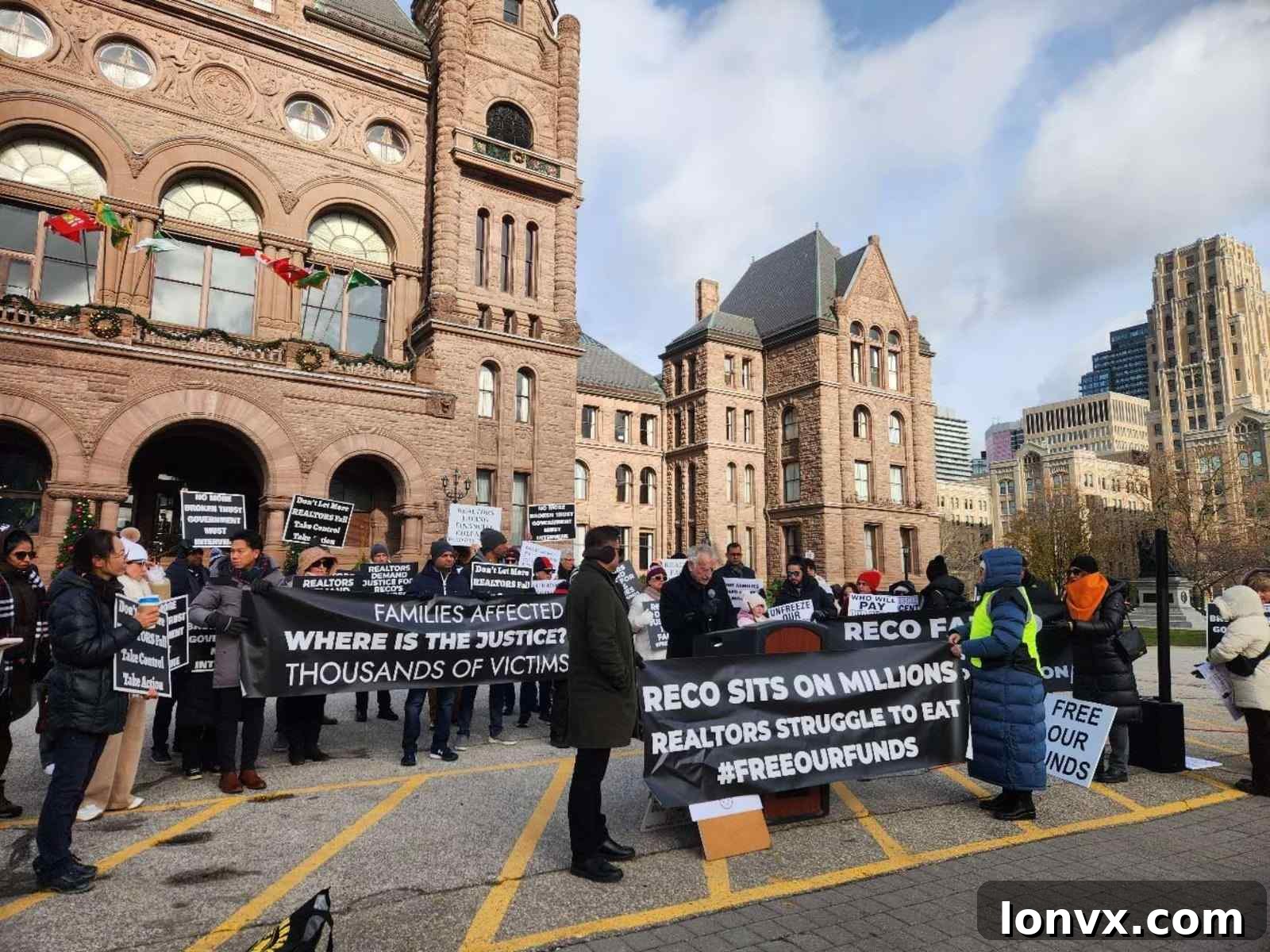
The rally at Queen’s Park on Friday morning (photo: Maria Florez)
The government’s announcement coincided with a powerful demonstration at Queen’s Park in Toronto, where scores of affected real estate agents gathered to demand answers and urgent action regarding their unpaid commissions. Many of these agents are facing losses upwards of six figures, a catastrophic financial blow that has jeopardized their livelihoods and personal well-being. This rally served as a poignant backdrop to the unfolding regulatory crisis, amplifying the voices of those directly impacted by RECO’s perceived failures.
The agents carried signs emblazoned with messages that conveyed their deep frustration and despair. Slogans such as, “RECO sits on millions. Realtors struggle to eat,” and “Families affected. Thousands of victims. Where is the justice?” highlighted the severe human cost of the iPro fraud and the regulatory body’s slow response. These messages painted a vivid picture of the stark contrast between the regulator’s apparent inaction and the desperate plight of those it was meant to protect.
In interviews with Real Estate Magazine, numerous agents shared harrowing accounts of the profound emotional and financial toll the situation has taken on them and their families. Many spoke of being unable to cover basic living expenses, including rent, mortgages, and groceries, as they anxiously await compensation for their legitimate earnings. While consumers whose deposits were lost have been receiving payouts from an insurance program funded by Realtors (a statutory trust prioritizing consumer claims), the path to recovery for agents has been far less clear and significantly delayed, fueling a sense of injustice and abandonment.
RECO Outlines Its Commission Claims Plan Amidst Uncertainty
In a memo published on its website on the same Friday, RECO provided an update on its plan for commission claims, attempting to address the growing chorus of concern. The regulator revealed that its insurer had received over 1,500 new submissions since early October, underscoring the immense scale of the problem. However, RECO admitted that claims were still undergoing verification, meaning the insurance program manager was not yet in a position to issue payouts or obtain the necessary court approvals to distribute trust account funds.
“Before the program can establish its approach to payment of commission claims, we must first understand the balance of funds in iPro’s trust accounts against the total amounts being claimed,” RECO stated. The complexity of the alleged fraud at iPro, requiring extensive diligence, tracing, and verification, has introduced significant uncertainty, making a swift resolution challenging. This ongoing uncertainty has only exacerbated the financial strain on affected agents, who grapple with the lack of a clear timeline for receiving their due compensation.
RECO assured claimants that all submissions would be treated equitably, emphasizing that payouts would not be on a first-come, first-served basis. Nevertheless, the regulator also confirmed that some submissions had already been deemed ineligible, further adding to the complexity and potential disappointment for some agents. Once assessments and reconciliations are finalized, RECO anticipates distributing approximately $4 million in available insurance coverage on a pro-rated basis. This distribution is tentatively projected for early 2026, a timeline that offers little immediate relief to those struggling financially.
“Once the insurance limits have been disbursed, we will work to secure as much of the frozen assets as possible to pay further amounts,” RECO added, indicating a multi-stage process for recovery that relies heavily on the successful recovery of iPro’s assets. This protracted process highlights the difficulties inherent in rectifying a large-scale fraud and the challenges faced by the regulatory body in meeting its obligations.
Calls for Accountability: ‘Heads Need to Roll’
Among the most vocal critics of RECO’s handling of the iPro debacle has been Toronto Realtor Sandra Jackson, who has publicly championed the cause of affected agents since the beginning. Jackson expressed satisfaction with the government’s choice of an administrator from outside the real estate industry, viewing it as a crucial step towards unbiased reform.
Jean Lépine, described on the Government of Ontario’s website as a “seasoned communications, government relations, investor relations, and sustainability executive,” brings a diverse skill set to the challenging role. Jackson commended Lépine’s qualifications, stating, “I will say that the Ontario government, the ministry, seems to have made a good choice. He’s educated, it appears that he has the experience needed.” Her primary endorsement, however, stemmed from Lépine’s lack of direct ties to the real estate sector: “I love the fact that he’s not industry-related, so no bad buddy-buddy decisions will be made.”
Jackson, who also instructs real estate law courses, conveyed her hope that Lépine would implement bold and decisive changes. Her strong conviction is that accountability is paramount, declaring, “Heads need to roll on this one.” This sentiment reflects a broader demand within the real estate community for serious consequences for those deemed responsible for the regulatory failures that exacerbated the iPro scandal.
Lépine’s Broad Authority: Exercising RECO’s Board and Officer Powers
The Ministry of Public and Business Service Delivery and Procurement clarified the extensive authority granted to Jean Lépine over RECO. The administrator will be a direct liaison, providing regular updates to the department and ministry staff, ensuring direct government oversight and transparency throughout the reform process.
According to a departmental spokesperson, Lépine’s powers are comprehensive: “The administrator will have the exclusive right to exercise all the powers and perform all the duties of RECO’s board, officers, and members and will oversee and maintain RECO’s operations to ensure that RECO is equipped to effectively regulate registrants and is fulfilling its consumer protection mandate.” This grants Lépine unprecedented control, enabling him to implement necessary changes without internal resistance from existing structures.
Furthermore, the statement emphasized Lépine’s immediate focus on addressing the financial impact of the scandal: “The administrator will work with the insurer and related parties promptly to support those financially impacted.” This dual mandate — reforming the organization and expediting relief for victims — underscores the urgency and multifaceted nature of the task ahead for the new administrator and the Ontario government.
Addressing the ‘Culture of Fear’ Identified by the Dentons Report
The Dentons report unearthed a concerning organizational culture within RECO, particularly highlighting the influence of former RECO registrar Joseph Richer. The report characterized Richer as “experienced, strong-willed, intimidating, and protective of his authority.” This dominant personality, according to the audit, created an environment that discouraged staff and even senior management from challenging his decisions or raising concerns to the board.
This “culture of fear” was directly implicated in RECO’s mishandling of the iPro case. The report found that it led to Richer unilaterally entering into an undertaking agreement with iPro’s principals without sufficient visibility or appropriate oversight from the board or other senior management. This lack of transparency and checks and balances is seen as a critical failure that allowed the situation to escalate.
Sandra Jackson vehemently rejected this cultural dynamic as an excuse for inaction. “If we have people who’ve been hired or voted in that can’t do their job because they said there was a culture of fear, then step aside and we will put a bulldog in who can handle it,” she asserted, advocating for strong leadership capable of navigating challenging internal dynamics. Jackson further criticized the board directly: “The board of directors could have easily contacted the ministry and said, ‘We have a problem here, and we need assistance.’ But they didn’t,” implying a dereliction of duty that contributed to the crisis.
Debate on Governance: A Return to Self-Governance or Sustained Oversight?
The government takeover has ignited a debate within the industry regarding the optimal form of regulation for Ontario’s real estate sector. Mark Morris, a seasoned real estate lawyer in Ontario with over two decades of experience, believes that while the RECO shakeup “was necessary,” the regulator should eventually return to self-governance.
Morris argues that self-governance, when effective, leverages the intimate knowledge of industry insiders. “If you have appointed governance, it’s not like they’re going to be making things up. They’re still going to have industry panels, and people who contribute and tell you what’s going on on the ground,” he acknowledged. However, he stressed, “The reason that self-governance works is that those people who are closest to the action should be the people who are ultimately responsible.” He expressed hope that the administrator’s appointment would be temporary, cautioning that “being closer to provincial authority doesn’t mean that it will be a good thing” in the long run.
In Morris’s view, the core issue wasn’t the structure of self-governance itself, but RECO’s leadership failing to uphold its mandate. He remains convinced that competent individuals within the industry are capable of effective self-regulation.
Former iPro Agent Disagrees with Administrator Appointment
Not all stakeholders, however, are in agreement with the government’s approach. Toronto Realtor Jeff Mount, a former iPro agent who fortunately exited the firm “just before I got caught up in the problem,” has been a vocal advocate for transparency and communication from RECO to both affected consumers and agents. Now with Web Max Realty, Mount expressed strong reservations about a government-appointed administrator.
In a letter addressed to RECO Chair Katie Steinfeld, Mount conveyed his belief that an administrator would “only complicate matters more.” Speaking to REM, he elaborated, “My gut tells me that we’ll be run by an administrator going forward, and that I don’t think is in the best interest of the registrants or the public.” He further posited that “The administrator will run RECO in the best interest of the government, and not in the best interest of the registrants or the public,” suggesting a potential conflict of interest between government priorities and the needs of the real estate community and the public it serves. Mount also noted his frustration with Minister Crawford, stating that the minister has “not returned one of my emails on the subject.”
RECO Commits to a ‘Smooth Transition’
In the aftermath of Minister Crawford’s announcement, a RECO spokesperson conveyed the organization’s commitment to cooperation. In an email to REM, the spokesperson stated that Crawford “has the firm commitment of our staff and our organization that we will work in close collaboration with the government and incoming administrator.” This response indicates a willingness on RECO’s part to facilitate the transition and engage with the new oversight structure.
As of the deadline, RECO had not confirmed any immediate changes to its executive leadership positions, leaving open questions about the future of current senior staff. The spokesperson concluded by emphasizing a shared objective: “Our shared goal is to ensure a smooth transition and to continue to drive the necessary reforms already underway at RECO, arising from Dentons’ independent report.” This suggests an acknowledgment of the need for reform, even if the method of achieving it has now been externalized.
OREA Applauds Government’s Decisive Action
The Ontario Real Estate Association (OREA) has been a steadfast advocate for stronger government intervention in RECO’s affairs for many months, especially in light of the iPro fallout. Their consistent calls for accountability and reform culminated in a statement released by OREA president Cathy Polan on Friday, commending Minister Crawford for his “decisive action on accountability.”
Polan’s statement highlighted the critical importance of the government’s intervention: “This decision by the provincial government will ensure RECO can get back to the basics of fulfilling its consumer protection mandate.” She further articulated OREA’s vision for a robust regulatory framework: “Ontario’s real estate regulatory framework must protect both consumers and registrants, safeguarding families making the biggest financial transaction of their lives and shielding Ontarians from unethical behaviour.” OREA’s strong endorsement underscores the industry’s desire for a regulator that is both effective and trustworthy, a standard the government is now committed to upholding through its direct control.