
Real Estate Industry Leans Conservative: Key Insights from REM’s Federal Politics and Housing Poll
As Canada looks ahead to the anticipated 2025 federal election, the sentiment within the nation’s vital real estate sector is becoming increasingly clear. A recent, large-scale reader poll conducted by Real Estate Magazine (REM) offers a compelling glimpse into the political leanings and policy priorities of real estate professionals across the country. The findings suggest a distinct preference for the Conservative Party, particularly concerning housing policies and economic stewardship in the Canadian real estate market.
The poll, REM’s inaugural deep dive into federal politics and its impact on housing, surveyed 674 respondents. The majority of participants identified as Realtors over the age of 40, representing a significant voice from the front lines of the Canadian housing market. The results indicate that if an election were held today, a solid majority – 54.3 percent – would cast their ballot for Pierre Poilievre’s Conservative Party. This stands in contrast to 38.3 percent who would support the Liberal Party, led in this hypothetical scenario by Mark Carney. A small fraction, just over 5 percent, remained undecided, with other parties garnering single-digit support.
This preference extends beyond general political affiliation to specific leadership and policy effectiveness. When respondents were asked which leader they believed would be more beneficial for the real estate industry itself, Poilievre maintained a clear lead, favored by 52.7 percent. Mark Carney received 35.5 percent of the vote, with 11.2 percent expressing uncertainty. These figures underscore a prevailing belief within the industry that the Conservative platform and leadership align more closely with their professional interests and crucial market needs concerning housing affordability Canada and supply.
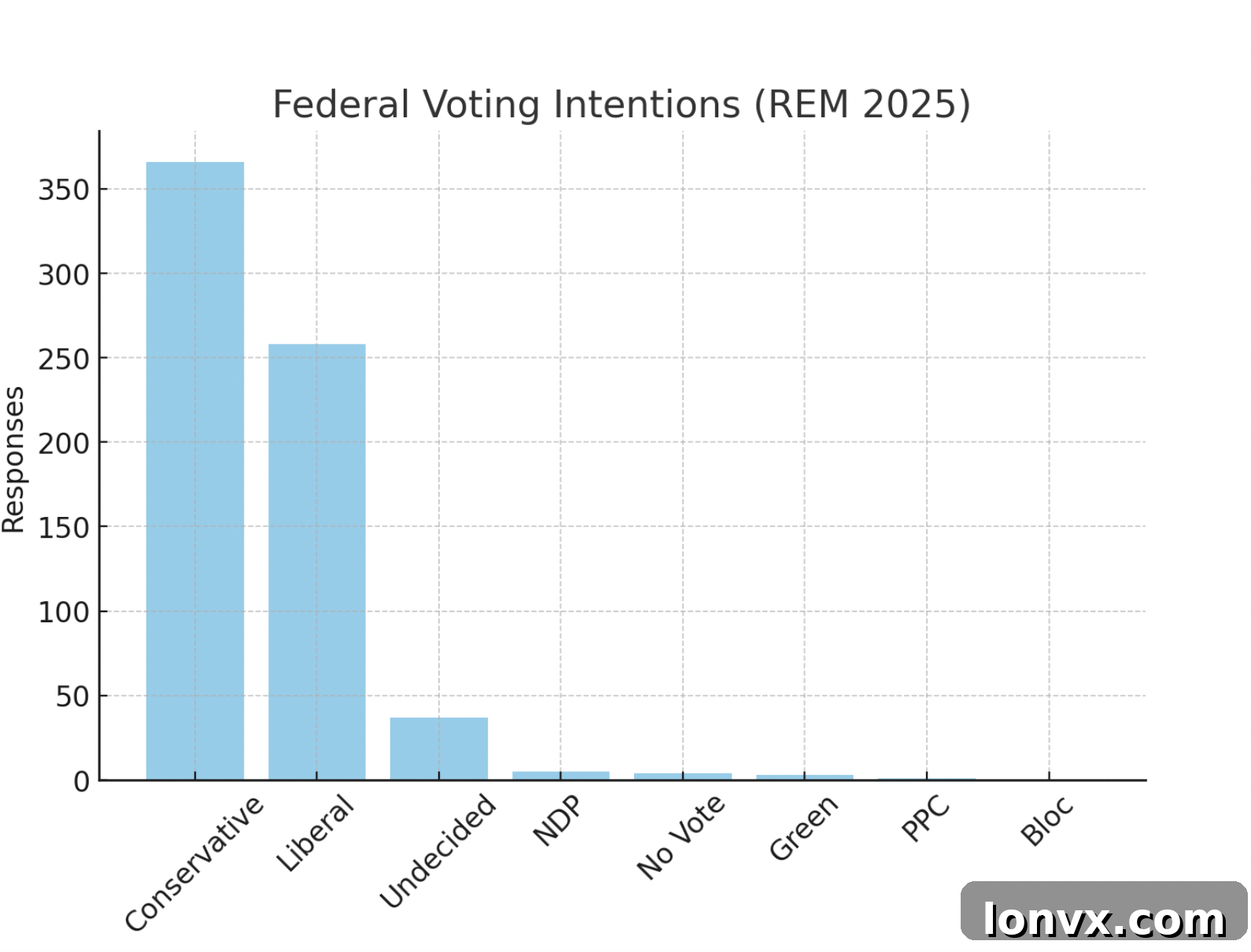
Industry expert and columnist Daniel Foch, who unveiled the poll results during REM’s monthly market call, noted that these findings largely mirrored his observations and independent polling. “One aspect that didn’t surprise me, based on polling I’ve conducted with my own audience and what I’ve consistently seen across the industry, is the strong consensus that most real estate professionals believe Pierre Poilievre would be better for the sector,” Foch explained. He elaborated on the reasons behind this sentiment, highlighting the perceived differences in the two major parties’ approaches to housing policy.
Foch argued that the Conservative Party housing policy, with its emphasis on reducing bureaucratic red tape and increasing housing supply, resonates deeply within the real estate industry. These priorities are seen as fundamental to unlocking greater market efficiency, facilitating more transactions, and addressing the Canadian housing supply shortage. Conversely, Foch suggested that the Liberal Party housing initiatives, often characterized by a focus on immigration levels and various forms of market intervention, have historically contributed to rising housing prices. While higher prices might seem beneficial at face value, Foch offered a crucial caveat: “Rising house prices often mean that people can no longer afford homes, which consequently means they don’t buy them. Therefore, escalating prices are not necessarily a healthy or sustainable situation for the real estate industry in the long run.” This perspective underscores a shift from merely desiring price appreciation to recognizing the paramount importance of affordability for a vibrant and active market, where real estate agents can facilitate more home sales.
Housing Policy Matters: A Deep Dive into Preferred Solutions for Housing Affordability
It comes as no surprise that housing remains a dominant concern for Canadians, and especially for those working within the real estate market. What the REM poll uniquely reveals is the nuanced way in which Realtors evaluate proposed solutions from federal parties regarding housing policy reform. The data provides valuable insight into which specific policy initiatives garner the most support among these key stakeholders.
When asked which federal party’s housing plan held the most appeal, the Conservative plan narrowly edged out the Liberal plan, with 245 respondents preferring the former compared to 230 for the latter. This slim margin suggests that while the overall political preference is clear, the specifics of policy proposals also play a critical role in shaping opinions within the real estate industry sentiment.
Several key features of the Conservative platform resonated strongly with real estate professionals. These include linking federal funding to municipal housing targets, a strategy designed to incentivize local governments to streamline development and increase housing starts effectively addressing the housing supply shortage. Another widely supported measure is the deferral of capital gains on investments, which could encourage greater investment in rental properties or other housing-related ventures, stimulating the Canadian economy. Furthermore, the proposal to remove the Goods and Services Tax (GST) on new homes priced under $1.3 million was particularly well-received, aiming to directly reduce the cost burden for many prospective homebuyers and enhance housing affordability Canada.
Daniel Foch specifically highlighted the appeal of the capital gains deferral. “The Conservative plan—and particularly the capital gains deferral piece—appears to have garnered significant support,” he noted. Foch described this as a “fascinating idea” with broad appeal. He suggested it “could specifically appeal to boomers, for instance, who are looking to sell their existing property and reinvest the proceeds into Canadian stocks or other qualified investments, providing a powerful incentive for market movement and capital allocation.” This policy is viewed as a way to free up equity and stimulate economic activity, rather than simply taxing gains immediately, which could promote longer-term investment in housing-related assets.
Beyond party-specific proposals, respondents also expressed strong support for broader affordability policies that aim to ease financial pressures on buyers. These include extending mortgage amortizations, which would allow homebuyers to stretch their loan payments over a longer period, thereby reducing monthly obligations and potentially making homeownership more accessible. Additionally, the removal or significant easing of the mortgage stress test, a regulatory measure that assesses a borrower’s ability to handle higher interest rates, was also highly favored. Such measures are seen as direct ways to increase purchasing power and facilitate smoother transactions in a challenging market environment, thereby boosting consumer confidence and buyer affordability.
Priorities for the Federal Government: Cutting Red Tape, Building More Homes, and Easing Financial Strain
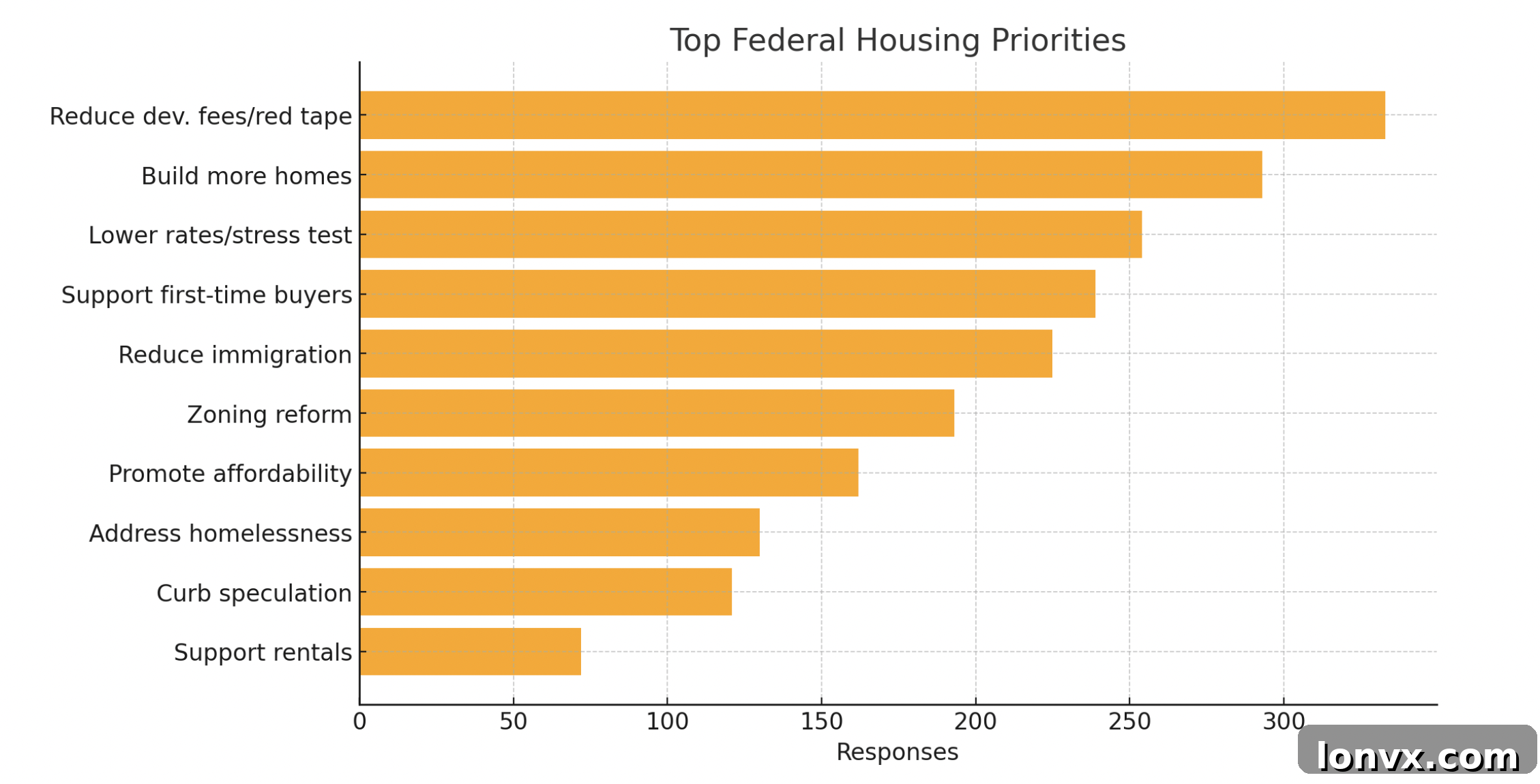
The REM poll delved into the most pressing housing issues that real estate professionals believe the federal government should prioritize. When asked to identify the top three concerns, a clear consensus emerged, pointing towards a supply-side strategy coupled with financial flexibility rather than direct market intervention.
The most common responses were:
- Reducing development fees and bureaucratic red tape (49.4 percent)
- Building more homes to address the critical housing supply shortage (43.5 percent)
- Easing mortgage qualification rules or reducing interest rates (37.7 percent)
These priorities paint a vivid picture of the challenges faced by the real estate industry and the desired solutions for improving housing affordability. The overwhelming support for reducing development fees and red tape signifies a recognition that municipal and provincial regulations often act as significant impediments to construction. Streamlining these processes is seen as essential for accelerating housing development and reducing the ultimate cost for consumers. Similarly, the call for building more homes directly addresses Canada’s well-documented housing supply crisis, which is a fundamental driver of affordability issues across the country.
The emphasis on easing mortgage qualification rules or interest rates directly reflects the current high-interest rate environment and its impact on buyer affordability. Stricter qualification criteria and elevated rates have significantly constrained purchasing power, leading to reduced transaction volumes and market stagnation. The industry seeks measures that would make financing more accessible without undermining financial stability, perhaps by revisiting the mortgage stress test criteria or implementing targeted interest rate relief programs.
It’s noteworthy that these preferences stand in stark contrast to policies focused on direct market intervention, such as national rent control or taxing corporate landlords, which received notably lower support. This suggests that real estate agents largely believe that systemic issues related to supply and financing are at the root of Canada’s housing challenges, and that solutions should focus on enabling market mechanisms rather than imposing controls that could inadvertently deter investment or further restrict supply.
Daniel Foch reiterated that these responses align perfectly with the industry’s desire to increase transaction volume. “The fact that reducing development fees and red tape was identified as a top federal priority is telling,” Foch commented. “This is likely why people feel Pierre Poilievre’s proposed solutions are better for the industry. Ultimately, more supply available for transaction is always beneficial for Realtors and the broader market, as it creates a more dynamic and accessible environment for homebuyers.”
When respondents were pressed to name the single most important housing issue, the sentiment remained consistent. A significant 20.3 percent cited reducing interest rates or easing mortgage qualification stress as their primary concern. This was closely followed by increasing housing supply and cutting bureaucracy, further solidifying the industry’s core priorities for federal action ahead of the federal election 2025.
Desired Federal and Municipal Involvement in Housing Initiatives
Beyond identifying specific problems, the REM poll also explored the preferred level of government involvement in housing. The results reveal a nuanced perspective, indicating a desire for increased engagement from both federal and municipal levels, but likely with specific types of interventions in mind that promote housing affordability and increase supply.
Nearly half of the respondents, 47 percent, stated that the federal government should be more involved in housing matters. This contrasts with 28.3 percent who believed it should be less involved. Simultaneously, an even larger majority, 55 percent, felt that municipal governments should also play a more significant role. This suggests a call for a multi-faceted, coordinated approach, where federal leadership sets national targets and incentives, while municipalities address local zoning, permits, and infrastructure challenges, which are critical for new housing development.
One of the most contentious, yet strongly supported, findings was that three out of four readers (75.8 percent) believe immigration levels should be directly tied to housing supply capacity. This stance, while a subject of national debate, is clearly viewed by real estate professionals through the practical lens of housing demand. High immigration, without a corresponding increase in housing stock, inevitably places greater pressure on an already strained market, exacerbating affordability issues and the housing supply shortage.
Daniel Foch found this particular question especially insightful. “This question fascinated me the most,” he admitted. “I previously held the assumption that Realtors primarily wanted house prices to simply go up. However, what I’ve genuinely determined from a thorough review of this survey is that Realtors have a clear understanding that excessively high house prices are, in fact, a significant problem for our industry. The core realization is that affordable homes ultimately lead to more transactions, creating a healthier and more sustainable market for everyone involved.” This suggests a mature understanding within the industry that long-term stability and transaction volume are more valuable than short-term price spikes that alienate potential buyers and hinder the overall health of the Canadian real estate market.
Optimism vs. Uncertainty: Navigating the Future of the Canadian Housing Market
The outlook on the future of the Canadian housing market among real estate professionals is characterized by a blend of cautious optimism and pervasive uncertainty. While a notable 35.6 percent of readers expressed feeling somewhat confident about the housing market’s trajectory over the next two years, a nearly identical proportion conveyed either pessimism or neutrality. This divided sentiment underscores the complex and often unpredictable nature of the current economic landscape and its impact on real estate industry sentiment.
When asked to pinpoint the biggest challenges currently facing their businesses, three key factors emerged prominently: market uncertainty (38.7 percent), buyer affordability (19.4 percent), and low consumer confidence (18.4 percent). These challenges are deeply interconnected. High interest rates, inflationary pressures, and global economic instability fuel market uncertainty, which in turn erodes consumer confidence. This lack of confidence, combined with persistent issues of affordability, creates a difficult environment for buyers and subsequently for real estate professionals who rely on active transactions within the Canadian economy.
Daniel Foch offered a perspective on how these challenges might evolve. “Market uncertainty and consumer confidence were clearly identified as the biggest hurdles,” Foch explained. “However, it’s possible that over time, people may begin to accept this new normal of uncertainty and gradually return to the market. When that happens, when buyers adapt to the prevailing conditions and re-engage, that’s precisely when you start seeing a buyer’s market begin to emerge, characterized by more options and potentially more negotiating power for purchasers.” This shift could signify a move towards greater market stability and sustained activity.
Foch also drew attention to the broader economic conditions that are significantly shaping voter sentiment across Canada. “Globally, Canada is often interpreted as a left-leaning country in terms of its political ideology,” he noted. “However, what we are observing within the electorate is a discernible shift of voters from the traditional left spectrum towards a more centrist voting bloc. This is not primarily an ideological shift; rather, it is an economically driven transition, motivated by concerns over cost of living, inflation, and the overall financial health of households and the nation.” This observation links directly back to the poll’s findings, suggesting that the preference for parties perceived to offer economic stability and affordability solutions is a pragmatic response to current financial realities and a key factor in the upcoming federal election 2025.
A Landmark Poll for Real Estate Magazine
This comprehensive reader poll marks a significant milestone for Real Estate Magazine, representing its first survey of such an expansive scale and scope. The results provide invaluable insights into the prevailing sentiments and policy preferences within the Canadian real estate industry as the nation approaches the next federal election. While the findings offer a robust snapshot of industry thinking, it is important to acknowledge certain demographic characteristics of the respondent pool.
For instance, the poll did not ask respondents to identify their gender, which is a limitation in understanding potential gender-based differences in political or policy views. Additionally, the demographic profile skewed towards experienced professionals, with more than 94 percent of respondents being over the age of 40. Furthermore, a substantial majority—nearly 90 percent—identified specifically as Realtors or brokers. While this focus on experienced industry professionals provides a highly informed perspective on real estate industry sentiment, it also means the survey primarily captures the views of a seasoned segment of the real estate community.
Despite these demographic nuances, the poll’s consistent themes and strong indications provide a clear picture of the issues that matter most to those actively shaping and working within the Canadian housing market. As election day draws closer, REM and the industry will be closely monitoring how political conversations evolve and whether industry sentiment undergoes further shifts regarding housing affordability, the housing supply shortage, and federal housing policy. What remains unequivocally clear from this extensive survey is that these issues are not merely talking points; they are the beating heart of discussions and concerns among Realtors across Canada, and will undoubtedly be central to the upcoming federal political discourse.