
The Year of the Horse, a potent symbol of action, momentum, and diligent effort, sets a timely backdrop as industry veteran Conrad Zurini issues a compelling challenge to real estate agents: cease waiting passively for the next market boom and instead, proactively build a resilient business.
Having been immersed in the real estate world since childhood, I had the unique vantage point of witnessing every ebb and flow, every glorious boom, and every humbling bust of the industry. My parents, shrewd in their understanding of market volatility, never shielded us from the raw realities of economic cycles. We experienced firsthand the exhilaration of a thriving market and the stark scarcity that accompanied a downturn.
Recently, a journey through old family photo albums offered a profound sense of nostalgia. Unlike the fleeting scrolls through digital galleries, the physical act of turning pages, feeling the texture of a photograph encased in plastic, transports you back to an unfiltered moment. Pulling a faded print from its shiny sleeve, you connect with the eyes, the smiles, and the unspoken stories, reigniting memories with an almost visceral intensity. These tangible photos, often blemished by time, capture truth in its rawest form.
As I meticulously reviewed decades of these photographic memories, the periods of abundance and scarcity in our family’s life became strikingly evident. While my childhood was undeniably charmed, filled with love and laughter, the subtle dependence on a capricious real estate market to sustain our livelihood was most pronounced during the holiday season. My father, a true enthusiast, insisted on a genuine Christmas tree – nothing artificial, much to my mother’s dismay, as she wrestled with an endless cascade of pine needles and tinsel. What truly resonated in these vintage photos was the undeniable correlation between the economic climate and the sheer volume of gifts encircling the tree’s base. Larger circles of consumerism marked prosperous times, while smaller, more modest clusters appeared during the technical recessions of 1974-75, 1981-82, and 1990-92. These visual cues offered an undeniable, if informal, economic barometer of our family’s fortunes.
Living within a real estate family meant that market booms and busts were not abstract economic concepts, but integral threads woven into the fabric of daily life. This environment fostered a culture where veteran real estate agents often rationalized their dependence on the market’s unpredictable currents. Much like surfers patiently awaiting the perfect wave, many agents perpetually anticipate the next market uptick. Yet, paradoxically, once immersed in a booming market, a common inclination is to lament its demands and challenges. This reactive approach, unfortunately, fuels what I refer to as the “Realtor Creed” – a mindset that is, regrettably, still prevalent within the real estate community. But what if the current real estate cycle stretches far beyond conventional expectations? Will you be an agent who clings to this creed of passive waiting, or one who takes definitive action to cultivate a systematic, sustainable, and truly resilient business?
The “I Just Need One More Great Market” Creed: A Call to Action for Real Estate Agents
This creed, often recited implicitly or explicitly, highlights a pervasive mentality within the real estate industry – a reliance on external market forces rather than internal strategic action. It’s a prayer whispered in uncertain times, reflecting a hope for a past glory that may not return in the same form.
In the name of listings, offers, and the holy multiple, let this be my creed:
I have survived buyers’ markets, sellers’ markets, and whatever we are calling this one,
Yet I still believe in one more glorious boom before I hang up my lockbox.
Grant me steady nerves if and when rates may rise,
Sharp instincts when prices fall,
And the stamina to answer late-night texts that start with “Just one more question …”
May my open houses be busy,
My appraisals come in at value.
Deliver me from lowball offers with endless conditions,
And the seller’s song of “maybe I’ll wait for the market to get better.”
Bless my database, my CRM, and every name I’ve ever scribbled on a gas receipt,
For they are the seeds of my final, fabulous run.
Let the next cycle be kind,
The bidding wars be civilized,
And the headlines stop saying “Affordability Crisis” just in time for my farewell tour.
And when the boom at last returns in full force,
May my IG likes be plentiful and DMs engaging,
My listings sell in days, not months,
And my retirement party be funded by that one listing that sold before the sign went up.
Until that day, I will renew my license and pay my board dues,
Recharge my phone,
And repeat this creed:
“Just one more market,
Just one more peak,
And then, maybe, I’ll finally retire.”
This creed, while humorous in its candor, underscores a dangerous dependence. It suggests that success is contingent upon an external, unpredictable market upturn rather than proactive business development. In today’s dynamic real estate landscape, this mindset can be detrimental, leading to stagnation and missed opportunities. Real estate professionals must transcend this passive waiting and actively forge a path to sustainable growth, regardless of prevailing market conditions.
Understanding Current Real Estate Market Dynamics: A Deep Dive into the Bear Market
As a lifelong student of real estate, I’ve always found the simplistic categorization of markets into “buyers’,” “sellers’,” and “balanced” to be disappointingly insufficient. Do these three pillars truly encapsulate the complex dynamics of real estate? Furthermore, how can such broad definitions accurately predict market performance, especially when two of these conditions are inherently contradictory? For instance, why would a seller opt to list their home in a buyer’s market, or conversely, why would a buyer consider purchasing in a seller’s market? The record-breaking home sales of 2021, the epitome of a seller’s market, highlight this paradox, making the traditional categorizations seem counterintuitive and inadequate for comprehensive market analysis.
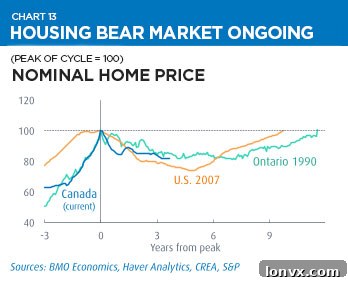
The Bank of Montreal’s recent 2026 outlook report provides a far more nuanced and perhaps sobering answer to the fundamental question of our current market state: we are navigating a bear market. This environment is characterized by either plateauing or slightly declining home values, coupled with a pervasive sense of pessimism among buyers and sellers. Historical parallels offer a stark warning. Consider the Ontario housing market in the 1990s, where it took over a decade for home prices to rebound to their pre-peak levels. Similarly, the U.S. housing crisis of 2007 saw a recovery period of approximately ten years to return to peak values. There’s an uncanny resemblance in the trajectory of current home prices to these past downturns, prompting a critical question for real estate investors and homeowners alike: Will home prices rebound to 2022 levels in a sharp, deeper “V” pattern, suggesting another year of decline before a swift recovery? Or are we more likely to experience a “lazier U” shape, signifying a more gradual, prolonged recovery akin to the 1990s? Understanding this distinction is crucial for strategic planning, reminding us that sometimes, looking “back to the future” offers the clearest insights.
Navigating a Bear Market: Emphasizing Best Value Over Price Point
In a bear market, the path to survival and prosperity hinges on a fundamental shift in perspective: we must preach value, not merely price point. This isn’t about our professional value as real estate practitioners, but rather the intrinsic, long-term value of the properties we represent. In a bear stock market, astute traders actively seek out undervalued companies with high growth potential, where robust earnings, profitability, and market rarity are paramount. Stockbrokers diligently uncover these hidden gems to satisfy their clients’ long-term investment goals. Real estate agents should adopt a similar, analytical approach.
Why do so few agents emulate this sophisticated strategy? Instead of solely focusing on bedrooms and bathrooms, why aren’t agents leading their property descriptions with comprehensive data such as price per square foot? Why aren’t they equipping buyers with invaluable historical context, including one, five, ten, and twenty-year pricing trends and unit-sales charts for specific neighborhoods? Providing detailed comparisons, such as whether an area is currently undervalued compared to surrounding communities, or if it shows signs of plateauing versus being on an upward trajectory, empowers buyers to make informed, data-driven decisions. In this market, it’s not enough to simply list a property; agents must build a compelling investment case, demonstrating undeniable value. When buyers are presented with a clear, rational reason to purchase, they will engage. Sellers, too, will come to understand that success in a bear market transcends superficial attributes and demands a deeper appreciation of a property’s true worth and market positioning.
The K-shaped Economy: Unmasking False Positives in Real Estate Data
The concept of a K-shaped economy gained significant traction during the pandemic, illustrating a bifurcation where certain industries thrived while others struggled, and rural properties often outperformed urban real estate. Beyond pandemic-specific conditions, the Canadian real estate market frequently exhibits a K-shape, driven less by broad demographics or socioeconomic standing, and more by distinct geographical variances. It’s a tale of two economies: while the Calgary market might be experiencing a boom, the Ontario market could be simultaneously grappling with challenges, and vice versa. This phenomenon is vividly demonstrated in housing starts: Montreal, for instance, reported a staggering 104 percent increase above last year, whereas Toronto saw an 85 percent decrease below its 10-year average. Such disparities highlight the critical need for localized, granular market analysis.
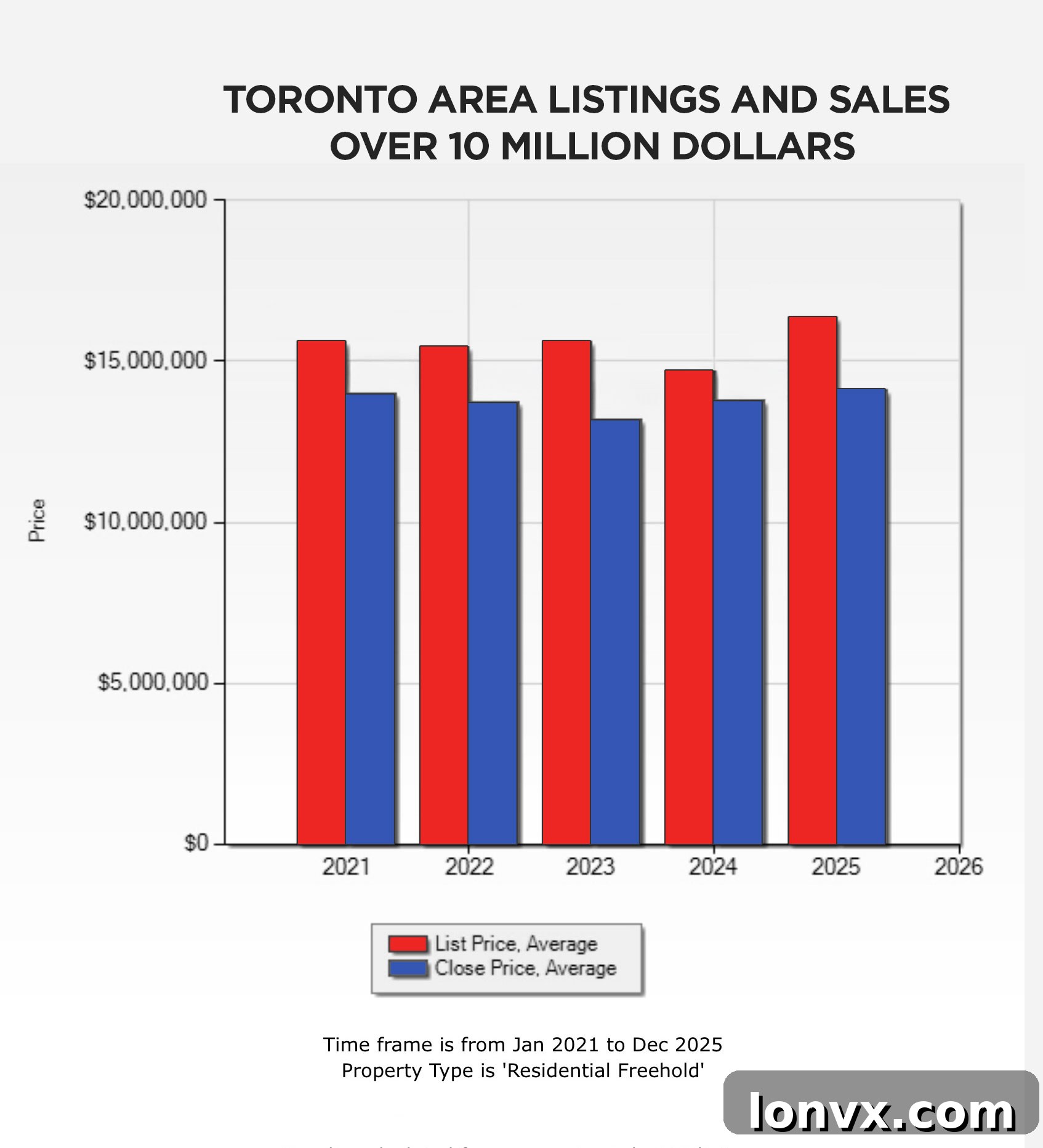
The U.S. economy serves as a compelling poster child for the K-shaped recovery, particularly in consumer buying behavior. While holiday spending in 2025 appeared to be up, this increase wasn’t due to a surge in buyer volume, but rather to the significantly higher dollar value of individual goods purchased. With estimated holiday spending exceeding $1 trillion in an otherwise uncertain economic climate, the underlying reason points to the uber-wealthy making expensive purchases, thereby inflating overall spending figures and driving GDP. Critically, this spending isn’t reflective of broad-based consumer confidence; it’s concentrated among the top one percent. This pattern is mirrored in the Greater Toronto Area’s (GTA) real estate market: while overall sale prices are down, the narrative changes dramatically in the $10-million-plus luxury segment. As the graph below illustrates, the upper end of the market has demonstrated remarkable resilience, with average prices surpassing 2021 levels and showing increases of 2.5 percent and 7 percent above 2024 and 2023, respectively. These nuances underscore a vital point for professionals: average price statistics can often taint and distort the true picture of a market, misleading both consumers and practitioners. It is incumbent upon us, as real estate professionals, to cut through the noise, delve into granular data, and provide credible, sound market insights that reflect these intricate realities.
From Reflection (Year of the Snake) to Action (Year of the Horse): Strategic Shifts for Real Estate Success
With the Lunar New Year falling on February 17, 2026, it’s an opportune moment for reflection and recalibration. I’ve always been captivated by the ancient origins of Chinese astrology, a complex system developed over millennia that intricately links time, politics, and the destinies of individuals. It serves as a profound framework through which we can adjust our mindset as we embark on a new year. The fact that the Lunar New Year typically occurs several weeks after January 1st – the Gregorian calendar’s starting point, which tracks Earth’s orbit – while the lunar calendar follows the moon’s phases, inherently grants us additional time for introspection. This extended period is a welcome reprieve from the immediate post-holiday glut, allowing for more realistic career and personal resolutions, rather than solely focusing on diet and exercise. It provides a valuable month to assess how the year is truly unfolding, often with the clarity of holiday credit card statements in hand, enabling us to set achievable and impactful goals.
The Lunar Zodiac is comprised of 12-year animal cycles, with each animal’s unique attributes offering guidance for the year ahead. Last year, 2025, was the Year of the Snake, an animal associated with profound intuition, meticulous analytical thinking, strategic foresight, and calm, observant contemplation. This period encouraged a reflective approach, urging us to analyze market conditions with a keen eye and plan meticulously. The critical question now is: are you prepared to shed the skin of past failures and inertia, translating those analytical insights into a robust, working plan for the forthcoming Year of the Horse?
The Horse, which governs 2026, is an emblem of pure action, intense drive, and unwavering courage to implement significant change. This is not a year for passive observation or wishful waiting; it is a time to roll up your sleeves, embrace industry, and infuse every aspect of your business with vigor and initiative. For real estate agents, this means moving beyond the “Realtor Creed” and actively shaping their destiny. The agent who merely waits for business to magically appear in 2026 will undoubtedly encounter frustration, stagnation, and defeat. Instead, the Year of the Horse demands proactive lead generation, innovative marketing strategies, deeper market analysis to truly add value, and a relentless commitment to serving clients with informed, strategic guidance. It’s about harnessing the energy of the Horse to gallop ahead, rather than being left behind.
Seizing the Moment: The Final Weeks for Quiet Reflection and Strategic Planning
While you may not have consciously identified 2025 as the Year of the Snake, rest assured, our buyers and sellers implicitly did. Many adopted its attributes, sitting in silent reflection on the sidelines. They meticulously analyzed a continuous stream of doom-and-gloom information, anxiously awaited every interest-rate announcement, and observed politicians grapple with trade deals under the full, emotional glare of public scrutiny. This period of deep consumer introspection should serve as a powerful lesson for us, real estate professionals. When will we truly align with our consumers’ needs by providing them with far deeper, more sophisticated analysis – whether it’s pricing homes accurately and strategically for sellers, or conversely, empowering buyers to make better, more informed, and confident decisions?
We now have just five crucial weeks until the Lunar New Year to solidify our career resolutions and strategic plans for 2026. This is the ultimate crossroads for real estate agents. Will you be the Realtor who embodies the spirit of the Horse, injecting real horsepower and proactive energy into every facet of your business? Or will you remain the agent who passively sits at home, praying the “Realtor Creed,” forever awaiting the elusive “next big wave” that may never materialize as hoped? The Year of the Horse calls for courage, action, and strategic intent. The choice, and your business’s future, is entirely yours.