Navigating Canada’s Shifting Real Estate Landscape: A Comprehensive Look at Price Trends
Canada’s real estate market has long been a subject of intense discussion and analysis, characterized by periods of rapid growth and, more recently, notable adjustments. In June 2023, the national benchmark price for homes reached a significant peak of $760,600, a figure that marked a high point for the year. However, this peak was followed by a consistent downturn over the subsequent five months, signaling a shift in market dynamics across the country. Major urban centers, including the bustling markets of Vancouver and Toronto, the nation’s capital Ottawa, and the prairie hub of Winnipeg, largely mirrored this national trend, experiencing a cooling period.
Understanding the factors contributing to this market evolution is crucial for both prospective buyers and current homeowners. While the inherent seasonality of the real estate market undoubtedly plays a role – with sales typically slowing during the colder winter months – a more dominant force has been the sustained period of elevated borrowing costs. The Bank of Canada’s aggressive interest rate hikes aimed at taming inflation have significantly impacted mortgage affordability, making homeownership more challenging for many. In this evolving landscape, a silver lining has emerged for some: a market where home prices are beginning to align more closely with budget realities, potentially offering a window of opportunity for previously sidelined buyers.
To gain a deeper understanding of these localized shifts, Zoocasa meticulously analyzed benchmark price data across 21 major Canadian markets. Their comprehensive findings shed light on which cities have experienced the most significant price adjustments since the summer months, providing valuable insights into the varied health of regional housing markets.
Ontario’s Affordability Resurgence: A Closer Look at Price Declines
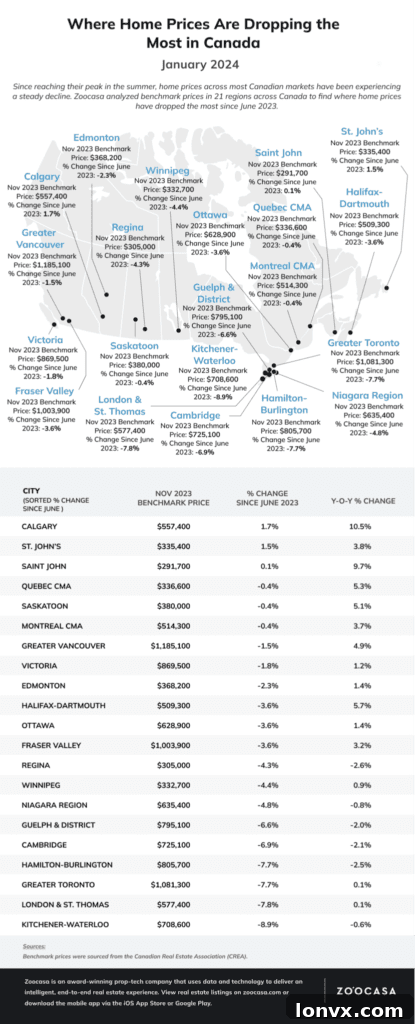
The study revealed that within a mere five-month span, the majority of Canadian markets observed a benchmark price drop exceeding three percent. Notably, some areas even saw prices dip below those recorded in the previous year, indicating a more pronounced correction. This trend was particularly evident and impactful within Ontario, Canada’s most populous province and home to some of its most active real estate markets. A decrease in buyer demand across several Ontario markets contributed to a stabilization of prices, bringing them closer to pre-pandemic figures, a significant development after years of rapid appreciation.
The most substantial hit to affordability, or rather, the most significant gain in affordability for buyers, was felt in Kitchener-Waterloo. This vibrant technological hub experienced an impressive 8.9 percent decline in its benchmark price since June 2023, settling at $708,600. Furthermore, its price point was down by 0.6 percent compared to the previous year, highlighting a consistent downward pressure. This significant adjustment reflects a recalibration in a market that had previously seen explosive growth.
Kitchener-Waterloo was not an isolated case. Other prominent Ontario cities also registered substantial price decreases. The Greater Toronto Area (GTA), a bellwether for the national market, along with London & St. Thomas, and Hamilton-Burlington, all saw their benchmark prices fall by over seven percent since June. These reductions offer a notable reprieve for potential buyers in some of Canada’s priciest regions. Guelph & District’s market also experienced a considerable drop, with its benchmark price declining by more than 6.5 percent since June. For the first time since January 2023, Guelph’s November benchmark price fell below the $800,000 mark, indicating a significant softening in what was previously a fiercely competitive market. These Ontario trends collectively paint a picture of a market actively adjusting to higher interest rates and a more cautious buyer sentiment, ushering in a period of increased accessibility for many.
Resilience Amidst Retreat: Markets That Defied the Downward Trend
While much of the country experienced a downward trajectory in home prices, a select few markets demonstrated remarkable resilience, managing to see price increases even amidst the broader national cooling. Only three markets bucked the trend since June 2023: Calgary, Alberta; St. John’s, Newfoundland and Labrador; and Saint John, New Brunswick. These cities offer compelling case studies in localized market strength, driven by unique economic factors and demographic shifts.
Calgary, in particular, stood out, with its home prices appreciating more than any other market assessed in the Zoocasa study. The city recorded a robust 10.5 percent increase in its benchmark price since November 2022. This upward momentum reflects Calgary’s buoyant economy, bolstered by a strong energy sector and significant interprovincial migration from more expensive Canadian cities. Despite this impressive growth, Calgary’s November 2023 benchmark price of $557,400 still positions it as a relatively affordable major metropolitan area compared to Vancouver or Toronto, making it an attractive destination for those seeking value and opportunity.
On the East Coast, St. John’s and Saint John also showcased positive growth. These markets, traditionally offering more accessible price points, have benefited from renewed interest and, in some cases, an influx of buyers seeking a lower cost of living and a different lifestyle. Their continued price appreciation underscores the diverse nature of Canada’s real estate landscape, where regional economic health and affordability dynamics can diverge significantly from national averages.
Dissecting Property Types: Single-Family Homes Versus Condominiums
The real estate market’s response to changing economic conditions is rarely uniform across all property types. The Zoocasa analysis meticulously differentiated between single-family homes and condominiums, revealing distinct trends that offer crucial insights for buyers and sellers alike.
Single-Family Home Market Adjustments
The steepest declines in benchmark prices for single-family homes were predominantly observed in seven Ontario cities, mirroring the broader provincial trend towards increased affordability. Once again, Kitchener-Waterloo led this category, experiencing the most substantial decline. Its single-family home benchmark price fell by a significant 9.7 percent since June 2023, settling at $802,900. This substantial correction indicates a return to more sustainable pricing after a period of intense competition. Similarly, Hamilton-Burlington saw an 8.5 percent price drop since June, bringing its November benchmark price down to $864,200. These figures highlight how elevated interest rates disproportionately affect the demand for larger, more expensive properties, leading to sharper price corrections in these segments.
Beyond Ontario, other regions also saw adjustments in the single-family home market. Regina, Saskatchewan, recorded the largest year-over-year price drop for single-family homes at 3.2 percent. Since June, prices in Regina declined by 4.3 percent, resulting in a benchmark price of $321,400. This makes Regina one of the most affordable provincial capitals for single-family homes, potentially attracting buyers seeking significant value. Halifax-Dartmouth in Nova Scotia and Winnipeg in Manitoba also experienced notable decreases in single-family home prices, both falling by over 4.5 percent since June. With both cities’ benchmark prices now sitting below $520,000, these markets offer compelling opportunities for homebuyers looking for relatively accessible ownership costs compared to Canada’s most expensive urban centers. These regional variations underscore the importance of understanding local economic conditions and supply-demand dynamics when evaluating real estate prospects.
The Resilient Condominium Market
In contrast to the more pronounced declines seen in single-family homes, more affordable property types, particularly condominiums, demonstrated remarkable resilience throughout the past year. This sustained demand for condos can largely be attributed to the persistently high borrowing costs. As mortgage payments on larger homes became prohibitive for many, prospective buyers, especially first-time purchasers and those on tighter budgets, turned to condominiums as a more accessible entry point into homeownership. This increased demand helped to buffer condo prices against the sharper drops observed in other property segments.
However, even within the resilient condominium market, some notable adjustments occurred. The Ontario markets of Kitchener-Waterloo, Greater Toronto, and London & St. Thomas saw condominium prices drop by more than four percent since June. These declines, while less steep than those for single-family homes in the same regions, indicate that even the condominium segment is not entirely immune to broader market forces and the impact of higher interest rates in densely populated urban areas.
Conversely, condominium prices experienced growth in nine cities across the country, further illustrating the segmented nature of the market. The strongest increases were recorded in Saint John, New Brunswick, and St. John’s, Newfoundland and Labrador, which saw impressive respective increases of 12.9 percent and 7.4 percent since June. This robust growth in East Coast condominium markets suggests a surge in demand, possibly fueled by interprovincial migration, relative affordability, and a growing desire for urban living spaces in these regions. The varied performance of single-family homes and condominiums across Canada highlights the nuanced interplay of affordability, interest rates, and localized demand, influencing buyer choices and investment strategies.
Broader Implications and Future Outlook for the Canadian Real Estate Market
The detailed analysis of Canada’s real estate market from June to November 2023 reveals a complex landscape characterized by significant regional disparities and a clear response to evolving economic conditions. The national benchmark price downturn, particularly prominent in key Ontario markets, signals a move towards increased affordability, a welcome change for many prospective buyers who were previously priced out. This correction is a direct consequence of higher borrowing costs, which have recalibrated buyer expectations and reduced purchasing power.
For first-time homebuyers, these price adjustments, particularly in the single-family home segment and specific condo markets, could represent a crucial opportunity. A market with softening prices and less fierce competition allows for more careful consideration, potentially leading to more favorable purchasing terms. However, the hurdle of high interest rates remains, meaning while prices might be lower, the overall cost of homeownership through mortgage payments could still be substantial. Buyers should carefully evaluate their financial readiness and consider the long-term implications of current interest rate environments.
Conversely, sellers in declining markets face a more challenging environment. Understanding local market trends and setting realistic expectations for pricing and selling timelines is paramount. In contrast, sellers in resilient markets like Calgary, St. John’s, and Saint John continue to benefit from robust demand and appreciating values, showcasing the importance of regional economic drivers and interprovincial migration patterns.
Looking ahead to 2024, the Canadian real estate market is anticipated to remain dynamic. Predictions for potential interest rate cuts by the Bank of Canada could inject renewed optimism and affordability into the market, potentially stimulating demand later in the year. However, persistent housing supply issues in many major urban centers, coupled with strong population growth through immigration, will likely continue to exert upward pressure on prices in the medium to long term. Therefore, while recent adjustments offer a glimpse of hope for buyers, the underlying structural challenges of supply and demand are likely to persist.
Ultimately, the Canadian housing market is a mosaic of diverse local conditions. While national averages provide a general overview, a granular understanding of specific cities and property types is essential. Potential buyers and sellers are encouraged to consult with local real estate professionals and financial advisors to navigate these complexities and make informed decisions tailored to their individual circumstances. Staying updated on economic indicators, interest rate forecasts, and regional market reports will be key to successfully engaging with Canada’s ever-evolving real estate landscape.
For more granular details and data, refer to the full Zoocasa report.