
Toronto Real Estate Market: Early Signs of Renewed Competition Emerge Amidst Volatility
The Greater Toronto Area (GTA) real estate market has been a fascinating and often unpredictable landscape for both buyers and sellers in recent years. Marked by significant economic shifts and evolving consumer confidence, the region has experienced pronounced volatility in both median home prices and overall sales volumes. Following a period of notable cooling and correction, which saw substantial year-over-year declines, the latest market intelligence now points towards a subtle yet crucial turning point. Fresh data suggests the nascent signs of an uptick in buyer demand and a resurgence of competition, signaling a potential new phase for the GTA’s dynamic housing sector.
February’s market performance underscored the ongoing adjustments, with the average home selling for 17.9 percent less than in the corresponding period of the previous year. This significant price reduction was accompanied by a sharp contraction in sales volume, which decreased by 47 percent year-over-year. These headline figures highlight a market that has been recalibrating after a period of unprecedented growth. However, a deeper dive into market specifics, provided by Wahi, a leading digital real estate platform, reveals a more nuanced narrative. Their comprehensive analysis indicates the early but clear emergence of heightened demand and a competitive spirit re-entering certain segments of the market.
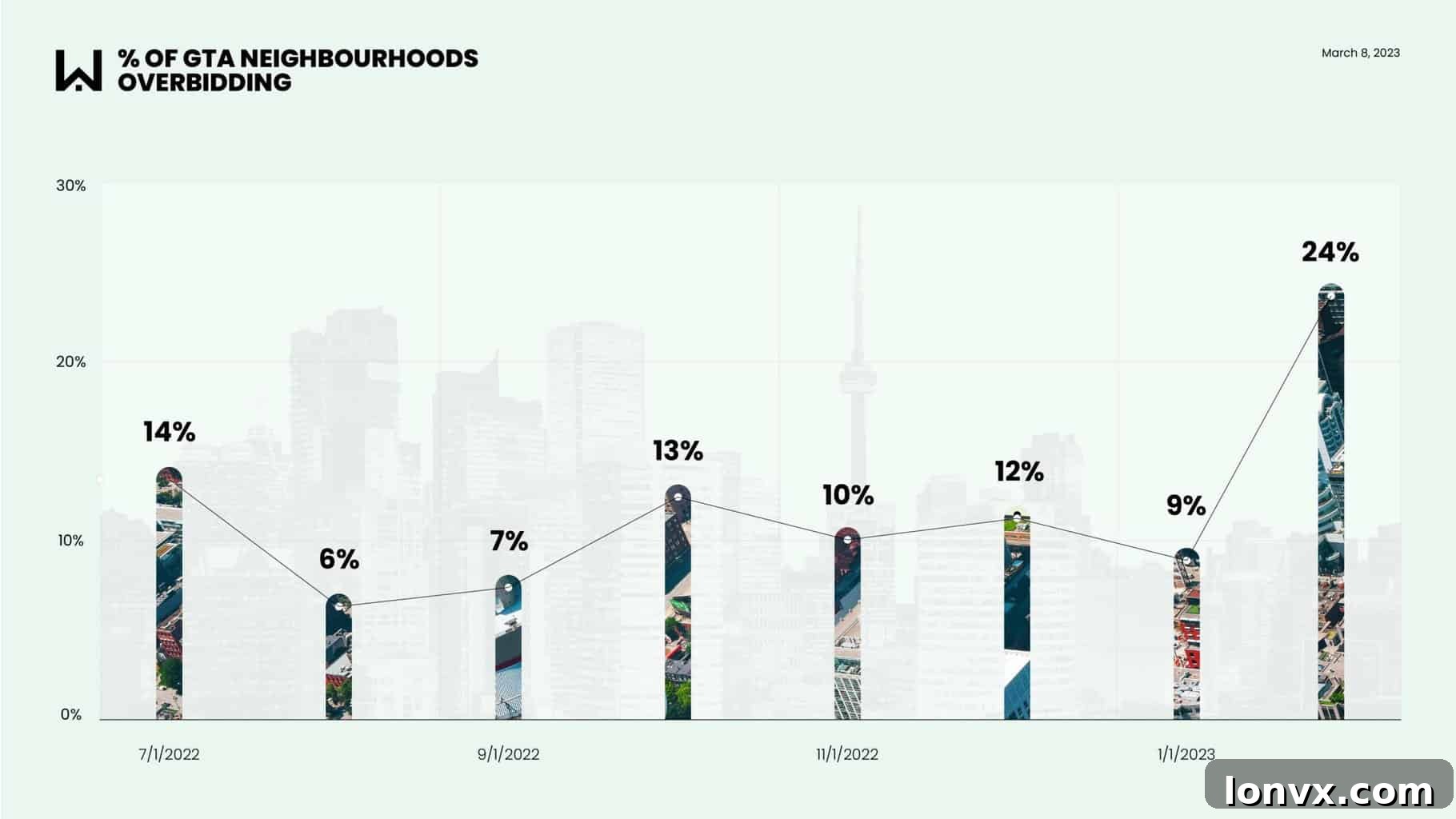
Perhaps the most compelling evidence of this burgeoning shift is the dramatic increase in what Wahi terms “overbidding territories.” These are specific neighbourhoods within the GTA where the median sale price consistently exceeds the median list price. Wahi’s research reveals that the number of such competitive neighbourhoods tripled between January and February. This rapid expansion of areas experiencing bids above the initial asking price is a powerful indicator of a psychological and practical shift in buyer behavior and overall market dynamics, suggesting a gradual departure from a predominantly buyer-centric environment in certain desirable locations.
Decoding Overbidding Territory: A Key Indicator of Market Momentum
To truly grasp the evolving dynamics of the GTA real estate market, it is essential to understand the concept of “overbidding territory” as defined by Wahi. A neighbourhood is classified as being in overbidding territory when its median sale price—the midpoint of all sales prices in that area—is higher than its median list price—the midpoint of all initial asking prices. This metric serves as a robust barometer for gauging the intensity of buyer demand and the level of competition within a particular community. It signifies a market where properties are not only attracting interest but are consistently securing offers at or above their initial asking price, often escalating into competitive bidding wars among multiple prospective buyers.
Conversely, “underbidding territory” describes a market where the median sale price falls below the median list price. This scenario typically indicates less intense demand, giving buyers more negotiation leverage and a greater likelihood of acquiring properties below the original asking price. Wahi’s analytical methodology is designed to provide clear, actionable insights into these distinctions.
For February, Wahi’s rigorous analysis extended across nearly 400 distinct neighbourhoods within the Greater Toronto Area. The findings were quite striking: roughly one-quarter, specifically 24 percent, of these neighbourhoods were officially categorized as being in overbidding territory. This represents a dramatic increase from just 9.0 percent in January, unequivocally demonstrating the swift change in market sentiment. To place this into historical context, the previous peak for overbidding activity in recent times was recorded at 14 percent in July 2022. February’s 24 percent thus stands as a significant milestone, marking a new high in the re-emergence of buyer competition.
Geographic Hotbeds of Competition: Where Demand is Intensifying
The granular data from Wahi distinctly highlights York Region as a primary hub for this renewed overbidding activity. Several communities within this region are leading the charge, showcasing particularly robust buyer competition and commanding significant premiums over asking prices. Rouge Woods in Richmond Hill, for example, stood out as a prime example, recording a remarkable median sale price that was 26 percent higher than its median asking price. This substantial premium underscores exceptionally strong localized demand and fierce competition among buyers eager to secure properties in this desirable area.
Following closely in competitiveness was Berczy Village in Markham, where the median sale price exceeded the median listing price by 22 percent, confirming it as another highly contested market. Rural Richmond Hill also demonstrated significant overbidding, with homes selling for an average of 20 percent above their median list price. Further illustrating the highly localized nature of this intensity, Wismer in Markham narrowly surpassed Westbrook in Richmond Hill. Wismer saw its median overbid amount represent a 15 percent increase from the median list price, while Westbrook registered a still significant 14 percent difference. These specific examples from York Region communities emphatically demonstrate that while the broader GTA market presents a complex picture, certain localized pockets are experiencing an undeniable resurgence of intense buyer pressure.
It is crucial to acknowledge Wahi’s rigorous and transparent methodology for these market classifications. To ensure the statistical reliability and to filter out any potential anomalies or outlier transactions, Wahi deliberately excludes neighbourhoods where fewer than five homes were transacted within a given month. By adhering to these stringent standards, their analysis confidently identified 64 overbidding neighbourhoods in February, a dramatic increase from just 20 such neighbourhoods in January. This tripling in number within a single month signifies a genuine, widespread, and noteworthy shift in competitive dynamics across a significant portion of the Greater Toronto Area.
Unpacking the Factors Driving Renewed Overbidding
The observed resurgence of overbidding in the GTA is rarely attributable to a single cause. Instead, it typically emerges from a complex interplay of various market forces, economic conditions, and strategic behaviors by both sellers and their agents. Eman Nejad, the Head of Data Science at Wahi, provides invaluable insight into the primary drivers behind this latest market behavior. According to Nejad, a critical contributing factor is the persistent and increasingly low inventory levels available on the market. When the supply of homes struggles to keep pace with a growing pool of eager buyers, a fundamental imbalance is created, inevitably leading to intensified competition and competitive bidding.
Low inventory creates a palpable sense of scarcity among buyers, compelling them to act swiftly and decisively to secure a property they desire. In such an environment, offering above the asking price becomes a common strategy to outmaneuver competitors. This dynamic can be further amplified by the strategic pricing approaches employed by seasoned real estate agents. Agents might intentionally price a property slightly below its perceived market value, a tactic designed to generate widespread interest, attract a larger pool of potential buyers, and, crucially, ignite a bidding war. This calculated strategy aims to drive the final sale price significantly higher than the initial list price, ultimately maximizing returns for the seller.
Another fascinating and consistent insight from Wahi’s analysis is the strong correlation between specific price points and the prevalence of overbidding activity. Generally, overbidding markets were observed predominantly in properties priced below or around the $1 million mark. This suggests that the more affordable or mid-range segments of the market are currently experiencing the most heightened competition, as buyers fiercely vie for entry-level homes or properties within more accessible price brackets. Conversely, underbidding markets tended to be concentrated among more expensive properties, with median prices often extending well into the multi-million-dollar range. This indicates a clear bifurcation in the market, where the luxury segments may still offer buyers considerably more negotiation leverage and a greater chance to secure a property below asking.
Price Point Disparities: A Tale of Two Distinct Markets
To further illustrate this significant distinction within the GTA market, consider the median sales prices recorded in the top five overbidding neighbourhoods identified by Wahi. These ranged from approximately $1,209,000 in Berczy Village to $1,500,944 in Rouge Woods. While these figures represent substantial investments, they generally fall within the mid-to-upper range of the broader GTA market. In stark contrast, an examination of the top five underbidding neighbourhoods revealed significantly higher price points. For instance, prices in these areas ranged from $1,350,000 in Toronto’s exclusive Wychwood Park—a historically affluent community—to a staggering $3,362,500 in Oakville’s prestigious Eastlake neighborhood. This clear separation underscores that market conditions are highly granular and heavily dependent not only on geographical location but also on the specific value segment of the property in question.
Underbidding Remains Prevalent in the Broader GTA Landscape
Despite the recent and notable expansion of overbidding territories and the intensified competition observed in specific, desirable segments, it is crucial for both buyers and sellers to maintain a balanced perspective on the overall Greater Toronto Area real estate landscape. While certain hot pockets are undeniably experiencing a resurgence of bidding wars, the vast majority of the market continues to operate within “underbidding territory.” This fundamental reality implies that many buyers across the expansive region are still finding viable opportunities to negotiate and secure properties at prices below their initial listing. The current market, while evolving, is far from a widespread return to the frenetic, “anything goes” pace witnessed during the peak of 2021-2022.
Wahi’s comprehensive data solidifies this overarching trend: only three percent of all GTA neighbourhoods recorded homes selling exactly at their asking price in the last month. This exceedingly narrow band indicates perfect alignment between buyer and seller price expectations, which is a rare occurrence. The overwhelming majority, a substantial 73 percent, remained firmly in underbidding territory. For prospective buyers, particularly those exploring higher price brackets or considering homes in less intensely competitive areas, this data suggests that careful negotiation, thorough due diligence, and strategic offers can still yield significantly favorable outcomes. It implies that while the market is undoubtedly undergoing a transition, it has not yet swung back entirely into an all-encompassing sellers’ paradise across every segment.
Savvy buyers can still identify and capitalize on opportunities to secure relatively good deals, emphasizing the critical importance of detailed market analysis and localized expertise when navigating the diverse and multifaceted GTA real estate environment. This complex blend of conditions reinforces that a one-size-fits-all approach to buying or selling in the GTA is unlikely to be effective; instead, a highly tailored strategy based on specific neighbourhood dynamics and price points is paramount.
Navigating the Evolving GTA Real Estate Market
The latest in-depth data from Wahi paints a nuanced and intricate picture of the Greater Toronto Area real estate market. It’s unequivocally a market in an active state of transition, gradually moving beyond the significant corrections and adjustments of the past year but not yet fully returning to its previous peak performance levels. The simultaneous existence of expanding overbidding territories alongside the continued prevalence of underbidding underscores the profound complexity and the highly localized nature of current market dynamics. For prospective buyers, this translates into a dual reality: while ample opportunities to negotiate below asking price still exist, particularly in higher price segments and less intensely competitive locales, certain desirable neighbourhoods—especially those with robust demand for mid-range homes and persistently limited inventory—are now experiencing fierce and escalating competition. A granular understanding of these micro-market dynamics is absolutely paramount for success.
Sellers, conversely, might find renewed confidence and optimism in the market, particularly if their property aligns with the characteristics typically found in overbidding areas. For such properties, a strategic pricing approach combined with effective marketing efforts—potentially designed to attract and generate multiple offers—could prove highly beneficial in maximizing their return. However, for properties situated in areas predominantly categorized as underbidding territories, a realistic pricing strategy from the outset and a demonstrated willingness to negotiate with prospective buyers remain absolutely essential to facilitate a successful sale.
The overarching trend suggests a market actively seeking a new equilibrium. Several critical macro-economic factors will undoubtedly continue to shape the GTA real estate landscape, including the future trajectory of interest rates, the sustained impact of population growth driven by immigration, and the persistent, underlying challenge of housing supply. As these early signs of increased demand and buyer competition become more pronounced and widespread in specific market segments, it will become even more crucial for both buyers and sellers to remain exceptionally well-informed, agile in their decision-making, and to consult proactively with experienced and knowledgeable real estate professionals. The GTA market, renowned for its blend of volatility and inherent resilience, continues to offer both considerable challenges and compelling opportunities, demanding a precise and sophisticated understanding of its ever-shifting tides and nuanced complexities.