
Navigating the Canadian Housing Market: CREA’s Mixed Forecast for 2024 & 2025
The Canadian Real Estate Association (CREA) recently unveiled its quarterly forecast, presenting a complex yet cautiously optimistic outlook for the national housing market. While expectations lean towards a modest recovery in national home sales and a continued downward trend in interest rates, underlying affordability challenges remain a significant factor for prospective homeowners across the country.
This nuanced perspective suggests that while the market is indeed showing signs of improvement, it’s far from a full-blown boom. Buyers and sellers alike are advised to approach the coming months with informed caution, understanding that the path to a robust recovery is paved with incremental gains rather than sudden surges.
The Current State of the Canadian Real Estate Market: A Glimmer of Recovery
Despite persistent affordability hurdles, a sense of cautious optimism is beginning to permeate the Canadian real estate industry. Recent interest rate adjustments by the Bank of Canada have injected a much-needed breath of fresh air into sales activity, signaling the potential for a gradual market revival.
Modest Gains in Home Sales: A Closer Look at 2024
CREA’s forecast highlights a steady, albeit gentle, increase in national home sales, primarily attributed to recent cuts in the Bank of Canada’s benchmark interest rate. A projected 5.2 percent rise in sales for 2024 is being touted as a clear indication of a recovering market. However, this recovery is not uniform. While some regions are experiencing noticeable upticks in activity, others continue to lag, reflecting the diverse economic and demographic landscapes across Canada.
Furthermore, while price increases are present, they are best described as subdued. This indicates a market that is finding its footing rather than engaging in a rapid ascent. The enthusiasm from falling rates is tempered by ongoing economic pressures and consumer sentiment, leading to a recovery that is more marathon than sprint.
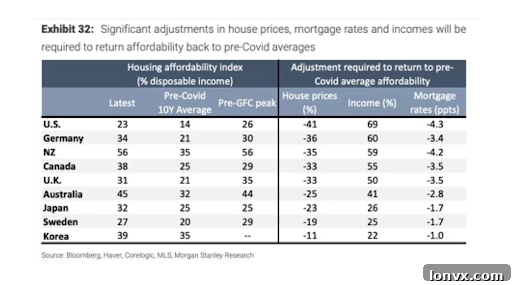
Source: Bloomberg
The Lingering Shadow of Affordability Challenges
Even with positive movements in sales and the prospect of lower borrowing costs, the issue of housing affordability continues to cast a long shadow over the Canadian market. Bloomberg data suggests a stark reality: interest rates would need to fall an astonishing 350 basis points (bps) from current levels to restore the affordability seen before the COVID-19 pandemic. This significant gap underscores the deep-rooted nature of the affordability crisis, driven by a combination of high property values, stagnant wage growth relative to housing costs, and elevated interest rates over the past few years.
For many Canadians, particularly first-time homebuyers, the dream of homeownership remains a formidable challenge. While rate cuts offer some relief, they are unlikely to single-handedly close the substantial affordability gap in the short to medium term. Policy interventions, alongside market adjustments, will be crucial in addressing this persistent national concern.
Unpacking the Impact of Interest Rate Adjustments
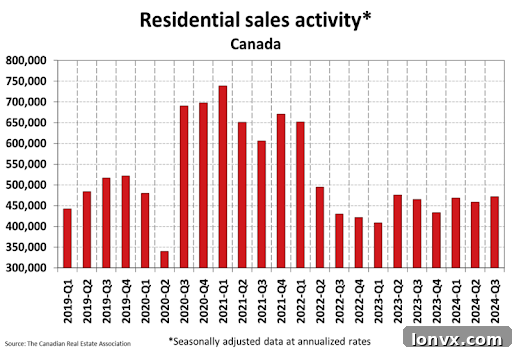
The Bank of Canada’s recent series of interest rate cuts in 2024 has undoubtedly been a focal point for the real estate sector. While these adjustments are generally seen as a positive catalyst, their immediate impact on the market has been more gradual than some might have anticipated, highlighting the complex interplay of economic factors and psychological influences.
Slow Burn: Why Rate Cuts Aren’t Instantly Igniting the Market
Following three interest rate cuts in 2024, national home sales recorded over Canadian MLS® Systems did show a 1.9 percent increase in September compared to August. This marked the highest level of sales activity since July 2023, offering a tangible sign of market response. Each subsequent rate cut has been met with a slight bump in sales, yet consumer sentiment has remained relatively subdued. This suggests that while buyers are reacting to lower borrowing costs, a widespread surge in confidence has yet to materialize.
Shaun Cathcart, CREA’s Senior Economist, has voiced concerns that prospective buyers might be adopting a “wait and see” approach, anticipating further rate reductions in the upcoming year. This cautious behavior could lead to a temporary stalling of market activity before the anticipated rebound in 2025. The delay in the full impact of rate cuts is a critical factor, as buyers may strategically hold off on purchases, believing that even more favorable financing conditions are on the horizon. This dynamic can prolong the market’s recovery phase, making it less immediate and more drawn-out than purely economic models might suggest.
Expert Projections: Shifting Forecasts and CMHC’s Influence
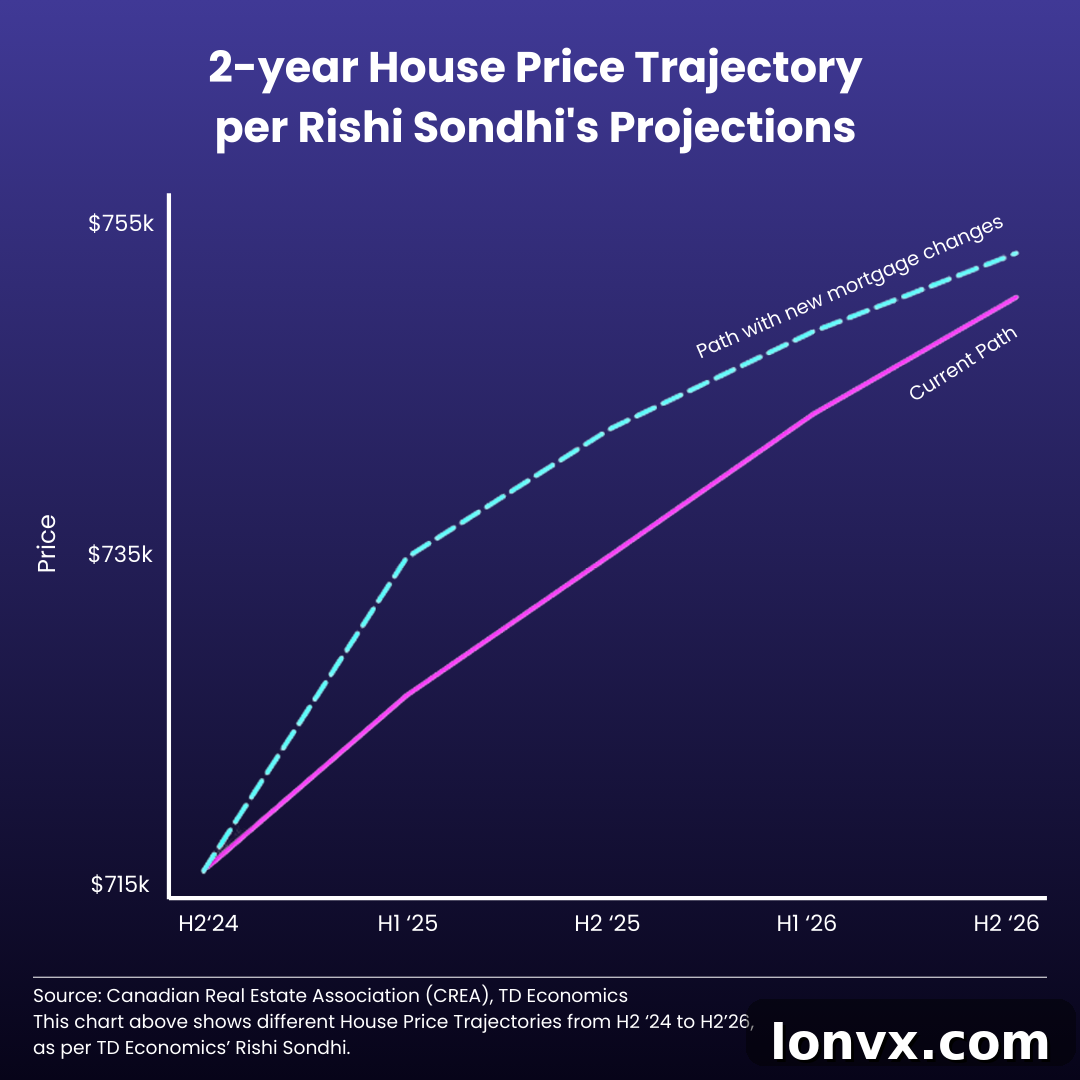
While the market navigates these complexities, some experts propose alternative scenarios. TD Bank, for instance, recently projected that recent changes to CMHC (Canada Mortgage and Housing Corporation) insurance rules could front-load any significant house price increases into the first half of 2025. This means that a substantial portion of the expected price growth might occur earlier than initially forecast, potentially leading to slower growth towards the end of next year. The increased CMHC limit, now up to $1.5 million, makes high-value homes eligible for insured mortgages, potentially broadening the pool of buyers for these properties and impacting price dynamics.
Such shifts in expert projections underscore the inherent unpredictability of the real estate market, even amidst positive policy changes. These varying outlooks highlight the need for continuous monitoring and adaptive strategies for both buyers and sellers, as external factors and policy adjustments can significantly alter market trajectories.
Price Trends and Inventory Dynamics
Understanding the interplay between housing prices and inventory levels is crucial for gauging the health and direction of the Canadian real estate market. Recent data reveals intriguing trends that suggest a market in transition, moving from volatility towards a more balanced state.
Understanding Year-over-Year Price Movements vs. Monthly Stabilization
September witnessed a encouraging 6.9 percent increase in home sales compared to the same period last year. This surge is less about a sudden market explosion and more about a welcome stabilization following the roller coaster ride of elevated interest rates and economic turbulence experienced over the past two years. The market is finding a new equilibrium, demonstrating resilience despite lingering challenges.
However, this positive sales growth occurs against a backdrop where the national average home price saw only a modest year-over-year increase of 0.9 percent, settling at approximately $683,200. Crucially, prices were still down 3.3 percent year-over-year in September, indicating that while sales volume is improving, robust price growth across the board has yet to materialize. This suggests that the initial hope among sellers that rate cuts would automatically lead to higher prices or faster sales has not fully materialized. Month-to-month figures, however, do show an upward trend, indicating a gradual recovery is underway, but it requires patience.
The Return of Sellers: Rising Listings and Buyer Opportunity
A significant development in September was the notable 4.9 percent increase in newly listed properties month-over-month. This signals a renewed confidence among sellers, who are now more willing to test the market waters. This marks a positive shift from earlier in the year, when many sellers adopted a “wait and see” approach, holding back inventory in anticipation of more favorable conditions. The influx of new listings is a welcome change for buyers, who have often faced limited choices and intense competition in recent years.
While an increase in supply is generally beneficial for buyers, leading to more options and potentially greater negotiating leverage, it has not yet translated into a dramatic surge in sales. Sales are climbing at a slower rate than new listings, which could eventually tip the scales in favor of buyers, moving the market out of its currently “balanced” territory. In a balanced market, neither buyers nor sellers hold significant control, making transactions more equitable. However, if listing volumes continue to rise disproportionately to sales, a definitive shift towards a buyer’s market could occur.
Months of Inventory and Sales-to-New Listings Ratio: Key Market Indicators
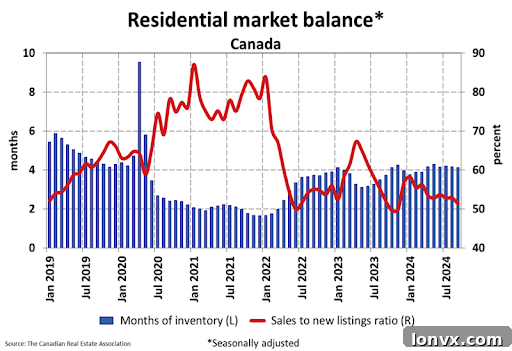
Further analysis of market dynamics reveals that months of inventory has stabilized just above four months, a level often associated with a balanced market. However, the sales-to-new listings ratio continues to slow down, dropping to 51.3 percent in September from 52.8 percent in August. This metric is crucial because it indicates the proportion of new listings that are absorbed by sales within a given period. A declining ratio suggests that buyers are not purchasing new listings as quickly as they are coming onto the market.
This trend is a strong indicator of an evolving market. While a ratio around 50-60 percent typically signifies a balanced market, a sustained decline, especially with increasing inventory, points towards a potential shift where supply begins to outpace demand. This scenario often precedes a buyer’s market, where properties stay on the market longer, and price growth moderates or even declines.
Looking Ahead: CREA’s 2025 Outlook and Market Dynamics
While 2024 is shaping up to be a year of cautious recovery, CREA’s forecast suggests that 2025 could be the year the Canadian real estate market truly regains its momentum. However, as with any long-term projection, several variables could influence this anticipated rebound.
The Road to Recovery: Projections for Sales and Prices in 2025
CREA projects a significant climb in home sales for 2025, forecasting a 6.6 percent increase, with an estimated 499,800 units expected to change hands. This optimistic outlook is heavily predicated on the expectation of additional interest rate cuts and a more favorable overall economic environment. Lower borrowing costs would undoubtedly stimulate demand, making homeownership more accessible and spurring investment in real estate.
Coupled with rising sales, national average home prices are projected to increase by another 4.4 percent in 2025, potentially crossing the $700,000 mark to reach approximately $713,375. This anticipated growth would be supported by strengthening market fundamentals, including a healthy demand-to-supply ratio and sustained buyer confidence. Moreover, the aforementioned changes to Canadian mortgage rules, such as the increased CMHC limit, could further support this price growth by expanding the purchasing power of eligible buyers.
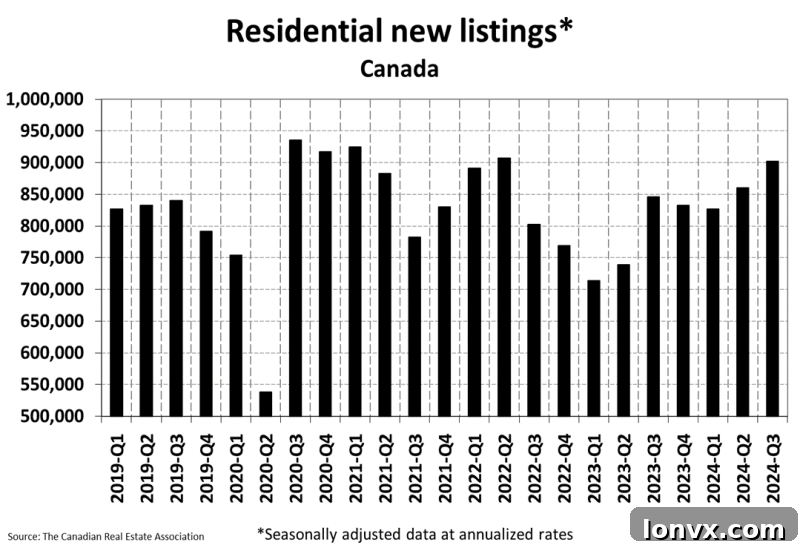
As of September, there were 185,427 properties listed for sale on MLS® Systems nationwide, marking a 16.8 percent increase from the previous year. While this is a substantial rise, it’s important to note that this figure remains below the historical average of around 200,000 listings. This suggests that while inventory is improving, it hasn’t yet reached levels that would significantly imbalance the market in favor of buyers. However, if the trend of new listings outpacing sales continues, the power dynamic could soon shift, giving buyers greater influence.
Variables at Play: Beyond Interest Rates
While the narrative for 2025 paints a picture of robust recovery – characterized by surging demand, balanced inventory levels, and steadily rising prices – the reality is often more complex. Numerous variables can impact this trajectory. Global economic conditions, unforeseen geopolitical events, persistent inflationary pressures, or even shifts in government policy could introduce new challenges or opportunities. Furthermore, the pace of wage growth relative to housing costs will continue to play a critical role in determining genuine affordability and sustainable market growth. Buyer and seller psychology, influenced by media narratives and economic uncertainty, will also contribute to how smoothly (or not) the market progresses.
Therefore, while the outlook for 2025 is broadly positive, stakeholders in the Canadian real estate market should remain vigilant and adaptable. The path to full recovery is rarely linear, and an understanding of both the opportunities and potential pitfalls will be essential for making informed decisions.
Conclusion: A Measured Approach to Canada’s Evolving Housing Market
CREA’s latest forecast provides a comprehensive, albeit cautiously optimistic, assessment of the Canadian housing market. While 2024 is characterized by incremental improvements and a gradual stabilization, the real momentum is largely anticipated for 2025, contingent on further interest rate reductions and a strengthening economic backdrop. This period of transition demands a measured approach from all participants.
For the remainder of 2024, the market is expected to continue its slow, steady recovery – a phase more focused on regaining stability than on celebrating rapid gains. Buyers should closely monitor interest rate trends and increasing inventory levels, which may offer more choices and potentially better negotiating positions. Sellers, while benefiting from improved sentiment, should temper expectations for dramatic price surges and prepare for a more balanced market environment. Staying informed and exercising patience will be key to navigating this evolving landscape and positioning oneself for success as the Canadian real estate market continues its journey towards a more predictable future.
Enjoying this article?
Get the latest REM articles in your inbox 3x week so you stay up to date on the latest in the Canadian real estate industry