
The once scorching-hot real estate markets across Canada, including the highly competitive Greater Toronto Area (GTA), continue to navigate a period of significant cooling. Driven primarily by the aggressive interest rate hikes implemented by the Bank of Canada, November 2022 proved to be another challenging month for prospective buyers and sellers alike. The Toronto Regional Real Estate Board (TRREB)’s latest market analysis paints a clear picture of a market in transition, characterized by reduced sales activity and moderating price growth, albeit with underlying strengths that suggest a resilient long-term outlook.
Courtesy: TRREB
GTA Home Sales See Significant Year-Over-Year Drop
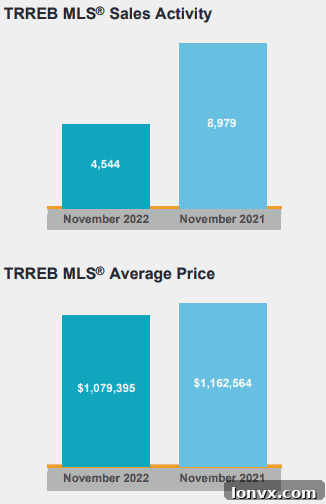
TRREB’s November 2022 market statistics, released earlier, revealed a substantial slowdown in residential transactions across the GTA. Realtors reported a total of 4,544 home sales through TRREB’s Multiple Listing Service (MLS) System last month. This figure represents a dramatic 49.4 per cent decline compared to November 2021, when a robust 8,979 sales were recorded. This nearly 50% reduction in sales volume underscores the profound impact that elevated borrowing costs and general economic uncertainty have had on buyer confidence and market activity.
The consistent rise in the Bank of Canada’s benchmark interest rate throughout 2022 has significantly increased the cost of borrowing, making mortgages more expensive and qualifying for them more difficult. This has pushed many potential homebuyers to the sidelines, adopting a “wait and see” approach in anticipation of greater market stability or a potential decrease in rates. The substantial year-over-year drop in sales is not just a statistical anomaly but a reflection of a broader market adjustment, shifting away from the frenzied pace of previous years.
New Listings at Historically Low Levels
While sales activity contracted sharply, new listings entering the market also experienced a notable decline. TRREB reported close to 9,000 new listings added last month, a figure described as “substantially down from last year and at a very low level historically.” This reduction was observed on both a year-over-year and month-over-month basis, indicating that sellers are also exercising caution. Many potential sellers, observing the softening market conditions and lower average selling prices, may be choosing to delay listing their properties, hoping for a market rebound or more favorable selling conditions.
This dynamic creates a complex interplay: while demand has waned, the constricted supply of new homes entering the market has paradoxically provided some support to average selling prices. This limited inventory helps prevent a more precipitous price correction, as fewer homes available for sale mean that motivated buyers still face a degree of competition, particularly for well-priced and desirable properties. However, for a truly balanced market to emerge, a more robust supply of listings is typically required to meet demand effectively.
Average Selling Price Down by 7.2%, But Trend Stabilizes
The average selling price of a home in the GTA saw a year-over-year decrease of 7.2 per cent, dropping from $1.16 million in November 2021 to $1.08 million in November 2022. This decline reflects the overall market rebalancing, moving away from the peak prices observed in early 2022. However, it’s crucial to note the nuanced trend within this decline.
According to TRREB, the low supply of homes for sale has been a key factor in supporting average selling prices since August. Jason Mercer, TRREB’s Chief Market Analyst, elaborated on this trend: “Selling prices declined from the early year peak as market conditions became more balanced and homebuyers have sought to mitigate the impact of higher borrowing costs. With that being said, the marked downward price trend experienced in the spring has come to an end. Selling prices have flatlined alongside average monthly mortgage payments since the summer.”
Mercer’s analysis highlights a stabilization in prices after a period of rapid decline in the spring. This “flatlining” suggests that while prices are lower than their peak, they have not continued to fall aggressively in recent months. This newfound stability, even at a lower average, could potentially instill a renewed sense of confidence among some buyers and sellers, helping them to better anticipate market movements.
Greater Price Declines for More Expensive Home Types
A deeper dive into price movements across different housing types reveals a segmented market response. Annual price declines were more pronounced for higher-value properties, such as detached and semi-detached homes, which are typically more sensitive to changes in borrowing costs due to their larger price tags.
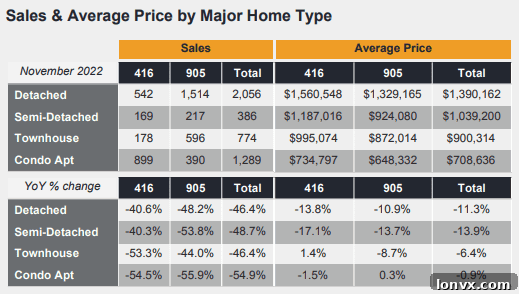
- Detached Homes: The average price of a detached home in Toronto witnessed a nearly 14 per cent decrease year-over-year. These properties, often at the upper end of the market, face greater challenges in an environment of rising interest rates, as higher mortgage payments significantly impact affordability for potential buyers.
- Semi-Detached Homes: Similarly, semi-detached houses saw their average cost drop by a substantial 17 per cent. Like detached homes, semi-detached properties often require significant financing, making them highly susceptible to interest rate fluctuations.
- Condominiums: In contrast, the average price of a condominium in the GTA experienced a more modest decline of 1.5 per cent year-over-year. Condos often represent a more accessible entry point into homeownership, making them relatively more resilient during periods of market adjustment, as demand shifts towards more affordable options.
- Townhomes: Interestingly, the cost of a townhome increased by 1.4 per cent. This modest rise suggests that townhomes, often bridging the gap between condos and detached houses in terms of space and price, are increasingly appealing to buyers looking for value and practicality in a tightening market. They offer more space than a condo but often at a lower price point than a detached house, making them an attractive compromise.
This stratification in price performance highlights a rebalancing of demand towards more affordable housing segments as buyers adjust their expectations and budgets to the new economic reality.
Future Outlook: Short-Term Shock vs. Long-Term Demand
Despite the current market slowdown, experts emphasize the distinction between short-term market corrections and long-term fundamental demand. Kevin Crigger, President of TRREB, articulated this perspective, stating, “Increased borrowing costs represent a short-term shock to the housing market. Over the medium- to long-term, the demand for ownership housing will pick up strongly.”
Crigger’s optimism for the long term is rooted in Canada’s ambitious immigration targets, particularly the significant influx of newcomers expected to settle in the GTA and the broader Greater Golden Horseshoe (GGH) region. “This is because a huge share of record immigration will be pointed at the GTA and the Greater Golden Horseshoe (GGH) in the coming years, and all of these people will require a place to live, with the majority looking to buy,” Crigger added. This sustained population growth acts as a powerful underlying force, guaranteeing robust demand for housing in the years to come.
However, this long-term demand also brings a critical challenge. Crigger highlighted this by saying, “The long-term problem for policymakers will not be inflation and borrowing costs, but rather ensuring we have enough housing to accommodate population growth.” This statement underscores the persistent issue of housing supply, which has plagued the GTA market for years. Even with reduced short-term demand, the structural shortage of housing units relative to population growth remains a fundamental problem that requires urgent and concerted efforts from all levels of government and the construction industry.
Addressing the supply crunch involves tackling complex issues such as zoning restrictions, development charges, skilled labor shortages, and slow municipal approval processes. Without significant improvements in housing supply, the underlying pressure on prices will likely return once interest rates stabilize or decline, making affordability a continuous challenge for new generations of homebuyers.
Navigating the Evolving Toronto Real Estate Landscape
The November 2022 TRREB report clearly illustrates the ongoing adjustment in the Toronto and GTA housing markets. While higher interest rates have undeniably put a damper on sales activity and led to price corrections, particularly in the more expensive segments, the market appears to be finding a new equilibrium. The “flatlining” of prices since the summer, coupled with historically low new listings, indicates a cautious stabilization rather than a freefall.
For potential buyers, this period presents both challenges and opportunities. While borrowing costs are higher, the reduced competition and stabilized prices could offer a chance to enter the market without the intense bidding wars seen previously. Sellers, on the other hand, are adapting to a more balanced environment, requiring realistic pricing strategies and patience.
Ultimately, the long-term outlook for the Toronto real estate market remains fundamentally strong, supported by relentless population growth and the region’s economic vibrancy. However, the path forward will require continued vigilance from market participants and proactive policy responses from government to ensure adequate housing supply can meet the needs of a growing metropolis. The current pause in market momentum provides a crucial window to address these foundational challenges, paving the way for a more sustainable and equitable housing future in the Greater Toronto Area.
For a comprehensive understanding of the market dynamics, you can access the full report here.
Courtesy: TRREB