
Navigating Canada’s Dynamic Housing Market: Q4 2023 Trends and 2024 Outlook
The Canadian housing market has recently entered a period of significant transformation, marked by a notable increase in seller activity. This surge in new listings, particularly pronounced in September across all major Canadian markets, signals a crucial shift in the real estate landscape. The primary driver behind this evolving trend is the sustained rise in borrowing costs, a direct consequence of higher interest rates, as detailed in the latest report from Robert Hogue, Assistant Chief Economist at RBC Economics.
This evolving environment presents a complex challenge and potential opportunity for both prospective homeowners and those looking to sell. Understanding the intricate interplay of economic forces and the diverse regional responses is paramount for anyone navigating Canada’s housing sector in the coming months.
Rising Interest Rates: A Double-Edged Sword for the Market
The persistent upward movement of interest rates has created a distinct push-pull effect within the housing market. On one side, elevated borrowing costs are compelling more sellers to enter the market. Homeowners facing increased mortgage payments, or those anticipating a potential dip in property values, may opt to sell. This influx of supply contributes to a more balanced, or in many cases, a buyer-favouring market environment.
Conversely, these same higher interest rates simultaneously deter potential buyers. The escalated cost of financing a home purchase significantly impacts affordability, shrinking the pool of eligible buyers and dampening overall demand. This dynamic is most evident in historically competitive markets like Ontario and British Columbia, with Calgary presenting a unique counter-narrative. Major urban centers such as Toronto, Vancouver, and the Fraser Valley are now experiencing market conditions that increasingly favour buyers, or are quickly approaching such a state.
The RBC report indicates a gentle decline in national home prices. Specifically, the August and September MLS Home Price Index recorded month-over-month decreases in key regions including Toronto, Vancouver, and the Fraser Valley. In stark contrast, Calgary continues its remarkable defiance of national trends, reporting sustained price increases and maintaining a robustly tight demand-supply balance.
Robert Hogue anticipates little change in this overarching market picture in the months ahead. He remarks, “We think buyers will stay on the defensive in many parts of Canada despite more choice becoming available to them.” His cautionary statement highlights formidable obstacles: “High interest rates, ongoing affordability issues and a looming recession are poised to pose major obstacles. Any material acceleration in the market recovery will have to wait until interest rates come down in 2024.” This forecast suggests a period of extended caution, with a significant market rebound largely dependent on future adjustments in monetary policy.
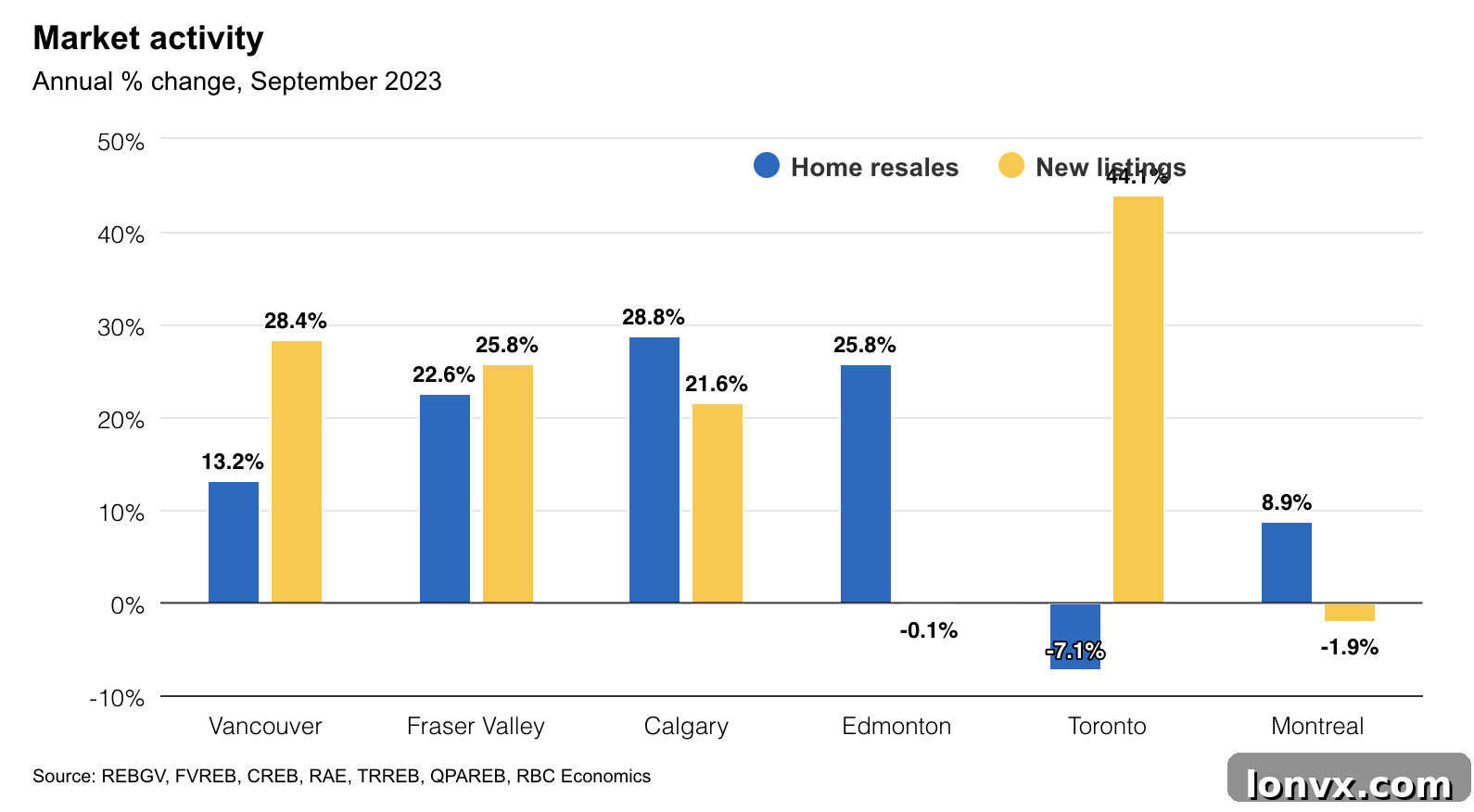
The intricate interplay of supply, demand, and interest rates is reshaping Canada’s diverse housing markets.
Regional Market Snapshots: Diverse Responses to National Trends
While overarching economic forces like interest rates certainly cast a long shadow, the Canadian housing market is fundamentally a mosaic of distinct regional ecosystems. Each major urban centre reacts to these forces with its own unique characteristics, shaped by local demographics, employment landscapes, and specific housing stock challenges. Let’s explore the detailed dynamics of key Canadian markets.
Greater Toronto Area (GTA): A Shifting Balance Towards Buyers
For an extended period, buyers in the Greater Toronto Area faced the formidable challenge of acutely low housing inventory, which fuelled intense competition and rapidly escalating prices. However, the market landscape has significantly evolved. The GTA is now witnessing a welcome expansion of housing options as more sellers re-enter the market. September alone recorded an impressive 11 percent increase in new listings, marking the sixth consecutive monthly rise in available properties. This growing supply offers a much-needed respite for prospective buyers, providing them with greater choice and potentially alleviating the intense pressure of bidding wars that previously dominated the region.
Despite this increase in inventory, sales figures continue their downward trend, decreasing by 1.8 percent month-over-month in September. This persistent softening in demand can be attributed to a combination of factors: persistent affordability challenges, the substantial burden of higher interest rates, and a pervasive sense of economic uncertainty among potential purchasers. These elements collectively dampen buyer confidence and restrict purchasing power, even with more homes becoming available.
Consequently, the evolving demand-supply environment is exerting noticeable downward pressure on prices. The Home Price Index for the GTA experienced a modest month-over-month decrease of approximately 0.2 percent in August, followed by a more pronounced 0.8 percent decline in September. This trend signals a crucial shift in negotiation power. Robert Hogue confirms this outlook, predicting “further erosion in the near term with buyers holding a stronger bargaining position.” This implies that buyers are increasingly likely to encounter less competition and potentially secure more favorable terms, moving away from the seller-dominated conditions that have historically defined the GTA market.
Vancouver: Rapid Softening and Price Adjustment
Vancouver’s housing market has experienced a swift and significant transformation since June, exhibiting a marked softening in demand-supply conditions that became even more apparent last month. This rapid shift is primarily driven by substantial boosts in inventory, particularly noticeable in September, coupled with an increasingly cautious buyer sentiment. The notoriously high cost of living and housing in Vancouver, exacerbated by rising interest rates, has pushed affordability to critical levels, prompting many potential buyers to adopt a wait-and-see approach.
This quick change has brought a definitive end to the price rally that characterized the market earlier in the year. Hogue observes, “The upshot of this rapid shift has been an end to the price rally that began this winter.” Indeed, Vancouver’s Home Price Index recorded declines of 0.2 percent and 0.4 percent month-over-month in August and September, respectively. The consistent influx of new listings, now exceeding pre-pandemic levels, is expected to perpetuate this downward price trend. For a market historically known for aggressive price appreciation, this softening represents a significant recalibration, potentially offering opportunities for buyers who were previously priced out, provided they can manage the higher borrowing costs.
Montreal: A Slow Recovery Amidst Conflicting Market Forces
The Montreal housing market presents a more nuanced picture, characterized by a slow but incremental recovery from the sharp correction it endured throughout 2022. While the pace of recovery may be gradual, it is steady. September saw resales increase by nearly 9 percent compared to the same period last year and over 2 percent from the previous month, indicating a gradual return of market activity and confidence.
This recovery is being shaped by two powerful, yet opposing, forces. On one side, a steady influx of sellers since spring has helped to unlock a degree of pent-up demand, providing more options for buyers and stimulating transactions. On the other side, the persistent challenge of higher interest rates continues to impede affordability, making home purchases more difficult for many prospective buyers and effectively muting overall market momentum. Hogue eloquently explains this dynamic: “on one side, an influx of sellers since spring has helped unlock some pent-up demand; on the other, higher interest rates have made it more difficult for buyers to afford a home purchase – muting momentum.” The easing of the market’s supply-demand balance has contributed to stabilizing overall prices, preventing either drastic declines or significant surges.
Interestingly, price trends in Montreal showed divergence last month. Prices for condominium units in the Montreal area experienced a jump of 2.3 percent month-over-month, potentially reflecting their relative affordability compared to larger properties and consistent demand from various buyer segments. In contrast, detached homes saw a drop of over 2 percent. However, it is worth noting that prices for both home types were slightly up compared to September 2022, suggesting a cautious year-over-year improvement despite recent monthly fluctuations. Hogue anticipates that similar mixed results are likely to persist in the coming months, reflecting the ongoing tug-of-war between supply, demand, and affordability constraints in the region.
Calgary: An Unstoppable Market on Fire
Calgary stands out as a unique outlier in the current Canadian housing landscape, frequently described as a market “on fire.” The city’s robust population boom is the primary engine driving this exceptional market performance. A significant wave of inter-provincial migration, largely from more expensive provinces like Ontario and British Columbia, is fueling this growth. Individuals and families are increasingly drawn to Calgary by its comparatively lower home ownership costs, promising economic opportunities, and vibrant lifestyle, creating an insatiable demand for housing.
This demographic shift is attracting “droves of buyers,” as Hogue keenly observes, leading to unprecedented levels of real estate transactions and pushing prices to historical highs. For the sixth consecutive month, sales figures continued their upward trajectory, increasing by approximately 4 percent month-over-month. Despite a steady increase in new listings, the available supply continues to trail significantly behind this surging demand. This persistent imbalance means that Calgary remains a highly competitive, seller-favored market, where properties often sell quickly and frequently above asking price due to intense buyer competition.
Compared to Canada’s largest markets, Calgary’s Home Price Index recorded the most substantial increase over the past year, soaring by an impressive 8.7 percent. This remarkable growth underscores the city’s unique and resilient position in the national housing context. Hogue emphasizes, “Calgary is easily the tightest (and hottest) market in Canada at the moment … we think upward price pressure isn’t about to let up anytime soon.” This strong forecast suggests that Calgary’s housing market will likely continue its robust performance, driven by strong fundamentals and sustained population influx, making it a compelling case study of regional resilience amidst broader national slowdowns.
Navigating the Future: Outlook for 2024 and Beyond
The current state of the Canadian housing market reflects a complex interplay of monetary policy, significant demographic shifts, and evolving consumer sentiment. While some regions are experiencing a much-needed cooling and a gradual return to more balanced conditions, others continue to demonstrate robust growth, propelled by unique local factors. The overarching theme, however, remains the significant influence of interest rates and persistent affordability challenges across the country.
As we look towards 2024, the trajectory of interest rates will undoubtedly be the single most critical determinant of market activity. Should inflation continue to moderate as expected, the Bank of Canada might consider strategic rate cuts, which could potentially reignite buyer confidence and incrementally ease affordability pressures. However, any such adjustments are widely anticipated to be gradual, implying that a swift return to the overheated market conditions witnessed in prior years is unlikely.
Affordability will continue to be a predominant concern across many parts of Canada. While government initiatives aimed at boosting housing supply and providing support for first-time buyers may offer some localized relief, systemic issues demand comprehensive, long-term strategies. For buyers, the current environment presents a unique opportunity for increased negotiation power in softening markets, while sellers in these areas may need to adjust their price expectations. Conversely, in resilient markets like Calgary, intense competition is likely to persist.
Ultimately, the Canadian housing market is demonstrating its inherent adaptability and resilience. While 2023 has largely been a year of recalibration and adjustment, 2024 is poised to be a period of continued evolution and careful observation. Staying well-informed about regional nuances and broader economic signals will be absolutely paramount for anyone engaging with this dynamic and vital sector of the Canadian economy.
For more in-depth analysis and economic insights, you can read RBC Economics’ full report here.
Enjoying this article?
Get the latest REM articles in your inbox 3x week so you stay up to date on the latest in the Canadian real estate industry.