
The year 2022 presented significant financial challenges for households across Canada, largely driven by persistent inflation and the relentless rise in the cost of living. This economic pressure permeated every aspect of daily expenses, with housing costs emerging as a primary concern for both homeowners and renters. While both groups undoubtedly felt the strain, recent comprehensive research suggests a notable divergence in who bears the heavier financial burden when it comes to shelter.
According to new, meticulous research compiled by Point2, a leading real estate intelligence platform, the average Canadian homeowner allocates a substantial 24 percent more each month towards their shelter costs compared to the average renter. This striking statistic highlights a significant and widening gap in housing affordability, prompting a closer examination of the underlying dynamics within the Canadian real estate sector.
The long-standing debate between buying and renting a home involves a complex interplay of financial, lifestyle, and aspirational considerations. Homeownership is frequently viewed as a cornerstone of long-term financial stability, a tangible asset, and a pathway to building equity. It offers a sense of permanence and the freedom to customize one’s living space. Conversely, renting has traditionally offered greater flexibility, reduced responsibility for property maintenance, and often, a lower barrier to entry in terms of upfront capital. For many, it represents a more adaptable living solution in a rapidly changing world.
While some shared expenses, such as utility bills, are common to both housing types, the fundamental structure of monthly financial commitments differs significantly. Point2’s analysis, drawing extensively from the latest national census data, illustrates that renters primarily face a single, predictable monthly rent payment. Homeowners, however, contend with a more multifaceted financial outlay that typically includes property taxes, potentially condominium or strata fees, and, for the vast majority, substantial mortgage payments. These varied components contribute to the overall disparity in shelter costs, making the comparison between owning and renting increasingly relevant in the face of today’s economic realities.
To provide an granular understanding of these evolving housing cost dynamics, Point2 undertook an extensive study, scrutinizing Canada’s 50 largest cities. This robust research aims to precisely determine how the escalating expenses associated with shelter are impacting the financial well-being and lifestyle choices of both owners and renters residing in these key urban centres, offering vital insights into the nation’s housing crisis.
The Growing Divide: Renters Benefit from Lower Shelter Costs
Despite the persistent cultural emphasis on homeownership as an aspirational goal, Canada’s residential landscape reveals a shifting demographic balance. Currently, homeowners number approximately 9.96 million, nearly double the 4.95 million renters, collectively accounting for over 66 percent of the nation’s total population. However, this historical dominance is showing clear signs of erosion. The most recent census data indicates a noticeable and concerning decline in Canada’s overall homeownership rate, signaling a potential long-term trend reversal in the national real estate market.
Recent statistics emphatically confirm this ongoing shift, revealing that the proportion of Canadians choosing to rent their homes has reached an unprecedented high. This significant surge in the renter population serves as compelling evidence that the dream of homeownership is becoming progressively out of reach for an increasing segment of the populace. Numerous interconnected factors contribute to this phenomenon, including historically inflated property prices, persistent market volatility, stringent mortgage qualification criteria, and rising interest rates. Beyond these broad economic forces, the sheer magnitude of monthly housing costs is proving to be a decisive factor, propelling more Canadians towards the rental market.
Indeed, Point2’s research explicitly highlights a substantial financial advantage for renters: on average, they consistently spend $289 less per month than homeowners on their shelter expenses. This figure, meticulously derived from the latest national census, illustrates a significant cost saving that is becoming a crucial determinant in housing decisions for countless households across the country.
Analyzing the historical trajectory of shelter costs reveals concerning patterns for both groups. Nationally, the average shelter costs for homeowners experienced a notable 14 percent increase over a five-year period, reaching an average of $1,498 per month. While renter households witnessed an even larger percentage increase of 20.66 percent, their average monthly shelter costs, at $1,209, remained substantially lower in absolute terms than those shouldered by homeowners. This suggests that while rental rates are indeed climbing, the cumulative baseline expenses associated with homeownership—encompassing property taxes, maintenance, and elevated mortgage interest payments—are driving a considerably larger overall expenditure.
The 30% Income Benchmark: A Critical Measure of Housing Stress
To comprehensively assess the sustainability of monthly housing expenditures, Point2 adopted a widely recognized benchmark: the principle that shelter costs should ideally not exceed 30 percent of a household’s gross income. This threshold is a standard metric employed by financial advisors, government agencies, and housing advocates to evaluate affordability and identify households at risk of financial stress or housing insecurity.
Encouragingly, the company’s extensive research indicates that a significant majority of Canadian dwellings, approximately 79 percent, successfully adhere to this crucial benchmark, allocating less than 30 percent of their total income towards shelter-related costs. This translates to over 11.6 million households enjoying relatively manageable housing expenses, allowing for greater financial flexibility. However, the study also reveals a stark reality for a substantial minority: over 3.07 million households are spending 30 percent or more of their monthly income on housing. This segment faces pronounced affordability challenges, where the burden of shelter costs can severely impact their ability to save, invest, cover other essential living expenses, or cope with unexpected financial emergencies.
Regional Disparities: Exploring Canada’s Most and Least Affordable Housing Markets
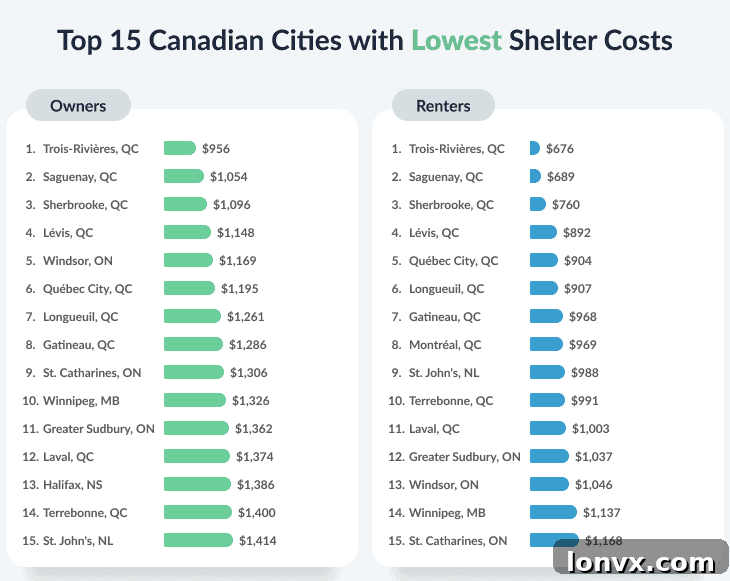
The landscape of housing affordability in Canada is characterized by pronounced regional variations, presenting a mosaic of challenges and opportunities across different provinces and cities. Point2 researchers specifically identify Quebec cities as leading the nation in offering more reasonable and accessible shelter costs, positioning them as a more financially attainable option for many residents.
This finding presents a stark contrast to the broader national trends, particularly when considering the undeniable evidence from the 2021 census. This census unequivocally positioned British Columbia and Ontario as Canada’s most expensive provinces for housing. Consequently, it comes as no surprise that the largest urban centers within these two provinces consistently occupy the less affordable end of the housing spectrum, often presenting formidable financial barriers for prospective residents and current occupants alike.
A detailed examination of Quebec’s housing market reveals a distinct pattern of affordability. Virtually all Quebec cities included in Point2’s comprehensive analysis demonstrate monthly shelter costs for renters that fall below the national average of $1,209. This regional affordability extends significantly to homeowners as well, with the notable exception of Montreal, where homeowner costs align more closely with national trends, reflecting its status as a major metropolitan hub. Communities such as Levis and Saguenay further exemplify this regional advantage, with an impressive 89 percent and 88 percent of all households, respectively, dedicating less than 30 percent of their income to housing expenses. This suggests a combination of factors, possibly including more accessible land, different market pressures, or provincial policies that promote housing stability.
Trois-Rivières further distinguishes itself as the sole major city where both renters and owners consistently benefit from monthly housing costs that remain below the coveted $1,000 threshold. This remarkable level of affordability makes Trois-Rivières an exceptional outlier and a potential case study for sustainable and equitable urban living within Canada.
Source: Point2
The Pricey Provinces: Unpacking Ontario and British Columbia’s Soaring Shelter Costs
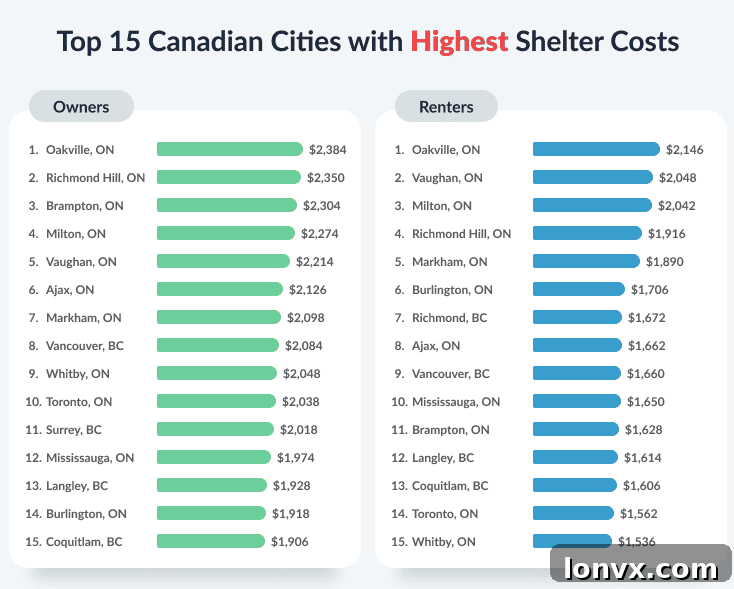
In stark contrast to the relative affordability found in Quebec, city-dwellers across Ontario and British Columbia are consistently confronted with some of the highest housing costs nationwide. Point2’s extensive data unequivocally demonstrates that these two provinces collectively dominate the top 15 list of cities with the most expensive shelter costs, a reflection of intense demand, constrained housing supply, robust economic activity, and significant population growth.
The research specifically identifies Oakville, Ontario, as the undisputed most expensive city in terms of overall shelter costs across Canada. Homeowners in Oakville face an astonishing average monthly payment of $2,384. This figure is significantly higher than that for renters in the same city, who pay an average of $2,146. This substantial difference underscores the premium associated with homeownership in such highly desirable, affluent, and economically vibrant areas.
Oakville’s situation is by no means an isolated anomaly. Other prominent Ontario cities, including Richmond Hill, Milton, and Vaughan, also feature prominently among the top five most expensive locations for both renters and owners. These municipalities, often characterized by strong local job markets, superior public services, excellent amenities, and close proximity to major economic hubs like Toronto, command higher prices due to sustained demand and limited developable land.
Even in Toronto, Canada’s largest and most densely populated city, the cost of living remains exceptionally high. Renting in Toronto averages $1,562 per month, while the costs associated with homeownership escalate to $2,038. Alarmingly, residents in some of Toronto’s surrounding municipalities, such as Markham, Brampton, and Ajax, according to the most recent census data, often face even higher monthly shelter costs, illustrating the profound ripple effect of Toronto’s expensive market on its neighbouring suburbs.
An intriguing demographic paradox emerges in these high-cost Ontario cities: despite the significant financial burden, homeowners constitute the majority of residents. Their percentages range from 78 percent in Oakville to an impressive 86 percent in Vaughan, suggesting that high costs have not deterred a large portion of the population from pursuing or maintaining homeownership, perhaps due to factors like higher average household incomes, long-term investments made prior to recent price surges, or strong intergenerational wealth transfers.
However, Ontario’s housing market is not uniformly prohibitive. There are notable pockets within the province where both renters and owners can encounter more reasonable shelter costs. Cities like Windsor, St. Catharines, and Greater Sudbury offer a welcome reprieve from the soaring prices seen elsewhere, presenting more accessible housing options and a potentially higher quality of life for those seeking greater affordability without leaving the province.
British Columbia, much like its eastern counterpart Ontario, consistently presents a challenging and expensive housing market. Whether an individual opts to rent or own in major B.C. cities, their monthly housing expenses almost invariably exceed the national averages for both categories, as meticulously documented by Point2’s analysis. The province’s unique geography, characterized by natural boundaries, coupled with high demand driven by immigration, inter-provincial migration, and a strong economy, significantly contributes to its persistently elevated housing costs.
For homeowners in British Columbia, monthly costs fluctuate significantly depending on the region, ranging from $1,614 in Kelowna to a staggering $2,084 in Vancouver, which consistently ranks among Canada’s most expensive major cities. Similarly, renter costs span from $1,324 in Abbotsford to $1,672 in Richmond, further illustrating the pervasive nature of high housing expenses throughout the province. This continuous upward pressure on housing costs impacts all segments of the population, leading to growing concerns about liveability, economic sustainability, and the ability of residents to secure affordable housing.
Source: Point2
Where Housing Costs Are Nearly Identical: Narrowing the Financial Gap
While the overarching trend reveals homeowners generally incurring higher shelter costs, there are specific urban centers across Canada where the financial disparity between owning and renting is remarkably narrow. In these particular cities, the data suggests that the overall housing costs are not significantly different, offering a more balanced and nuanced financial decision for residents contemplating their long-term living arrangements.
For instance, in the scenic city of Kelowna, British Columbia, embracing homeownership comes with a comparatively modest increase in monthly housing costs – merely $78, which represents approximately a five percent bump, when directly compared to renting. This marginal difference makes the potential long-term investment benefits and stability associated with ownership potentially more attractive, without requiring an overwhelming immediate financial jump.
Similarly, in Kingston, Ontario, homeowners can expect to pay approximately $120 more per month than renters, representing a nine percent increase. This relatively small premium allows residents to thoughtfully consider the advantages of building home equity and benefiting from property appreciation, without facing an exorbitant or prohibitive monthly financial burden. And in Richmond, British Columbia, the difference in monthly shelter costs for owners is only $122, translating to a seven percent increase compared to what renters pay. These compelling examples highlight specific pockets within the Canadian market where the financial landscape between owning and renting is more equitable, providing crucial insights for prospective residents and challenging the notion of uniform housing cost disparities.
Cities with the Widest Gap: When Renting Becomes the Clear Financial Winner
Conversely, in other Canadian cities, the financial calculus dramatically shifts, with census data clearly indicating that being a renter offers a substantial and undeniable economic advantage. In these particular regions, the cost of homeownership significantly outweighs rental expenses, creating a considerable and often prohibitive financial divide that influences housing choices for thousands.
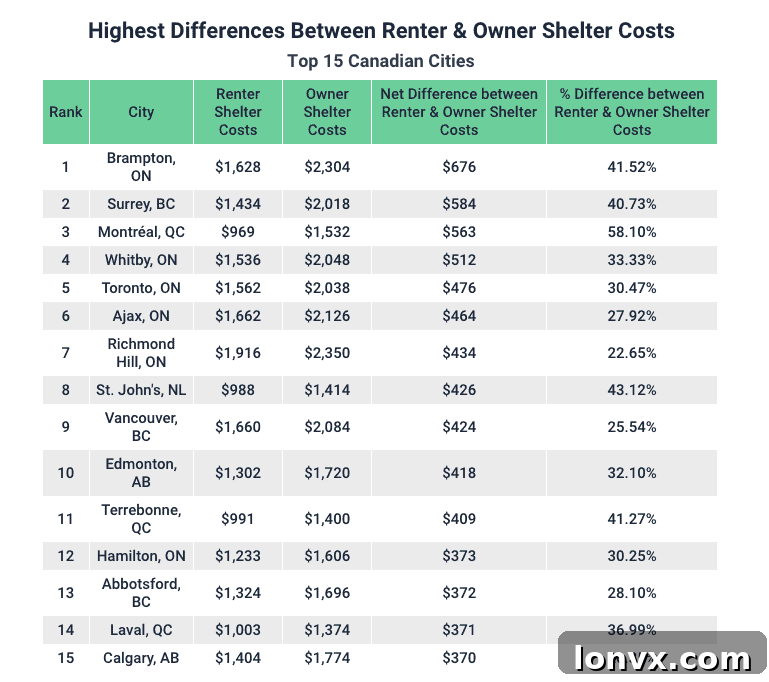
Brampton, Ontario, stands out as a prime example where homeowners bear a much heavier financial load. They consistently spend an astonishing $676 more than renters on monthly housing costs. This substantial difference can profoundly impact household budgets, limiting discretionary spending and complicating long-term financial planning for homeowners in the city. A remarkably similar situation unfolds in Surrey, British Columbia, where homeowners contend with a formidable $584 difference in monthly shelter expenses compared to renters, illustrating the stark contrast in housing expenditures between the two groups.
Point2’s comprehensive analysis also reveals a noteworthy and troubling correlation: owners in both Surrey and Brampton experienced the sharpest five-year uptick in housing costs since the previous Census of 2016. Surrey saw a staggering 25.5 percent increase in homeowner costs, while Brampton followed closely with a significant 23 percent rise. These rapid and substantial escalations further exacerbate the financial strain on homeowners in these already expensive and highly competitive markets.
From a percentage perspective, Montreal homeowners face a particularly acute financial challenge, paying an astounding 58 percent more, or approximately $563, than what renters allocate for shelter costs. This considerable premium for ownership is particularly striking given the city’s unique demographic makeup: renters constitute a significant majority, making up 64 percent of Montreal’s residents, as opposed to only 36 percent who are homeowners. This imbalance highlights not only the pronounced affordability challenge for potential buyers but also the robust and growing rental market thriving within the city, catering to a population for whom ownership is increasingly inaccessible.
Source: Point2
The Evolving Canadian Housing Landscape: What Lies Ahead?
The detailed and insightful research from Point2 paints a clear and nuanced picture of the Canadian housing market: one where the financial burden of shelter costs is increasingly shifting towards homeowners, especially in the nation’s most dynamic and sought-after urban centers. While homeownership continues to be a significant aspiration and a deeply ingrained cultural goal for many, the escalating costs associated with acquiring and maintaining it are undeniably making renting a more financially viable, and for a growing segment of the population, the only realistic option.
The stark disparity of a 24 percent higher monthly expenditure for homeowners nationally, coupled with the significant regional variations explored in this analysis, profoundly underscores the complexity and multi-faceted nature of Canada’s real estate environment. From the relative affordability and stability found in Quebec cities like Trois-Rivières to the exorbitant costs in Ontario’s Oakville or British Columbia’s Vancouver, the individual and household experience of housing affordability is profoundly shaped by geographical location, local market dynamics, and broader economic forces. The observable trend of declining homeownership rates alongside a surging renter population strongly suggests a fundamental recalibration of traditional housing norms in Canada, driven by a confluence of inflation, rising interest rates, and persistent supply-demand imbalances.
Understanding these critical trends is not merely an academic exercise; it is crucial for policymakers, urban planners, real estate developers, and individual Canadians alike. For prospective buyers, the research emphasizes the paramount importance of thorough financial planning, realistic expectations, and careful consideration of both the short-term cash flow implications and the long-term investment benefits of ownership. For current renters, while rental costs are undeniably rising across many markets, the immediate financial relief compared to the cost of owning in numerous major urban centers remains significant, offering flexibility and potentially reducing monthly financial stress. As Canada navigates a period of ongoing economic uncertainty and evolving demographics, the delicate balance between the deeply held desire for homeownership and the stark reality of housing affordability will continue to shape the financial futures and residential choices of millions.
For a deeper dive into these findings and to access more comprehensive data and city-specific analyses, the full report from Point2 is available here.