Quebec Real Estate Market Surges: Montreal and Quebec City Report Strong July Growth
The Quebec real estate market showcased remarkable resilience and significant growth in July, with both the Montreal and Quebec City Census Metropolitan Areas (CMAs) experiencing a robust surge in residential transactions and median prices. Insights from the latest report by the Quebec Professional Association of Real Estate Brokers (QPAREB) highlight a vibrant market defying conventional summer slowdowns, signaling renewed buyer confidence and strong underlying demand.
This comprehensive analysis delves into the key statistics and market dynamics shaping Quebec’s two largest urban centers, offering a detailed look at sales volumes, property types, inventory levels, and price trends. From Montreal’s impressive historical performance to Quebec City’s unwavering growth trajectory, the July 2024 data paints a promising picture for the province’s housing sector.
Montreal CMA: A Market Rebounding with Historical Strength
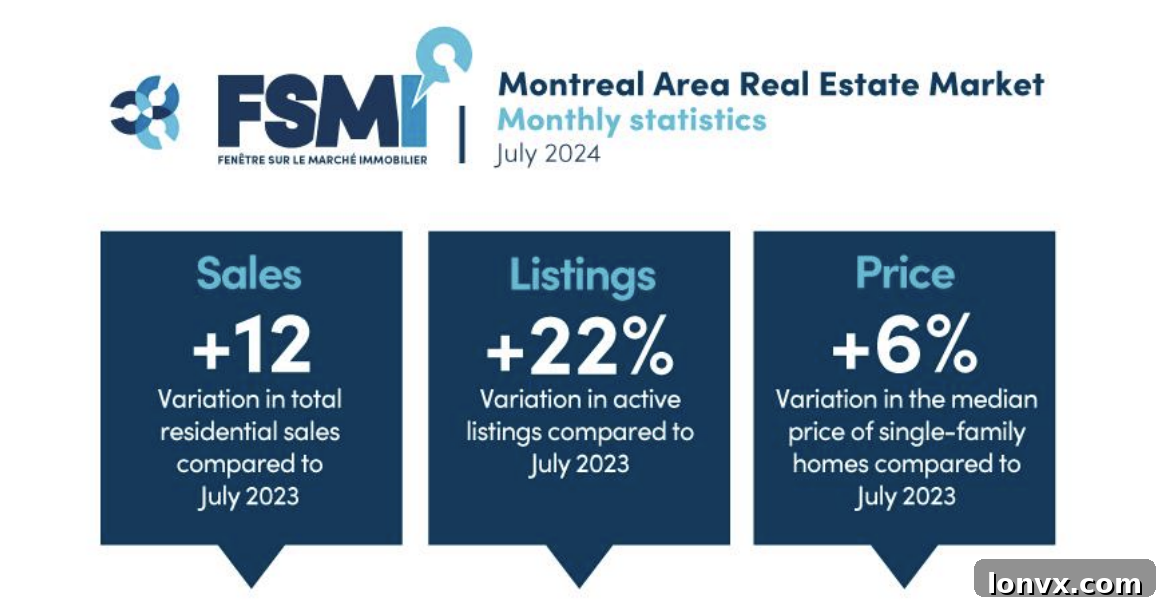
July proved to be an exceptionally strong month for the Montreal real estate market. The Montreal CMA recorded a total of 3,439 residential transactions, marking a substantial 12 percent increase compared to the same period last year. This level of activity is not merely a modest recovery; it represents a return to historically robust performance for the month of July, surpassing the average transactional volume observed since the year 2000.
Sales Volume and Historical Context
Charles Brant, QPAREB market analysis director, emphasized the significance of these figures, stating, “July starts off the summer period when transactional activity is usually quieter. It is interesting to note, however, that the Montreal CMA is back to a level of activity above the historical average calculated since 2000 for this period of the year. In fact, it posted the fourth-best July in the 25 years that market data has been compiled by the real estate brokers’ Centris system.” This remarkable performance underscores a potent underlying demand and a swift rebound in market confidence after recent economic shifts.
Brant further elaborated on the drivers behind this surge: “This is a clear sign that despite the fact that the CMA posts the highest prices in the province, the massive exodus towards other regions of Quebec is well and truly over, and that more and more newcomers are settling there. According to the Institut de la statistique du Québec, the Island of Montreal experienced a historical population increase of 90,000 between 2022 and 2023.” This influx of new residents is undoubtedly a crucial factor fueling demand across various property types and sub-regions within the Montreal CMA, counteracting previous trends of outward migration.
Regional and Property Type Performance
The growth in sales was broadly distributed across the Montreal CMA, indicating widespread market strength. Every major metropolitan area within the region experienced an uptick in transactions. Leading this growth were Saint-Jean-sur-Richelieu and Vaudreuil-Soulanges, which saw impressive increases of 25 percent and 21 percent, respectively. These peripheral areas often appeal to buyers seeking more space, relative affordability, and good commuter links, suggesting a continued demand for suburban and exurban living within reach of the urban core.
Breaking down sales by property type reveals varied but consistently positive trends:
- Single-family homes: Sales for this segment rose by a solid 8.0 percent, reaching 1,765 transactions. Despite their higher price points, single-family homes continue to be a cornerstone of the market, driven by family buyers and those seeking more private living spaces.
- Condominiums: The condominium market exhibited even more vigorous growth, surging by 20 percent to total 1,350 transactions. This substantial increase highlights the ongoing demand for urban living, smaller footprint properties, and more accessible entry points into the homeownership market, particularly for first-time buyers and downsizers.
- Small-income properties (plexes): Sales in this category, encompassing duplexes, triplexes, and other multi-unit dwellings, increased by 3.0 percent. These properties are vital for investors and owner-occupants looking to generate rental income, contributing to the overall rental housing supply.
Inventory and Price Dynamics in Montreal
While sales activity soared, the number of active listings in the Montreal CMA also climbed, increasing by 22 percent to reach 17,545 units. Although this represents a significant boost in available homes, it remains slightly below the historical average. This suggests that while more properties are coming onto the market, the robust demand is absorbing much of the new inventory, preventing an excessive build-up and maintaining a relatively competitive environment for buyers.
The strong demand translated directly into median price increases across all property types, signaling a healthy appreciation in real estate values:
- Condominiums: The median price for condominiums reached $411,000, an increase of 4.0 percent year-over-year. This steady growth reflects the intense buyer interest in this segment and the increasing desirability of urban living.
- Single-family homes: Single-family homes saw their median price rise by a notable 6.0 percent, settling at $585,000. This sustained appreciation indicates that despite higher interest rates and general economic concerns, the appeal of detached housing remains strong.
- Plexes: Small-income properties, or plexes, also experienced price growth, with their median price climbing by 3.0 percent to $755,000. The consistent demand for income-generating properties underpins this price stability and growth.
Quebec City CMA: Consistent Growth and Market Resilience
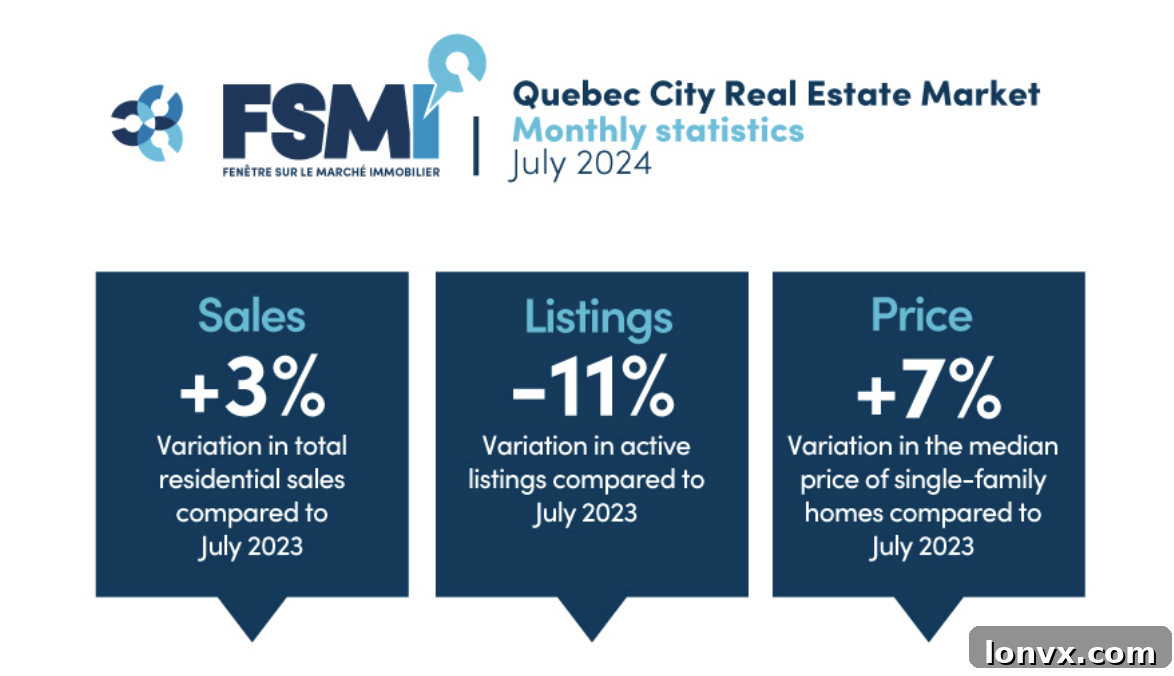
The Quebec City CMA also demonstrated strong market performance in July, solidifying its position as a resilient and growing real estate hub. The region recorded 667 residential sales, marking a 3.0 percent increase compared to July of the previous year. While this percentage increase is more modest than Montreal’s, it is crucial to view it within Quebec City’s broader market context.
Unwavering Growth Trajectory
According to QPAREB’s analysis, this represents the second-highest transactional activity for July since 2000, underscoring the market’s consistent strength over the long term. Charles Brant offered further insight into Quebec City’s unique market dynamics: “There is no recovery dynamic to the Quebec City market as is the case with many other markets in the province. It is, however, in a strong growth mode, and has been since the pandemic. Moreover, it has been unaffected by interest-rate fluctuations over the past 28 months.”
This statement highlights Quebec City’s remarkable stability and sustained growth, even in the face of fluctuating interest rates that have impacted other markets. Brant added, “Even if the increase in July sales seems relatively modest, make no mistake, the market posted its second-strongest activity in 25 years for this time of year. The resilience of this market, combined with the start of a cycle of lower interest rates, is increasing the confidence of buyers, particularly investors.” This points to a deeply rooted strength in the Quebec City market, making it particularly attractive to both owner-occupants and real estate investors.
Geographic and Property Type Sales Trends
Geographically, sales growth in the Quebec City CMA was particularly strong in certain peripheral areas. The South Shore of Quebec posted an impressive 42 percent increase in sales, suggesting a spillover effect from the central agglomeration and a search for more affordable or spacious options. Similarly, the Northern Periphery of Quebec City saw a significant 41 percent rise, indicating robust development and demand in these expanding regions. The Agglomeration of Quebec City itself experienced a respectable 7 percent increase, maintaining its core market strength.
When examining specific property types, a distinct pattern emerges:
- Condominiums: The condo market in Quebec City was particularly strong, with sales rising by 15 percent to 210 transactions. This demonstrates a healthy appetite for multi-unit dwellings, potentially driven by affordability, lifestyle choices, and investor interest.
- Small-income properties (plexes): This segment saw an outstanding 32 percent increase in sales, underscoring the strong demand for investment properties and rental income generation in the region. This robust growth suggests a confident investor base in Quebec City.
- Single-family homes: In contrast to other segments, single-family home sales experienced a slight dip of 5.0 percent. This could be attributed to tighter inventory or a shift in buyer preferences towards multi-unit dwellings or condos, or perhaps a natural rebalancing after a period of intense activity.
Inventory Challenges and Soaring Prices in Quebec City
Unlike Montreal, Quebec City faces more acute inventory challenges. The number of active listings dropped by 11 percent, with only 2,305 listings available on the market. This marks the third-lowest inventory level for the month of July since 2000, signaling a tight supply environment. Low inventory typically intensifies competition among buyers and exerts upward pressure on prices, a trend clearly evident in the July statistics.
Median prices in the Quebec City CMA surged significantly across all property types, reflecting the constrained supply and strong buyer demand:
- Condominiums: The median price for condominiums jumped an impressive 15 percent to $282,000. This substantial increase highlights the high demand relative to available units in this segment.
- Single-family homes: Despite the slight dip in sales, single-family homes saw their median price rise by 7.0 percent, reaching $375,000. This indicates that even with fewer transactions, the existing demand is strong enough to drive price appreciation.
- Plexes: Small-income properties experienced the most dramatic price surge, jumping a remarkable 21 percent to a median price of $437,750. This exceptional growth underscores the fierce competition for income-generating properties and the strong investor confidence in Quebec City’s rental market.
Broader Market Implications and Outlook
The July 2024 real estate statistics for both Montreal and Quebec City paint a picture of a robust and resilient Quebec housing market. Montreal’s return to historical highs, fueled by significant population growth and a renewed sense of confidence, indicates a strong recovery dynamic. The impressive sales figures and steady price appreciation across all property types suggest that the province’s largest metropolitan area is firmly back on a growth trajectory.
Quebec City, on the other hand, exemplifies consistent and stable growth. Its ability to navigate interest rate fluctuations with minimal impact, coupled with a tight inventory and soaring prices, highlights a market with deep underlying strength and sustained demand. The strong performance of condos and small-income properties in both CMAs also points to evolving buyer preferences, with an increasing focus on urban living, affordability, and investment opportunities.
Looking ahead, the Quebec real estate market appears poised for continued momentum. The start of a potential cycle of lower interest rates, as hinted by QPAREB’s director, could further boost buyer confidence and transactional activity in the coming months. While inventory levels remain a concern, particularly in Quebec City, the overall resilience and growth observed in July suggest a positive outlook for homeowners, buyers, and investors across the province.
For a detailed breakdown of the market trends and comprehensive data, interested parties are encouraged to review the full reports directly from QPAREB.
Review the full reports here.
Enjoying this article?
Get the latest real estate market insights and industry updates delivered to your inbox three times a week. Stay informed on the newest trends in the Canadian real estate industry.
Sign up now to receive exclusive content and market analysis!