Attention Realtors and Market Enthusiasts! Don’t miss this crucial opportunity to gain expert insights into the shifting real estate landscape. Join us online for REM’s exclusive monthly market breakdown, featuring esteemed columnist Daniel Foch. Mark your calendars for April 22nd at 2 PM Eastern. Daniel will deliver a comprehensive analysis of CREA’s latest statistical releases, delving into the nuances of market slowdowns and dissecting what evolving buyer sentiment signifies for real estate professionals in the lead-up to the federal election. This invaluable session is completely free, with no obligations. Secure your spot by registeringhere.
The GTA Real Estate Market: Embracing a Necessary Recalibration After Years of Frenzied Growth
If the dynamic real estate market of the Greater Toronto Area (GTA) has offered us any profound lesson in recent times, particularly through the lens of March 2025 data, it’s this: a gravitational pull isn’t always detrimental. For an extended period, the GTA witnessed unprecedented growth, characterized by skyrocketing prices and an intensity of buyer competition that frequently defied conventional market fundamentals. This era of unchecked escalation is now giving way to a more measured environment, as the market begins a notable descent. This shift is primarily in response to two significant uncertainties casting their shadows over the Canadian economic landscape:
- The potential implications of Donald Trump’s proposed tariffs; and
- The upcoming Canadian federal election, scheduled for April 28th.
However, it’s crucial to understand that this current phase of “pause and reflect” might be precisely what the market needs for long-term health and sustainability. Hints of this change emerged in February, with observable declines in sales volumes, an easing of price pressures, and a palpable increase in buyer hesitation. March has only served to solidify this reality, marking what has become the slowest spring market observed in the GTA since the 1990s. This isn’t a market collapse, but rather a vital recalibration—a psychological and economic pause that reflects a heightened sense of caution among participants, yet one that has not escalated into a full-blown crisis.
Source: TRREB, The Habistat
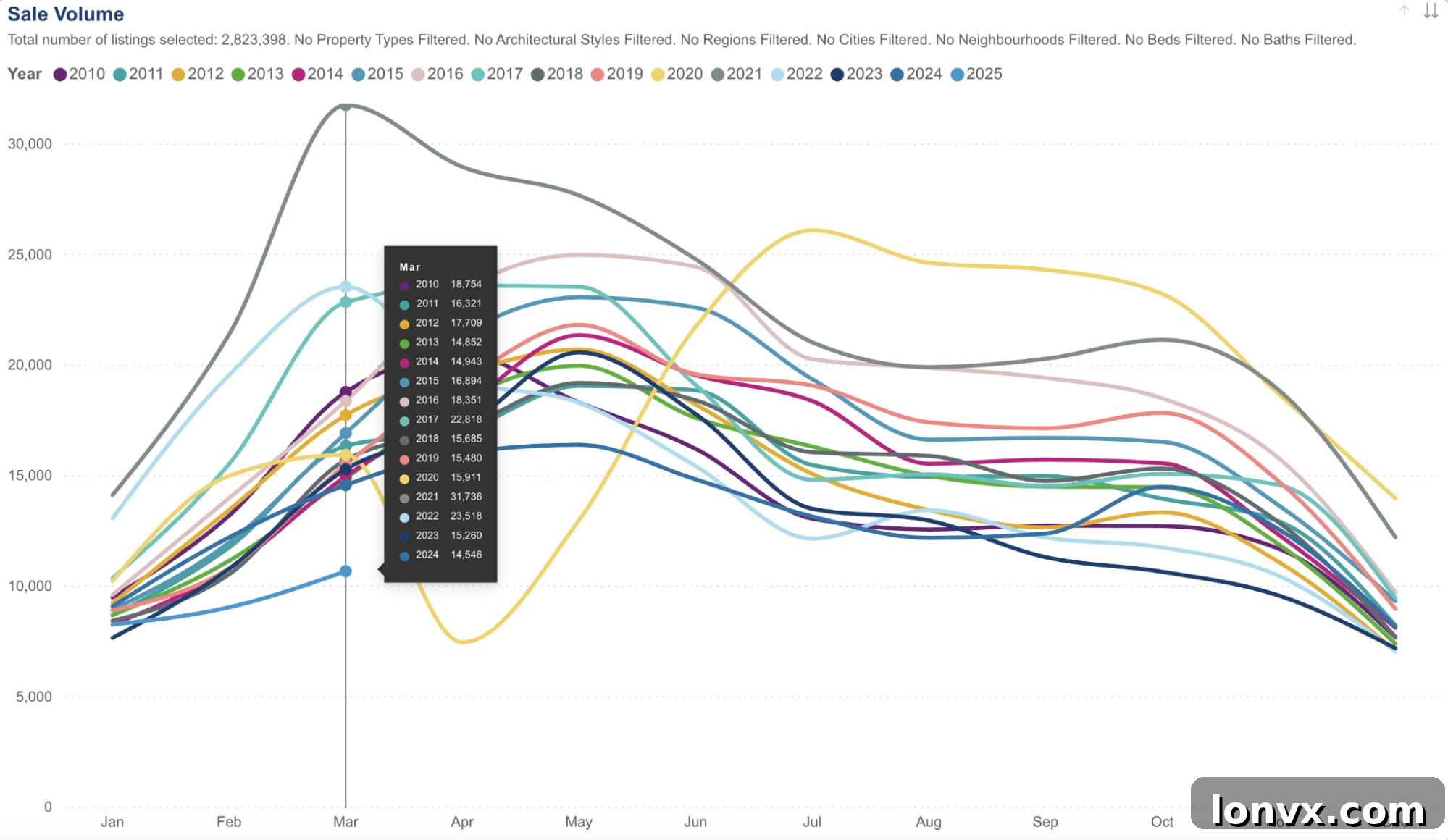
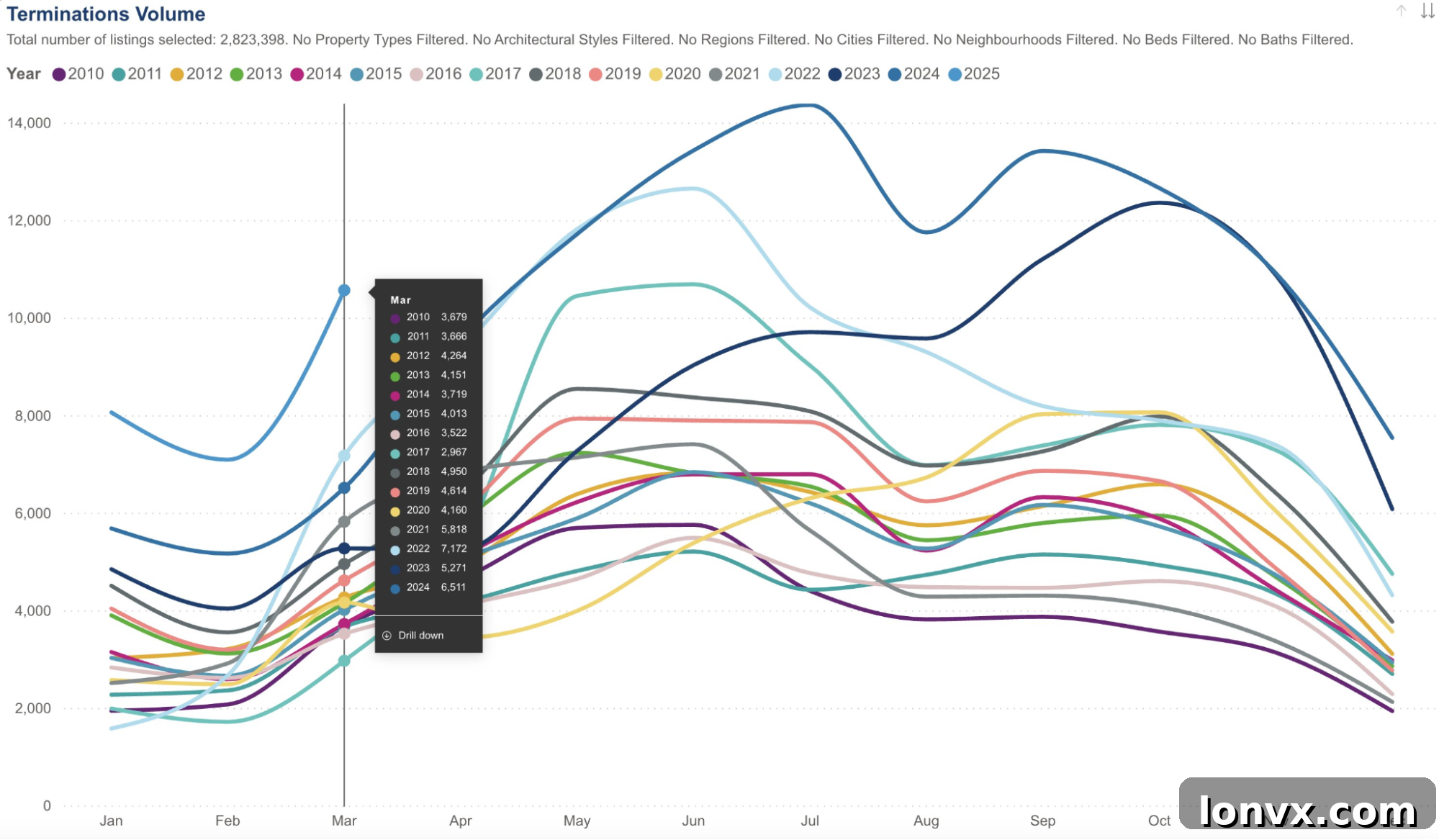
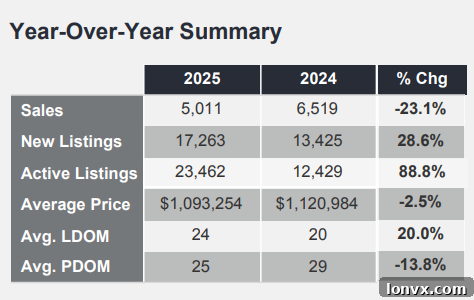
Recent statistics from the Toronto Regional Real Estate Board (TRREB) underscore this narrative. Sales experienced a substantial year-over-year decline of 23.1 per cent. While this figure might initially appear concerning, a deeper examination reveals a less dramatic, and indeed, more rational underlying story. The current market dynamics suggest that buyers are not abandoning the market; instead, they are deliberately pausing their activity. This calculated delay is a direct response to the two aforementioned external forces that are currently shaping the broader economic environment. Much like the market hit a “pause” button during the US election in November, buyers are now patiently awaiting clarity on the future economic landscape they will be investing their property in. Concurrently, sellers are exhibiting similar confusion, evidenced by the highest rate of listing terminations ever recorded, signaling uncertainty on both sides of the transaction.
Source: TRREB, The Habistat
Affordability Returns: A Modest but Meaningful Comeback in the GTA Housing Market
For the first time in several years, the concept of affordability in the GTA housing market is not only showing signs of improvement but is also emerging as a central theme. This development is a welcome change for many prospective homeowners. In March, the average sale price across the Greater Toronto Area registered at $1,093,254, representing a 2.5 per cent decrease from the same period last year. Further reinforcing this trend, the MLS Home Price Index (HPI) Composite benchmark experienced a 3.8 per cent year-over-year decline. This broader fall in the HPI indicates that price softening is no longer an isolated phenomenon affecting only specific neighborhoods or particular housing types; rather, it has become a systemic characteristic of the market.
TRREB President Elechia Barry-Sproule aptly summarized the prevailing sentiment in TRREB’s recent monthly market report: homeownership is gradually becoming more attainable. This improving accessibility is attributed to several converging factors. With an increase in the available housing inventory, there is less intense upward pressure on prices. Additionally, expectations of potential interest rate reductions in the coming months are contributing to a more optimistic outlook for buyers. Collectively, these conditions are empowering buyers with something they have not possessed in years—significant negotiating power. This subtle, yet powerful, shift in market dynamics could have profound and lasting consequences for how the GTA real estate market evolves in the foreseeable future, moving towards a more balanced and buyer-friendly environment.
The Psychological Stalemate: Navigating Uncertainty in Toronto’s Housing Market
The subdued atmosphere observed in the GTA real estate market during March can best be described as a collective holding of breath. This prevailing sentiment is largely a byproduct of pervasive policy ambiguity, spanning critical areas such as international tariffs, domestic employment prospects, and future housing regulations. Such uncertainty naturally causes households to pause and reconsider significant financial commitments. When consumer confidence wavers, the willingness to take on long-term debt, such as a mortgage, inevitably diminishes. Buyers are hesitant to commit substantial capital in an environment where future economic conditions and policy frameworks are unclear.
However, this psychological limbo is not expected to be a permanent fixture. The fundamental drivers of housing demand—robust population growth, sustained immigration levels, and an inherent need for shelter—remain unchanged and continue to exert upward pressure on the market over the long term. What has fundamentally transformed is the emotional tenor of the market. The “fear of missing out” (FOMO) that characterized the frenzied pandemic-era housing boom has largely dissipated. In its place, a more measured and cautious hesitancy has emerged. Prospective buyers are now prioritizing clarity; they want to understand where interest rates will ultimately settle, how the platforms of federal political parties will address housing and economic policies, and whether job security can once again be taken for granted. Until these critical questions find definitive answers, many are content to remain on the sidelines, observing and waiting for more favorable conditions to emerge.
Rising Supply: A Healthy Development for Toronto’s Housing Landscape
While buyer activity has undeniably cooled, a significant and healthy development is taking shape on the supply side of the GTA real estate market. New listings experienced a substantial surge, increasing by 28.6 per cent year-over-year to reach 17,263 units. Concurrently, active listings soared to 23,462, marking a remarkable 88.8 per cent increase in available inventory compared to the previous year. This dramatic expansion of supply represents a crucial and positive shift for a market that has long grappled with insufficient inventory. In essence, these conditions could be inadvertently creating a substantial pent-up demand scenario, as numerous buyers choose to remain on the sidelines, patiently waiting for more clarity. Should these buyers decide to re-enter the market with renewed confidence post-election, they will be greeted with an abundance of options to choose from, a stark contrast to the limited choices of recent years.
A truly functioning and healthy real estate market is not one where homes are snapped up within two days amidst a flurry of twenty competing bids. Instead, it is a market where buyers possess genuine choices, where sellers are compelled to justify their pricing strategies, and where a fundamental balance between supply and demand begins to be restored. March’s sales-to-new listings ratio, which landed at a mere 36.6 per cent, firmly places the market into “buyer’s market” territory. This statistic powerfully underscores how current conditions are affording buyers significantly more leverage and room to maneuver, even if many are currently exercising their option to wait.
With this influx of inventory, a natural rebalancing is occurring. Homes are now taking longer to sell; the average days on market (LDOM) has edged up from 20 to 24 days, indicating a less frenetic pace. Pricing, too, has become far more elastic and responsive to market realities. Sellers who continue to cling to the ambitious pricing expectations of the 2021 peak market are increasingly met with silence and a lack of interest. Conversely, those who accurately assess the current market conditions and price their properties accordingly are still successfully moving their inventory. In this evolving landscape, meticulous presentation, precise pricing strategies, and a degree of patience have become paramount virtues for sellers aiming to achieve successful outcomes.
Varied Responses: How Different Housing Types Are Absorbing the Slowdown
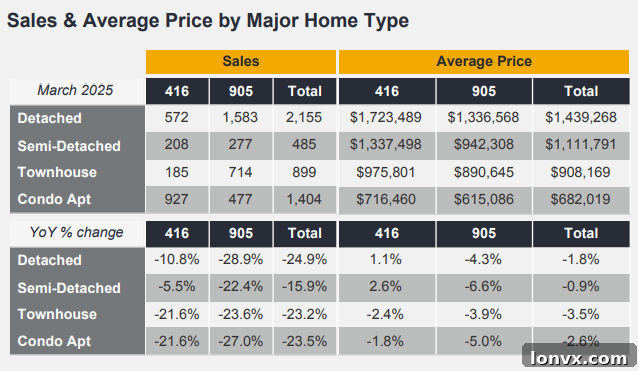
While the overall price movements across the GTA real estate market have trended broadly downward, a closer inspection reveals subtle yet significant shifts in how different buyer segments are responding to the prevailing market conditions. Detached homes continue to command the highest prices and retain their prestige, averaging approximately $1.44 million. Semi-detached properties settled at an average of $1.11 million, townhomes at $908,000, and condominiums remained the most accessible option at an average of $682,000 (all figures rounded for clarity). However, it is within the realm of sales activity, rather than merely pricing, where a more revealing narrative about market sentiment unfolds across these diverse housing types.
Detached homes experienced a notable 24.9 per cent drop in sales year-over-year, indicating a significant pullback in this premium segment. Condominiums followed closely, registering a 23.5 per cent decrease in sales activity. Townhouses and semi-detached properties also experienced comparable declines in their respective sales volumes. What this data collectively suggests is that the current market pullback is not being driven by any single segment of the market but rather by a widespread sense of hesitation that cuts across different buyer demographics. This indicates a kind of “cross-demographic caution.” Notably, the sharper drop in detached home activity may specifically reflect a pause among “move-up” buyers. Many of these buyers already possess significant equity in their existing homes but are wisely waiting for clearer economic signals and greater stability before deciding to upgrade to a larger or more expensive property. Meanwhile, the cooling activity in the condo market implies that first-time buyers, often the primary purchasers in this segment, are still encountering considerable constraints related to financing costs and mortgage affordability. In both scenarios, the observed slowdown speaks more directly to a shift in market sentiment and buyer confidence than it does to any fundamental structural weakness within the GTA housing market itself.
The Path Forward: All Eyes on the Bank of Canada and Parliament Hill
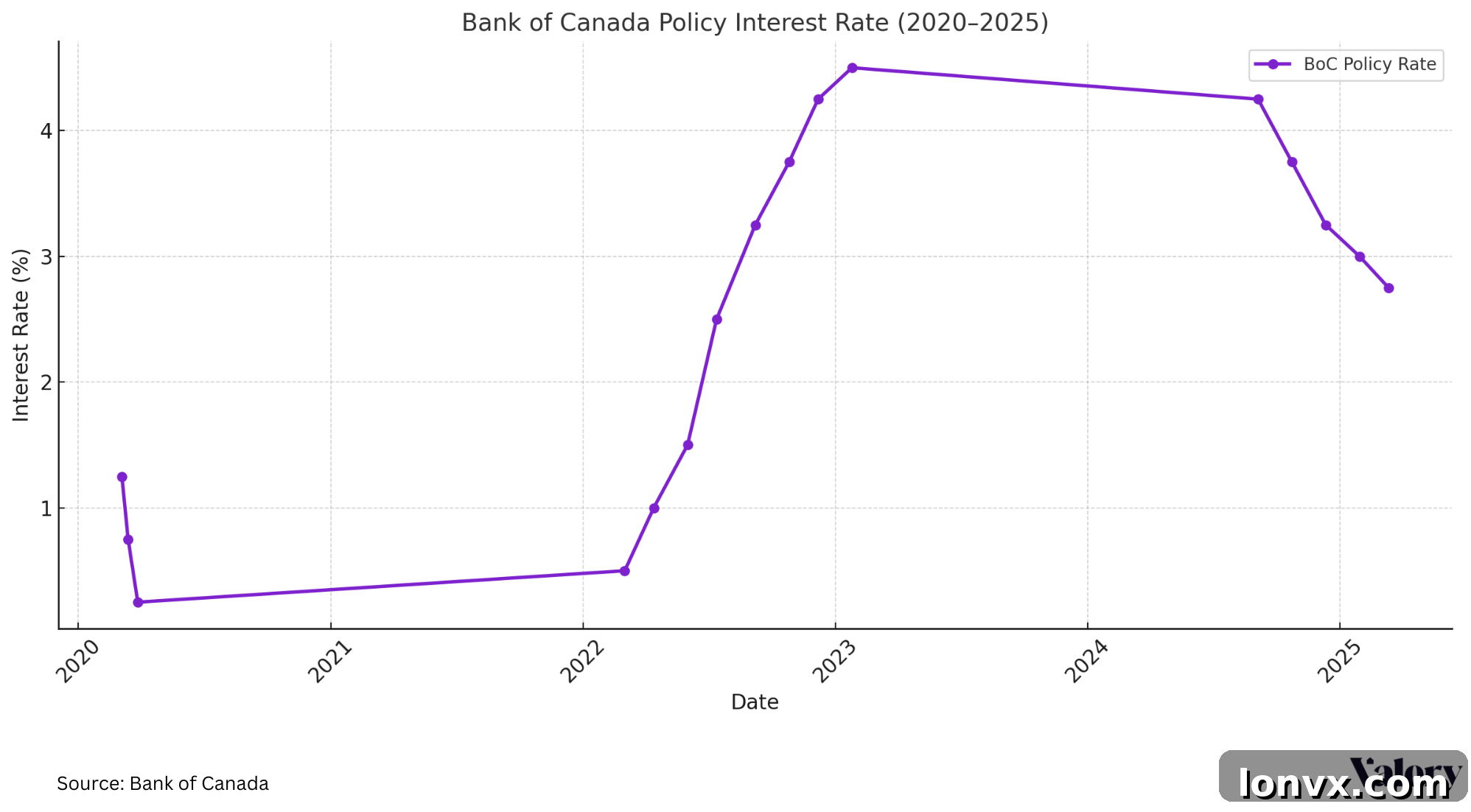
The trajectory of the GTA real estate market in the immediate future remains critically dependent on a single, dominant variable: interest rates. In March, the Bank of Canada took a significant step by reducing its target overnight rate to 2.75 per cent. While this adjustment does not signify a return to the ultra-accommodative monetary policies that characterized the early 2020s, it nevertheless represents a meaningful strategic move. This reduction is primarily aimed at stimulating economic activity and injecting confidence into the market, especially amidst ongoing global trade uncertainties and domestic economic pressures (as illustrated in the chart below). Further adjustments by the Bank of Canada will be closely watched, as they directly influence borrowing costs and, consequently, buyer affordability and market momentum.
The other major wildcard influencing the market is distinctly political. As the federal election rapidly approaches, housing has unequivocally re-emerged as a top-tier issue across the platforms of all major political parties. There is a clear and resounding demand from voters for bold and decisive action on several critical fronts: increasing housing supply, enhancing affordability, and addressing the complexities of taxation policies related to real estate. While the specific policy proposals and their intricate details continue to evolve and remain somewhat fluid, the overarching message from the Canadian public is unambiguous: housing is no longer perceived merely as an individual or personal challenge; it has definitively transitioned into a pressing national imperative. The outcomes of the federal election and the subsequent policies enacted will undoubtedly have profound and lasting impacts on the direction and health of the Canadian housing market, including the dynamic GTA region.
The Balanced Market: A Long-Awaited Reality for GTA Real Estate
The Greater Toronto Area real estate market is demonstrably no longer operating in an overheated, frantic overdrive—and, quite frankly, this shift comes as a profound relief to many stakeholders. Back in February, TRREB had already identified early indicators of moderation, including a slowdown in sales volumes, a stabilization or slight decline in prices, and a gradual increase in inventory levels. The market data from March has merely served to emphatically confirm that this fundamental shift is indeed real and firmly entrenched.
After nearly a decade characterized by intense volatility, soaring prices, and an often-unmanageable pace, the current market conditions feel less like a sharp downturn and more like a long-overdue and necessary correction. We are witnessing a return to a more stable environment marked by predictable pricing, expanded supply, and extended selling windows. In this new phase, buyers are approaching their decisions with a healthy blend of caution and curiosity, actively seeking value and certainty. Sellers, in turn, are either adopting a more realistic outlook on pricing or are rapidly coming to terms with the new market realities. Concurrently, the entire real estate industry is adapting and learning to operate effectively without the artificial crutch of historically cheap money and unchecked appreciation.
This isn’t merely a temporary dip; it fundamentally represents a departure from the frenetic, unsustainable market of the past five years. Instead, it is the market that many have advocated for: one that is balanced, deliberate in its pace, sober in its expectations, and ultimately, far more sustainable. This recalibrated market is very possibly laying the essential foundation for a healthier, more predictable, and enduring chapter in the history of GTA housing, benefiting both buyers and sellers in the long run.