Navigating the Shifting Tides: Understanding the GTA Real Estate Market in Early 2025
January 2025 has emerged as a truly pivotal month for the Greater Toronto Area (GTA) real estate landscape, signaling a dramatic shift in market dynamics. We’re witnessing what could be the most significant year-over-year surge in new listings on record, with the condominium sector leading this unprecedented influx. This isn’t just a minor fluctuation; it’s a profound rebalancing of supply and demand that will likely shape the market for the rest of the year.
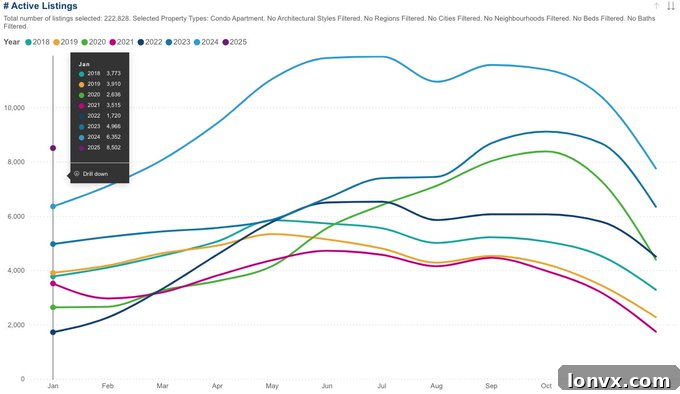
To put this into perspective, consider the trajectory of active condo listings. In 2024, the market began with approximately 6,300 active condo listings, eventually approaching the 12,000 mark. Fast forward to 2025, and we started the year with a staggering 8,500 active condo listings. Should historical growth trends persist, we could potentially see this figure soar to 15,000. This upward trajectory indicates a market grappling with an abundance of inventory, a stark contrast to the supply-constrained environment that dominated recent years.
Source: TRREB/TheHabistat.com
It’s important to acknowledge a minor structural change that could theoretically influence these numbers: the Toronto Regional Real Estate Board (TRREB) has integrated a few new local boards. However, based on the overwhelming dominance of condominiums in the current TRREB supply data, it’s highly improbable that this administrative change is the primary driver behind the massive supply surge. The underlying market forces, particularly in the condo segment, appear to be far more impactful.
Source: TRREB/TheHabistat.com
The GTA real estate market kicked off 2025 with a complex blend of surprises and mounting challenges. The most prominent characteristic is a significantly expanded pool of listings, coupled with a slight contraction in sales activity. This imbalance is actively reshaping buyer behavior, pushing them towards a more cautious and strategic approach. These early months are setting the tone for what many experts predict will be a transformative year for the region’s housing market.
So, what exactly is fueling these profound shifts? Let’s delve into three overarching trends that are currently defining the Greater Toronto Area’s real estate landscape:
- Pent-up Supply Unleashed: For months, a significant volume of properties remained off the market, with potential sellers awaiting more favorable conditions. This pent-up supply is now finally hitting the market with considerable force.
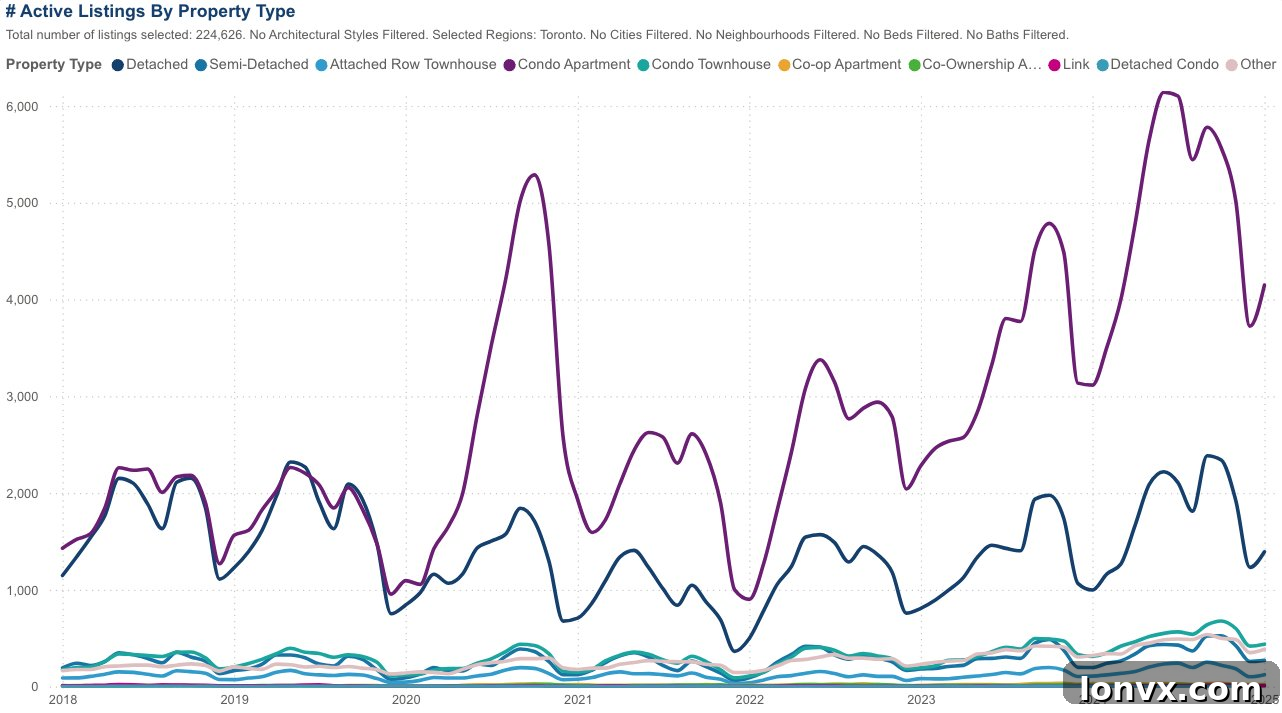
- Condominiums Under Immense Pressure: Among all housing segments, condos are experiencing the most pronounced struggle, facing unique headwinds that impact both sales volume and pricing.
- Diverging Regional Trends: The GTA is not a monolithic market. Conditions vary significantly across different regions and property types, creating a complex mosaic of opportunities and risks for participants.
The Unprecedented Supply Surge: Is a Buyer’s Market on the Horizon?
For an extended period, market observers have anticipated a substantial surge in supply, primarily driven by the completion and delivery of a record number of new condominium units. January’s data emphatically confirms this expectation. The GTA housing market is currently experiencing one of the largest influxes of new listings in its recent history, creating a noticeable imbalance as buyer demand struggles to keep pace.
The numbers speak volumes: New listings exploded by an astonishing 48.6 percent year-over-year, soaring from 8,337 in January 2024 to 12,392 in January this year. This dramatic increase alone is enough to shift market dynamics, but the story continues with active listings. The total available inventory skyrocketed by an even more remarkable 70.2 percent, bringing the total number of homes on the market to 17,157, a significant jump from 10,083 last year. Countering this flood of new properties, sales unfortunately dipped by 7.9 percent year-over-year, falling from 4,177 to 3,847 transactions.
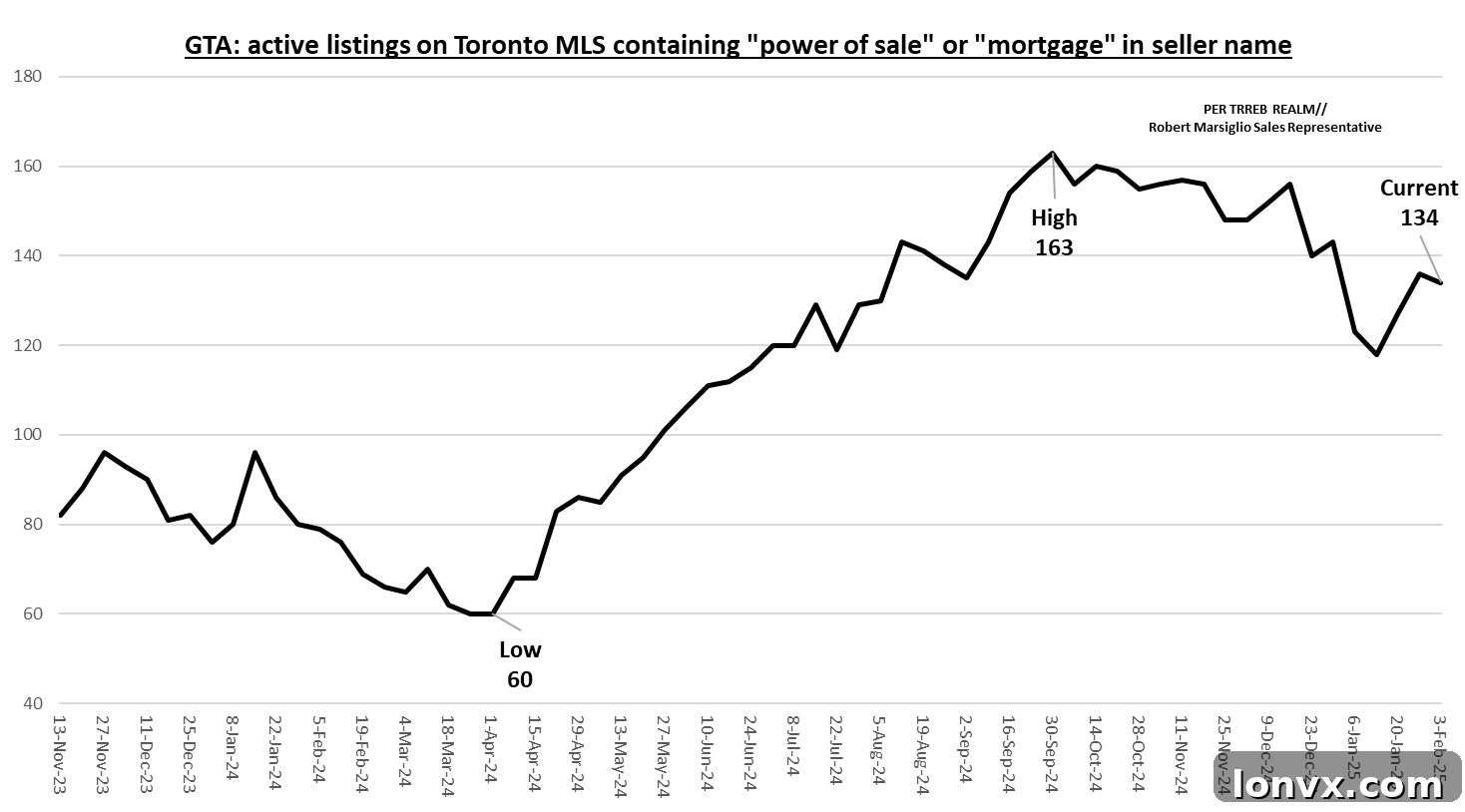
This data reveals a clear narrative: sellers, having potentially delayed their plans in previous years, are now rushing back to the market, eager to list their properties. If this trend of supply growth vastly outstripping demand persists, the GTA could very comfortably transition into a definitive buyer’s market by the spring of 2025. While the vast majority of these sellers are making voluntary decisions, a small but discernible segment is being compelled to sell due to financial distress. This is visibly indicated by a rise in “power of sale” listings, a trend diligently observed and highlighted by realtors Robert Marsiglio and Peter Kiriouzoupoulos.
These lender-driven sales, though still a fraction of the overall listings, serve as a critical indicator of increasing mortgage defaults. They introduce a layer of distressed inventory into an already supply-heavy market. Should this flow of distressed properties continue to grow, it could accelerate price discovery, as prudent lenders seek to find liquidity in what is becoming a more challenging, less liquid market for sellers. This adds another layer of complexity and potential downward pressure on prices.
Source: TRREB/TheHabistat.com
In stark contrast to the urgency displayed by sellers, prospective buyers appear to be in no immediate hurry. Even with a substantially greater selection of inventory, buyers are demonstrating patience, negotiating more aggressively, and often choosing to wait for anticipated interest rate cuts before committing to a purchase. This cautious approach is clearly evidenced by the “days on market” metric, which remained virtually unchanged in 2025 compared to last year, following a noticeable increase from 2023 to 2024. This suggests that despite more options, properties aren’t selling significantly faster, indicating buyer hesitation.
The fundamental economic principle holds true: more supply inherently leads to more pressure on prices. With inventory growth vastly outpacing sales, buyers now possess significantly enhanced leverage in negotiations, particularly within specific product categories and in weaker market segments. This dynamic compels sellers to adopt more competitive pricing strategies to attract attention and close deals in a crowded market.
If these trends persist throughout the first half of the year, we can anticipate several outcomes: longer days on market for listings, an increase in price reductions as sellers adjust expectations, and the solidification of a buyer’s market in various segments. While demand is likely to rebound once borrowing costs ease further in late 2025, for the immediate future, this massive surge in supply is definitively tilting the market balance in favor of buyers. This presents a unique window of opportunity for those who are prepared, pre-approved, and ready to make a strategic move.
The Condo Conundrum: A Vulnerable Segment Faces Headwinds
If there’s one particular segment of the GTA real estate market that is unequivocally showing signs of pronounced weakness and struggle, it is the condominium apartment sector. This asset class is navigating a perfect storm of oversupply and affordability challenges, making it the most vulnerable during this period of transition.
- Significant Sales Decline: Condo sales across the GTA experienced a notable drop of 12.1 percent year-over-year.
- Toronto (416) Hit Harder: Within the core Toronto (416) region, condo sales fell even more sharply, by 14.5 percent, indicating a more concentrated decline compared to the surrounding 905 regions (-7.4 percent).
- The Only Price Drop: Crucially, condo sale prices declined by 1.6 percent across the GTA, making it the only housing segment to record a price decrease during this period, underscoring its unique struggle.
Why are GTA Condos Underperforming? A Deeper Look
The underperformance of the condo market can be attributed to a confluence of factors, primarily centered around a looming oversupply and persistent affordability challenges. A significant wave of pre-construction completions is scheduled to hit the market throughout 2025. According to Urbanation, approximately 31,000 new condo units are projected to be completed this year, adding a substantial volume to an already swelling inventory.
Many of these units were initially purchased years ago, often by investors, when interest rates were considerably lower and market sentiment was bullish. Today, these purchasers face dramatically higher borrowing costs upon closing, making it difficult to secure favorable financing or meet their original proforma projections. This creates a dual pressure point: a flood of new inventory from these completions, alongside existing condo owners who might be compelled to sell.
Affordability challenges continue to exert immense pressure on condo demand, particularly from first-time buyers who traditionally enter the market through this segment. Current elevated mortgage rates have pushed carrying costs to unprecedented highs, rendering ownership less attainable for many. Concurrently, while the rental market remains relatively strong, rental income growth has not kept pace with the accelerated rise in ownership costs (mortgage, maintenance fees, property taxes), making it increasingly challenging for investors to achieve positive cash flow on newly completed or acquired units. This diminishes the appeal of condos as an investment vehicle, further dampening demand.
Navigating the Path Forward for the Condo Market
Looking ahead, it is highly probable that condo inventory will continue its upward trajectory through the first half of 2025. This sustained increase in supply will likely keep prices under considerable pressure unless a significant surge in demand materializes, which appears unlikely in the short term. Investors in particular may need to reassess their rental income expectations, potentially accepting lower yields, or even rethink their short-term exit strategies. For prospective buyers, especially first-time entrants, the evolving condo market could present unique negotiation opportunities, provided they have their financing in order and a long-term perspective.
Regional Realities: A Fragmented GTA Market
One of the most crucial takeaways from January’s TRREB report is the undeniable fact that the GTA real estate market is far from uniform. Different regions and housing types are experiencing vastly different conditions, highlighting the importance of granular analysis rather than broad generalizations.
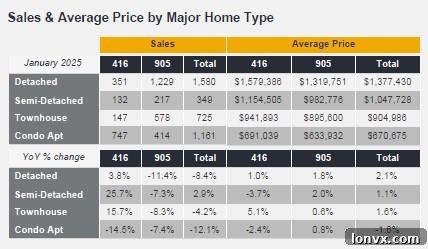
Semi-detached homes in Toronto (416) are leading sales growth. This housing category saw an impressive surge of 25.7 percent year-over-year in sales within the city proper, establishing them as the strongest-performing housing type in the 416 region. This signals a clear trend: buyers are increasingly recognizing the exceptional value proposition offered by semi-detached properties. They provide more living space and typically greater outdoor areas than condominiums, while remaining significantly more affordable than fully detached homes in prime urban locations, striking an attractive balance for many families and aspiring homeowners.
Townhouses in Toronto (416) experienced the strongest price appreciation. Townhouse prices in the city saw a healthy increase of 5.1 percent year-over-year. However, this growth was not evenly distributed across the GTA. Townhouse price growth in the surrounding 905 regions was minimal, registering a mere 0.6 percent. This stark contrast brought the overall GTA increase to 1.6 percent. This divergence indicates that demand for this particular housing type is far more concentrated within the urban core of Toronto, likely due to limited supply and a strong preference for city living, rather than extending uniformly into the suburban areas.
Condo sales continue to struggle significantly. While other housing types managed to demonstrate some level of resilience in either price growth or sales volume, condominium transactions across the GTA collectively plummeted by 12.1 percent year-over-year. Delving deeper, Toronto (416) condos saw an even sharper 14.5 percent drop in sales, whereas those in the 905 region declined by 7.4 percent. Concurrently, condo prices dipped by 1.6 percent overall, with properties in Toronto experiencing a steeper decline than the broader regional average. This reiterates the unique challenges facing the condo market, making it the most scrutinized segment.
Source: TRREB
The Road Ahead: GTA Real Estate Market Outlook for 2025
TRREB’s comprehensive outlook for 2025 suggests that the GTA housing market will likely experience moderate price growth, a trajectory that aligns closely with general inflation rates. However, the precise path and performance of the market will be intricately tied to the evolution of several critical factors that are currently in play.
Interest Rates: A key determinant will be the trajectory of interest rates. Current forecasts anticipate a decline, with predictions ranging from 2% to 2.75% by late 2025. Should these rate cuts materialize as expected, they could significantly help in boosting demand by making borrowing costs more manageable and improving overall affordability. However, the timing and magnitude of these cuts remain uncertain, creating a ‘wait and see’ environment for many potential buyers.
Inventory Levels: The delicate balance between supply and demand will continue to play a crucial role. If the current surge in listings persists and continues to outpace sales activity, the market could remain soft for an extended period, inevitably putting sustained downward pressure on prices. Conversely, if demand strengthens rapidly enough to absorb the new inventory, the market could stabilize or even see modest price appreciation.
Buyer Sentiment: Perhaps the most unpredictable factor is buyer sentiment. A significant number of prospective buyers are currently on the sidelines, exhibiting caution and waiting for clearer signals of sustained rate cuts and broader economic stability. If affordability significantly improves and consumer confidence returns with renewed vigor, demand could rebound quickly, once again shifting the market dynamics in favor of sellers. However, any economic uncertainty or unexpected rate hikes could prolong buyer hesitation.
Strategic Advice for Market Participants:
- For Buyers: The current market conditions present a compelling opportunity. With an abundance of inventory and less intense competition, buyers are empowered to shop around extensively, negotiate more aggressively on price and terms, and patiently wait for the right deal that aligns with their specific needs and budget. Thorough due diligence and pre-approval for financing are more crucial than ever.
- For Sellers: Realistic pricing is paramount in a shifting market. Overpricing a property in the current environment will almost certainly lead to longer days on market, increased holding costs, and ultimately, potential price reductions. Understanding recent comparable sales and working closely with a knowledgeable agent to set a competitive initial price is key to a successful transaction.
The upcoming spring market will serve as the ultimate litmus test for the GTA’s real estate resilience. Will the anticipated influx of buyers materialize, effectively absorbing the mounting supply? Or will the torrent of new listings continue to overwhelm demand, solidifying a protracted buyer’s market? The unfolding dynamics of Q2 will undoubtedly provide crucial insights into the direction of the GTA’s evolving housing narrative.