
Canadian House Prices Surge Again: A Deep Dive into July’s Real Estate Rally
The Canadian real estate market experienced another significant upswing in July, as evidenced by the Teranet-National Bank Composite House Price Index (HPI). Recording a robust 2.4 percent month-over-month increase after seasonal adjustments, this marks the fourth consecutive monthly rise in home values across the nation. This remarkable growth places July’s performance as the second-highest monthly surge ever recorded by the index, surpassed only by the extraordinary leap observed in July 2006. This renewed momentum signals a powerful resurgence in property demand and valuation, prompting close scrutiny from economists, policymakers, and prospective homeowners alike.
Understanding the Teranet-National Bank HPI: A Key Indicator
To fully appreciate the significance of this latest data, it’s crucial to understand how the Teranet-National Bank Composite HPI operates. Unlike some real estate metrics that rely on listing prices or market sentiment, this index is meticulously calculated based on actual closed transactions. This methodology, while providing a highly accurate reflection of market realities, inherently means the index typically lags behind the most immediate market shifts. It uses data collected from public land registries, tracking the prices of dwellings that have been sold at least twice. This ‘repeat sales’ method helps filter out noise and provides a more consistent measure of price changes for similar properties over time, making it a reliable gauge of long-term trends and underlying market health in Canada.
July’s Record-Setting Growth: A Detailed Look at CMAs
The impressive national average masks considerable variations at the local level. Among the 11 major Census Metropolitan Areas (CMAs) analyzed by the index, eight registered notable price hikes throughout July, showcasing a broad-based recovery across many key urban centers. These regional disparities highlight the complex interplay of local economic factors, housing supply, and buyer demand that shape Canada’s diverse real estate landscape.
Leading the Charge: Cities with Substantial Increases
Halifax emerged as the undisputed leader, experiencing a phenomenal 4.9 percent surge in house prices. This robust growth underscores the continued appeal and strong demand within the Atlantic Canadian market. Hot on its heels was Hamilton, recording a substantial 4.4 percent rise, indicative of the persistent competitive nature of the Greater Toronto Area’s surrounding markets. Vancouver also demonstrated significant strength with a 3.9 percent increase, confirming the sustained recovery in one of Canada’s most expensive urban centers. Toronto, the nation’s largest housing market, saw a solid 3.5 percent jump, signaling a return of buyer confidence. Victoria, another highly desirable market, rounded out the top performers with a 1.6 percent increase, reflecting the enduring allure of British Columbia’s capital.
Moderate but Steady Growth
Beyond the top five, several other CMAs reported more moderate yet consistent growth, contributing to the overall national upturn. Winnipeg saw a 1.3 percent rise, showcasing steady market conditions in the prairies. Ottawa-Gatineau recorded a 0.6 percent increase, indicating a stable yet less frenzied environment in the nation’s capital region. Edmonton also experienced a modest 0.3 percent hike, suggesting a cautious but positive trend in Alberta’s capital.
Areas of Contraction: Where Prices Dipped
In contrast to the widespread increases, three cities reported price contractions, highlighting the nuanced and sometimes divergent paths of Canadian real estate markets. Quebec City led with a 1.2 percent decline, suggesting specific local dynamics or perhaps a delayed market adjustment. Montreal followed with a 0.9 percent decrease, indicating that some of the earlier exuberance in this market may be cooling. Calgary recorded a more modest 0.3 percent dip, pointing to a slight softening despite earlier signs of strength in Alberta’s energy hub. These contractions serve as a reminder that market recovery is not uniform and local conditions remain paramount.
Economist’s Insight: A Market in Partial Correction
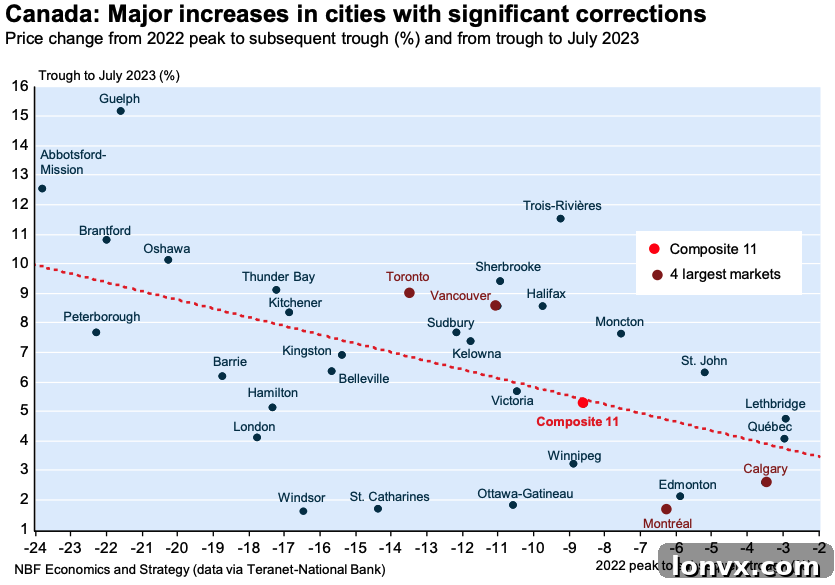
Commenting on these dynamic shifts in house prices, National Bank Economist Daren King emphasized the discernible recovery of the residential real estate market over recent months. King highlighted that the composite index’s 2.4 percent increase in July, especially when viewed against a cumulative decline of only 3.8 percent since its peak in April 2022, strongly indicates a partial correction of the market. This suggests that after a period of adjustment following the peak, the market is now regaining lost ground, but perhaps not yet reaching the unsustainable highs of yesteryear.
King’s analysis provides a crucial perspective: “Interestingly, the recent upturn in prices has been greatest in the cities that have seen the biggest corrections.” This observation suggests a natural market rebalancing act, where areas that experienced the most significant price adjustments downwards are now experiencing the most vigorous rebounds. This phenomenon is often seen after periods of rapid price growth followed by necessary cool-downs, as buyers return to markets they perceive as having become more reasonably priced.
Remarkable Recoveries: Markets That Bounced Back Fully
Adding another layer to the recovery narrative, four of the CMAs covered by the Teranet-National Bank HPI have managed to fully recover their previous price declines. These resilient markets include Saint John, Lethbridge, Quebec City, and Trois-Rivieres. While Quebec City showed a monthly decline in July, its overall trajectory since the April 2022 peak demonstrates a full recovery, indicating strong underlying fundamentals or perhaps a delayed response compared to other markets. This full recuperation points to diverse factors, potentially including affordability, strong local economies, or unique supply-demand dynamics that have allowed these specific regions to not just stabilize, but to regain all lost value and then some.
Looking Ahead: Projecting Growth and Assessing Affordability Challenges
The current upward trend prompts critical questions about the future trajectory of the Canadian housing market. Economist Daren King provides further insights into potential scenarios.
Drivers of Continued Growth
King forecasts that “prices could continue to rise in the third quarter, supported by strong demographic growth and the lack of supply of properties on the market.” Strong demographic growth, largely fueled by robust immigration targets and a growing population, consistently adds to housing demand, particularly in urban centers. This influx of potential buyers, combined with a persistent shortage of available properties—a long-standing issue in many Canadian markets due to factors like zoning restrictions, construction costs, and labor shortages—creates a classic supply-demand imbalance that inevitably pushes prices upwards. Developers struggle to keep pace with demand, and the existing housing stock becomes increasingly contested, further fueling competition and bidding wars.
The Looming Affordability Headwind
However, King also cautions about significant headwinds on the horizon. “That said, the deterioration in affordability with recent interest rate hikes in a less buoyant economic context should represent a headwind for house prices thereafter.” The Bank of Canada’s aggressive interest rate increases, aimed at curbing inflation, have significantly raised borrowing costs, making mortgages substantially more expensive. This directly impacts housing affordability, especially for first-time buyers and those with variable-rate mortgages. The combined effect of higher interest rates and a “less buoyant economic context”—characterized by concerns over a potential recession, slower job growth, and dampened consumer confidence—is expected to exert downward pressure on house prices in the medium to long term. This delicate balance between strong demand-side pressures and increasing affordability constraints will define the market’s trajectory in the coming quarters.
Conclusion: A Complex and Evolving Canadian Housing Market
July’s Teranet-National Bank HPI report paints a picture of a Canadian real estate market in a strong recovery phase, marked by impressive national gains and significant regional surges. The broad-based increases in many CMAs, coupled with the economist’s insights into a “partial correction,” suggest a market that is finding its footing after earlier adjustments. However, the path forward is not without its challenges. While demographic growth and persistent supply shortages continue to fuel demand, the rising cost of borrowing and a potentially weakening economic environment pose serious questions about long-term affordability and sustainable growth. As the market navigates these competing forces, stakeholders will need to closely monitor both national trends and local specificities to understand the evolving landscape of Canadian homeownership.