Canada’s Rental Market Reaches Unprecedented Heights: A Deep Dive into Record-Breaking Rents and Surging Demand
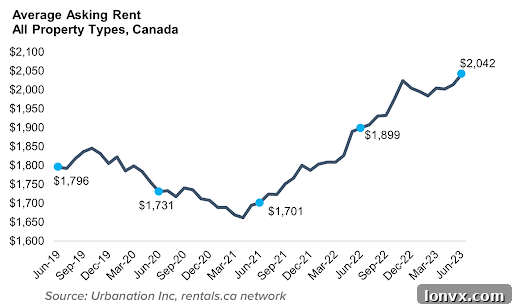
The Canadian rental landscape is undergoing a significant transformation, marked by a relentless surge in prices that continues to challenge housing affordability nationwide. According to the latest National Rent Report, a comprehensive analysis by Rentals.ca and Urbanation, the average asking rent in Canada soared to an unprecedented $2,042 in June. This new record not only surpassed the previous peak set in November by 0.9 percent but also signals a persistent tightening in the market that profoundly impacts millions of Canadians.
This remarkable increase reflects a broader trend of escalating costs across all property types listed on the Rentals.ca Network. Over the past year, average rents have climbed by a staggering 20 percent, translating to an average monthly increase of $341. This rapid escalation underscores the intense pressure on renters and highlights the urgent need for sustainable housing solutions.
The National Picture: A Market Under Intense Pressure
June proved to be a particularly challenging month for renters, with average rents experiencing a month-over-month rise of 1.4 percent, marking the highest monthly increase recorded this year. On an annual basis, the average rent across Canada saw a substantial increase of 7.5 percent. These figures are not just statistics; they represent a tangible shift in economic realities for individuals and families attempting to secure stable housing.
The continuous upward trajectory of average rents is primarily attributed to a confluence of powerful economic and demographic forces. Canada’s burgeoning population, which recently surpassed the 40 million mark, coupled with robust immigration rates, has fueled an unprecedented demand for rental properties nationwide. This demographic boom, while a sign of a vibrant and growing nation, places immense strain on an already constrained housing supply. Furthermore, the Bank of Canada’s recent interest rate hike, which saw rates climb by 25 basis points to 5.0 percent, has only exacerbated the challenges. Higher interest rates make homeownership more elusive for many, pushing a greater number of aspiring homeowners into the rental market and intensifying competition.
Decoding the Drivers: Why Rents Are Soaring Across Canada
Understanding the root causes of Canada’s escalating rental crisis requires a closer examination of several interconnected factors. The dynamic interplay between population growth, economic policies, and housing supply dictates the market’s direction, often to the detriment of renters.
Population Growth and Immigration: A Demand Surge
Canada’s welcoming immigration policies and its appeal as a destination for international students and workers have led to robust population growth. While beneficial for the economy and cultural diversity, this growth has significantly outpaced the development of new housing units. Each new resident or family requires housing, and with an insufficient supply of new homes, particularly purpose-built rentals, the existing stock becomes highly competitive. This imbalance inevitably drives up rental prices as landlords respond to overwhelming demand.
Interest Rate Hikes: A Ripple Effect on Renters
The Bank of Canada’s strategy to combat inflation through successive interest rate hikes has had a profound, albeit indirect, impact on the rental market. As borrowing costs increase, mortgage payments for homeowners rise. This can lead some landlords to pass on these increased costs to their tenants in the form of higher rents. More significantly, elevated interest rates make it increasingly difficult for potential first-time homebuyers to qualify for mortgages or afford down payments. This pushes a larger segment of the population, who might otherwise have transitioned to homeownership, back into the rental market, further inflating demand.
Supply-Demand Imbalance: A Chronic Challenge
The core issue remains a chronic imbalance between the supply of available rental units and the ever-growing demand. Shaun Hildebrand, president of Urbanation, succinctly captured this dynamic: “It’s no coincidence that cities with the fastest population growth are at the top of the list for rent increases.” Hildebrand further emphasized the anticipated sustained pressure on rents as the market enters its peak period, with demand continuing to outstrip the painfully slow pace of new housing supply. This structural deficit in housing construction, hampered by factors like zoning restrictions, labor shortages, and rising material costs, means that relief for renters is not immediately on the horizon.
Navigating the Top Tier: Vancouver, Burnaby, and Toronto’s Dynamic Shifts
While the national average tells a story of rising rents, the situation in Canada’s largest urban centers reveals the epicenter of this crisis, with some cities consistently setting new benchmarks for unaffordability.
Vancouver’s Unyielding Dominance
Once again, Vancouver solidifies its position as the city with the highest average monthly rent in Canada, a title it has frequently held. In June, the average monthly rent for a one-bedroom home in this highly desirable West Coast metropolis reached an astonishing $2,945. For those seeking more space, a two-bedroom home averaged an even steeper $3,863. The annual increases highlight the rapid pace of escalation: average monthly rents in Vancouver surged by 18.1 percent for one-bedroom homes and 14.2 percent for two-bedroom homes compared to the previous year. Month-over-month, Vancouver also saw significant jumps, with one-bedroom rents rising by 4.0 percent and two-bedroom rents by 5.4 percent. Vancouver’s unique geographic constraints, coupled with its status as a global city, contribute to its persistently high and ever-increasing rental costs.
Burnaby’s Ascendancy and Toronto’s Shifting Position
In a notable shift, Toronto, historically known for its notoriously high rental prices, found itself in an unfamiliar third place among the 35 cities ranked for average monthly rent in June. A one-bedroom home in Toronto commanded an average monthly rent of $2,572, while a two-bedroom home averaged $3,301. This marks a significant development, as it is the first time Toronto has not been ranked either number one or two on the National Rent Report. The city that surpassed Toronto for the second spot was Burnaby, B.C., a thriving city just east of Vancouver, which now boasts higher average rents for both one-bedroom and two-bedroom homes. This suggests that the extreme pressures of the Vancouver market are creating a spillover effect into neighboring communities.
Despite dropping in rank, Toronto’s rental market remains intensely competitive and expensive. Year-over-year, Toronto experienced a 14.1 percent increase in average monthly rent for one-bedroom homes and an 8.8 percent increase for two-bedroom homes. The city’s continuous appeal as an economic hub ensures that demand will remain robust, even as rents continue their upward trajectory.
Major Urban Centers: Beyond the Peak Performers
While Vancouver and Toronto capture headlines, other major Canadian cities are also grappling with rapidly escalating rental costs, reflecting a nationwide housing affordability crisis that is spreading beyond the traditional hotspots.
Calgary’s Rapid Rise to Prominence
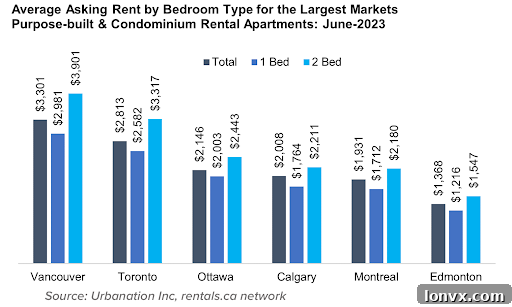
June marked a significant milestone for Calgary’s rental market, as average rents for purpose-built and condominium apartments exceeded the $2,000 threshold for the very first time, reaching $2,008. This figure represents a substantial 18.4 percent increase compared to the previous year, underscoring the rapid growth experienced in Alberta’s largest city. Consequently, Calgary has now surpassed Montreal, positioning itself as the fourth most expensive city for renters among Canada’s major urban centers. This surge can be attributed to a robust economy, inter-provincial migration, and a comparatively more affordable cost of living enticing new residents, which in turn fuels rental demand.
Sustained Growth in Other Major Markets
Even with Calgary’s ascendancy, Vancouver and Toronto continue to hold their titles as the country’s most expensive rental markets, with average asking rents (across all property types) of $3,301 and $2,813, respectively. These figures are supported by significant annual rent increases of 15.4 percent in Vancouver and 15.7 percent in Toronto during June, reinforcing the relentless upward pressure in these critical markets.
Ottawa, the nation’s capital, also registered strong growth, maintaining its position as the third most expensive of Canada’s largest markets with an average rent of $2,146 in June. The city experienced a similar annual rent growth of 15.3 percent for purpose-built and condominium apartments. Montreal, a vibrant cultural and economic hub, saw its average rent for such properties rise by a notable 11.2 percent annually, reaching $1,931 in June. While not as dramatically high as the Western markets, these increases signal a broader trend of diminishing affordability across all major Canadian cities.
The Greater Toronto Area’s Mid-Sized Markets: A Ripple Effect
The affordability crisis in downtown Toronto has created a significant ripple effect, driving renters outwards to mid-sized cities and suburbs within the Greater Toronto Area (GTA). This has transformed these areas into new hotspots for rapid rent increases, demonstrating the widespread nature of the housing challenge.
Oakville, a picturesque suburb in the GTA, maintained its status as the most expensive mid-sized market for renters, with an average rent of $3,230 for purpose-built and condominium apartments. This premium reflects its desirability, quality of life, and proximity to Toronto.
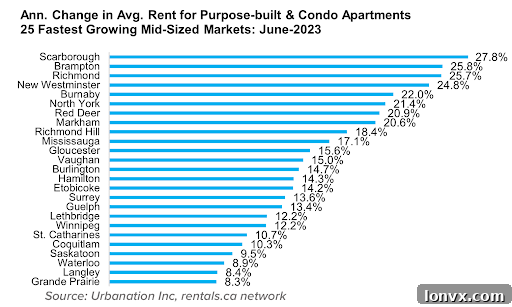
Among the 25 mid-sized markets across Canada, an astonishing nine GTA cities and areas recorded the highest year-over-year rent increases in June for these property types. This trend highlights a shifting dynamic where commuters and families are increasingly looking for more affordable, albeit still rising, alternatives outside the immediate core. The most significant annual surges include:
- Scarborough: Saw average annual rents rise by an astounding 27.8 percent, reaching $2,511.
- Brampton: Experienced a 25.8 percent increase, with average rents at $2,620.
- North York: Rents climbed by 21.4 percent to $2,612.
- Markham: Recorded a 20.6 percent increase, bringing average rents to $2,669.
- Richmond Hill: Saw an 18.4 percent rise, with rents averaging $2,679.
- Mississauga: Experienced a 17.1 percent increase, reaching $2,646.
- Vaughan: Rents increased by 15 percent to $2,537.
- Burlington: Recorded a 14.7 percent rise, with average rents at $2,561.
- Etobicoke: Saw a 14.2 percent increase, bringing rents to $2,630.
These figures underscore that the rental crisis is not confined to a few major downtown cores but is actively reshaping the housing market across entire metropolitan regions, pushing families and individuals into increasingly challenging financial situations.
The Hidden Costs of Living: The Rise of Roommate Accommodations
As traditional rental markets become increasingly unaffordable, a growing number of Canadians are turning to shared living arrangements. The latest report sheds light on the escalating costs of roommate accommodations, revealing another facet of the country’s deepening housing crisis.
Both British Columbia and Quebec experienced a significant 21 percent increase year-over-year in rent prices for roommate accommodations, reaching averages of $1,157 and $980, respectively, in June. This trend is particularly pronounced in provinces with high overall living costs, where sharing expenses becomes a necessity rather than just a preference.
Other provinces are also seeing substantial rises. Ontario witnessed an average roommate rent of $996, while Alberta averaged $808. Within specific cities, the costs for shared living are even more striking:
- Vancouver: Had the highest average roommate rent at a staggering $1,454.
- Toronto: Followed closely at $1,288.
- Ottawa: Recorded an average of $947.
- Montreal: Saw average roommate rents at $927.
These figures demonstrate the stark reality for students, young professionals, and lower-income individuals who rely on shared housing to remain in major urban centers. The increasing cost of even a single room in a shared apartment places immense financial pressure on these demographics, potentially impacting their ability to save, pursue education, or establish independent lives.
Looking Ahead: The Future of Canada’s Rental Landscape
The current trajectory of Canada’s rental market suggests that the challenges are unlikely to abate in the short term. With continued population growth, persistent interest rate pressures, and a sluggish pace of new housing supply, renters can anticipate sustained upward pressure on prices. This trend poses significant long-term implications for Canada’s economic competitiveness, social equity, and the overall quality of life for its residents.
Policymakers and industry stakeholders are facing mounting pressure to address this crisis with comprehensive and innovative solutions. Potential interventions could include accelerated housing construction initiatives, reforms to zoning laws to allow for greater density, incentives for purpose-built rental developments, and a re-evaluation of rental market regulations. Without concerted efforts to boost supply and enhance affordability, the dream of secure and affordable housing will remain out of reach for a growing segment of the Canadian population.
Navigating the Challenging Canadian Rental Landscape
Canada’s rental market is at a critical juncture, characterized by record-high rents and an acute affordability crisis stretching from coast to coast. The latest National Rent Report paints a clear picture of a market under intense strain, driven by strong demographic growth and economic factors that favor landlords. From Vancouver’s unparalleled costs to Calgary’s rapid ascent and the spreading affordability crunch in GTA suburbs, the need for effective and sustainable housing solutions has never been more urgent. As rents continue to climb, the collective focus must shift towards creating a housing ecosystem that is accessible, equitable, and sustainable for all Canadians.