
British Columbia Home Sales Navigating Interest Rate Headwinds: A Deep Dive into September’s Market
British Columbia’s vibrant real estate market, long a beacon of growth and investment, is currently navigating a period of significant adjustment. The Bank of Canada’s decision to re-ignite interest rate hikes in June has sent ripples throughout the province, directly impacting home sales and buyer sentiment. This article delves into the latest data from the British Columbia Real Estate Association (BCREA) for September, revealing how these economic shifts are reshaping the housing landscape.
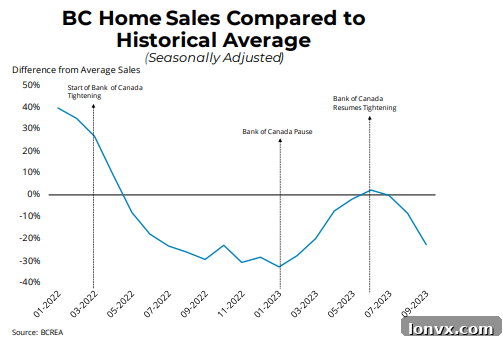
Interest rate hikes are a powerful tool used by central banks to combat inflation. While effective in cooling the broader economy, their impact on the housing market is often immediate and profound. Higher benchmark rates translate directly into increased mortgage costs for prospective homebuyers. For many, this means a significant reduction in purchasing power, making once-affordable homes suddenly out of reach. Brendon Ogmundson, Chief Economist at BCREA, succinctly captures this sentiment, stating, “Home sales in BC have clearly been impacted by the Bank of Canada’s recent tightening of interest rates, along with the resulting surge in mortgage rates.” This surge in borrowing costs has created an environment of heightened caution among buyers, leading to a notable slowdown in transactional activity across the province.
September’s Performance: A Closer Look at Market Dynamics
Despite the headwinds posed by rising interest rates, September witnessed a marginal uptick in the average price of a B.C. home. The average selling price last month reached $966,500, marking a 4.8 percent increase compared to September 2022, and remaining consistent with August’s figures. This modest year-over-year increase, however, tells only part of the story. While prices haven’t collapsed, the pace of appreciation has certainly moderated significantly from the frenetic activity seen in previous years, reflecting a market that is increasingly sensitive to economic pressures and affordability constraints.
The volume of sales, a more direct indicator of market activity, painted a clearer picture of the current slowdown. A total of 5,531 homes exchanged hands in September across British Columbia. While this figure represents an approximate 10 percent increase over September 2022, it’s crucial to contextualize this comparison. As Ogmundson points out, “…that month was a low point for sales last year.” September 2022 marked the initial phase of aggressive rate hikes, causing a significant jolt to the market. Therefore, while a year-over-year increase might appear positive on the surface, the current sales volume is still trending approximately 20 percent below the seasonal average, indicating a market grappling with reduced demand and increased buyer hesitancy in the face of elevated borrowing costs.
Sales Price and Volume Dynamics: Unpacking the Numbers
Delving deeper into the financial mechanics, the total value of home sales in September reached an impressive $5.3 billion. This figure represents a nearly 16 percent jump from the transaction values recorded in September of the previous year. This discrepancy between a modest average price increase and a substantial total value increase suggests a shift in the composition of sales, perhaps towards higher-value properties in certain segments, or simply the compounding effect of the slight price gain over a larger number of transactions compared to a very weak September 2022. It highlights the complex interplay of factors influencing market aggregate data.
However, when examining the broader year-to-date picture, the cumulative impact of the interest rate environment becomes even more apparent. The total sales volume from January to September experienced a significant downturn, decreasing by 15 percent to nearly $58 billion. Correspondingly, the number of units sold also saw an 11.5 percent reduction, totaling 59,570 units over the same period. This sustained decline in both volume and units underscores the cumulative effect of higher borrowing costs throughout the year, challenging the momentum that characterized the market in recent times. The year-to-date average price also registered a 4 percent drop, settling at $972,049. This demonstrates that while monthly prices might show fluctuations or slight increases, the overall trend over a longer period reflects a cooling market where prices are adjusting downwards from their peak levels as buyers face increasing affordability challenges.
Active Listings and Inventory: Shifting Towards a Balanced Market
One of the most encouraging developments for prospective homebuyers, and a key indicator of market rebalancing, is the notable increase in active listings. The province experienced a slight month-over-month increase, pushing total active listings to over 33,000. More significantly, this represents an approximately 8 percent rise year-over-year, marking the highest inventory levels seen in three years. This surge in available properties is a direct consequence of slowing sales – homes are spending more time on the market, leading to a build-up of inventory as demand moderates.
For buyers, increased inventory translates into more choice and potentially less intense bidding wars, a stark contrast to the fiercely competitive seller’s markets of recent years. For sellers, it means a need for more strategic pricing, effective home staging, and greater patience in a less frenzied environment. The sales-to-active listings ratio, a critical metric that measures market temperature by comparing the number of sales to available listings, currently hovers around 17 percent for British Columbia. This ratio helps determine if a market favors buyers, sellers, or is balanced. Generally, a ratio between 12-20 percent is considered a balanced market, while below 12 percent indicates a buyer’s market and above 20 percent a seller’s market. The fact that only Victoria’s market currently exceeds 20 percent suggests that most regions in BC are either balanced or leaning towards a buyer’s market, a significant shift from previous conditions.
Brendon Ogmundson’s analysis reinforces this shift, noting that “as sales slow and listings rise, we’re getting into balanced market territory.” This is a welcome development for those hoping for a more sustainable and less volatile housing market. A balanced market typically offers more stability, reduces the risk of speculative bubbles, and allows both buyers and sellers to operate with more deliberation. However, achieving a “sustainably balanced market” in the long run requires a more substantial adjustment. According to Ogmundson, active listings would need to increase by more than half their current levels to firmly establish a long-term equilibrium. This indicates that while the market is moving in the right direction, there is still considerable ground to cover before supply truly meets demand in a way that creates enduring stability and genuinely improved affordability across the province.
The Broader Economic Context and Future Outlook for BC Real Estate
The current state of British Columbia’s housing market cannot be viewed in isolation. It is intrinsically linked to broader economic factors, including persistent inflation, global economic uncertainties, and consumer confidence. The Bank of Canada’s mandate to control inflation often means painful but necessary adjustments in lending rates, which inevitably ripple through sectors like real estate. While the immediate impact is a slowdown in transactional activity and price adjustments, the long-term goal is to foster a stable economic environment where sustainable growth can occur. Potential shifts in inflation trends, geopolitical events, or changes in employment figures could all influence the Bank of Canada’s future policy decisions, which in turn will dictate the trajectory of mortgage rates and the housing market.
Looking ahead, the market is poised for continued vigilance and adaptation. While the recent increase in inventory offers a glimmer of hope for greater affordability and choice for prospective homeowners, the challenge of high borrowing costs persists, keeping a lid on widespread demand. Prospective homebuyers will need to carefully assess their financial positions, explore diverse financing options, and remain informed about evolving market trends and potential shifts in interest rate policy. Similarly, sellers may need to adjust their expectations, recognizing that the era of rapid price appreciation and swift, unconditional sales might be temporarily on hold. The BCREA’s insights suggest a market in transition – one where the initial shock of interest rate hikes is giving way to a more measured and potentially more sustainable pace, albeit with significant adjustments still required to achieve a truly balanced and accessible housing market across British Columbia.
Enjoying this article?
Get the latest REM articles in your inbox 3x week so you stay up to date on the latest in the Canadian real estate industry