
Don’t miss out—join us online for REM’s monthly market breakdown on Aug. 26 at 2 PM ET. REM columnist Daniel Foch will analyze CREA’s latest stats, regional variations, and what shifting sentiment means for Realtors—register here.
Navigating the Nuances of the Greater Toronto Area Housing Market: Beyond the Headlines
The real estate headlines are once again ablaze with optimistic pronouncements. Phrases like “home sales are up double digits,” “buyers are back,” and “the market is heating up” dominate the news cycle. While such headlines might suggest a triumphant return to the boom times of previous years in the Greater Toronto Area (GTA) housing market, a closer inspection of the data reveals a far more complex picture. For those deeply entrenched in this business, whether as buyers, sellers, or seasoned real estate professionals, it’s the subtle details, the fine print of market reports, not the sensational front-page stories, that truly indicate the direction of the market.
Yes, it is factually correct that sales figures have shown an increase. However, the crucial question that often goes unasked is: from what baseline are these gains being measured? Understanding the context behind these numbers is paramount to making informed decisions in today’s dynamic real estate landscape.
Deconstructing the “Sales Surge”: A Rebound from a Low Base
The recent report from the Toronto Regional Real Estate Board (TRREB) proudly highlights a significant year-over-year increase in sales, often cited as a 10.9 percent jump. On paper, this figure appears robust and indicative of strong market recovery. However, it’s essential to temper this enthusiasm with a dose of reality. This reported growth is benchmarked against a particularly slow period in the preceding year—a July that represented one of the weakest sales performances in recent memory.
Comparing current performance to a period of exceptionally low activity can naturally inflate percentage gains, creating an illusion of a roaring market. This is not a return to the frenetic, bidding-war driven environment of 2021, where homes consistently sold above asking with multiple offers. Instead, these gains are primarily a reflection of climbing out of a trough. While any upward movement is welcome, gains derived from such a low base can feel impressive statistically but often represent a relatively thin improvement when viewed against the broader historical context of the GTA housing market. Beneath the headline numbers, critical indicators like average home prices are still showing declines, the available housing inventory continues to accumulate, and properties are generally taking longer to sell. These aren’t the characteristic signs of a market in full swing; rather, they signal a tentative, fragile rebound still struggling to solidify its footing amidst persistent uncertainties.
The Paradox of Affordability: Prices Dip, but Headwinds Remain
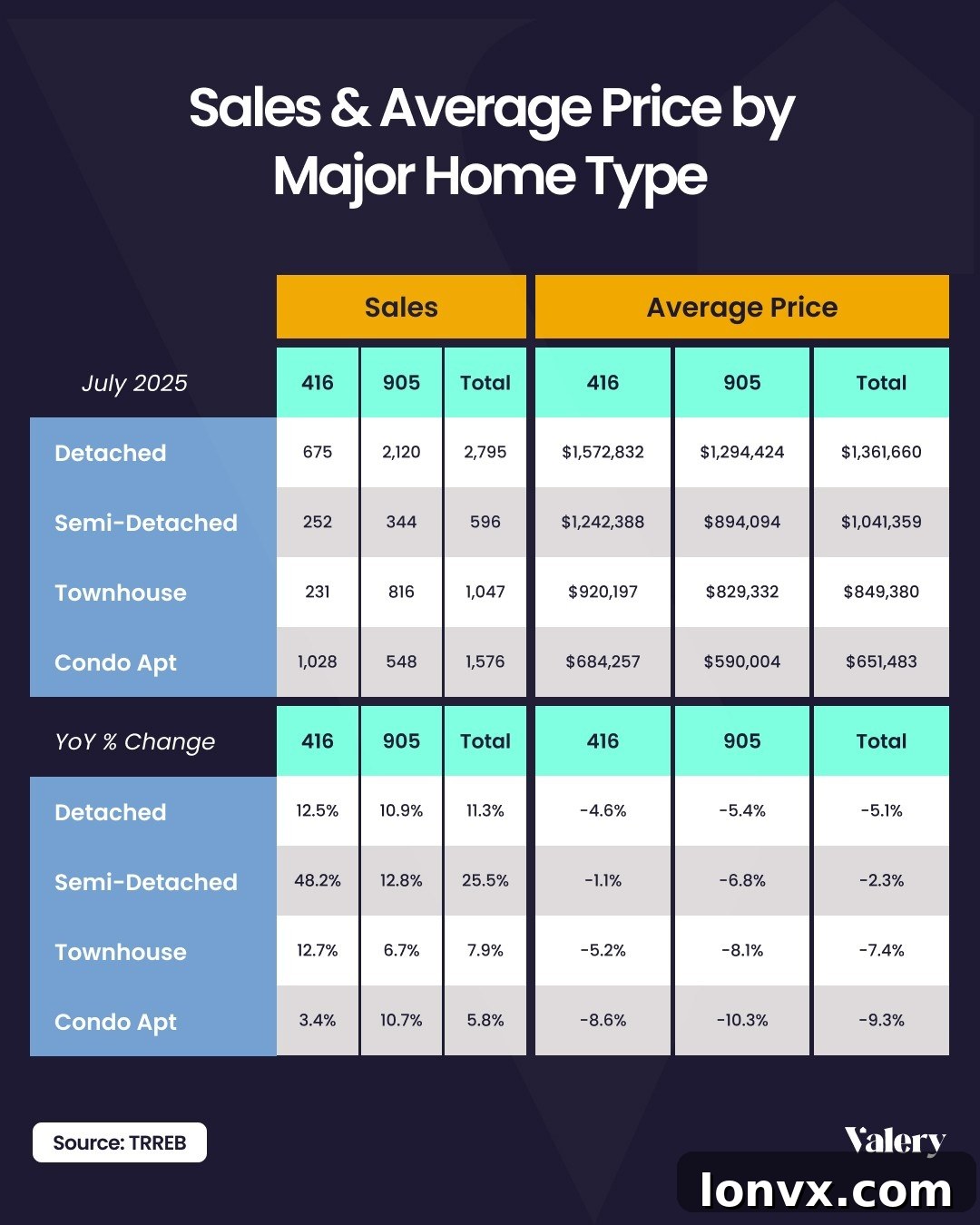
Analyzing the average home price across the GTA further illuminates the market’s true state. The average home price currently hovers around $1,051,719, marking a notable 5.5 percent decrease compared to the same period last year. A deeper dive into property types reveals even more significant adjustments: detached homes have seen a 5.1 percent decline, while the condominium segment has experienced a more substantial drop of 9.3 percent. These aren’t minor fluctuations; they represent meaningful corrections across various housing categories, shifting the market dynamics considerably.
Interestingly, this downward trend in prices has a silver lining: it improves affordability, at least superficially. This recalibration has effectively re-engaged a segment of buyers who were previously priced out or sidelined during the market’s peak exuberance. Their re-entry is undeniably contributing to the upward tick in sales volumes. These buyers aren’t chasing skyrocketing prices; rather, they are entering a market that has, in a sense, come back to meet their financial realities. This shift in buyer motivation is a critical element in understanding current transaction patterns.
However, it’s crucial to approach the concept of “improving affordability” with caution in the current economic climate. Despite the price adjustments, interest rates have not experienced any substantial easing. Mortgage qualification criteria remain stringent, influenced by ongoing stress tests and lenders’ conservative stances. For every buyer enthusiastically re-entering the market, there’s another household deliberately holding back, grappling with the lingering question of whether the market has truly hit its bottom or if further corrections are yet to come. This pervasive uncertainty acts as a significant drag on overall market momentum, preventing a widespread surge in demand.
The Inventory Imbalance: Supply Outpacing Genuine Demand
One of the most telling indicators in the current GTA housing market is the dramatic increase in active listings. Year-over-year, active listings have surged by an impressive 26.2 percent, pushing the total number of homes available on the market across the GTA to over 30,000 – a level not observed in several years. This substantial accumulation of inventory demands careful analysis.
In contrast to this rise in active listings, the volume of new listings entering the market has shown only a modest increase of 5.7 percent year-over-year, and even this was less pronounced than the uptick seen in previous months. This disparity points to a crucial insight: the swelling active inventory isn’t primarily being driven by a sudden influx of fresh supply. Instead, it indicates that existing properties are simply sitting on the market for extended periods. This accumulation of “old” supply is a clear manifestation of a demand-side problem. Homes are not transacting with the rapid velocity witnessed during the overheated periods of 2021. The average number of days a home spends on the market (LDOM) has jumped by a notable 25 percent year-over-year, underscoring that properties are lingering, and the majority of prospective buyers remain hesitant, taking their time to evaluate options and negotiate.
Segmented Struggles: Condo Corrections and Broad-Based Softness
The pain points in the current market are particularly acute within the condominium sector. For those who hold pre-construction condo units, the market’s struggles are not abstract statistics but a tangible reality reflected in their inboxes: a proliferation of assignment listings, noticeable price drops, and various developer incentives designed to spur sales. The condo market is undoubtedly bearing the brunt of the ongoing correction, feeling the full force of adjusted expectations and tighter financing conditions.
Specifically, condominiums in the 905 regions have witnessed price drops exceeding 10 percent. Even in the highly sought-after downtown core, where demand historically shows greater resilience, condo prices have slipped by nearly 9 percent. This represents a significant reversal for a segment that, for years, was touted as an endless source of investor upside. The dream of quick appreciation has, for many, given way to a more sober reality.
The softness, however, is not confined to condos. Townhouses and semi-detached homes, traditionally viewed as stable middle-market staples, have also experienced year-over-year price declines of 7.4 percent and 2.3 percent, respectively. Detached homes, though often seen as the most resilient, have also fallen by 5.4 percent, positioning them squarely between the other categories. What these figures collectively illustrate is a broad-based market deceleration, rather than an isolated slump within a single sector. Every major property type is feeling the chill of reduced buyer urgency and increased inventory, signaling a more comprehensive market recalibration.
A Market Lacking Conviction and Momentum
The prevailing challenge in today’s GTA real estate market isn’t a fundamental lack of desire among potential buyers. Instead, it’s a pronounced absence of conviction and urgency. During periods of low interest rates and rapidly appreciating prices, hesitation carried a significant financial penalty, often leading to buyers missing out on opportunities. Today, the dynamic has completely reversed: patience is often rewarded. Buyers are no longer gripped by the fear of missing out (FOMO); rather, they are exercising the fear of overpaying (FOOP).
This profound shift in market psychology is incredibly powerful and has effectively rewired the market’s metabolism. Buyers are now empowered to negotiate harder, knowing they have more options and less competition. Sellers, in turn, are being compelled to adjust their expectations downwards, aligning with the new market reality rather than holding onto peak-market valuations. This adjustment results in an entire transaction cycle that has elongated, with longer listing periods, more back-and-forth negotiations, and slower closing times.
In such a market environment, while transaction volume might show an increase, as it did in recent months, this volume is frequently more reactive than proactive. It’s driven by opportunistic buyers who are “bottom fishing”—seeking out perceived deals and properties that align with their revised affordability thresholds and investment strategies. It’s a market of selective engagement, not widespread enthusiasm.
Is This the Bottom of the Market? A Cautious Outlook
The question on everyone’s mind is, inevitably: have we reached the bottom? It’s plausible, but real estate market bottoms are rarely characterized by sharp, decisive turning points. They almost never announce themselves with fanfare. More often, they manifest as a prolonged period of flattening, akin to a tired breath exhaling slowly. What recent market activity has provided is a clear indication of a market attempting to find stability, not one unequivocally bursting back to life with renewed vigor.
Genuine and sustained market momentum, which would signal a true recovery, will likely materialize only when two critical factors align in a meaningful way:
- Significant Easing of Interest Rates: A substantial reduction in benchmark interest rates by central banks is essential to unlock credit, significantly improve mortgage qualification for a broader segment of the population, and restore widespread buyer confidence. This would alleviate a primary barrier to entry for many prospective homeowners.
- Seller Expectation Recalibration: Sellers must fully embrace the current market reality and adjust their pricing expectations to align with what buyers are genuinely willing and able to afford. The gap between seller aspirations and buyer capacity needs to close for transactions to flow more smoothly and consistently.
Until these two pivotal conditions converge, the market is likely to continue its current trajectory of sideways movement. We can anticipate continued observations of marginally increased transaction volumes, slight downward pressure on prices, a persistent abundance of listings, and ongoing delays in sales. It’s neither a dramatic crash nor an explosive boom, but rather a slow, deliberate digestion of past excesses and an ongoing adjustment to new economic realities.
Policy, Perception, and Reality: Beyond the Foreign Buyer Ban
It’s worth noting TRREB’s commentary regarding the Canadian federal foreign buyer ban. While many Canadians hold the perception that foreign investment in residential real estate has been completely shut out, this isn’t entirely accurate. The policy includes several key exemptions, particularly for multi-unit residential properties, development land, and certain types of rural housing. These exemptions mean the ban is not as comprehensive as often portrayed.
However, and this is a crucial point, it’s vital to be clear: foreign buyers are not the primary drivers of the current GTA housing market dynamics. Consequently, their partial absence is not the fundamental cause of the ongoing slowdown or market adjustments. The genuine forces shaping the market are profoundly domestic: the persistent challenges of affordability for local buyers, elevated household debt levels, and the acute sensitivity of homeowners and prospective buyers to prevailing interest rates. These internal factors are exerting a far greater influence on market activity than any policy tweaks related to international investment. Blaming or crediting foreign policy adjustments for the broader market trends distracts from these core economic fundamentals that truly dictate the pace and direction of Canadian real estate.
Finding Clarity Amidst the Market Noise
The current Greater Toronto Area housing market is undeniably challenging to interpret. The vast array of data often presents mixed signals, and the news headlines swing wildly between effusive optimism and dire predictions of impending doom. However, by diligently stripping away this surrounding noise and focusing on the underlying economic and psychological currents, a singular, overarching truth emerges with stark clarity:
We are firmly in the hangover phase of a market correction.
The excesses accumulated during the hyper-active periods of 2021 and 2022 are still being systematically worked out of the system. This process manifests in various ways: some households find themselves over-leveraged, struggling with higher mortgage payments; others remain underhoused, unable to find suitable and affordable options. While prices have undergone necessary corrections, the broader economic backdrop remains shadowed by uncertainty. TRREB’s assessment that the Canadian economy is merely “treading water” aptly captures the prevailing cautious sentiment, impacting everything from employment stability to consumer spending and, by extension, housing demand.
This is not a market characterized by irrational exuberance, nor is it one that warrants panic. It is, instead, a period demanding careful observation, strategic and selective action, and a resolute resistance to speculative “spin” from any direction. For all participants, discernment is the ultimate asset.
A Final Word on Prudence and Patience
In conclusion, it is crucial not to mistake a fleeting flicker for a sustained flame. Recent sales upticks may have given the market a pulse, but they are not indicative of a robust, full-fledged comeback. For anyone involved in the GTA real estate market—whether you are buying, selling, or advising clients—your most significant advantage right now lies in your ability to understand and navigate nuance. It is imperative to look beyond the often-misleading headlines, to meticulously study the available inventory, and to closely monitor the time properties are spending on the market. These granular details offer a more accurate reflection of underlying conditions than broad-stroke summaries.
Above all else, stay disciplined in your approach. The real estate market, in its fundamental essence, consistently rewards patience and thoughtful strategy. It always has, and in these uncertain times, that principle holds truer than ever.