
The Canadian housing market is poised to conclude 2024 with a remarkable and somewhat unexpected surge in activity, hinting at a significantly more optimistic trajectory for the upcoming year. A substantial upswing in home sales growth observed throughout the fourth quarter has dramatically reshaped previous expectations, pointing towards a vibrant and dynamic landscape for 2025. This fresh outlook, detailed in the latest comprehensive report from TD Economist Rishi Sondhi, underscores the resilience and adaptive nature of Canada’s real estate sector.
For potential homebuyers, sellers, and investors, understanding these shifts is paramount. The market is not merely recovering; it’s demonstrating a powerful return to momentum, influenced by a confluence of economic factors and policy adjustments that are setting the stage for renewed growth and evolving regional dynamics across the nation.
The Q4 Surge: Unpacking Unexpected Momentum
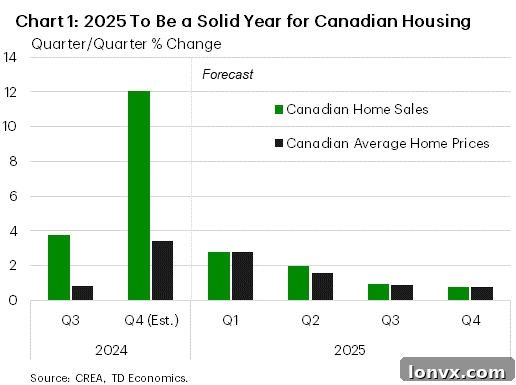
TD Economics’ latest analysis reveals that Canadian home sales experienced an impressive approximately 12 percent increase quarter-over-quarter in Q4 of 2024. This significant boost is particularly pronounced in key provinces such as British Columbia and Ontario, which have emerged as frontrunners in this renewed market vigour. Rishi Sondhi notes that this represents “a major change relative to our September projection,” indicating a rapid and decisive shift in market conditions that caught many by surprise.
Crucially, this accelerated growth means that sales are now projected to not only reach but surpass their pre-pandemic levels within Q4 2024, a milestone initially anticipated for the first quarter of 2025. This early achievement highlights a stronger-than-expected rebound and a powerful underlying demand that is pushing the market forward with considerable force. The implications are far-reaching, signalling robust buyer confidence and a potential for sustained activity as the market transitions into the new year. The ability of the market to regain and even exceed pre-pandemic benchmarks so swiftly speaks volumes about the underlying economic stability and consumer appetite for homeownership, especially after periods of uncertainty and adjustment.
Driving Forces Behind the Resurgence
Several pivotal factors are converging to fuel the robust breakout observed in the fourth quarter, creating a fertile environment for sustained growth in the Canadian housing market:
- Falling Borrowing Costs: A Catalyst for Buyer Activity. One of the primary drivers behind the renewed enthusiasm in the housing market is the easing of interest rates and the subsequent reduction in borrowing costs. As central banks potentially signal a more dovish stance or at least a pause in rate hikes, the cost of mortgages becomes more manageable for prospective buyers. This directly translates into increased purchasing power, allowing more individuals and families to qualify for loans or to afford a larger mortgage. Lower interest rates also tend to stimulate refinancing activity, which can free up capital for some homeowners, indirectly supporting the broader economic environment that underpins housing demand. The psychological effect of falling rates is also significant, as it instils greater confidence in buyers who may have been waiting on the sidelines for a more favourable financial climate.
- Sustained Economic Growth: A Favourable Macroeconomic Backdrop. The Canadian economy’s continued expansion provides a crucial foundation for robust housing demand. A healthy economy typically means lower unemployment rates, higher average incomes, and improved consumer confidence. When people feel secure in their jobs and have disposable income, they are more likely to consider major investments like homeownership. Economic growth also supports population growth through immigration, which consistently adds new households to the market, further bolstering demand for housing across all types and price points. A strong labour market ensures that more individuals meet the income criteria for mortgage qualification, thus expanding the pool of eligible buyers.
- Mortgage Rule Changes: Shaping Demand and Prices. New regulations implemented in December are also anticipated to play a significant role in stimulating both housing demand and prices. While specific details of these changes can vary, they often involve adjustments to mortgage stress tests, loan-to-value ratios, or down payment requirements. Favourable adjustments can make it easier for first-time buyers to enter the market or for existing homeowners to upgrade, thereby injecting fresh demand. Such policy shifts are carefully crafted by regulatory bodies to balance market stability with accessibility, and in this instance, they appear to be leaning towards facilitating market activity. The anticipation of these changes, or their immediate implementation, often spurs buyers into action, contributing to the observed market momentum.
Diverse Regional Trends: A Nuanced Outlook
While the nationwide trends paint a broadly “sunnier” picture for the Canadian housing market, it is essential to acknowledge that regional nuances are profoundly shaping the forecast. The diverse economic and demographic landscapes across Canada mean that local markets will experience this national momentum in unique ways, with varying impacts on sales volumes and price appreciation.
British Columbia and Ontario: Leading the Charge with Challenges
These two populous provinces are firmly positioned to lead in sales growth throughout 2025. This strong performance is largely fueled by a significant reservoir of pent-up demand. Many potential buyers in these regions had postponed their housing plans due to previous interest rate hikes, affordability concerns, or market uncertainty. As borrowing costs ease and confidence returns, these buyers are now re-entering the market, creating a surge in transaction volumes.
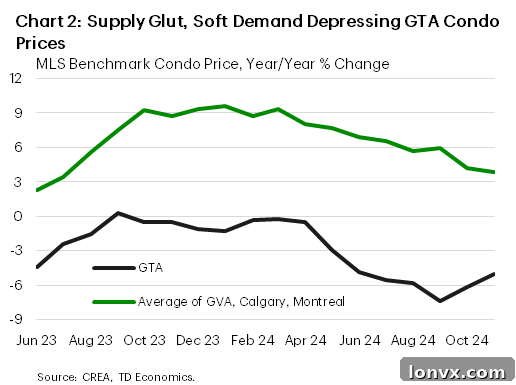
However, despite robust sales activity, persistent affordability challenges in both British Columbia and Ontario may temper the pace of price increases. High baseline property values, coupled with intense competition, mean that while more homes are selling, the rate at which prices climb might be constrained by what buyers can realistically afford. In Ontario, particularly within the bustling Toronto area, the condominium market faces distinct oversupply issues. A significant inventory of new condo units entering the market, combined with investor caution, is likely to result in continued price declines or stagnation for this segment next year. Conversely, Sondhi shrewdly observes, “This condo market weakness should make it easier for more expensive types of housing, like detached units, to outperform, delivering some offsetting upside for average prices.” This indicates a potential segmentation of the market, where luxury or more spacious single-family homes may see stronger appreciation, balancing out the overall average price growth.
The Prairies: Pillars of Stability and Steady Growth
The Prairie provinces, encompassing Alberta, Saskatchewan, and Manitoba, are expected to maintain a comparatively stable trajectory. This stability is primarily attributable to their significantly better affordability metrics compared to Canada’s coastal regions. Housing prices in the Prairies are more accessible for a broader range of incomes, which helps to sustain consistent demand. Furthermore, these regions are experiencing a slower deceleration in population growth compared to some other parts of the country. While other provinces might see a tapering off of interprovincial migration or international arrivals, the Prairies continue to attract newcomers, supporting a steady, albeit less explosive, expansion of their housing markets.
Alberta, in particular, stands out for its sustained strength. “Our forecast for Alberta’s home price growth suggests that by the end of 2026, average home prices will have expanded for 7 straight years in the province.” This remarkable streak underscores the province’s economic resilience, driven by a diversified economy, a strong energy sector, and a growing tech industry, all of which contribute to job creation and sustained housing demand. This long-term trend makes the Prairies an attractive option for buyers seeking more stable and predictable market conditions.
Quebec: Buoyed by Tight Conditions and Supportive Policies
Quebec’s housing market is projected to experience solid price gains in 2025, driven by a combination of tight market conditions and supportive federal policies. “Tight market conditions” typically refer to a low inventory of available homes relative to the number of active buyers, creating a competitive environment that naturally pushes prices upward. This imbalance between supply and demand is a key factor in Quebec’s anticipated appreciation. Additionally, the province benefits from broader federal policies designed to support homeownership, such as first-time buyer incentives, adjustments to mortgage insurance rules, or continued robust immigration targets that increase the overall housing pool. These external supports, combined with strong local demand, are creating a conducive environment for healthy price growth within the province.
Atlantic Canada: From Boom to Moderation
Atlantic Canada, which experienced a significant housing boom during the pandemic due to an influx of interprovincial migration, is now facing a period of adjustment. While prices in provinces like Nova Scotia, New Brunswick, and Prince Edward Island are likely to continue their upward trend in the short term, the pace of growth is expected to moderate. A marked slowdown in interprovincial migration, as pandemic-era relocation trends normalize, is significantly reducing ownership demand in the region. This reduction in the influx of new buyers means that the intense competition that characterized the market a couple of years ago is easing. Consequently, the region may face significantly slower price growth in 2026 as the market adjusts to a more normalized level of demand. This shift represents a transition from an overheated market back to a more sustainable and balanced growth trajectory, still positive but at a reduced pace.
Risks to the Outlook: Navigating Potential Headwinds
Despite the generally positive trajectory and the renewed optimism surrounding the Canadian housing market, Rishi Sondhi’s report prudently highlights that notable risks remain. These potential headwinds could impact the market’s performance, necessitating careful monitoring by all stakeholders.
One significant challenge identified revolves around potential tariff threats. The imposition of new tariffs, whether full or partial, could have detrimental effects on the broader economy. Such measures typically lead to increased costs for imported goods, which can fuel inflation, disrupt supply chains, and negatively impact specific industries. An economic downturn resulting from tariff implementation would inevitably damage the housing market, potentially reducing consumer confidence, dampening job growth, and making affordability even more challenging. Sondhi cautions, “Full or partial implementation will damage the economy and, therefore, housing more than we’ve built into our baseline.” This underlines the fragility of economic forecasts when external policy risks are in play.
Conversely, there is also an upside potential that could further bolster the market beyond current expectations. Falling borrowing costs, should they decline more rapidly or more significantly than anticipated, could exert greater upward pressure on sales volumes and home prices. If central banks adopt a more aggressive rate-cutting strategy, the resulting lower mortgage rates would substantially enhance buyer affordability and stimulate even stronger demand. This scenario could lead to an even more robust market than currently projected, acting as a powerful counterbalance to the identified downside risks. The delicate balance between these potential risks and opportunities will define the market’s ultimate performance in the coming year.
For a detailed analysis and further insights into these economic projections and their implications for the Canadian real estate sector, you can read the full report from TD Economics.