
Canadian Rental Market: Unpacking the Recent Decline in Average Asking Rents
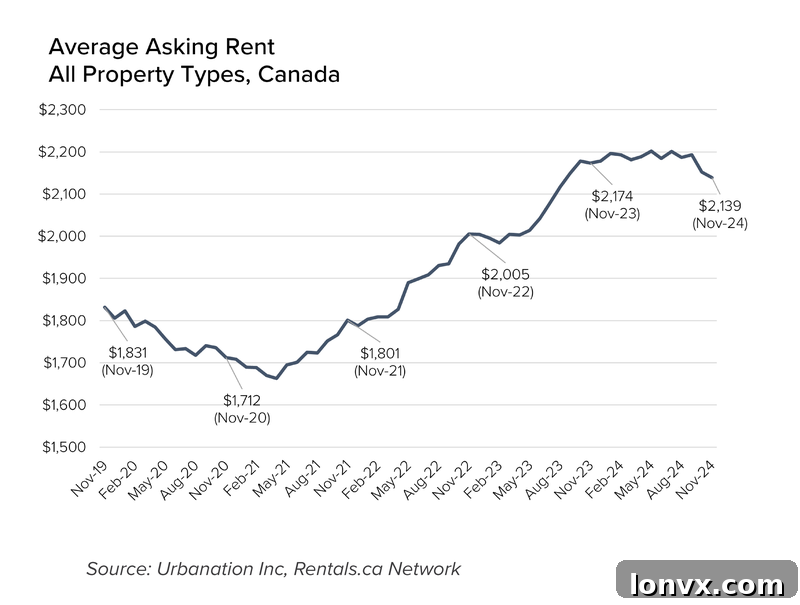
The Canadian residential rental market experienced a notable shift in November, with average asking rents falling to $2,139 across the country. This marks a significant 15-month low, according to the latest National Rent Report published by Rentals.ca and Urbanation. The report highlights a 1.6 percent year-over-year decrease and a 0.6 percent dip compared to October, indicating a broader softening trend that began earlier in the fall, with rents down 2.2 percent over the past three months.
Shaun Hildebrand, President of Urbanation, commented on these developments, stating, “Overall, the recent decline in rents has been very mild and is allowing affordability to improve following a rapid escalation in rents over the past few years.” Hildebrand further elaborated that these declines are primarily concentrated within the secondary market, encompassing condos and houses, particularly in British Columbia and Ontario. In contrast, purpose-built rental properties have largely maintained stable rent levels, suggesting varying dynamics within different segments of the rental landscape.
Despite this recent downturn, the current rental rates remain substantially higher than those observed in previous years. Rents are still up by a significant 6.7 percent compared to two years ago and a substantial 18.8 percent from three years ago. Over the past five years, the average annual increase in rents has been 3.4 percent, which the report suggests is “generally in line” with long-term historical trends. This juxtaposition highlights that while the recent dip offers a glimmer of relief, the overarching challenge of rental affordability in Canada persists after several years of accelerated growth.
Regional Disparities: A Closer Look at Canada’s Diverse Rental Markets
The national average, while indicative of a broader trend, masks significant regional variations that highlight the diverse economic and demographic landscapes across Canada. Some provinces experienced substantial declines, while others continued to see robust growth, reflecting localized pressures and opportunities.
Provinces Experiencing Rent Declines
- Ontario: The province witnessed the steepest declines, with average apartment rents dropping 6.4 percent year-over-year to $2,351. Two-bedroom apartments were particularly affected, seeing a notable 7.6 percent decrease. This softening in Ontario, a traditionally hot market, could be attributed to increased supply from new constructions and a potential cooling of demand.
- British Columbia: Another high-cost province, B.C., reported an annual decrease of 2.3 percent, bringing average rents to $2,524. While less dramatic than Ontario’s decline, it signals a similar trend of moderation in one of Canada’s most expensive rental markets.
- Quebec: The province experienced a marginal decline of 0.4 percent, with the average asking rent settling at $1,969. This relatively stable trend suggests a more balanced market compared to its Western counterparts, although it still reflects a slight downward pressure.
Provinces Experiencing Rent Increases
In stark contrast to the national trend, several provinces defied the overall decline, reporting significant increases in average asking rents. These regions often benefit from inter-provincial migration, stronger job markets, or a lower cost of living compared to major urban centers.
- Alberta: Rents in Alberta rose by a healthy 3.7 percent, continuing its trend of robust growth. This surge is likely driven by a growing economy, increased job opportunities, and an influx of residents seeking more affordable living options compared to Ontario and B.C.
- Saskatchewan: The province saw an impressive 12.1 percent jump in average rents, indicating strong demand and potentially tightening supply within its smaller market.
- Manitoba: Similarly, Manitoba’s average rent climbed by 7.9 percent, reflecting sustained interest and a competitive rental environment.
- The Maritimes (New Brunswick & Nova Scotia): New Brunswick experienced a 5.1 percent increase, while Nova Scotia saw a 4.4 percent rise. These Atlantic provinces have become attractive destinations for those seeking a lower cost of living and a different pace of life, leading to heightened rental demand.
- Newfoundland and Labrador: This province remained relatively stable, with rents declining by only 0.4 percent, essentially mirroring the slight national downtick but showcasing more resilience than Ontario or B.C.
Major City Markets: A Deep Dive into Declining Rents in Urban Hubs
Canada’s largest and often most expensive cities have been at the forefront of the recent rental market adjustments. All five of the country’s biggest metropolitan areas reported year-over-year declines, offering some respite to tenants in these high-demand markets.
- Toronto: Canada’s largest city saw its average asking rent drop by 9.4 percent year-over-year to $2,640, reaching a 28-month low. This significant correction in Toronto’s market could be a result of increased rental supply, coupled with a slight softening in demand due to economic uncertainties and high interest rates making homeownership less accessible, thus increasing the pool of potential renters in a crowded market.
- Vancouver: Following a similar trajectory, Vancouver experienced an 8.9 percent decline, bringing average rents to $2,888, its lowest point in 30 months. As one of the world’s least affordable cities, any reduction in Vancouver’s rental costs, however modest, is a welcome development for residents struggling with the high cost of living.
- Calgary: Despite Alberta’s overall upward trend, Calgary’s rental market saw a year-over-year decrease of 5.8 percent. This suggests that while the province as a whole is growing, specific urban dynamics within Calgary might be influencing its rental rates, perhaps due to a temporary increase in vacancy or a shift in the local job market.
- Ottawa: The nation’s capital reported a 3 percent decrease in average asking rents. This decline aligns with the broader Ontario trend and indicates a period of adjustment after sustained growth in previous years.
- Montreal: Quebec’s largest city saw a 2.3 percent decrease, mirroring the provincial trend. While Montreal’s rental market has historically been more affordable than Toronto or Vancouver, it too is undergoing a period of recalibration.
Underlying Factors Driving Rental Market Volatility
The intricate dance between supply and demand continues to dictate the direction of Canada’s rental market. Several key factors are at play, contributing to the observed fluctuations:
- Increased Supply: A surge in new purpose-built rental constructions, particularly in major urban centers like Toronto and Vancouver, has gradually increased the available housing stock. While not enough to solve the long-term affordability crisis, this new supply can temporarily alleviate pressure in specific sub-markets.
- Interest Rate Hikes: Elevated interest rates have made homeownership more expensive and less accessible for many, forcing them into the rental market. However, high rates also disincentivize some investors from purchasing additional properties for rental, potentially balancing the supply side. Furthermore, the economic slowdown induced by higher rates can reduce overall consumer spending and migration, indirectly impacting rental demand.
- Seasonality: Rental markets often experience seasonal slowdowns in late fall and winter, as fewer people tend to move during colder months or holidays. This natural cycle contributes to temporary dips in asking rents.
- Economic Slowdown: General economic uncertainty and a softening job market in some regions can lead to reduced household formation and a more cautious approach to spending, influencing the demand for higher-priced rental units.
- Migration Patterns: While international immigration continues to fuel demand, inter-provincial migration patterns are shifting. The movement of residents from expensive provinces like Ontario and B.C. to more affordable regions in Alberta and the Maritimes is a significant driver of localized rental market trends.
The Road Ahead: What to Expect from Canada’s Rental Market
Forecasting the future of the Canadian rental market is complex, given the interplay of numerous economic and social factors. While the recent decline offers a modest reprieve, most analysts believe it may be temporary or signify a stabilization rather than a sustained downturn. The long-term demand for rental housing, fueled by ongoing immigration and a challenging homeownership landscape, remains robust.
Experts anticipate that interest rate decisions by the Bank of Canada will continue to play a crucial role. A pivot to lower rates could ease some of the financial pressure on potential homebuyers and indirectly influence the rental market. However, the fundamental imbalance between housing supply and demand in many parts of the country suggests that significant, sustained drops in rent are unlikely in the near future. Instead, a period of more moderate growth or stabilization might be the most probable scenario, allowing for a gradual improvement in affordability, albeit from historically high levels.
The provincial and city-specific trends will likely continue to diverge, with growth concentrated in more affordable regions and stabilization or slight declines in the most expensive urban centers as supply catches up. Policy initiatives aimed at increasing housing density and accelerating construction will be vital in addressing the structural issues contributing to Canada’s rental affordability challenges.
Conclusion
The recent National Rent Report paints a nuanced picture of Canada’s rental market. While the national average asking rent has seen a welcome decline to a 15-month low, particularly in major urban centers and high-cost provinces, this relief is mild and uneven. Many provinces, especially in the Prairies and Atlantic Canada, continue to experience strong rental growth. This highlights a dynamic and segmented market, where localized economic conditions, supply increases, and shifting migration patterns create vastly different experiences for renters across the country. As we move forward, careful monitoring of these regional variations and a holistic approach to housing policy will be crucial for navigating the evolving landscape of Canadian rental affordability.
Enjoying this article?
Get the latest REM articles in your inbox 3x week so you stay up to date on the latest in the Canadian real estate industry
We respect your privacy and will never share your email.