
The Canadian housing market continues to navigate a landscape shaped by evolving economic forces, interest rate adjustments, and shifting affordability dynamics. According to the latest comprehensive outlook from TD Economics, the nation’s housing sector is poised to reach its cyclical low point this year. While this signals a potential stabilization, prospective buyers and sellers should temper expectations, as a dramatic, rapid rebound is not anticipated in the immediate future. This detailed analysis delves into the forecasts for 2023 and 2024, outlining the challenges and opportunities across different regions of Canada.
TD Economics economists project that Canadian home sales will bottom out “some time” in early 2023. This downturn is expected to result in a peak-to-trough decline of approximately 20 percent, a significant recalibration following years of unprecedented growth. This forecast, reiterated in their Provincial Housing Market Outlook, aligns with the Bank of Canada’s aggressive monetary tightening cycle. Rishi Sondhi, a leading economist for TD Economics, points to the Bank of Canada’s anticipated “modest” rate hike in January as the likely culmination of this tightening phase, setting the stage for the market’s eventual stabilization.
Understanding the interplay between interest rates, inflation, and housing market activity is crucial. The Bank of Canada’s concerted efforts to curb inflation through successive rate hikes have directly impacted borrowing costs, cooling buyer demand and tempering exuberance in the market. While higher rates have undoubtedly exerted downward pressure on sales volumes and prices, they are a necessary measure to restore economic balance. The market’s adjustment period is a testament to the effectiveness of these policies, albeit with short-term implications for homeowners and aspiring buyers.
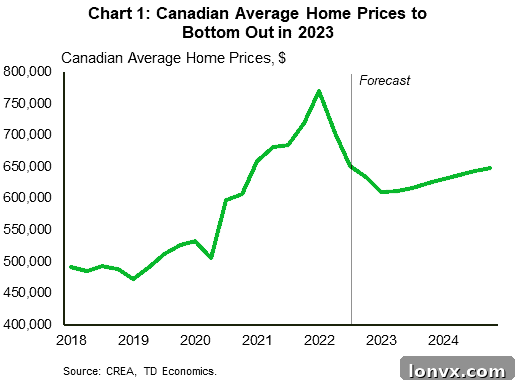
2023: A Challenging Horizon and Historic Lows
Looking ahead into 2023, economists, including Rishi Sondhi, caution that tougher times may still persist for the Canadian housing market. The year is anticipated to mark the weakest sales performance since 2001, underscoring the severity of the current market correction. This projected low sales volume is primarily attributed to what Sondhi describes as “…the poorest affordability backdrop since the late 80s/early 90s.” This critical factor combines elevated home prices with significantly higher interest rates, making homeownership increasingly challenging for many Canadians.
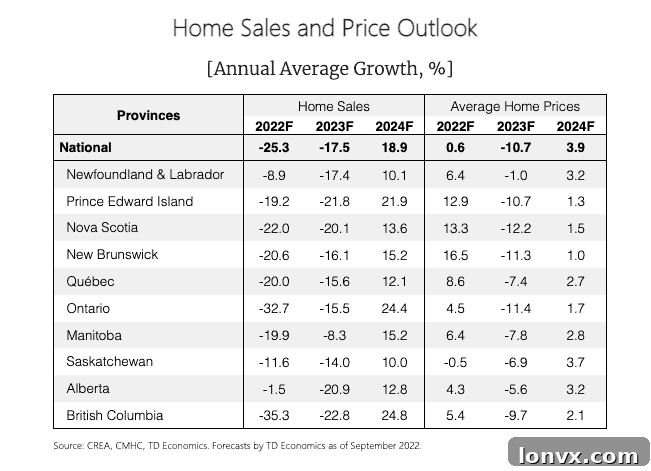
The affordability crisis is not uniform across the country. Steep annual average price declines are specifically forecast for major regions including most of the Atlantic Region, Ontario, and British Columbia. These areas, which experienced some of the most robust price appreciation during the pandemic-driven boom, are now undergoing a more pronounced correction. Notably, Sondhi highlights that the declines in Ontario and British Columbia are expected to “more than retrace the gains made in 2022,” indicating a significant reversal for these previously overheated markets. In contrast, while the Atlantic region will also see declines, they are not anticipated to fully erase the gains from the previous year.
Conversely, the Prairies and Newfoundland and Labrador are expected to experience smaller annual average price declines this year. This relative resilience is directly linked to more favourable affordability conditions in these regions. Compared to the high-cost markets of Ontario and B.C., housing prices in the Prairies and Newfoundland and Labrador have remained more accessible, offering a comparatively softer landing amidst the national downturn. This regional divergence underscores the complex and varied nature of Canada’s housing landscape, where local economic conditions and supply-demand dynamics play a crucial role in market performance.
The concept of affordability extends beyond just prices; it encompasses the interplay of household income, mortgage rates, and other living expenses. When interest rates rise rapidly, as they have recently, the cost of borrowing dramatically increases, directly impacting mortgage payments. For many potential homebuyers, this shift has priced them out of the market or significantly reduced their purchasing power, leading to a noticeable drop in demand. The lingering effects of inflation on everyday goods and services further compound this challenge, leaving less discretionary income for housing. This confluence of factors creates a challenging environment that weighs heavily on market activity, making 2023 a year of significant adjustment for the housing sector.
Anticipating 2024: A Gradual Path to Recovery
As the Canadian housing market navigates through the challenges of 2023, the outlook for 2024 offers a more optimistic, albeit cautious, perspective. TD Economics projects that growth in both sales and average prices should return to positive territory on an annual average basis. This anticipated recovery is predicated on several key economic assumptions: inflation is expected to be more contained, and the broader economy should begin a healing process following a period of weakness in 2023. These factors are crucial for restoring consumer confidence and fostering a more stable environment for housing activity.
While a return to positive growth is expected, it is important to manage expectations regarding the pace of this recovery. The outlook suggests that while sales activity will increase, it will likely do so at a rate that continues to lag pre-pandemic levels for much of the year. This indicates that the market will not immediately snap back to the frenetic pace witnessed in 2020-2021. Instead, it will be a gradual, measured ascent, reflecting a more balanced market environment.
Economist Rishi Sondhi notes that improving housing demand will likely stimulate renewed price growth. However, a crucial limiting factor will be the “still-constrained affordability backdrop.” Even with a potential easing of interest rates or some economic recovery, the fundamental challenge of housing affordability—particularly in high-cost regions—will persist. This underlying constraint will prevent a rapid acceleration of price growth, ensuring that the recovery remains somewhat muted compared to previous boom cycles.
Regionally, 2024 is expected to bring broad-based price gains across Canada. However, the recovery will not be uniform. The report specifically highlights an expectation for “some mild outperformance in the Prairies and Newfoundland and Labrador.” These markets are projected to continue benefiting from a “favourable affordability gap,” meaning that relative to income and other major Canadian cities, housing remains more accessible. This competitive advantage is likely to attract buyers seeking better value, driving stronger, albeit still moderate, growth in these regions.
In stark contrast, tougher affordability conditions in Ontario, British Columbia, and much of the Atlantic region are expected to restrain growth. Despite a national recovery, these historically expensive markets will likely face continued headwinds due to elevated prices, potentially still higher interest rates compared to pre-pandemic levels, and the cumulative impact of the previous market downturn. Buyers in these areas will continue to face significant financial hurdles, which will temper the pace of sales and price appreciation, ensuring a more subdued recovery compared to their more affordable counterparts.
Navigating Potential Risks and Uncertainties
While the TD Economics outlook paints a picture of a market finding its footing in 2023 and beginning a modest recovery in 2024, it also carries important caveats. Rishi Sondhi offers a crucial caution: “If higher interest rates and economic weakness result in significant amounts of forced selling on the part of homebuyers, price growth could be weaker than we expect.” This risk factor is significant and warrants close monitoring.
Forced selling occurs when homeowners are compelled to sell their properties due to unforeseen financial distress, rather than by choice. This could stem from several factors, including job losses, unexpected increases in living expenses, or the inability to manage mortgage payments, particularly as fixed-rate mortgages renew at significantly higher interest rates. A substantial wave of forced selling could flood the market with inventory, creating downward pressure on prices and potentially prolonging the market’s recovery phase beyond current expectations.
Furthermore, the broader economic landscape remains subject to various uncertainties. A deeper or more prolonged economic recession than currently anticipated could exacerbate financial pressures on households and businesses, impacting employment rates and consumer confidence. Geopolitical events, global supply chain disruptions, or unexpected shifts in international trade policies could also introduce volatility. These external factors, while not directly addressed in the housing outlook, invariably influence market dynamics by affecting interest rates, inflation, and overall economic stability.
Therefore, while the forecast provides a valuable roadmap, it is essential for market participants—homeowners, potential buyers, and investors—to remain vigilant and adaptable. Understanding the potential risks, alongside the projected recovery, will be key to making informed decisions in what promises to be a complex and evolving Canadian housing market over the coming years.
For a more in-depth analysis and detailed provincial breakdowns, the full TD Provincial Housing Outlook can be accessed by clicking the link below.
Read TD’s Provincial Housing Outlook here.