
For those in the Greater Toronto Area (GTA) holding out hope for a robust resurgence in the condominium market this year, the latest projections from TD Economics may prove to be a significant disappointment. A comprehensive new report authored by Rishi Sondhi, a seasoned economist at TD Economics, paints a rather sobering picture for prospective buyers and current owners alike, indicating a continued downward trend.
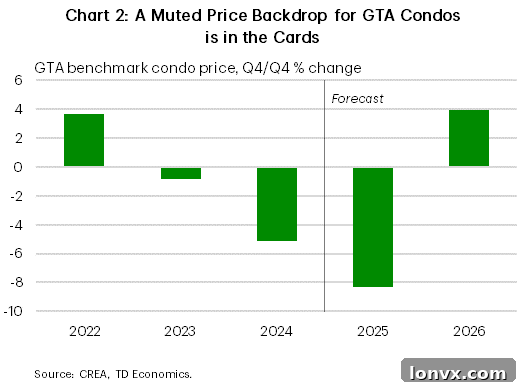
The report forecasts a substantial decline in resale condo prices across the GTA, projecting a fall of approximately 10 percent in 2025 alone. This isn’t an isolated dip but rather an integral part of a broader market correction. By the end of 2025, prices could cumulatively be down by as much as 15 to 20 percent from their peak observed in the third quarter of 2023. This extended correction suggests that the market is recalibrating after a period of rapid growth and speculative investment, facing new economic realities.
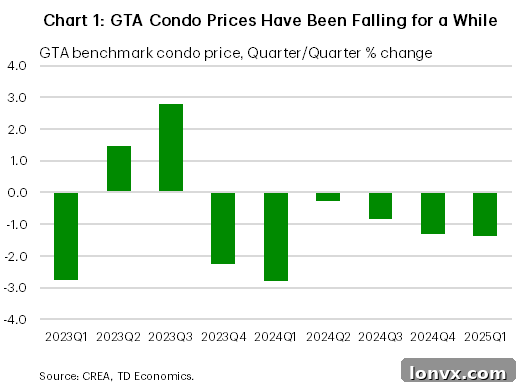
As Sondhi highlights in his analysis, “Demand conditions have weakened materially,” prompting TD to revise its already cautious, if not outright bearish, forecast even further downwards. This erosion of demand isn’t just exerting pressure on prices; it’s also expected to keep sales activity subdued throughout the current year, hovering near historic lows. This indicates a prolonged period of reduced transaction volume, reflecting a significant hesitation among potential buyers and a cautious stance from sellers.
Despite what might sound like a dramatic downturn, it’s crucial to put this correction into historical context. The report thoughtfully points out that even after this anticipated decline, GTA condo prices would still comfortably remain five to 10 percent above the levels observed prior to the COVID-19 pandemic. This perspective underscores that while the market is undergoing a significant adjustment, it is not a complete collapse, but rather a re-anchoring of values after an unprecedented surge.
What’s Weighing Heavily on the GTA Condo Market?
The current state of the GTA condo market is influenced by a confluence of macroeconomic factors and policy shifts, all working in concert against any immediate recovery in prices. Understanding these elements is key to grasping the depth and potential duration of the ongoing correction.
Slowing Population Growth and Its Ripple Effects
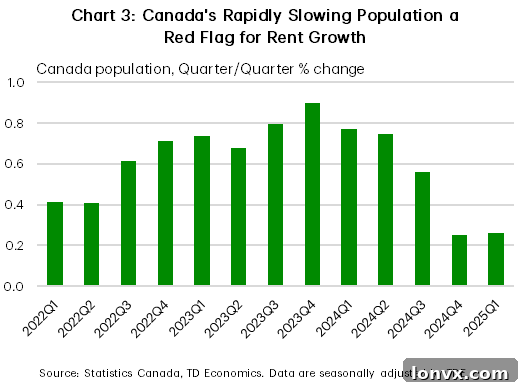
A primary driver behind the cooling demand is a noticeable slowdown in population growth. After a period characterized by record-high immigration levels, the federal government has implemented new, more restrictive policies. These changes are designed to moderate the pace of new arrivals, particularly non-permanent residents, which has a direct and immediate impact on the rental market, and subsequently, on investor sentiment.
The report explicitly highlights this connection: “In the resale market, rents for the average one-bedroom apartment in the GTA fell by 5 percent year-on-year in 2024 Q4.” This decline in rental income, a direct consequence of fewer people seeking housing, significantly diminishes the attractiveness of condos as investment properties. With fewer prospective tenants, landlords face increased competition, leading to lower rents and, consequently, a reduced interest from investors who rely on robust rental yields to justify their purchases.
Investor Pullback: A Fading Allure
Investors have historically represented a vital pillar of the GTA condo market, often driving demand for new developments and resale units alike. However, as economist Rishi Sondhi elaborates, “the math just isn’t working anymore.” The landscape for profitable condo investment has shifted dramatically. Beyond falling rents, the rising costs of ownership—including elevated interest rates on mortgages, increased property taxes, and maintenance fees—have eroded profit margins.
Sondhi adds a crucial psychological element: “It’s also possible that the allure of achieving an acceptable ROI (Return on Investment) through rising condo prices has faded for investors, given the weak conditions that have prevailed for a few years, and the large deterioration in condo affordability.” This suggests that investors are no longer banking on rapid capital appreciation to offset lower rental yields, a strategy that was highly successful during the boom years. The prolonged period of stagnant or falling prices, coupled with the increasing difficulty for even affluent buyers to afford properties, has made the investment thesis for condos less compelling.
Persistent Affordability Challenges
For potential homeowners, particularly first-time buyers, affordability continues to be an insurmountable hurdle. The dual pressures of stubbornly high interest rates, which make mortgage payments significantly more expensive, and elevated property prices relative to average household incomes, have effectively sidelined a substantial segment of the market. Even with a projected price correction, the entry barrier remains formidable for many. This lack of participation from first-time buyers means that the market is deprived of a crucial source of organic demand, further exacerbating the slowdown.
Economic Uncertainty and Consumer Hesitation
Beyond the immediate housing market dynamics, broader economic uncertainty is casting a long shadow over consumer confidence. Global trade tensions, geopolitical instabilities, and inflationary pressures are making Canadians think twice about committing to major purchases, such as a condo. A recent Bank of Canada survey, referenced in the TD report, vividly illustrates this sentiment: a significant 25 percent of respondents indicated that trade tensions made them less likely to spend, starkly contrasting with just 7 percent who reported an increased likelihood. This hesitance permeates the entire economy, impacting decisions that involve substantial financial commitments.
A Softening Job Market
The labor market, a key indicator of economic health, is also sending cautionary signals. March saw a dip in full-time employment, particularly within economically sensitive sectors such as technology, manufacturing, and construction. TD is forecasting further “near-term job losses,” with the national unemployment rate anticipated to nudge up to approximately 7 percent. A softening job market directly impacts potential homebuyers’ ability to secure and service mortgages, as lenders become more stringent with their criteria and consumers feel less financially secure to take on new debt.
The Complexities of Supply Dynamics
While one might assume fewer new condos coming to market would alleviate downward pressure on prices, the supply picture is more nuanced. Condo completions are indeed expected to fall significantly in 2025, with a 17 percent year-over-year decline already recorded in the first quarter. However, the overall *available* supply remains relatively high, especially when viewed against the backdrop of weakened demand. As Sondhi explains, “As these units complete, listings will likely see some upward pressure as they did in 2024.” This indicates that even with fewer *new* projects breaking ground, completed units from past construction booms are still making their way to the market, adding to the inventory available for sale and preventing a swift rebalancing of supply and demand.
Some Relief Ahead – But Not a Full Rebound for GTA Condos
Despite the prevailing gloomy outlook for the GTA condo market in 2025, TD Economics offers a glimmer of hope on the horizon, anticipating that conditions will begin to improve in 2026. However, it’s crucial to temper expectations; the forecast does not suggest a rapid or dramatic comeback, but rather a gradual stabilization.
The Pivotal Role of Interest Rate Cuts
A significant portion of this potential recovery hinges on the trajectory of interest rates. TD economists project that the Bank of Canada will implement further cuts to its policy rate this year, anticipating another 50 basis points reduction. This would bring the key policy rate down to 2.25 percent, where it is expected to hold steady through 2026. Such a move would have a tangible impact on affordability, making mortgages less expensive and potentially encouraging a greater number of buyers to re-enter the market. Lower borrowing costs directly translate to more manageable monthly payments, easing the financial burden that has kept many prospective homeowners on the sidelines.
Emerging Positive Economic Indicators
Rishi Sondhi also points to several other factors contributing to a cautious optimism for next year. These include the presence of pent-up demand, which has been building among buyers waiting for more favorable market conditions, improved broader economic conditions, and an easing of global trade tensions. As uncertainty begins to dissipate and economic stability takes firmer root, buyer confidence is expected to slowly but surely improve. This renewed confidence could unlock a segment of demand that has been dormant, ready to act once the market signals a more stable environment.
A Rebalancing Act on the Supply Side
On the supply front, the market is expected to achieve a better balance by 2026. The impact of reduced construction starts witnessed in late 2024 will begin to manifest in the form of fewer condo completions. This natural reduction in new inventory entering the market should help absorb some of the existing supply and prevent an excessive glut. A more balanced supply-demand dynamic is essential for price stability and can pave the way for a healthier, more sustainable market environment.
Government Policies May Help – But Not Right Away
The newly elected federal Liberal government has made boosting housing supply a cornerstone of its agenda, and Rishi Sondhi acknowledges that some of the proposed measures could eventually provide a much-needed lift to the condo sector in the GTA.
Key Government Pledges to Bolster Housing
Among the significant pledges are initiatives designed to make homeownership more accessible and stimulate construction. These include the elimination of the Goods and Services Tax (GST) for first-time buyers purchasing homes under $1-million, a move intended to reduce upfront costs. The government also plans to create a new construction-focused agency, aptly named “Build Canada Homes,” aimed at streamlining processes and accelerating housing development. Furthermore, a proposed 50 percent cut in development charges is particularly noteworthy, as these fees significantly contribute to the cost of new housing, especially in high-cost urban areas like the GTA. Reducing these charges could encourage developers to undertake more projects, making new units potentially more affordable.
The Inherent Lags in Policy Impact
Despite the potential benefits of these policies, Sondhi issues a crucial warning: the market will not see immediate effects. “Lags inherent in the homebuilding process suggest that the bulk of this impact on condo construction could happen after 2026,” the report notes. The journey from policy inception to shovels in the ground, through to unit completion and market availability, is a lengthy one, often spanning several years. This means that while government initiatives are a positive step, they will not be a quick fix for the current market challenges and their significant influence will only be felt in the medium to long term.
The Bottom Line: A Cautious Path Ahead for GTA Condos
In summation, the Greater Toronto Area condo market is bracing for another challenging year in 2025. The prevailing sentiment is one of continued contraction, with prices firmly expected to fall further and sales activity projected to remain sluggish. Key segments of demand, particularly from investors, are slowing down significantly as the financial calculus shifts against them. Affordability, for both first-time buyers and those looking to upgrade, remains a formidable barrier, exacerbated by persistent economic uncertainty that continues to hang over the entire sector, dampening consumer and investor confidence alike.
Looking ahead, 2026 may indeed offer a glimmer of hope and a much-anticipated turning point. This cautious optimism is primarily fueled by the expectation of lower interest rates, which should ease some of the financial pressure on buyers. Furthermore, an anticipated improvement in overall economic sentiment, coupled with a more balanced supply picture stemming from reduced construction starts, could contribute to a healthier market environment. However, any rebound observed is likely to be modest and gradual rather than an explosive surge.
As Rishi Sondhi wisely cautions, “The anticipated turnaround in hiring and economic activity will probably be gradual and moderate.” This deliberate pace means that stakeholders should not expect a return to the frenzied activity of past boom cycles. With population growth now more restrained due to revised federal policies, and the appeal of condos as swift investment vehicles somewhat diminished, the market dynamic is poised for a significant shift. It is increasingly likely that first-time homebuyers, rather than speculative investors, will emerge as the primary driving force in the next chapter of the GTA condo market, fostering a potentially more stable and sustainable growth trajectory.