
A Decade of Transformation: Navigating the Canadian Real Estate Market from 2013 to 2023
The landscape of any nation is constantly evolving, and Canada’s real estate market stands as a prime example of this dynamic change. A single decade can bring about monumental shifts, profoundly impacting everything from property values to buyer sentiment and housing trends. Comparing the Canadian real estate scene in 2013 to its current state in 2023 reveals a compelling narrative of adaptation, resilience, and unprecedented transformation. From navigating the lingering aftermath of a global financial crisis to confronting the unique challenges and opportunities of a post-pandemic era, the market has undergone a complete metamorphosis.
In 2013, Canada was largely in a phase of cautious recovery, with buyers and sellers carefully testing the waters as the economy stabilized. Fast-forward to 2023, and the market is grappling with a vastly different set of pressures, including a series of aggressive interest rate hikes by the Bank of Canada, record-breaking immigration levels, and significant shifts in demographic preferences. This article delves into a detailed comparison of these two distinct periods, offering insights into how prices, demographics, mortgage rates, and popular housing types have evolved, painting a comprehensive picture of a market that continues to redefine itself.
Prices: A Tale of Two Markets, Defined by Stability and Volatility
Then: Consistent and Predictable Price Growth in 2013
A look back at 2013 reveals a Canadian real estate market characterized by steady and predictable price growth. The initial months of the year saw the market finding its footing, with the Canadian Real Estate Association (CREA) reporting an average national price of $365,700 in January. This figure, while a slight dip from the previous year’s peak, signaled a market that was regaining momentum. Throughout 2013, prices climbed consistently, culminating in a robust 4.1 percent increase to $380,600 by December. While these figures might appear modest when viewed through today’s lens, they represented a significant historic high at the time, reflecting a healthy, recovering market and growing buyer confidence.
This period of consistent growth also saw shifts in housing affordability. According to the Bank of Canada’s Housing Affordability Index, a key indicator measuring the proportion of disposable income needed to cover mortgage payments, property taxes, and utilities for a typical home, affordability decreased from the first quarter to the fourth quarter of 2013. Notably, the affordability level seen in Q1 2013 has not been matched since, underscoring the early stages of a long-term trend towards increasing housing costs. Major urban centers, particularly Greater Toronto and Metro Vancouver, were at the forefront of this growth, experiencing benchmark price increases of 6.8 percent and 4.7 percent, respectively, over the same year, solidifying their positions as Canada’s most dynamic and sought-after real estate markets.
Now: Prices Stabilizing After a Period of Unprecedented Volatility
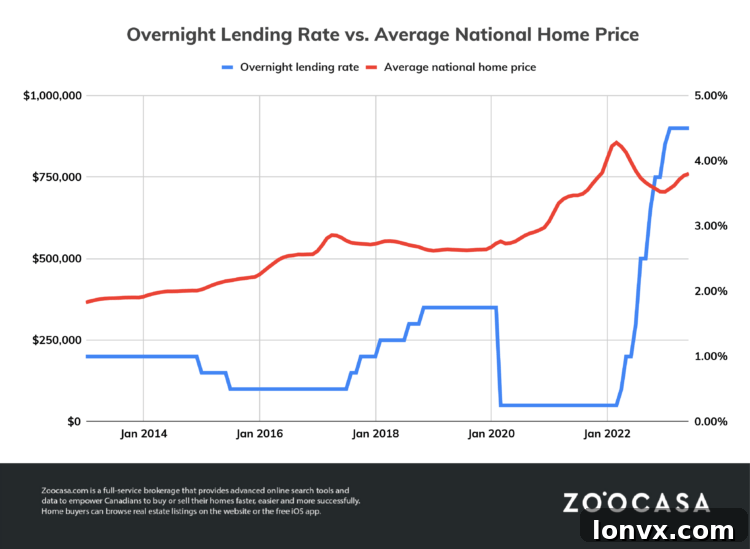
In stark contrast to the steady trajectory of a decade ago, the past few years have been defined by remarkable price volatility, particularly following the unique conditions of the pandemic. The national average price surged dramatically, peaking at an astounding $855,800 in March 2022. This exponential growth was fueled by historically low-interest rates, a surge in demand for larger living spaces, and limited inventory, creating an intensely competitive environment. However, this peak was followed by a sharp correction, as the Bank of Canada began its aggressive campaign of interest rate hikes. The national average price plummeted, bottoming out at $705,000 in January 2023 – the lowest point since August 2021, according to CREA data.
Since early 2023, the market has shown signs of a cautious rebound, with a resurgence of buyer confidence and persistently limited inventory fueling a recovery that drove prices back up to $760,600 by June. This rollercoaster ride, marked by rapid ascent and sharp descent, appears to be settling into a more stable pattern. The recent moderation in price increases can be directly attributed to the cumulative effect of the Bank of Canada’s interest rate hikes, which have aimed to cool inflation and temper the housing market. While the market continues to adjust to these higher borrowing costs, the current trend hints at a future of more measured, sustainable growth, albeit at significantly higher price points than a decade ago. The sharp fluctuations of the early 2020s have left a lasting impression, making market stability a new and welcome focus for many homeowners and prospective buyers.
Changing Demographics: Reshaping Housing Demand and Preferences
Then: Urban Centers as the Primary Magnet for Homebuyers
A decade ago, the Canadian real estate market was heavily influenced by the allure of major urban centers. Cities such as Greater Vancouver, Greater Toronto, Calgary, and Hamilton-Burlington served as powerful magnets for prospective homebuyers. These bustling metropolitan areas offered abundant job opportunities, diverse cultural amenities, and a vibrant lifestyle that appealed to a broad demographic, including young professionals and growing families. Despite the lingering effects of stricter mortgage lending guidelines introduced in previous years to cool an overheating market, low-interest rates and relatively affordable mortgage payments served as strong incentives for first-time homebuyers. This period saw a moderate but consistent resurgence in the market, as individuals and families sought to establish roots in these dynamic urban hubs, contributing to sustained demand and localized price appreciation.
The trend of urbanization was a dominant force, leading to increased population density in city cores and surrounding suburbs. Developers responded by focusing on high-rise condominiums and townhouses, catering to the demand for more compact and accessible housing options within or close to urban cores. The narrative was largely about proximity to work and amenities, with less emphasis on sprawling single-family homes in distant exurbs, though they remained popular in certain segments. This demographic gravitation towards cities laid the groundwork for future challenges related to housing supply and affordability.
Now: Newcomers and First-Time Buyers Driving Demand in Diverse Markets
Today’s real estate landscape tells a profoundly different story, with demographic shifts playing an even more critical role in shaping market dynamics. Canada’s population has recently surged past 40 million, largely propelled by record immigration levels. This influx of new residents has intensified the demand for housing across the country, creating significant pressure on an already constrained supply. As inventory dwindles, competition among buyers has heated up considerably, pushing prices higher in many regions and making homeownership a formidable challenge for many.
Adding to this demand is a renewed wave of first-time buyers who have entered the scene, encouraged by adjusted interest rate expectations and a strong desire for homeownership. Their preferences, however, have evolved. While urban centers remain attractive, there’s a growing inclination towards affordability and more spacious living environments, leading many to explore options beyond the traditionally expensive metropolitan hubs. This has fostered significant interest in smaller maritime cities like Halifax and the burgeoning markets across the prairies, such as Winnipeg and Regina. The rise of remote work capabilities, accelerated by the pandemic, has further empowered buyers to prioritize lifestyle and affordability over strict geographical proximity to employment centers, diversifying demand across the national market and creating new growth pockets in previously overlooked areas.
Mortgage Rates: From Favorable Conditions to Challenging Borrowing Costs
Then: Historically Low-Interest Rates Fueling Market Confidence
In 2013, the Canadian mortgage landscape was defined by historically low-interest rates, creating exceptionally favorable borrowing conditions for homebuyers and existing homeowners alike. The Bank of Canada’s overnight lending rate, a crucial benchmark for variable mortgage rates, remained remarkably stable at 1.0 percent until 2015. It did not exceed 1.25 percent until well into 2018. Such a prolonged period of low rates provided significant advantages, particularly for variable-rate holders who enjoyed lower monthly payments and increased purchasing power. Even fixed-rate holders, while facing slightly higher rates than variable options, benefited from a generally low-interest rate environment compared to historical averages.
These accommodative monetary conditions played a pivotal role in stimulating the housing market recovery post-global financial crisis. Low borrowing costs made homeownership more accessible, incentivizing new buyers to enter the market and encouraging existing homeowners to upgrade or refinance. This environment fostered a sense of confidence and stability, allowing for steady price appreciation without the immediate pressures of rising debt service costs. It set the stage for a period where leverage was relatively inexpensive, a stark contrast to the current financial climate.
Now: Highest Borrowing Costs in Over a Decade Impacting Affordability
The economic landscape underwent a dramatic transformation in the latter half of the decade, culminating in the highest borrowing costs Canada has seen in more than 10 years. Propelled by the pandemic-induced price surge, widespread supply chain disruptions, and escalating inflation, the Bank of Canada embarked on a series of aggressive interest rate hikes starting in 2022. The overnight lending rate, which remained historically low for years, currently stands at 5.0 percent (as of late 2023). This substantial increase has profoundly impacted mortgage affordability, making it significantly more expensive for new buyers to qualify and for existing homeowners with variable-rate mortgages to manage their monthly payments.
Fixed rates have also climbed considerably, with the average 5-year fixed rate reaching as high as 6.79 percent, a level not seen in many years. These elevated borrowing costs have created significant challenges for a wide range of market participants. Prospective buyers face higher stress test thresholds, reducing their maximum loan amounts, while many homeowners are seeing substantial increases in their mortgage payments, often coinciding with rising costs of living. While the current environment presents considerable hurdles, historical patterns and economic forecasts suggest that interest rates may gradually decrease in the coming years as inflation is brought under control. However, the days of historically cheap money appear to be firmly in the past, reshaping the fundamental economics of Canadian homeownership.
House Type: The Enduring Appeal and Evolution of Condominiums
Then: The Condo Boom as an Answer to Urbanization and Affordability
In 2013, the Canadian real estate market, particularly in major urban hubs like Vancouver and Toronto, was in the midst of a significant “condo boom.” Apartments dominated new construction starts, reflecting a robust demand for more affordable housing options in increasingly dense cities. As urbanization trends continued, and land became scarcer and more expensive, multi-unit dwellings emerged as the most viable and accessible pathway to homeownership for many. Condo sales enjoyed consistent and robust growth, driven by a combination of factors including changing lifestyles, the desire for urban amenities, and the economic necessity of finding attainable properties.
The condo market at this time was also attractive to investors, drawn by potential rental income and property appreciation. This era saw a proliferation of high-rise towers altering city skylines, providing housing solutions for a growing population that valued convenience and proximity to work and leisure over large private lots. Condos effectively served as an entry point into the market for many first-time buyers, contributing significantly to the overall health and activity of the real estate sector a decade ago.
Now: Condo Demand Remains Hot, Adapting to New Market Realities
Fast-forward to 2023, and the enduring appeal of condominiums continues to be a defining feature of the Canadian housing market. Despite the dramatic shifts in interest rates and economic conditions, condos remain a highly sought-after property type. First-time buyers, who largely remained on the sidelines during the peak of market volatility and single-family home price surges in the preceding years, are now flocking to condos as their primary entry point into homeownership. These properties offer a comparatively affordable gateway into the market, especially in smaller cities and regions where detached homes have become prohibitively expensive.
In Canada’s most competitive markets, such as Toronto and Vancouver, condo apartments have continued to demonstrate impressive year-over-year growth in sales and values. This sustained demand is not only from first-time buyers but also from downsizers, empty-nesters, and investors looking for relative value and strong rental potential. The shift in buyer preferences towards affordability, combined with the continuous influx of new residents and changing urban planning priorities, ensures that condominiums will remain a crucial and vibrant segment of the Canadian real estate landscape, adapting to new market realities while maintaining their fundamental appeal.
Conclusion: A Decade of Profound Evolution and Enduring Resilience
The journey of the Canadian real estate market from 2013 to 2023 is a testament to its profound adaptability and the myriad forces that shape it. What began a decade ago as a period of cautious optimism and steady growth, recovering from a global crisis, has transformed into a complex, multi-faceted market grappling with unprecedented volatility, demographic shifts, and significant policy interventions. From the predictable single-digit price increases of 2013 to the dramatic highs and subsequent corrections of the 2020s, the market has tested the resilience of buyers, sellers, and policymakers alike.
The shift from historically low-interest rates to the highest borrowing costs in over a decade has fundamentally altered affordability dynamics, while record immigration levels have intensified the perennial challenge of housing supply. Yet, amidst these dramatic changes, certain themes persist: the enduring demand for homeownership, the strategic importance of condominiums as an accessible entry point, and the continuous recalibration of buyer preferences. Looking ahead, the Canadian real estate market will undoubtedly continue to evolve, influenced by global economic currents, domestic policies, and the evolving aspirations of its population. Understanding this past decade of transformation is crucial for navigating the opportunities and challenges that lie on the horizon, as Canada’s housing story continues to be written.
Get the latest news directly in your inbox
Join industry leaders getting the latest news right in your inbox 3x per week!