
Calgary’s Dynamic Real Estate Market: A Deep Dive into CREB’s Q2 2024 Report
The Calgary Real Estate Board (CREB) recently unveiled its comprehensive Q2 2024 housing market report, offering crucial insights into the evolving real estate landscape across Calgary and its surrounding regions. This detailed analysis highlights significant trends in sales activity, pricing dynamics, and the underlying factors shaping one of Canada’s most vibrant housing markets. Understanding these trends is essential for anyone involved in or impacted by Calgary’s competitive real estate environment, from prospective homebuyers and sellers to investors and industry professionals.
A Resilient Seller’s Market: Navigating Shifting Supply and Demand
Calgary’s real estate market continues to heavily favor sellers, a trend that has persisted despite some emerging shifts. The Q2 2024 report indicates a notable increase in new listings for the fourth consecutive quarter compared to the previous year. This surge is predominantly observed in the upper price ranges across various property types, driven by a combination of rising home prices and higher lending rates that have incentivized more property owners to list their homes.
This uptick in available properties led to the sales-to-new listings ratio dipping below 80 percent for the first time since Q1 2023. While this might suggest a slight easing, the market’s underlying strength as a seller’s domain remains undeniable. With a Q2 sales-to-new listings ratio of 75 percent and a critically low months-of-supply standing at just one month, the balance of power firmly rests with sellers. This low supply level indicates that if no new homes were listed, the current inventory would be depleted within a month, underscoring intense competition among buyers and swift property sales.
Key Metrics Underscore Market Tightness:
- New Listings Growth: Fourth consecutive quarter of year-over-year increases, particularly in higher price segments.
- Sales-to-New Listings Ratio: Fell to 75% in Q2, indicating strong absorption of new inventory.
- Months of Supply: Held firm at one month, a clear indicator of a highly constrained market where demand significantly outstrips supply.
Sales Activity: Slower Pace but Still Outpacing Historical Norms
During the second quarter of 2024, Calgary experienced a modest three percent slowdown in sales compared to the same period last year. This deceleration was primarily concentrated in lower-priced properties, where inventory levels are at their most restrictive. The acute shortage of affordable housing options means fewer transactions can occur in this segment, even with high demand.
Despite this recent moderation, the overall sales levels remain remarkably robust, soaring 29 percent above long-term historical trends. Furthermore, the first half of the year concluded with sales nearly six percent higher than last year, reflecting an enduring demand that continues to defy expectations. These figures underscore a resilient market with significant underlying momentum, albeit one grappling with specific supply constraints at the entry level.
“The unexpected surge in migration over the past two years has profoundly contributed to the demand growth and supply challenges experienced in the Calgary market,” notes Ann-Marie Lurie, chief economist at CREB. She adds, “While we still have to work through the pent-up demand, slowing migration levels and supply gains in the resale and new home markets should start to support more balanced conditions, taking some of the pressure off home prices.” Lurie’s comments highlight the critical interplay between population growth, housing availability, and price stability in Calgary.
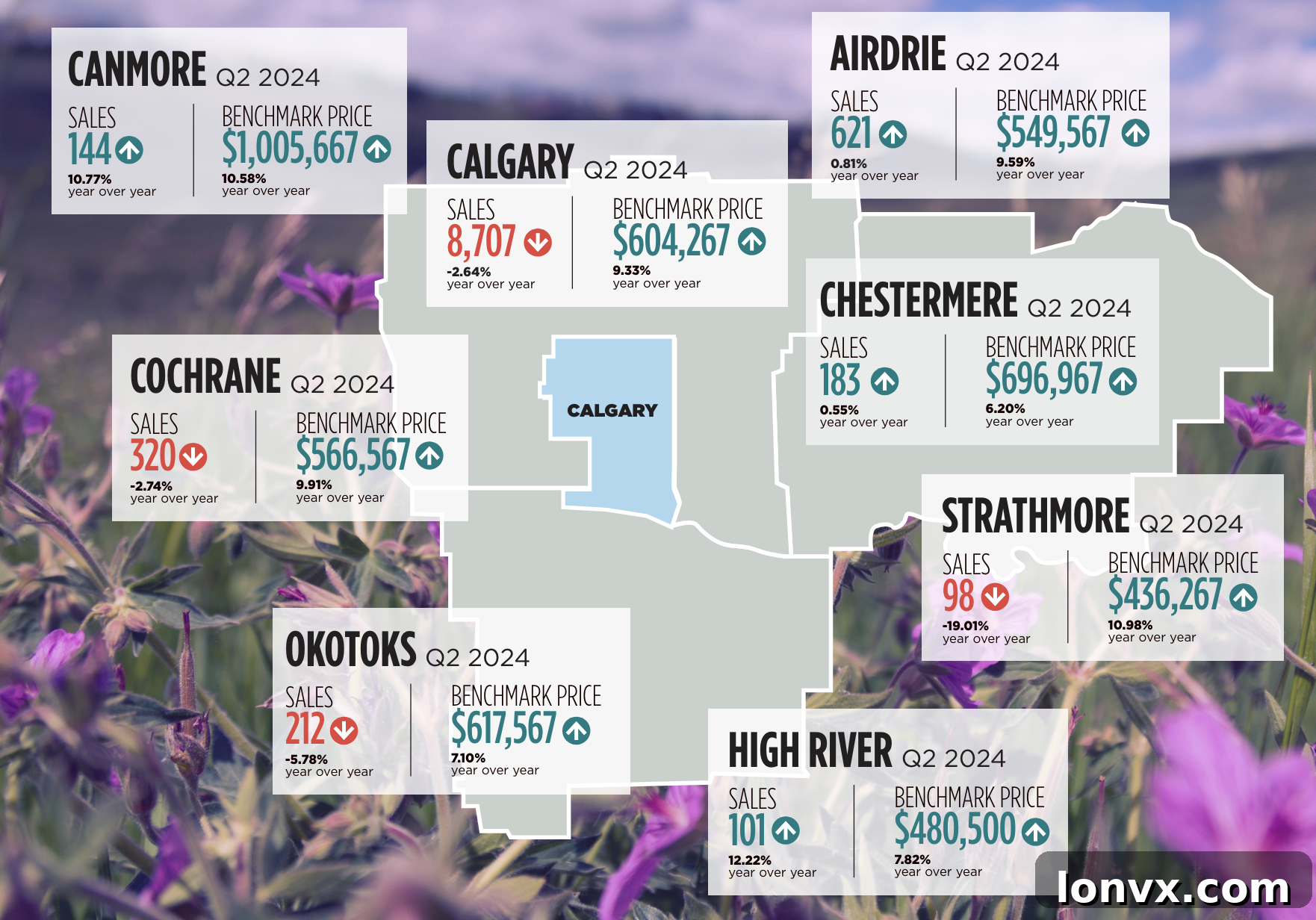
Source: CREB
Home Prices Continue Ascent Across Property Types
Calgary’s home prices have maintained an upward trajectory, rising by an average of 10 percent so far this year. This significant appreciation reflects the strong demand and tight supply conditions prevalent across the market. However, the gains have not been uniform across all property types, indicating nuanced preferences and affordability thresholds among buyers.
Row properties have experienced the most substantial growth, with a remarkable 19 percent increase. This surge in row housing prices can be attributed to their relative affordability compared to detached homes, making them an attractive option for first-time buyers and those seeking more space without the higher price tag of traditional single-family dwellings. Conversely, detached and semi-detached homes, while still appreciating, saw comparatively smaller growth at 13 percent. This suggests that while demand for these larger property types remains strong, the higher price points might be experiencing a slight cooling effect or facing less intense competition than more accessible options.
Price Growth Breakdown:
- Overall Home Prices: Up 10% year-to-date.
- Row Properties: Leading the charge with a 19% gain, reflecting robust demand for more affordable, multi-family options.
- Detached & Semi-Detached Homes: Posted a 13% increase, a healthy gain but less aggressive than row properties.
What’s Next for Calgary Real Estate: CREB’s Forward Outlook
Looking ahead, CREB projects several key developments that could shape Calgary’s housing market for the remainder of 2024 and beyond. A significant factor anticipated to influence market dynamics is the increased supply from the new home construction sector. This influx of new inventory is expected to play a crucial role in creating a better-supplied market, which will also extend to the rental segment. A greater availability of homes, both for sale and rent, is poised to alleviate some of the persistent pressure on home prices.
Analysts anticipate a slowdown in price growth during the second half of the year as supply levels gradually improve. This moderation is expected to predominantly impact higher-priced properties, where increased options might give buyers more leverage and temper aggressive bidding wars. However, the report cautions that the most affordable property types will likely continue to experience persistent price increases due to persistently tight conditions. Despite overall market adjustments, the demand for entry-level and mid-range housing remains exceptionally strong, meaning competition in these segments is unlikely to abate significantly in the near term.
The interplay of slowing migration, increasing supply, and continued high demand for specific property types will be critical to monitor. Calgary’s market is in a dynamic state of evolution, moving towards what CREB hopes will be more balanced conditions, yet affordability challenges for many prospective buyers will likely persist.
For a complete understanding of the statistics and analysis, review the full report here.
Enjoying this article?
Get the latest real estate articles in your inbox 3x a week so you stay up to date on the latest in the Canadian real estate industry.