Navigating Uncertainty: The Bank of Canada, Recession Risks, and the Future of British Columbia’s Housing Market
As economic forecasts sharpen and anticipation builds, the Bank of Canada stands poised to deliver what is widely expected to be its eighth consecutive interest rate hike. This anticipated move, often a necessary measure to curb persistent inflation, simultaneously ignites significant concern among economists and the general public alike: could this aggressive monetary tightening push the Canadian economy into a recession? The expected 25-basis-point increase would elevate the overnight lending rate to 4.5 percent, a benchmark not observed since 2007, signalling a profound shift in Canada’s economic landscape.
In response to these burgeoning anxieties and the potential for significant economic disruption, the British Columbia Real Estate Association (BCREA) has released a crucial market intelligence report. Titled A Guide to Recessions and the BC Housing Market, this comprehensive document offers invaluable historical context and forward-looking analysis. It delves deep into how the province’s dynamic housing market has previously navigated periods of economic contraction, providing critical insights for homeowners, potential buyers, and industry professionals.
Brendon Ogmundson, the Chief Economist at BCREA, spearheads the report’s analysis, meticulously examining the historical performance of the BC housing market during past recessions. Crucially, the report also ventures into prognostications, exploring how the unique conditions of a potential 2023 recession might influence the province’s real estate sector. Understanding these intricate relationships between broader economic trends and localized market dynamics is paramount as Canada braces for an uncertain economic future.
Historical Echoes: Unpacking Canada’s Past Recessions
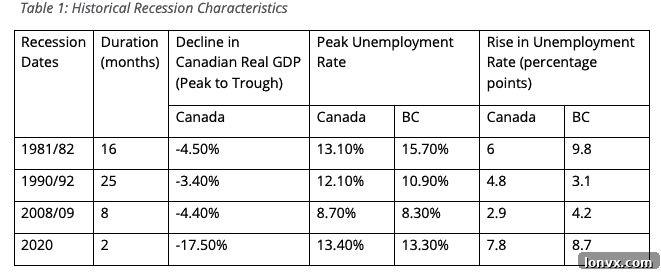
To truly grasp the potential implications of a future recession, it’s essential to look back at Canada’s economic history. Brendon Ogmundson’s analysis identifies four distinct Canadian recessions since 1980, each offering unique lessons about economic resilience and vulnerability. These include the severe downturns of the early 1980s, the early 1990s, the 2008-2009 Global Financial Crisis, and the most recent, albeit brief, pandemic-induced contraction of 2020.
Excluding the extraordinary circumstances of the COVID-19 recession, which was characterized by an unprecedented sharp but short contraction, a typical Canadian recession generally spans between eight and 25 months. Such periods are historically marked by an average decrease of approximately four percent in real Gross Domestic Product (GDP), a key indicator of economic output. Concurrently, these downturns are often accompanied by a significant surge in the unemployment rate, typically increasing by around 4.5 percentage points as businesses shed jobs in response to reduced demand and economic uncertainty.
The report highlights the 1981-1982 recession as a particularly severe episode for British Columbia. Fueled by aggressive interest rate hikes aimed at taming runaway inflation, this period saw the province’s economy contract by a staggering 6.4 percent. The unemployment rate soared by nearly ten percentage points, cementing its reputation as the worst recession on record for BC, leaving a lasting impact on the provincial economy and its residents. This period underscores the profound impact that tight monetary policy, when combined with other economic pressures, can have on regional economies.
In stark contrast, the 2020 pandemic-induced recession, while remarkably brief, presented an entirely different economic shock. Early estimates indicated months where the economy contracted by over ten percent, a sharper immediate decline than any other recession in recent memory. However, unprecedented government support programs and rapid adaptation meant a swift, albeit uneven, rebound.
The 1990-1992 recession, on the other hand, painted a slightly different picture. While Canada experienced modest growth in real GDP during this period, the unemployment rate climbed significantly, reaching nearly eleven percent. This “jobless recovery” scenario highlighted how economic growth doesn’t always translate immediately into robust employment gains, particularly after periods of restructuring or cautious business investment.
More recently, the 2008-2009 Financial Crisis and subsequent recession saw the B.C. economy peak in November 2008. Over the subsequent 12 months, the province experienced a contraction of 3.7 percent, accompanied by an increase in the unemployment rate of more than four percentage points. This global event, triggered by a crisis in the U.S. subprime mortgage market, demonstrated the interconnectedness of international financial systems and their ripple effects on regional economies, even those seemingly insulated.
Source: BCREA
The Seismic Shifts: How Recessions Have Influenced B.C.’s Housing Market
The housing market, a sector acutely sensitive to interest rate fluctuations and consumer confidence, often serves as a bellwether for broader economic shifts. The BCREA report meticulously details how sales activity in British Columbia typically begins to decline several months before a recession is officially declared. This pre-emptive downturn is largely driven by anticipatory consumer behaviour, where rising interest rates or a darkening economic outlook prompt potential buyers to delay purchases, leading to a cooling of market enthusiasm.
Brendon Ogmundson illustrates this trend with compelling historical examples. During the 1990 recession, for instance, housing sales activity peaked a full four months before the official onset of the economic downturn. By the time the recession was officially recognized, sales had already reached their nadir, demonstrating the forward-looking nature of the housing market. Similarly, ahead of the 2008 Financial Crisis, sales peaked a significant 15 months prior to the official start of the recession, again hitting their lowest point as the economic contraction began in earnest. This pattern suggests that by the time a recession is formally announced, a substantial portion of the housing market correction may have already occurred.
The 1980-1982 period, characterized as a “double-dip” recession, witnessed the most extreme fluctuations in sales activity among recent historical downturns. This era of high inflation and successive interest rate shocks created an exceptionally volatile environment for real estate, with sales experiencing sharp peaks and valleys in quick succession.
The 2020 pandemic-induced recession, however, defied some of these historical norms. While sales did initially dip, the decline was less pronounced compared to previous recessions. This unique resilience was followed by an extraordinary post-recession boom, driven by record-low interest rates, shifts in lifestyle preferences (work-from-home), and robust government support. This anomaly underscores how exogenous shocks can disrupt traditional market responses.
Overall, while there is some variation in how the province’s home sales react to recessions, a general pattern emerges. Historically, sales typically decline by 50 to 70 percent from their pre-recession peaks. This suppressed level of activity often persists for at least one year before a gradual recovery takes hold. Currently, Ogmundson observes that the housing market largely aligns with these pre-recession patterns, with sales having fallen approximately 50 percent from their record high at the start of 2022. Furthermore, current sales volumes remain 25 to 30 percent below historical averages, indicating a significant cooling in market demand.
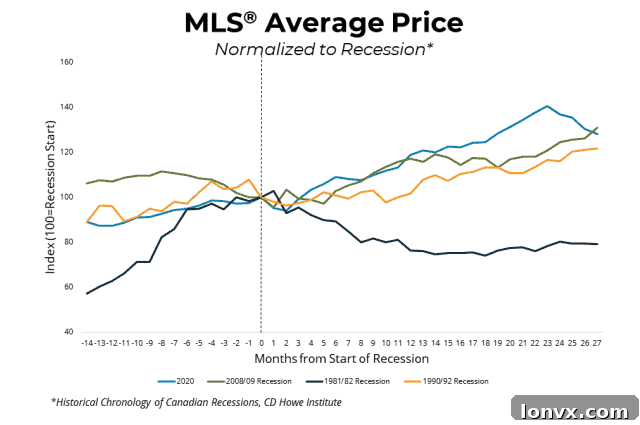
Beyond sales volumes, the report highlights that home prices tend to follow a similar trajectory to sales in the months preceding and during a recession. The 1981-1982 recession serves as a stark example: following a period of significant price appreciation, prices declined for almost two full years after the official start of the recession, reflecting the deep economic malaise and high interest rates of that era.
In the 1990-1992 and 2008-2009 recessions, home prices exhibited a period of relative stability for one to two years following the initial market cooling before beginning their ascent again. This plateauing effect often suggests a period of market adjustment where sellers and buyers recalibrate expectations in the new economic environment, rather than an immediate and dramatic price crash.
The pandemic era once again presented a contrasting scenario. After the initial onset of COVID-19, prices bottomed out remarkably quickly in May 2020, only four percent below their February levels. This brief dip was immediately followed by a historic surge. By March 2021, prices were 24 percent higher than pre-pandemic levels, and they continued to climb, peaking in early 2022 at a staggering 46 percent above pre-pandemic benchmarks. This unprecedented appreciation was largely a result of exceptionally low interest rates and a pandemic-driven surge in housing demand. Since reaching these dizzying heights, prices have subsequently declined from their peak levels, directly coinciding with the Bank of Canada’s aggressive monetary tightening cycle.
Source: BCREA
Charting the Course to Recovery: The Crucial Role of Interest Rates
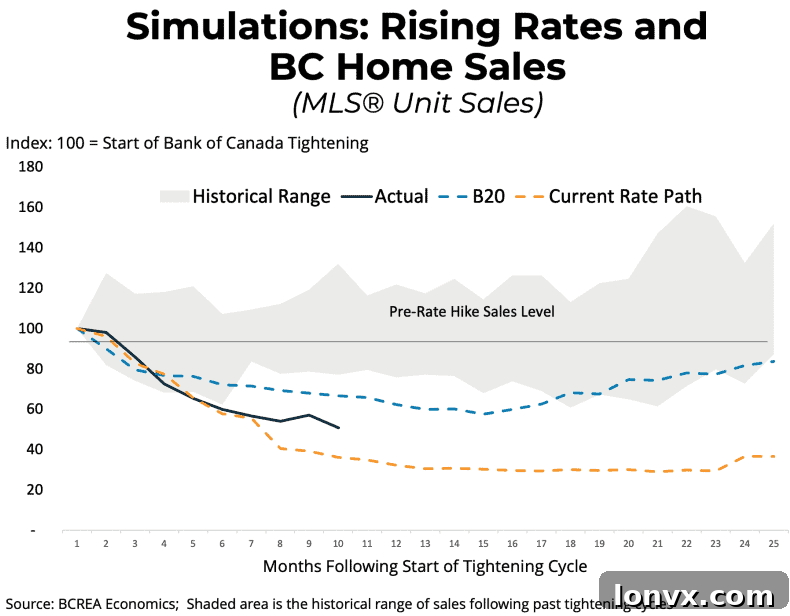
The path to recovery for British Columbia’s housing market, following what many anticipate to be a challenging period, is intricately linked to the trajectory of interest rates. BCREA’s sophisticated economic modelling suggests a clear dependency: if interest rates remain on their current upward path, or even at their elevated levels, housing market activity will likely persist well below its average historical levels. This stagnation stems from reduced affordability, subdued buyer confidence, and diminished borrowing capacity, collectively acting as a drag on sales volumes and new construction.
Economists at the BCREA echo this sentiment, projecting that home prices may continue to decrease in the coming months based on their analytical models. However, they are quick to add a crucial caveat: historical patterns reveal that prices have not always followed identical trajectories after periods of aggressive rate tightening. Market responses can be influenced by a myriad of factors, including population growth, housing supply constraints, and broader investor sentiment, making precise predictions challenging.
A significant finding of the report offers a glimmer of hope amidst the economic gloom: “…if the Canadian economy finds itself in recession this year, it may come at a time when the B.C. housing market is already at a low point,” the report states. This observation implies that the housing market might be in a more resilient position to weather the official declaration of a recession, having already undergone a significant correction due to earlier monetary policy actions. In essence, the pain of the downturn for housing may already be largely priced in, potentially allowing for a quicker rebound once economic conditions stabilize.
Economists consistently highlight the historical tendency of the housing market to lead the broader business cycle. This means that a recovery in real estate often precedes, or coincides with, the official end of an economic recession. If this pattern holds true for the current cycle, it suggests that the housing market could begin to show signs of revitalization around the same time as the onset of a recession, acting as an early indicator of broader economic healing.
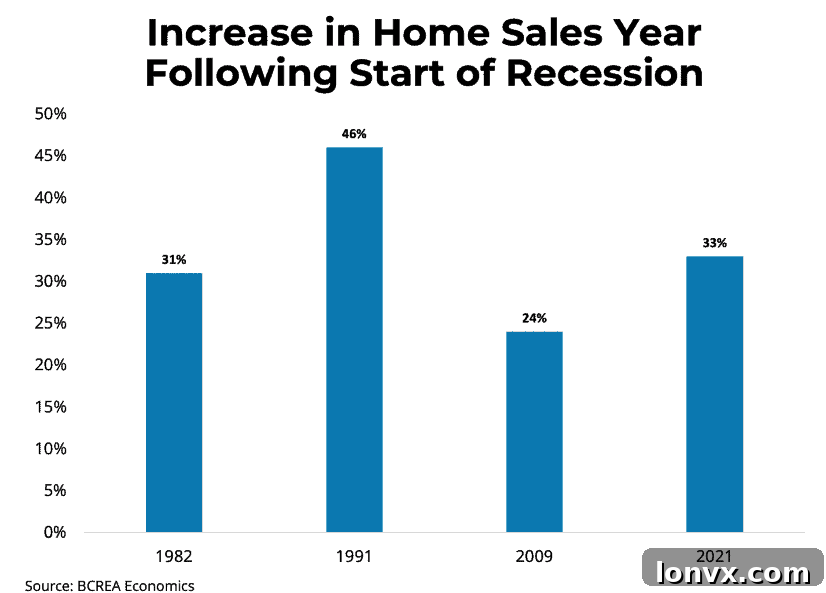
The BCREA report emphasizes this forward-looking characteristic: “We know from history that home sales post strong recoveries in the year following the start of a recession as the economy heals and the impact of falling interest rates unlocks demand.” This historical precedent is a powerful indicator that while the immediate future may involve further challenges, the underlying demand for housing, coupled with eventual interest rate easing, has the potential to reignite market activity.
The authors of the report add a vital condition to this optimistic outlook: “Importantly, any recovery is predicated on a continued decline in bond yields and fixed mortgage rates through 2023 in anticipation of the Bank of Canada easing monetary policy.” This highlights that for the housing market to truly rebound, the financial markets must signal a future shift in central bank policy, leading to lower borrowing costs for consumers. This anticipation, rather than immediate action, often drives market sentiment.
Concluding their analysis, the economists offer a long-term perspective that transcends the immediate concerns: “While the housing market and the economy may experience a temporary downturn over the next year, there will be no shortage of demand for housing in the future.” This powerful statement underscores the fundamental demographic and societal factors that underpin housing demand in British Columbia, including strong population growth, immigration, and evolving household formations. These enduring drivers suggest that any current slowdown is likely a temporary correction within a structurally robust, albeit cyclical, housing market.