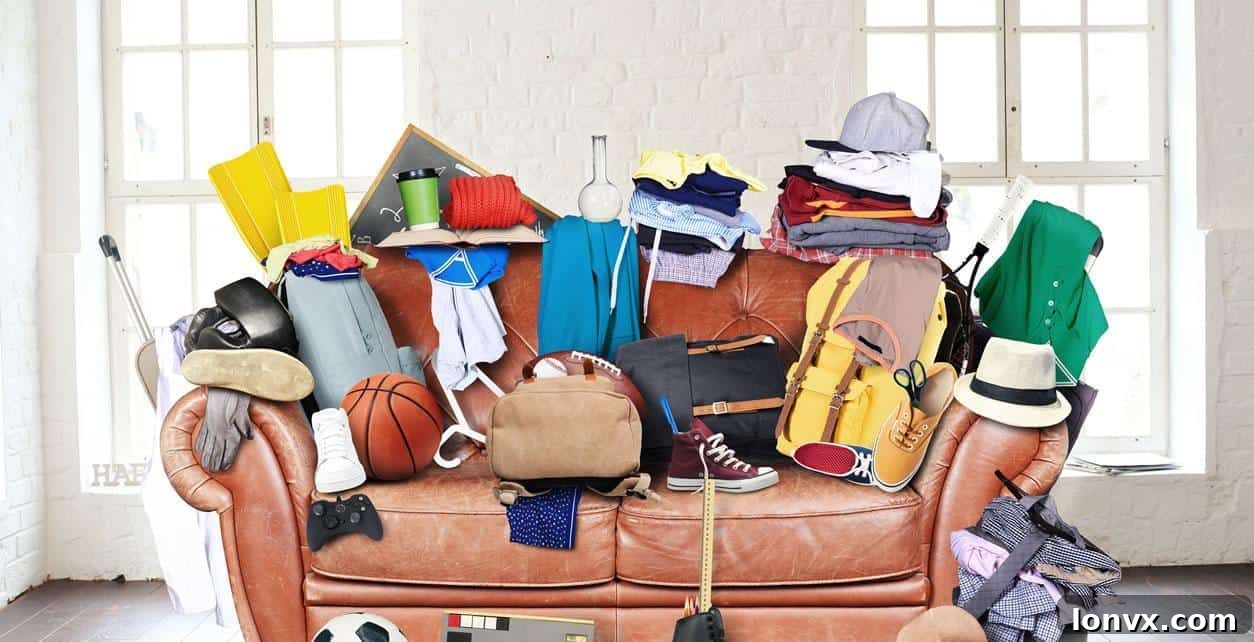
All journeys, no matter how long or arduous, eventually reach their destination. Yet, some projects, despite the most fervent efforts and unyielding dedication, feel like an endless odyssey, a tunnel without the promise of light. My family and I have embarked on one such monumental undertaking: the formidable task of clearing out over six decades of shared lives, memories, and countless possessions accumulated under one roof – the beloved family home. This is more than just a clean-out; it’s an excavation of history, a physical and emotional marathon that has tested our resolve and redefined our understanding of material wealth and sentimental value.
For what now feels like an eternity, my siblings and I have been systematically working through the myriad belongings my mother had to leave behind when she transitioned to an assisted living facility. There are moments when I whimsically ponder if, during her residency application process, a member of the admissions team paid a visit to our family home. Perhaps they were so overwhelmed by the sheer volume of possessions that they hastily crafted a stringent limit on what could accompany her to her new abode. One might imagine their wide eyes and raised eyebrows, struggling to conceal their astonishment, a force so potent it might have dislodged a toupee and sent it sailing into the nearest La-Z-Boy. The reality, while less theatrical, is no less daunting.
Decades of Discovery: Unearthing a Lifetime’s Collection
My mother, a lifelong enthusiast of collecting, possessed an inclusive spirit when it came to what she accumulated – or, to use a gentler term, “gathered” – over many decades. From the attic’s dusty recesses to the basement’s damp corners, and every hidden nook and cranny in between, we have unearthed an astonishing array of items we now hope to sell, donate, or responsibly discard. These weren’t merely objects; they were artifacts of a life richly lived, each with its own story, often tucked away in long-forgotten pockets of that humble, old residence.
Books, for instance, were stored with the ingenious diligence of squirrels stuffing acorns into every available tree cavity. Yet, even an over-achieving squirrel, perhaps one fortified by an extra dose of caffeine, would be utterly impressed by the ingenious locations my mother discovered to stash paperbacks. This archaeological endeavor has allowed us to carbon-date our way through various decades, encountering literary treasures from different eras. We found them neatly (or not so neatly) arranged in the attic, stacked precariously in the basement furnace room, and artfully concealed behind sliding doors built directly into the main staircase. The discovery often felt like uncovering secret passages, each leading to a new literary era.
Their presence wasn’t confined to obvious storage areas. Books were shoved into the very base of a heavy china cabinet, slid covertly under couches and armchairs, and even hidden behind boxes of cereal in the pantry, transforming everyday spaces into unexpected libraries. The sheer ubiquity of these printed pages made me seriously consider knocking on walls, half-expecting to discover a hidden panel leading to yet another clandestine bookshelf. But alas, I have my own carefully maintained toupee to keep firmly in place, for goodness sake! The thought of provoking such a theatrical mishap kept my impulses in check.
Second only to the vast, passively maintained used bookstore that was our home, was the astonishing collection of dishes and cups of every conceivable variety. This was not merely a set of dinnerware; it was a testament to promotional offers, inherited legacies, and lucky finds. Some pieces harked back to an era when they came free inside laundry detergent boxes, while others were painstakingly collected as part of weekly promotions at the local grocery store. There were dish and cup sets proudly won at boisterous church bazaars, elegant heirlooms inherited from departed aunts, and charming, mismatched pieces snapped up from tables at countless yard sales. Attempting to tally the grand total proved to be a numerical impossibility; I managed only to acquire a nasty sliver from my abacus in the process. I can confidently state that even Walmart’s entire distribution hub likely hasn’t stocked a close approximation of the sheer volume we’ve accumulated.
Without delving into the exhaustive specifics of every drawer, suffice it to say that many around the house resembled prolific clown cars. Items poured forth in an endless cascade, defying any conceivable expectation of internal capacity. Some individual drawers, seemingly innocent at first glance, took hours to empty entirely, revealing layers upon layers of forgotten trinkets and necessities. It wouldn’t surprise me if I had inadvertently uncovered the legendary resting place of missing socks, at least for one family’s feet, all neatly tucked away in junk drawers rather than having been returned to their respective bedroom homes. Why not, indeed? The logic of accumulation often eludes rational explanation.
The Father’s Curiosities: A Different Kind of Collection
Of course, my dad was hardly an innocent bystander in this grand tradition of questionable keepers. His contributions to the household’s vast inventory were distinct yet equally compelling. We’ve unearthed camping supplies that have petrified over time, their original purpose now a matter of historical speculation. Glass jars of preserves, once brimming with vibrant fruits, have similarly mummified beyond recognition, their contents transformed into intriguing, fossilized specimens. And while I’m in this vein of sharing the more…unusual discoveries, I’ve also come across more mummified spiders than one might ever expect to encounter in a lifetime. Or, more accurately, ever *want* to encounter. My initial thought was to donate them to my old high school science lab, perhaps for a particularly macabre biology lesson. Or maybe, just maybe, there’s some current culinary craze to cover them in batter and serve them as a unique movie snack? The mere thought elicits an immediate and profound “Ugh!”
The “Living Landfill”: An Overwhelming Reality
The common denominator in all of these discoveries appears to be a philosophy of extreme retention: anything potentially worth keeping was indeed kept and diligently stored somewhere within the vast expanse of the home or garage. Conversely, anything deemed *not* keepable was also, quite paradoxically, stashed away in a dark corner, only to be unearthed eventually by well-meaning but utterly overwhelmed family members desperately hoping to clear out the house for its eventual sale. This creates a challenging paradox, turning the act of decluttering into a multi-layered archaeological dig where value and sentimentality are constantly being re-evaluated.
The emotional toll of this process cannot be overstated. Each item holds a memory, a story, a connection to a past life. Deciding what to keep, what to let go of, what to sell, and what to donate becomes an emotionally charged decision, often fraught with sentimentality and occasional disagreements among family members. It’s a journey through grief and nostalgia, forcing us to confront not just physical objects, but the intangible legacy of our loved ones. The sheer volume of material possessions often overshadows the precious, irreplaceable memories, creating a formidable barrier to an otherwise straightforward process.
Lessons Learned and a Personal Commitment
I will readily admit that this ongoing process has profoundly inspired me. It has ignited a powerful resolve to manage my own collections and belongings much more efficiently. My goal is to make them easier to spot, group together, and organize for when my surviving family members inevitably get to tackle my own estate. This experience has been a sobering reminder of the burden that excessive accumulation can place on those left behind. It’s a compelling argument for embracing minimalism, or at the very least, mindful acquisition and regular decluttering throughout one’s life.
As one particularly weary family member recently muttered under their breath, referring to our old family home, it had become “the living landfill.” This poignant phrase encapsulates the overwhelming reality of inheriting not just a home, but a lifetime’s worth of everything – the good, the bad, the beautiful, and the utterly baffling. This journey has taught us invaluable lessons about memory, material possessions, and the true meaning of legacy. It has underscored the importance of intentional living, not just for ourselves, but for the peace of mind of future generations. May my own collections tell a simpler, more organized story, a narrative of deliberate choices rather than overwhelming accumulation.