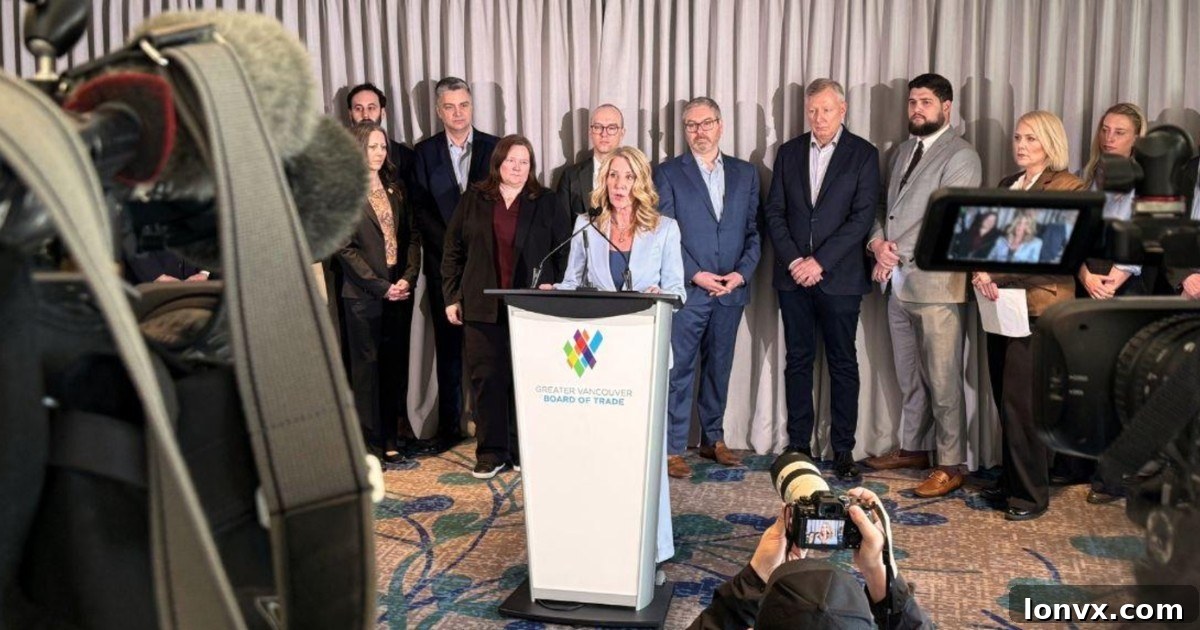

Bridgitte Anderson, President and CEO of the Greater Vancouver Board of Trade, represents a unified voice of British Columbia’s business community in a critical call to action against proposed tax changes. (Image courtesy: Greater Vancouver Board of Trade)
BC Business Leaders Demand Halt to PST Expansion on Key Professional Services
In a powerful display of unity and concern, a prominent coalition of British Columbia business organizations is urging the provincial government to reconsider and ultimately cancel its proposed expansion of the Provincial Sales Tax (PST) to a wide array of professional services. This controversial tax hike, explicitly detailed in Budget 2026, is vehemently opposed by the business community, which argues it will inevitably escalate operational costs for companies and severely impede progress on desperately needed housing construction across the province.
The Greater Vancouver Board of Trade, a pivotal force in B.C.’s economic landscape, released a joint statement this week following the unveiling of Budget 2026. This comprehensive statement, endorsed by numerous influential signatories including the British Columbia Real Estate Association (BCREA), unequivocally outlines how these impending tax changes are poised to make both home construction and general business operations substantially more expensive throughout British Columbia. This collective outcry underscores a deep-seated apprehension about the future economic vitality and housing market stability of the province.
Budget 2026 proposes to broaden the scope of the existing seven percent PST to encompass a significant range of essential professional services. These include critical sectors such as accounting, engineering, architectural design, security services, and commercial real estate services. Notably, specific architectural, engineering, and geoscience work will face a partial 30 percent tax base, a measure that, while seemingly reduced, still represents a new and unwelcome financial burden. The budget itself projects a staggering record deficit of $13.3 billion for the 2026-27 fiscal year and an alarming increase of $80 billion in provincial debt over the next three years, raising questions about the fiscal strategy and long-term sustainability behind such tax impositions.
The Alarming ‘Tax on a Tax’ Phenomenon: A Deeper Dive
One of the most significant and frequently cited concerns among the coalition of business groups is the inherent nature of British Columbia’s PST, which they describe as creating a detrimental “tax on a tax” scenario. This unique aspect of the B.C. sales tax distinguishes it sharply from other harmonized or national sales taxes found elsewhere in Canada, such as the Goods and Services Tax (GST) or the Harmonized Sales Tax (HST). Unlike these federal taxes, the B.C. PST is not refundable for businesses, meaning that the tax paid on input services cannot be reclaimed.
This fundamental difference has profound implications for project costs and consumer prices. As the joint statement elaborates, “This means every time a service is taxed during a project, that cost is baked in and then taxed again at the next stage, leading to higher final prices for consumers.” Consider, for instance, a housing development: a developer pays PST on architectural services, then again on engineering, then on legal services, and so on. Each of these taxes becomes a non-recoverable input cost, accumulating throughout the project lifecycle. This cumulative effect is then inevitably passed down to the end consumer, resulting in significantly higher purchase prices for homes or increased rental rates, directly undermining affordability goals.
Beyond the direct financial impact, this non-refundable nature is anticipated to create a massive new administrative burden for businesses of all sizes. Companies will need to meticulously track and account for these new PST obligations on professional services, adding layers of complexity to their financial management and potentially requiring additional staffing or software solutions. This administrative overhead is particularly onerous for small and medium-sized enterprises (SMEs), which often lack the extensive resources of larger corporations to adapt to such intricate tax changes, potentially stifling innovation and growth within these vital segments of the economy.
Exacerbating British Columbia’s Housing Crisis and Affordability Challenges
The timing of this proposed PST expansion could not be more critical, as British Columbia is currently grappling with one of the most severe housing affordability crises in its history. The decision to tax essential services indispensable for the construction of new homes, including the new levy on architectural and engineering work, is seen as a direct affront to efforts aimed at improving affordability and ensuring the viability of housing projects. This tax policy risks pushing an already strained housing market further into crisis.
The joint statement starkly warns, “It could not come at a worse time as housing projects are being shelved and cancelled all across B.C. as market conditions deteriorate.” Rising interest rates, escalating material costs, and labor shortages have already created a challenging environment for developers. Adding a new, non-refundable sales tax on the very services required to plan, design, and execute construction projects will inevitably increase overall project costs. This additional financial pressure acts as a significant disincentive for developers, potentially leading to fewer new housing starts, delays in existing projects, and even the outright cancellation of planned developments.
The impact extends beyond market-rate housing. Affordable housing initiatives, often operating on thin margins with complex funding structures, are particularly vulnerable. Charities and non-profits striving to deliver essential housing solutions will find their budgets stretched even thinner by these new taxes, potentially limiting their capacity to provide homes for vulnerable populations. Ultimately, fewer homes being built across the residential spectrum—from single-family dwellings to multi-unit complexes and rental properties—will only intensify the supply shortage, driving prices further upwards and making homeownership or even secure rental accommodation an increasingly distant dream for many British Columbians.
Jeopardizing Economic Competitiveness and Investment in British Columbia
The concerns articulated by the business coalition extend far beyond the housing sector, encompassing the broader economic health and competitive standing of British Columbia. The groups have emphatically warned that these tax changes will render B.C. a considerably more expensive and less attractive place for investment, thereby jeopardizing existing jobs and the successful realization of major infrastructure and development projects crucial for the province’s future prosperity.
In an increasingly globalized and competitive economic landscape, provinces and nations actively vie for investment capital and skilled labor. Tax policies play a pivotal role in this competition. By increasing input costs for businesses across various sectors, the expanded PST risks eroding British Columbia’s competitive edge relative to other jurisdictions that may offer more favorable tax environments. Businesses contemplating new investments, expansions, or even maintaining their current operations may reconsider B.C. if the cost of doing business becomes prohibitively high. This could lead to capital flight, reduced foreign direct investment, and a slower pace of economic growth.
Moreover, the ripple effect on employment cannot be understated. When businesses face higher operating costs and reduced profitability, their capacity to hire new staff, retain existing employees, or invest in training and development is diminished. This could result in job losses, particularly in the professional services sectors directly targeted by the tax, but also cascading into industries reliant on these services, such as construction, technology, and manufacturing. Major projects, from infrastructure upgrades to resource development, often hinge on detailed financial viability assessments. An unexpected increase in project costs due to new taxes could render previously viable projects uneconomical, leading to their abandonment or relocation to other provinces or countries.
The message from the business community is clear and resolute: “British Columbia is facing an uncertain future, and we cannot tax our way to prosperity by targeting the essential services that build our homes, protect our streets, and grow our economy.” This statement encapsulates the core belief that instead of imposing new taxes that stifle economic activity, the government should focus on creating an environment that fosters growth, innovation, and investment. A punitive tax on essential services risks undermining the very foundations upon which a thriving economy and a livable society are built, ultimately hindering the province’s ability to address its fiscal challenges in the long run.
A Call for Prudent Fiscal Management and Collaborative Solutions
The current economic climate, characterized by global uncertainties, inflationary pressures, and a pressing need for economic recovery and growth, demands prudent fiscal management and policies that support, rather than hinder, business activity. The coalition of B.C. business groups is not merely protesting the tax; they are advocating for a more sustainable and collaborative approach to addressing the province’s financial challenges. They suggest that alternatives to increasing the tax burden on productive sectors should be thoroughly explored, focusing instead on efficiency gains, strategic spending, and fostering an environment conducive to robust economic expansion.
The provincial government’s intention to expand the PST to professional services, while perhaps seen as a means to address the looming deficit, is viewed by the business community as a short-sighted solution with potentially severe long-term consequences. It risks creating a less competitive business environment, escalating the cost of living for residents, and exacerbating the critical housing supply shortage. As British Columbia navigates its economic future, the voices of its business leaders underscore the urgency of rethinking tax policies that could inadvertently stifle the very engines of growth and prosperity.
The call to action from Bridgitte Anderson and the collective business groups serves as a critical reminder that a healthy economy is built on a foundation of supportive policies that encourage investment, innovation, and job creation. By reconsidering the PST expansion, the B.C. government has an opportunity to demonstrate its commitment to fostering a vibrant and competitive provincial economy that benefits all British Columbians.