
The highly anticipated discussions surrounding a potential housing market rebound in Toronto have largely focused on industry forecasts predicting stabilization later in 2026. Many experts have optimistically projected a recovery in sales volumes as interest rates normalize and the persistent issue of affordability gradually improves. However, the latest data from January 2026 paints a significantly bleaker picture—one that demands serious attention from anyone invested in the housing sector, including those in construction, real estate development, and the broader economic ecosystem of the Greater Toronto Area (GTA).
January’s Toronto housing market performance saw sales plummet by nearly 20 percent year over year. In a robust, healthy market, such a decline would be cause for concern. But when viewed against the backdrop of current market conditions, this figure is far more alarming. The preceding year, 2025, already registered as one of the weakest on record for Toronto real estate. Activity had stalled, home prices consistently trended downwards month after month, and prospective buyers largely remained on the sidelines, showing no meaningful return to the market. Far from signaling the initial stages of a recovery, January 2026 instead revealed a worrying acceleration of market deterioration, extending the difficult period for both buyers and sellers alike.
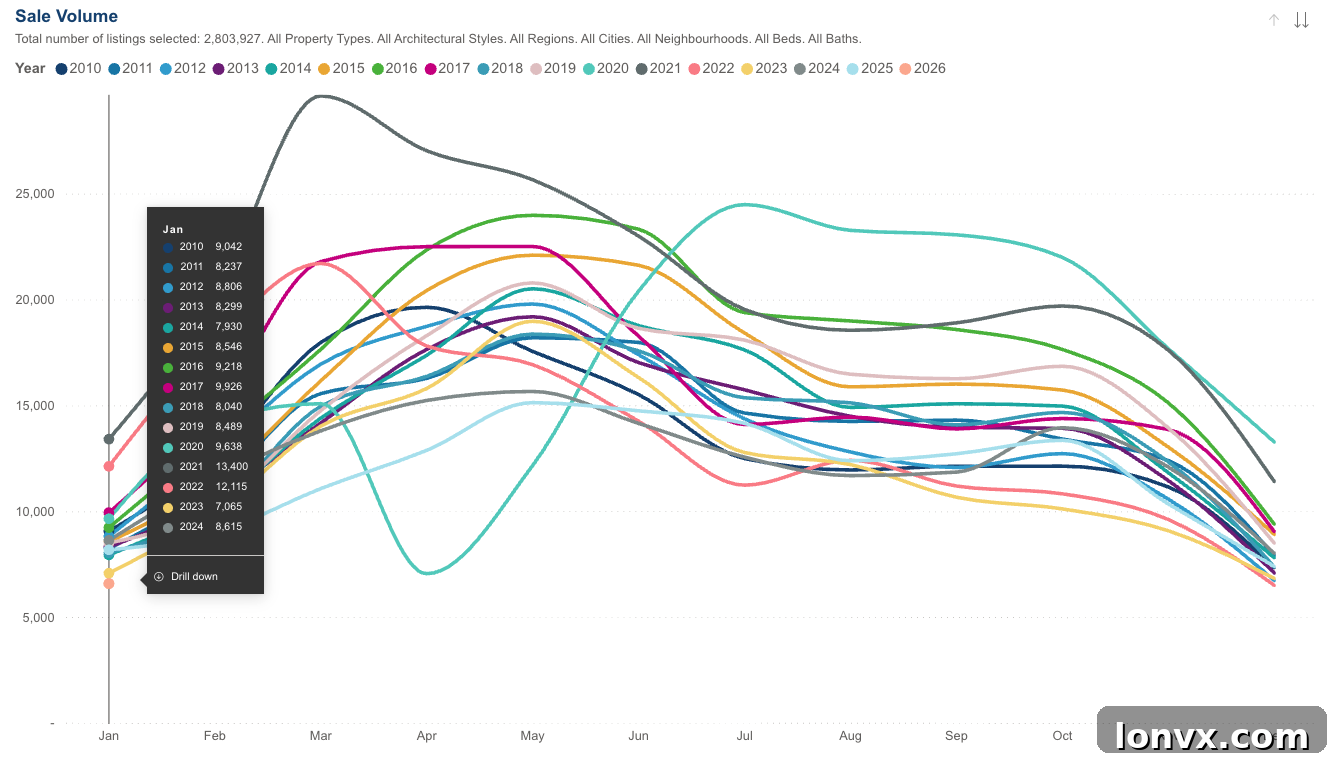 Per PropTX data from TheHabistat.com, January 2026 marked the slowest January for Toronto housing sales in at least 16 years.
This wasn’t merely a sluggish start to the new year for the Toronto real estate market. It was, in fact, one of the slowest Januarys observed in several decades. This historical context is vital, as it includes periods that encompassed significant economic upheavals, such as the global financial crisis of 2008-2009 and multiple periods of widespread pandemic-related lockdowns. The current slowdown thus indicates a profound underlying weakness, transcending typical seasonal fluctuations or transient external shocks, and pointing to systemic challenges within the GTA housing market.
Demand Continues to Evaporate in the Toronto Housing Market
The most critical insight derived from the latest Market Watch report concerning the Toronto housing market is starkly clear: buyer demand is not just weak; it continues to diminish. The core indicators confirm this trend across the board, painting a comprehensive picture of a market struggling to attract participation from prospective purchasers, despite the ongoing discussions about future rate cuts.
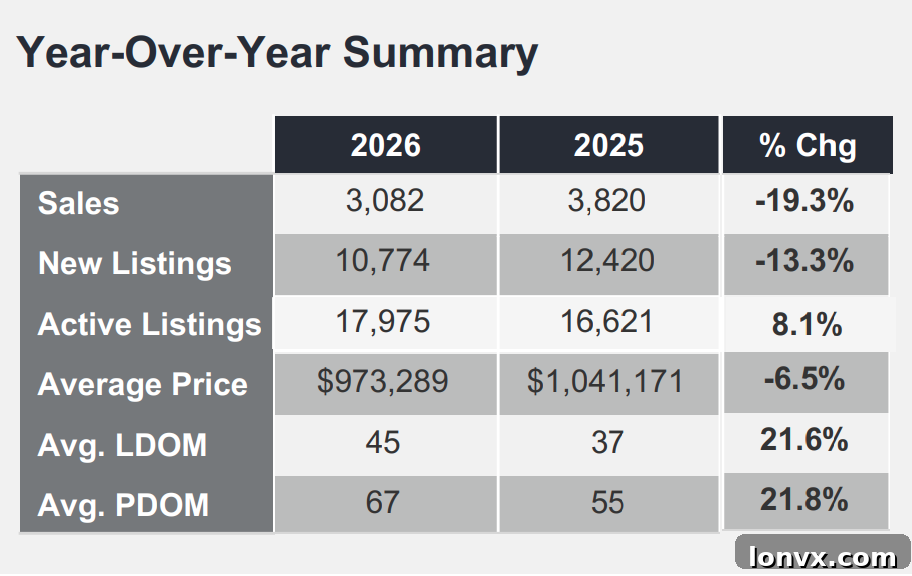
Overall sales across the Greater Toronto Area were down by a substantial 19.3 percent year over year, a figure that underscores the severe lack of buyer engagement. This significant reduction in transaction volume has, in turn, exerted downward pressure on prices. The average price for homes sold in January fell by 6.5 percent, a considerable correction that further erodes equity for existing homeowners. Even more indicative of broad market weakness, the MLS House Price Index (HPI), which adjusts for changes in the types of homes sold, dropped by approximately 8 percent. This consistency between the average price and the HPI suggests a genuine decline in home valuations, rather than merely a shift towards more affordable property types.
While new listings also saw a decline, down roughly 13 percent, this reduction was nowhere near sufficient to rebalance market conditions. Crucially, sales are falling at a faster pace than new listings are being withdrawn from the market. This dynamic is profoundly significant; it signals that buyers are retreating and pausing their purchasing plans at a greater rate than sellers are withholding their properties. The direct consequence of this imbalance is a steady accumulation of inventory. As more properties linger on the market without buyers, the supply-demand equilibrium shifts dramatically. The result is a growing inventory surplus and an increasingly imbalanced market that remains firmly tilted in favor of buyers, placing sellers at a distinct disadvantage in negotiations and expectations.
Active listings throughout the GTA are now more than 8 percent higher year over year, a concerning trend even with the reduction in new listings coming to market. This upward trajectory in available homes strongly contradicts any notion of market stabilization, highlighting instead an ongoing accumulation of supply.
Source: TRREB
A Confidence Collapse is Holding Down the Toronto Real Estate Market
A critical factor suppressing the Toronto real estate market is an undeniable collapse in consumer and investor confidence. While it is true that interest rates have largely stabilized, and the sharp, continuous increases in mortgage costs that characterized much of the previous year have abated, market activity continues its downward slide. This suggests that the issues run deeper than just the immediate cost of borrowing; they are rooted in a pervasive sense of uncertainty and apprehension among households.
Many potential homebuyers and investors are operating with deep uncertainty about their financial futures. Job security is perceived as increasingly fragile across various sectors, with layoffs becoming more visible in corporate news and within communities. The construction employment sector, which is highly sensitive to real estate trends, is particularly feeling the pinch, experiencing notable weakening. Broader economic stagnation, coupled with ongoing geopolitical and trade uncertainties, is feeding widespread hesitation. This environment leads many prospective buyers to believe that home prices could continue to fall, creating little to no urgency to enter the market. The prevailing sentiment is that waiting might lead to better deals or lower prices, a powerful psychological barrier to transaction volumes.
This collective hesitation from buyers has a profound and cascading effect, slowing the entire real estate ecosystem. When buyers retreat, transaction volumes dry up significantly. This ripple effect extends to every facet of the industry: home builders pause or delay new projects, wary of committing capital to an uncertain market. Real estate developers reconsider or even shelve plans for land acquisition and future developments. Quietly, before making headlines, employment within the real estate sector begins to contract, affecting agents, brokers, administrative staff, and various support services. This kind of systemic slowdown doesn’t typically result in dramatic, sudden market crashes. Instead, it fosters prolonged periods of grinding weakness and stagnation that are far more difficult to rectify, as they erode confidence slowly and deeply, making recovery a lengthy and arduous process.
The Toronto Housing Market is Fracturing by Product Type
The current stress within the Greater Toronto Area housing market is far from evenly distributed across all property types. While much discussion has centered on the significant pain points within the pre-construction condo sector, the resale market, particularly for condos, appears to be grappling with similar, if not intensified, challenges. This segmentation highlights distinct vulnerabilities that are shaping the overall trajectory of Toronto’s real estate landscape.
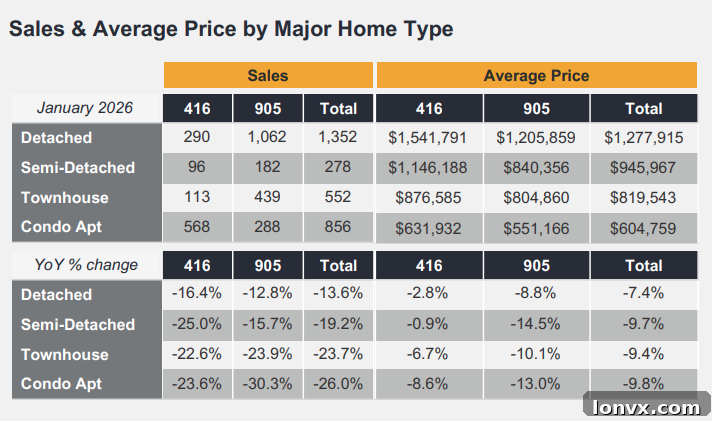
Lower-density freehold homes, such as detached and semi-detached properties, have shown slightly more resilience, especially within the core Toronto market. However, even these segments are not immune to the broader downturn; prices are still falling, and sales activity remains persistently weak. The 905 regions surrounding Toronto have experienced more pronounced declines in this category, with detached home prices specifically down close to 9 percent year over year. This suggests that while traditionally stronger, even these segments are feeling the gravitational pull of reduced demand and affordability constraints.
In stark contrast, the condo market is in a significantly worse state, acting as a clear leading indicator of the market’s struggles. In the 905 areas, condo prices have plummeted by roughly 13 percent year over year, reflecting severe downward pressure. Accompanying this price decline, sales volumes in the condo sector have collapsed by nearly 30 percent, signaling a drastic reduction in liquidity and buyer interest. This disproportionate impact on condos underscores the unique pressures facing this segment, from investor oversupply to heightened carrying costs and the struggle of first-time buyers to qualify for financing.
Source: TRREB
The profound collapse in condo market liquidity is a critical concern for the entire Toronto housing ecosystem. Condominiums traditionally serve as the primary entry point for many first-time homebuyers, providing an initial foothold in an otherwise unaffordable market. They also represent a major source of demand for pre-construction projects, which are vital engines for construction jobs, various trades, consultants, and municipal revenues through development charges and taxes. When the condo market stalls, the detrimental effects spread far beyond just resale listings. It impacts the pipeline of new housing supply, jeopardizes construction sector employment, and can slow the overall economic growth that the GTA has long relied upon from its vibrant real estate and development industries. Consequently, inventory in the condo market continues to build, with months of inventory reaching levels typically observed only during severe economic downturns, signaling deep distress and a prolonged period of adjustment.
Prices Falling Below One Million Dollars Carry Significant Psychological Weight
January 2026 recorded just over 3,000 home sales across the Toronto housing market, set against a backdrop of approximately 10,000 new listings introduced to the market. This significant imbalance between supply and demand naturally led to a sharp decline in average home prices, which decisively broke below the psychologically important $1-million threshold, settling at approximately $973,000. This specific price point holds considerable weight and implications for the perceptions and behaviors of both buyers and sellers in the GTA real estate market.
Crossing this $1-million benchmark matters profoundly from a psychological standpoint. It reinforces the widespread perception among potential homebuyers that prices are indeed continuing to move lower. This perception, in turn, suggests that waiting to purchase carries minimal risk, as further price reductions might be on the horizon. For many, seeing average prices dip below a million dollars validates their cautious approach and diminishes any sense of urgency to commit to a purchase. It empowers buyers with greater negotiation leverage and allows them to take their time in making decisions, knowing that the market is currently favoring their position. This dynamic further exacerbates the slowdown, as sellers find themselves under increasing pressure to adjust their expectations or face prolonged listing periods.
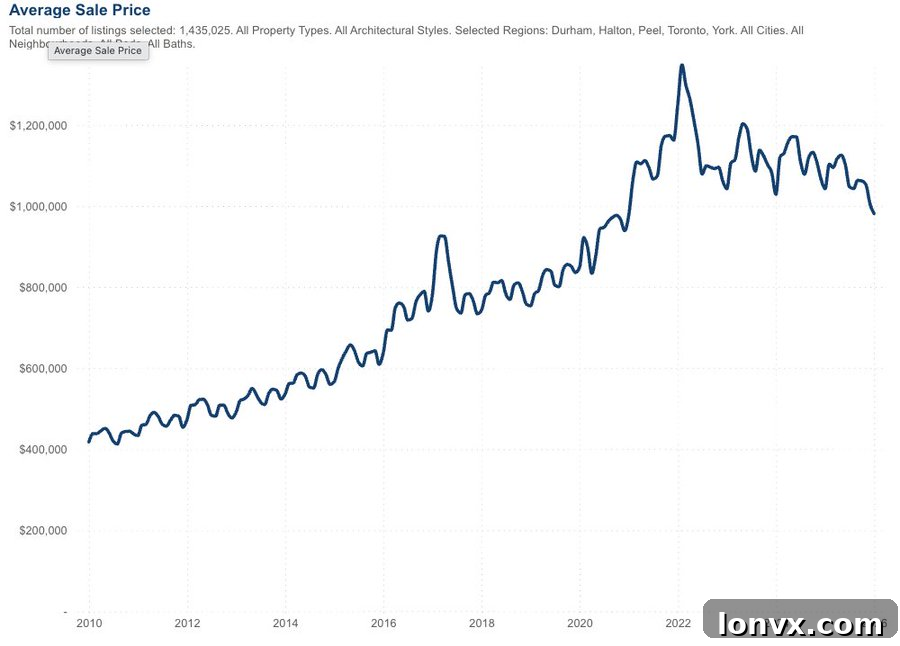
Both the average price and the MLS House Price Index experienced month-over-month declines in January. When these two key measures fall in tandem, it provides a strong signal of genuine downward pressure on valuations, rather than simply reflecting a change in the composition of homes being sold (e.g., more affordable homes selling, pulling down the average). This synchronized decline indicates a broad-based adjustment occurring across various segments of the market. Consequently, price discovery—the process by which buyers and sellers agree on a fair market value—is unfolding slowly and often painfully through protracted negotiations and extended time on market. Sellers are being forced to reduce their expectations significantly, sometimes multiple times, while buyers are exercising unprecedented patience, meticulously evaluating options and making offers well below initial asking prices, further cementing the buyer’s market conditions.
Inventory, Cancellations, and a Market Losing Momentum
The Toronto housing market continues to grapple with rising months of inventory, a clear indicator of growing supply relative to demand. This trend cannot be dismissed as merely seasonal; its direction has been unequivocally upward for many months, signaling a persistent imbalance. The significant accumulation of unsold properties indicates a fundamental shift in market dynamics that extends beyond typical cyclical fluctuations, pointing to deeper structural issues that are hindering market absorption and recovery.
Transaction volumes for January 2026 underscore this market weakness, positioning it as one of the weakest Januarys in decades, as previously highlighted. This severe downturn in sales is particularly notable because, at the same time, new listings remain historically elevated for this point in the year. The combination of subdued buyer activity and a consistent influx of new properties to the market creates a challenging environment where supply outstrips demand, leading to longer selling times and increased downward pressure on prices.
Adding another troubling layer to this complex scenario is the alarming rise in listing cancellations. The previous year already set records for terminated listings in the Toronto real estate market, but January 2026 has unfortunately exceeded those levels. This phenomenon reflects a growing trend where more sellers are listing their properties, only to discover they cannot attract buyers at acceptable price points. Faced with the prospect of selling significantly below their desired value or perceived market worth, many are choosing to withdraw their listings and step back from the market rather than transact at a loss. This behavior, while understandable from a seller’s perspective, reflects a deep-seated exhaustion and pervasive uncertainty within the market. Crucially, it also delays the necessary clearing of excess supply, keeping overhangs of inventory intact and prolonging the period of market weakness. Until sellers’ expectations align more closely with buyer willingness, this cycle of listings and cancellations will continue to hamper a meaningful recovery.
The sales-to-new-listings ratio, a crucial metric for gauging market balance, remains deep within buyer’s market territory, consistently sitting in the low 30-percent range. Historically, a robust price recovery in the Toronto housing market struggles to gain traction until this ratio moves significantly higher, ideally into the 40-60 percent range or above, indicating a healthier balance or even a shift towards a seller’s market. The current low ratio further underscores the buyer’s leverage and the severe challenges sellers face in successfully completing transactions.
Condos Are Carrying the Weight of the Downturn in Toronto Real Estate
When the inventory landscape is dissected by property type across the Greater Toronto Area, condominiums stand out prominently as the segment bearing the brunt of the current market downturn. Condos currently hold a significantly higher volume of inventory relative to sales compared to freehold homes, such as detached or semi-detached properties. This pronounced imbalance within the condo sector is a primary driver behind much of the widespread price weakness observed across the entire GTA housing market. The oversupply in the condo market creates a ripple effect, impacting overall market sentiment and pulling down average price metrics, even in other property types that might otherwise be more resilient.
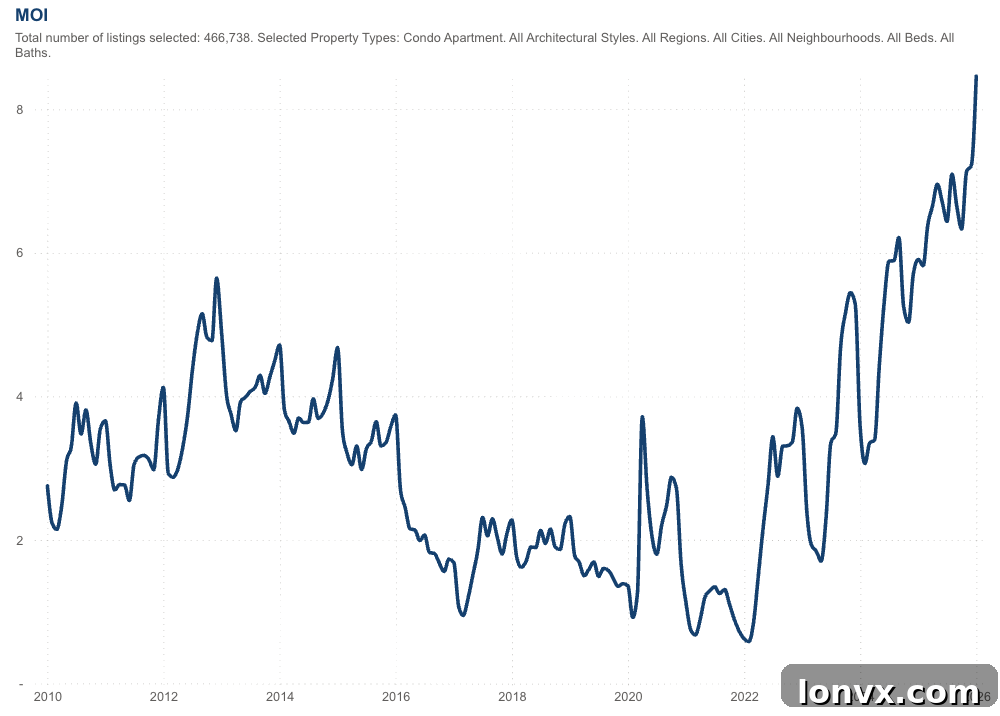
Condo months of inventory across PropTX boards continue to hit record highs, according to TheHabistat.com data, reflecting acute oversupply.
Furthermore, the “time on market” for properties is quietly but steadily rising. Homes are still selling, but the process has become noticeably slower and more arduous. This slow bleed of activity progressively erodes confidence among both potential buyers and developers. For buyers, it reinforces the belief that there’s no rush to enter the market, as properties are lingering. For developers and builders, it discourages new construction commitments, leading to fewer new projects breaking ground. This stagnation in new development, particularly for condos, will have long-term implications for future housing supply and affordability in the GTA.
Critically, this pervasive weakness is not an isolated phenomenon affecting only specific pockets of the Toronto housing market. It is a systemic issue affecting the entire Greater Toronto Area. Toronto proper, along with the surrounding regions of Peel, York, Durham, and Halton, all recorded year-over-year price declines in January. This widespread slowdown is deeply rooted in unresolved affordability constraints that have been exacerbated by high interest rates and broader economic uncertainty. Until these fundamental issues are addressed, a robust and widespread recovery across the GTA housing market remains elusive, placing continued strain on residents and the industry alike.
What January 2026 Actually Told Us About Toronto Real Estate
The January 2026 data delivered an undeniable and stark message to everyone involved in the Toronto housing market. Despite the persistent hopeful forecasts and discussions about a forthcoming rebound, the reality painted by the latest figures is far less optimistic: the market is not yet stabilizing. On the contrary, it continues its trajectory of deterioration, presenting a challenging landscape for sellers, developers, and the broader economy.
Home prices are undergoing an adjustment, which is happening gradually rather than violently. While this might seem less dramatic than a sudden crash, it often makes the underlying damage and ongoing weakness easier to overlook or downplay. This slow, grinding correction erodes equity and confidence incrementally, making it harder to pinpoint a bottom or for the market to regain significant momentum. Within this overarching trend, the condominium segment remains the weakest link and serves as the clearest leading indicator of the market’s overall health. As long as this crucial entry-point segment continues to struggle with high inventory, falling prices, and dwindling sales volumes, a broader and more sustainable recovery for the entire Toronto real estate market will remain an uphill battle.
This prolonged environment of weakness is proving brutal for the real estate industry, affecting agents, brokers, and ancillary services. It is also deeply concerning for the construction sector, which relies heavily on a healthy housing market to drive projects and employment. Fewer transactions directly translate into fewer new projects, a reduction in construction jobs, and a slowdown in overall economic activity. Historically, the housing sector has been a major engine of growth and prosperity in the GTA. Currently, that engine is barely idling, contributing minimally to regional economic momentum.
For discerning buyers equipped with sufficient capital and the patience to navigate this uncertain period, these market conditions can eventually create significant opportunities. Distressed sales, longer time on market, and increased negotiation leverage might allow them to acquire properties at more favorable prices. However, for the real estate industry as a whole, these conditions represent a period of prolonged strain, financial pressure, and difficult adjustments. The critical question now looming over the Toronto housing market is whether sufficient confidence can return in 2026 to arrest this deterioration, or if this relentless grind of weakness will persist well into 2027. The answer to this question will not only shape the future of housing affordability and accessibility but will also have profound and far-reaching impacts on employment rates, investment flows, and the overall economic momentum across the entire Greater Toronto Area for years to come.