
[et_pb_section fb_built=”1″ _builder_version=”4.16″ da_disable_devices=”off|off|off” global_colors_info=”{}” da_is_popup=”off” da_exit_intent=”off” da_has_close=”on” da_alt_close=”off” da_dark_close=”off” da_not_modal=”on” da_is_singular=”off” da_with_loader=”off” da_has_shadow=”on”][et_pb_row _builder_version=”4.16″ background_size=”initial” background_position=”top_left” background_repeat=”repeat” global_colors_info=”{}”][et_pb_column type=”4_4″ _builder_version=”4.16″ custom_padding=”|||” global_colors_info=”{}” custom_padding__hover=”|||”][et_pb_text _builder_version=”4.27.2″ background_size=”initial” background_position=”top_left” background_repeat=”repeat” global_colors_info=”{}”]
Canada’s real estate landscape is experiencing a significant shift within its condominium sector, marked by a notable surge in inventory across major urban centers. A recent comprehensive report from Re/Max Canada reveals that sellers are increasingly bringing their condominium units to market, driven by the strategic anticipation of robust buyer demand expected to materialize in late 2024 and extend into early 2025. This proactive approach by sellers is reshaping the current supply dynamics and offering new opportunities for prospective homeowners and investors alike.
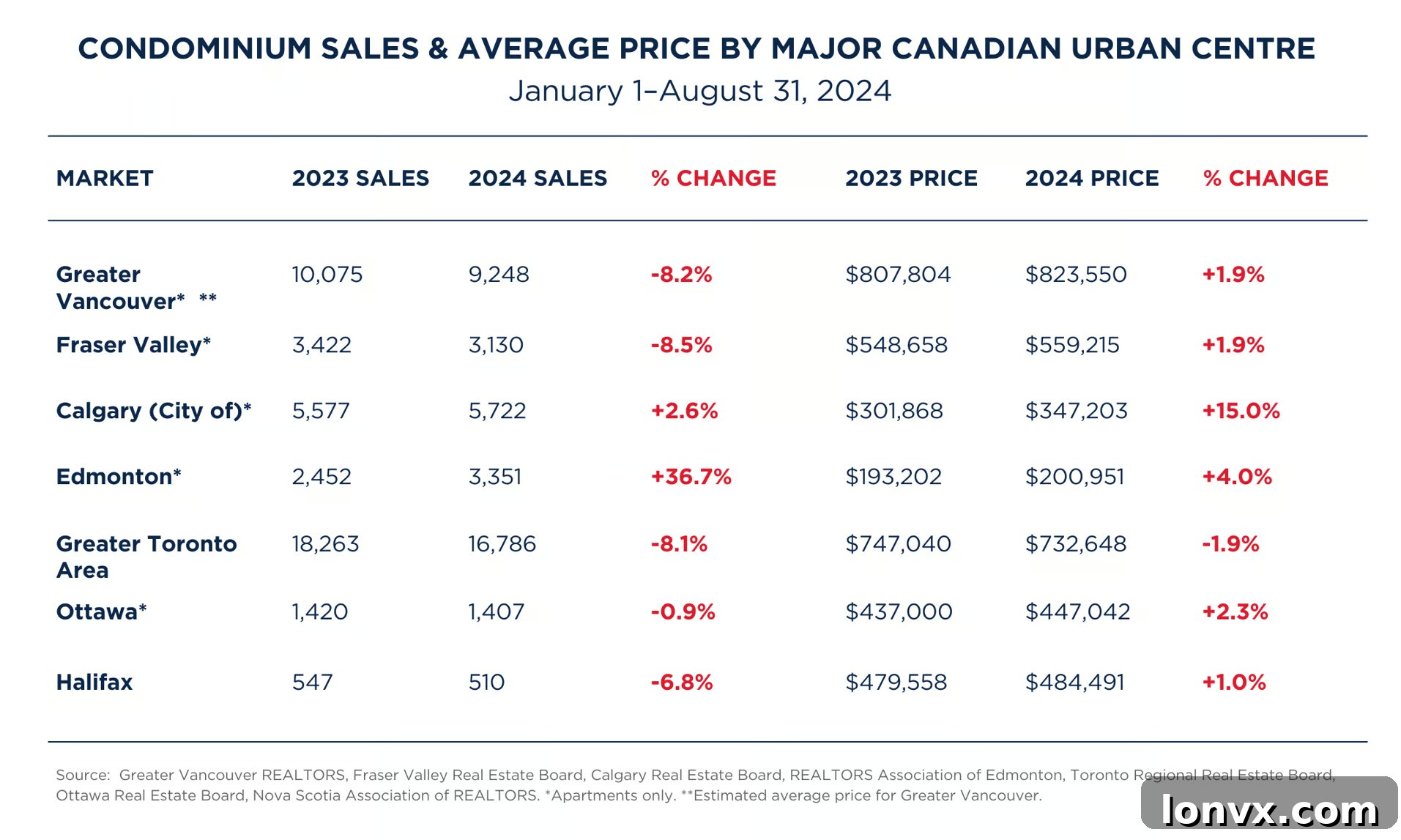
The report, which meticulously analyzed condominium market activity across seven pivotal Canadian markets from January to August 2024, highlights substantial growth in new condominium listings. Leading this trend are the Fraser Valley, which saw a remarkable 58.7 percent increase, followed closely by Greater Toronto with a 52.8 percent rise, Calgary at 52.4 percent, and Ottawa experiencing a 44.5 percent expansion in available units. More moderate, yet still significant, gains were observed in Edmonton (17.7 percent), Halifax (8.1 percent), and Vancouver (7.3 percent). This influx of inventory suggests a renewed confidence among sellers, preparing for what they believe will be a more active buying period.
Despite this considerable surge in new listings, the average condominium values have demonstrated a surprising resilience, holding steady or even increasing in the majority of markets examined. Calgary emerged as a standout performer, registering an impressive 15 percent increase in average condominium prices. Edmonton also saw healthy growth at 4.0 percent, while Ottawa recorded a 2.3 percent rise. Smaller but positive gains were noted in Vancouver, the Fraser Valley, and Halifax. Greater Toronto stands as the sole exception among these markets, where average condominium prices experienced a modest dip of 2.0 percent year-over-year, reflecting specific local market pressures.
Sales activity within the condominium sector has presented a mixed picture across the country, showcasing varied responses to prevailing economic conditions. Edmonton led the nation with a robust year-over-year increase of approximately 37 percent in condominium sales, marking its strongest performance in half a decade. Calgary also experienced a positive, albeit more modest, rise in sales activity at 2.6 percent. Conversely, other key markets observed slower condominium sales as many potential buyers adopted a wait-and-see approach, holding out for more favorable interest rates and improved affordability conditions before making their purchase decisions.
Future Outlook: Navigating the ‘Calm Before the Storm’ in Canadian Condos
The current state of the Canadian condominium market, characterized by increased inventory and cautious buyers, is aptly described by Re/Max Canada president Christopher Alexander as “the calm before the storm.” For many years, aspiring first-time homebuyers have faced significant hurdles, primarily due to persistently high interest rates and stringent lending policies. These financial pressures have often kept the dream of homeownership out of reach for a large segment of the population, even as they contended with record-high rental costs that frequently mirrored, or even exceeded, potential mortgage payments.
Alexander anticipates a significant shift in market dynamics starting in the spring of next year. He predicts that the substantial pent-up demand, accumulated over years of challenging market conditions, will inevitably fuel a much stronger resurgence in market activity. This heightened interest is expected to be particularly pronounced within entry-level price points, making affordable condominiums highly sought after once again. As interest rates begin to stabilize or decline, both first-time buyers eager to finally step onto the property ladder and savvy investors looking for viable opportunities are expected to vigorously compete for these accessible units, transforming the current lull into a vibrant and competitive marketplace.
Understanding Market Dynamics and Key Regional Trends in Canadian Condos
Re/Max’s analysis offers critical insights into the diverse regional dynamics shaping Canada’s condominium market. Edmonton and Calgary currently stand firmly as seller’s markets, benefiting from sustained demand and relatively higher affordability compared to other major urban centers. In these cities, conditions favor sellers, often leading to quicker sales and competitive bidding. In contrast, markets such as Vancouver, Ottawa, and Halifax are currently experiencing more balanced conditions, where supply and demand are in closer equilibrium. However, these markets are poised for potential shifts next year, with anticipated changes in interest rates likely to tilt the balance.
Greater Toronto’s condominium market, while presently experiencing sluggish activity and a slight price dip, is widely expected to undergo a rapid turnaround once broader market conditions improve. Experts believe that prices in Toronto have likely bottomed out, making it an attractive prospect for future growth. Despite the overall rise in new listings across the country, buyers remain notably cautious. Initial interest rate cuts by the Bank of Canada have yet to trigger a significant surge in buyer activity, but the widespread expectation of further cuts is set to act as a powerful catalyst. This anticipated monetary policy easing is expected to unleash latent demand, particularly from end-users seeking more affordable condominium options.
Even within seemingly softer markets, specific “hot pockets” consistently emerge, demonstrating localized strength and demand. Christopher Alexander notes the diverse nature of these in-demand condominium areas. This includes traditional blue-chip communities known for their stability and long-term value, rapidly gentrifying up-and-coming neighborhoods offering growth potential, and thriving suburban hot spots that appeal to those seeking space and community amenities. Condominiums located in top recreational areas, in particular, have shown robust sales activity, indicating a strong appeal for lifestyle-oriented buyers.
Illustrating these trends, Toronto’s midtown neighborhoods, such as Yonge-Eglinton and Forest Hill South, recorded double-digit sales growth in the first eight months of 2024. Similar strong performance was observed in the city’s west end, including desirable communities like High Park and Roncesvalles. In Vancouver, the appeal of suburban living was evident, with areas like Port Coquitlam experiencing a notable 11 percent increase in apartment sales, underscoring the ongoing shift in buyer preferences towards more accessible suburban locations that still offer urban amenities.
Investor Sentiment Shifts: A Strategic Pullback Except in Key Condo Markets
While end-users currently dominate the Canadian condominium market, Re/Max’s report highlights a discernible pullback among real estate investors, particularly noticeable in the Greater Toronto Area. Many investors in Toronto, up to 30 percent according to the report, have faced significant financial strain due to escalating mortgage carrying costs, which have led to negative cash flow. This challenging environment has naturally dampened investor confidence and prompted a more cautious approach to new acquisitions.
However, this investor reticence is anticipated to be temporary. As interest rates are expected to drop in the coming months and rental incomes continue their upward trajectory, the economic viability of real estate investment is set to improve significantly. This shift will likely restore investor confidence, making condominium investments a more favorable and attractive proposition once again. Smart investors are already positioning themselves to capitalize on these anticipated market changes, ready to re-enter when conditions align more favorably with their financial models.
Bucking the national trend, Edmonton has emerged as a compelling exception, actively attracting investors seeking affordability and growth potential. With condominium supply in Edmonton currently outpacing demand, astute investors have identified a unique opportunity. They are strategically acquiring and revitalizing older condominium stock, transforming these units into attractive rental properties that command premium rates. This strategy not only generates strong rental income but also contributes to the renewal of the city’s housing inventory. A significant portion of these investors are from out-of-province, particularly from Ontario and British Columbia, capitalizing on Edmonton’s comparatively lower property costs and its development-friendly environment, which offers a more accessible entry point into the investment market.
A Unique Opportunity: The Most Favorable Climate for Condo Buyers in Recent Years
The current market dynamics present an exceptionally unique and advantageous opportunity for end-users in the condominium sector. As Christopher Alexander explains, “In many markets, end-users are in the driver’s seat right now.” This temporary market condition, characterized by a strategic pullback from investors, creates a distinctive window for aspiring condominium buyers. For a limited time, these buyers will likely face significantly less competition from large-scale investors and benefit from a more ample supply of available properties, allowing for more considered decisions and potentially better negotiation leverage.
This advantageous climate is particularly pronounced in high-cost markets like Toronto and Vancouver, where the impact of monetary policy has disproportionately affected investor profit margins, despite the strong underlying fundamentals of high rent and low vacancy rates. As property values are widely projected to rebound and rise in these key markets, the present moment is “arguably the most favorable climate condominium buyers have seen in recent years.” This confluence of reduced competition and robust inventory offers a golden opportunity for those looking to secure a condominium, especially before broader market conditions shift and investor activity intensifies once more.
The Inevitable Future: Condominiums as the Driving Force for Canada’s Housing Market
Looking ahead, the role of condominiums in Canada’s housing landscape is set to become even more central and indispensable. Persistent immigration and continuous inter-provincial migration are critical demographic drivers that will consistently boost housing demand across the nation. As Canada’s population continues to grow, condominiums are naturally evolving into both essential entry points for new homebuyers and crucial “middle steps” for those seeking to move up or downsize within Canada’s most expensive and densely populated markets. While population growth might experience short-term fluctuations, projections from Statistics Canada indicate a robust long-term trend, with Canada’s population potentially reaching as high as 49 million by 2035, thereby ensuring enduring and substantial demand for condominium living.
Christopher Alexander emphasizes that “the housing mix is evolving very quickly as a result of densification and urbanization.” Condominiums are no longer just an alternative; they now represent the very heart of Canada’s largest cities, embodying a modern urban lifestyle. It is, therefore, “inevitable that further development will see condominiums become the driving force accounting for the lion’s share of sales in years to come.” This transformation reflects a fundamental and structural shift in how Canadians live and where they choose to reside.
This burgeoning preference for condominium living signifies more than just a housing trend; it represents “a physical and cultural shift that Canadians are not only adjusting to but are embracing.” Younger generations, in particular, are at the forefront of redefining urban neighborhoods. Their demand for vibrant communities, coupled with robust amenities, accessibility, and sustainable living options, is infusing new life into Canada’s urban cores. This generational embrace of condominium living is actively shaping the future of Canadian cities, fostering dynamic, diverse, and well-connected urban environments that cater to modern lifestyles and contribute significantly to economic and social vitality.
For a detailed analysis and regional highlights, review the full report.
[/et_pb_text][et_pb_signup mailchimp_list=”REM|3f4c7c7b65″ first_name_field=”off” last_name_field=”off” title=”Enjoying this article?” description=”
Get the latest REM articles in your inbox 3x week so you stay up to date on the latest in the Canadian real estate industry
” _builder_version=”4.21.0″ _module_preset=”default” form_field_background_color=”#f7f7f7″ form_field_text_color=”#000000″ header_text_align=”center” header_text_color=”#FFFFFF” header_font_size=”33px” body_text_align=”center” body_text_color=”#FFFFFF” body_font_size=”18px” background_color=”#000000″ custom_button=”on” button_text_size=”21px” button_border_radius=”3px” custom_margin=”31px||31px||true|false” custom_margin_last_edited=”off|desktop” custom_padding=”28px||28px||true|false” custom_css_newsletter_title=”margin-bottom:10px” border_radii=”on|5px|5px|5px|5px” border_width_all_fields=”1px” border_color_all_fields=”#bfbfbf” box_shadow_style=”preset2″ box_shadow_horizontal=”1px” box_shadow_blur=”12px” box_shadow_color=”rgba(0,0,0,0.31)” global_colors_info=”{}”][/et_pb_signup][/et_pb_column][/et_pb_row][/et_pb_section]