
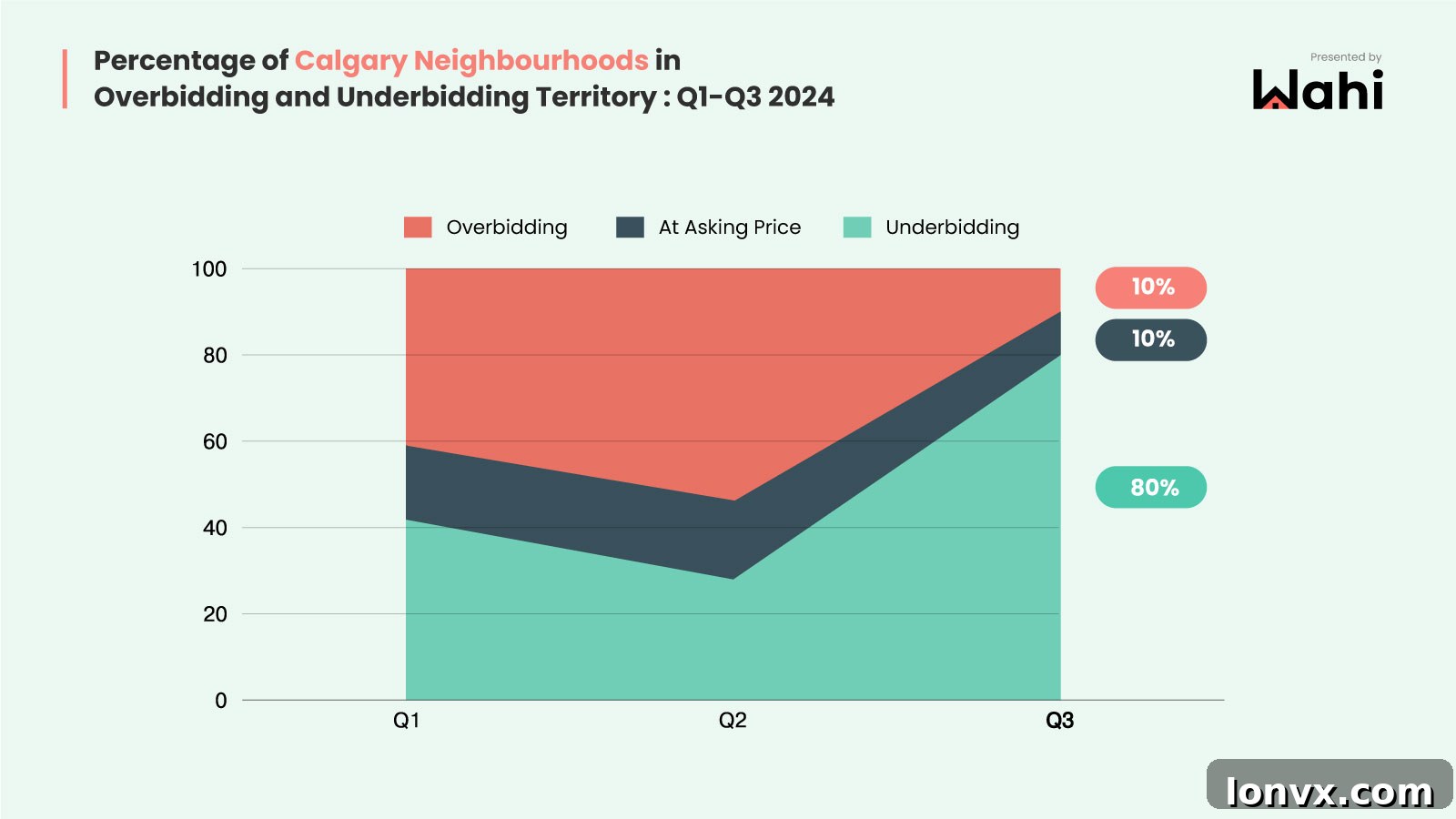
Calgary’s real estate market experienced a significant and insightful shift during the third quarter (Q3) of this year, transitioning from a highly competitive environment to a more balanced landscape. According to a detailed analysis by Wahi, there was a dramatic decline in overbidding activity. Only 10 percent of neighborhoods saw homes sell above their asking price in Q3, a stark contrast to the 54 percent recorded in the second quarter. This significant deceleration in aggressive bidding indicates a pivotal moment for both buyers and sellers, marking a move towards more normalized market conditions after a period of intense activity.
Calgary Home Prices Hold Steady Despite Drop in Overbidding
While the substantial reduction in overbidding might initially suggest a weakening market, Wahi’s analysis clarifies that this trend does not signal a collapse in home prices or significant losses for sellers. Instead, it highlights a broader market stability. The data reveals that prices across most Calgary neighborhoods remained remarkably consistent with their asking prices, demonstrating a resilient market foundation.
A compelling statistic from Q3 shows that over two-thirds (69 percent) of Calgary’s approximately 200 neighborhoods saw homes selling within a narrow $5,000 range of their listed price. This precise alignment between asking and selling prices indicates a market where realistic valuations are prevalent and negotiations are typically modest. It underscores a shift towards an equilibrium where neither buyers nor sellers hold overwhelming leverage, fostering a healthier and more predictable transaction environment for all participants. This stability is a key characteristic of a maturing market that is adjusting to new economic realities rather than succumbing to a downturn.
Understanding Calgary’s Q3 Median Home Price and Market Resilience
In the third quarter, the median price for a home in Calgary was recorded at $561,000. This figure represents a slight decrease of 2 percent from the previous quarter, indicating a minor correction following a period of strong growth. However, when viewed on an annual basis, the Calgary housing market continues to demonstrate robust performance, with median prices still up an impressive 13 percent compared to the same time last year. This annual growth trajectory highlights the underlying strength and sustained appeal of the Calgary market, which has absorbed various economic pressures and continued to deliver value to homeowners.
Even as the overall Calgary market subtly moved into underbidding territory, the extent of these underbids was notably restrained. The median underbid amount registered at a modest $4,925. This small figure is crucial, as it reflects minor negotiation room rather than significant price reductions, reaffirming the market’s stability. Such moderate adjustments are typical of a balanced market and suggest that while buyers are gaining slightly more negotiation power, sellers are generally not experiencing steep price concessions.
Benjy Katchen, CEO of Wahi, offered a pertinent perspective on these trends, noting, “The Calgary market has been holding steady despite an apparent rise in underbidding activity.” Katchen attributed part of this stability to seasonal factors, specifically pointing out that summer is typically a period when people often go on vacation. This seasonal slowdown in activity can naturally lead to a temporary softening in bidding intensity and sales volume, without necessarily signaling a fundamental shift in the market’s long-term health. Buyer and seller behavior tends to adapt to holiday schedules, creating a momentary lull before market activity potentially picks up again.
Analyzing the Q3 Drop in Home Sales Amidst Stable Pricing
Despite the relative stability in home prices, Calgary experienced a pronounced drop in home sales volume during Q3. A total of 6,585 homes were sold in the third quarter, marking a substantial 25 percent decline from the previous quarter. This also represents a 16 percent decrease when compared to the same period in 2023. This dual trend of stable prices but fewer transactions suggests a market that is undergoing a period of recalibration, where supply and demand are finding new points of equilibrium.
Several factors likely contributed to this sharp decrease in sales volume. High interest rates continue to be a significant deterrent for many potential buyers, impacting affordability and increasing the cost of homeownership. Economic uncertainties, coupled with tighter lending conditions, may also be leading buyers to exercise more caution and potentially delay their purchasing decisions. Furthermore, while inventory levels may be rising in some segments, a lack of suitable homes at certain price points can also restrict transactions. The interplay of these macroeconomic and localized factors has created a scenario where fewer homes are changing hands, even as the value of existing properties remains largely intact. This indicates a market where buyers are becoming more selective and thoughtful about their investments.
Calgary’s Diverse Neighborhoods: A Look at Overbid and Underbid Leaders in Q3
The granular data from Calgary’s Q3 market offers fascinating insights into neighborhood-specific trends. A considerable 149 Calgary neighborhoods found themselves in underbidding territory during the third quarter. This phenomenon was particularly evident in the city’s upscale areas, where home prices frequently exceed $1 million, often ranging well into the $2 million-plus bracket. In these luxury segments, buyers typically exhibit greater price sensitivity to factors like interest rate changes, and the higher absolute value of properties allows for larger nominal underbid amounts, even if the percentage discount remains relatively small. This suggests that the luxury market, with its smaller buyer pool, might be more susceptible to slight shifts in economic sentiment and buyer confidence.
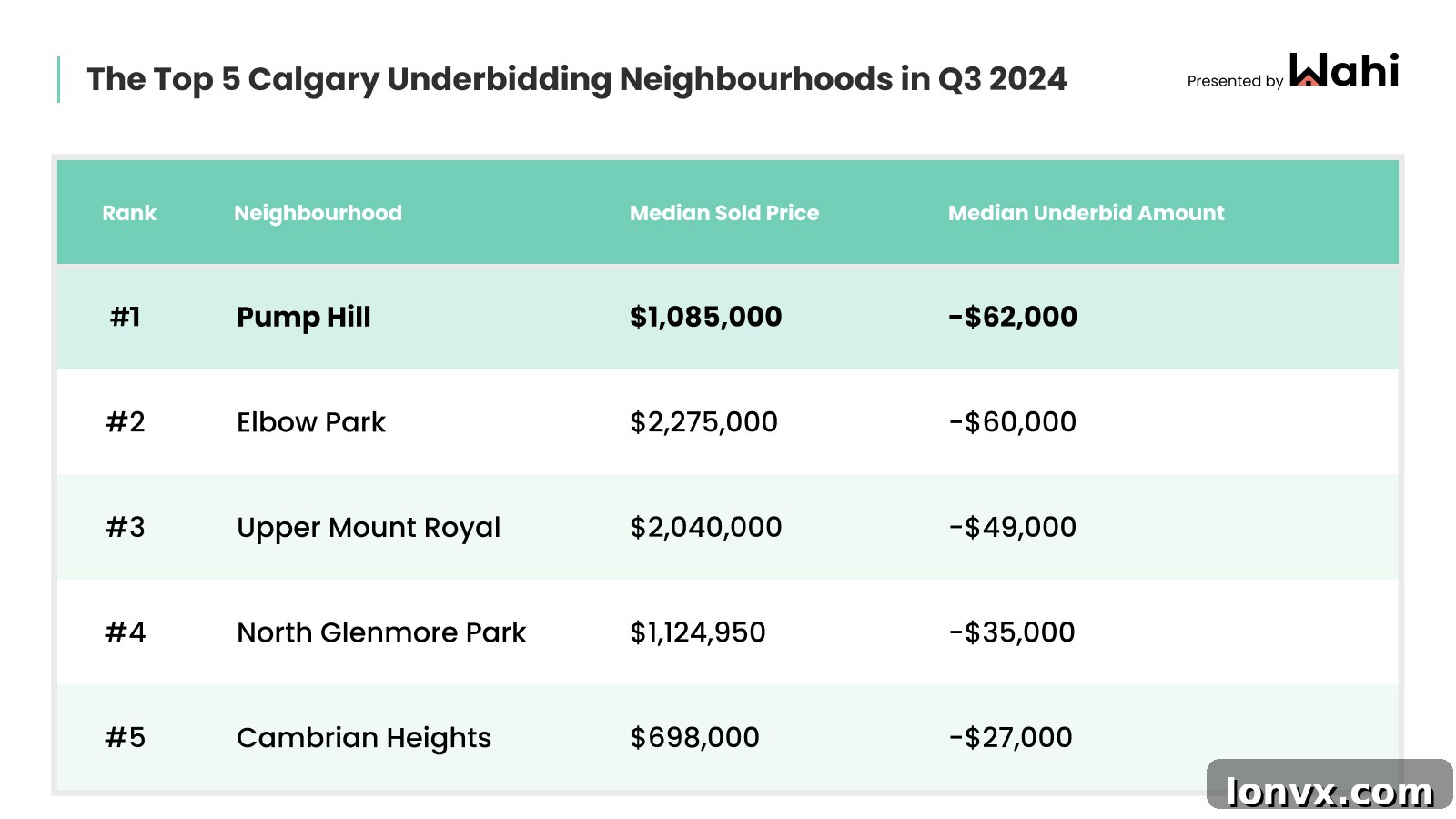
An interesting anomaly within this trend was Cambrian Heights. Despite generally featuring lower price points compared to the city’s high-end luxury districts, this neighborhood also experienced significant underbidding activity. This highlights that while broad market forces are at play, localized conditions such as specific inventory levels, property types, or unique community characteristics can profoundly influence bidding dynamics at the neighborhood level. It underscores the importance of a granular understanding of the market, as not all communities react uniformly to city-wide trends.
Conversely, 19 neighborhoods managed to resist the broader cooling trend and remained in overbidding territory, showcasing persistent demand in specific pockets of the city. Red Carpet led this exclusive group, recording a median overbid of $10,200. The continued strength of these neighborhoods can be attributed to various factors, including highly desirable amenities, excellent school districts, limited housing supply, or unique community appeal that maintains strong buyer competition. Even within these resilient areas, however, the overall market narrative for Q3 suggests a more tempered approach, with little evidence of widespread, large price escalations. This indicates that even the most competitive bids were measured, reflecting a more cautious and value-driven approach from buyers across the board.
Calgary Real Estate Outlook: Navigating Future Market Dynamics and Opportunities
As Calgary moves into the final quarter of the year and looks ahead, the real estate market appears to be on a trajectory of sustained stability, albeit with continuous adjustments. The Q3 data paints a picture of a market maturing from a period of intense activity to a more balanced and predictable rhythm. Several factors are expected to underpin this outlook. Alberta’s consistent population growth, fueled by interprovincial migration, continues to drive housing demand. The city’s relatively robust job market further supports affordability and purchasing power compared to other major Canadian urban centers. However, prospective buyers and sellers must remain vigilant about potential shifts in interest rate policies and the broader economic landscape, which will undoubtedly influence market sentiment and housing affordability in the coming quarters.
For buyers, the noticeable cooling in overbidding activity presents a more favorable and less frantic environment. This translates into increased opportunities for negotiation, potentially allowing buyers to acquire properties closer to their asking prices, and even secure slight underbids in certain segments. The pressure to make hurried decisions has lessened, empowering buyers with more time for due diligence. Sellers, conversely, may need to adjust their pricing strategies and focus intensely on property presentation to attract discerning buyers in a market that is no longer characterized by intense competition. Adaptability and a realistic understanding of current market conditions will be paramount for successful transactions.
In conclusion, Calgary’s Q3 2024 real estate market performance is a testament to its resilience and adaptability. The significant decline in overbidding, paired with stable median prices and a moderate underbid average, points towards a healthier and more balanced market environment. While a reduction in sales volumes indicates a period of adjustment, this appears to be a natural market response to evolving economic conditions and seasonal patterns, rather than a harbinger of distress. The city’s dynamic housing landscape continues to offer diverse opportunities for both buyers seeking value and sellers aiming for strategic transactions. All stakeholders will closely monitor how these nuanced dynamics continue to unfold, shaping Calgary’s vibrant real estate future.
Enjoying this article?
Get the latest REM articles in your inbox 3x week so you stay up to date on the latest in the Canadian real estate industry