
The landscape of housing affordability in Ontario is undergoing a significant shift, with a new survey revealing that residents are increasingly looking beyond mere market demand as the sole driver of escalating costs. Commissioned by the Ontario Real Estate Association (OREA) and conducted by Abacus Data, the comprehensive poll highlights a growing belief that government policies, taxes, and fees play a crucial and often underestimated role in shaping the affordability crisis.
According to the findings, a striking 62 percent of Ontarians believe that property taxes and various government-imposed fees have at least a moderate impact on their ability to afford housing within their local communities. This perception marks a pivotal change, underscoring a public demand for greater accountability and transparency from all levels of government in addressing the province’s housing challenges.
These insights are drawn from OREA’s detailed report, “Housing Affordability in Ontario: Perceptions, Impacts, and Solutions,” which is based on a robust survey of 2,000 Ontarians aged 18 and older, conducted in January. The report offers a critical snapshot of public sentiment and expectations regarding one of the province’s most pressing issues.
Ontario Braces for Worsening Housing Affordability
Despite a slight easing in the perception that buying a home has become harder, the reality for most Ontarians remains bleak. The survey reveals that a clear majority, 61 percent, still experienced a worsening of housing conditions over the past year. This sentiment is particularly pronounced among younger adults and renters, who are often at the sharp end of the affordability crisis.
Optimism for future relief is remarkably low, painting a grim picture for prospective homeowners and current residents alike. Only a meagre 12 percent of respondents believe that housing will become more affordable in the next five years. Conversely, nearly half of all Ontarians anticipate a further deterioration in affordability, signaling deep-seated anxieties about the future of the housing market.
This widespread pessimism reflects not only the current challenges but also a lack of confidence in existing solutions to turn the tide. Younger generations, often burdened with student debt and precarious employment, face an uphill battle in entering the housing market, making the dream of homeownership increasingly elusive. Renters, too, grapple with soaring rental costs, leaving little room for saving towards a down payment. The persistent upward trajectory of housing costs, combined with stagnant wage growth for many, fuels a cycle of affordability decline that impacts social mobility and economic stability across the province.
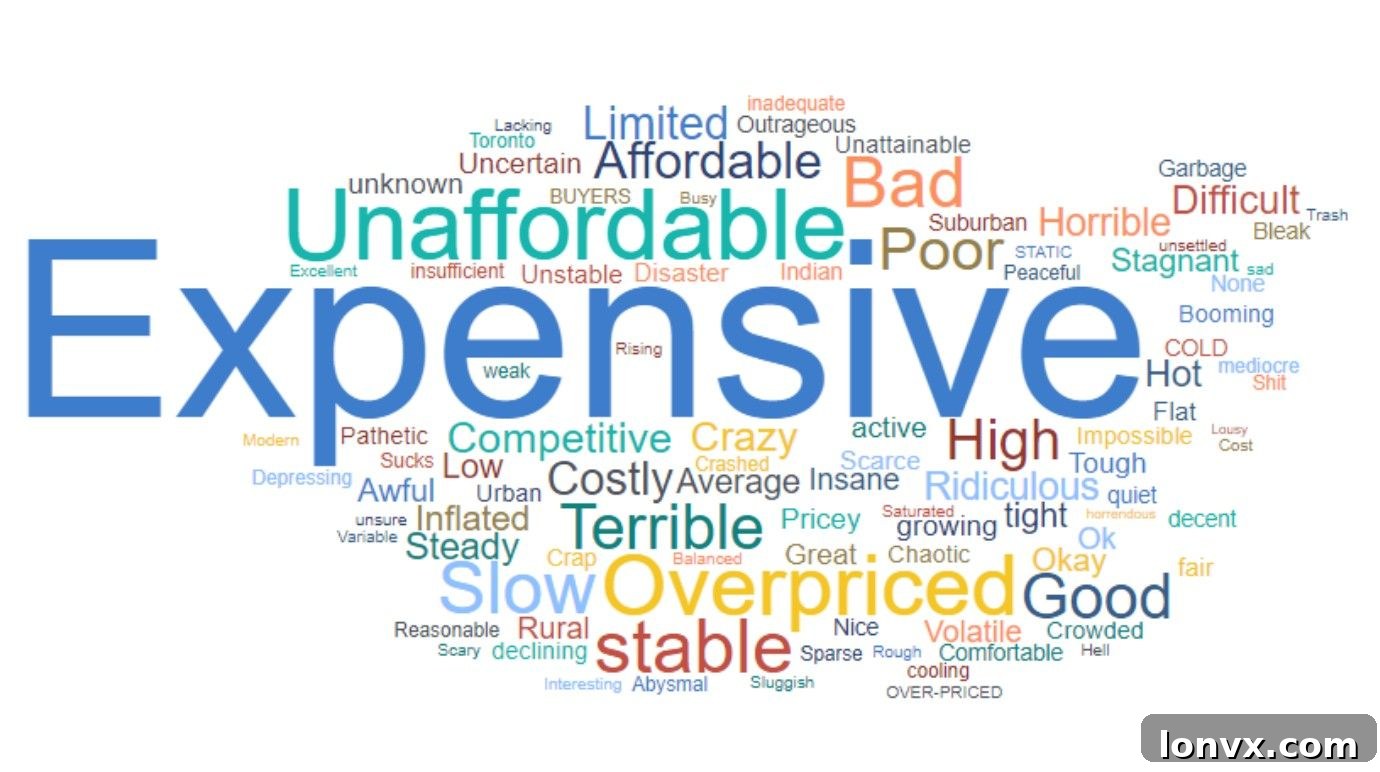
Words survey respondents used to describe Ontario’s housing market.
Development Charges: A Source of Growing Concern
A significant portion of the survey delved into Ontarians’ attitudes towards municipal development charges. These fees are levied by municipalities on new construction to help fund essential infrastructure projects, such as roads, water systems, and parks, needed to support growing populations. While many respondents indicated an understanding of the fundamental principle behind these charges – that growth should pay for growth – their application and impact on affordability are sparking considerable unease.
The survey found a palpable tension between the accepted logic of funding infrastructure and the real-world consequences for homebuyers. A notable two in five respondents expressed the view that it is unfair to pass the entirety of these development charge costs directly onto homebuyers. This sentiment is amplified by the fact that a vast majority, 71 percent, unequivocally stated that these fees make housing less affordable. While the concept of development charges may be theoretically sound, the practical implementation of the system and its direct contribution to escalating housing prices are clearly a point of contention among Ontarians.
The public’s discomfort stems from the understanding that these charges, while intended to support community expansion, are ultimately factored into the final price of a new home. This effectively places a significant financial burden on new homebuyers, who are often already struggling to afford a property. The discussion around development charges therefore transcends a simple question of funding; it delves into issues of equity, fairness, and the overall accessibility of housing in a rapidly developing province.
Calls for Greater Transparency and Accountability
Beyond the impact of development charges on affordability, the survey also unearthed significant concerns regarding how municipalities manage and utilize the revenue generated from these fees. A startling lack of public confidence emerged, with only 26 percent of Ontarians expressing belief that these funds are used appropriately. Even fewer, a mere 22 percent, felt that municipalities were transparent about how the money is spent, indicating a substantial trust deficit.
Adding to these concerns, a substantial seven out of ten respondents voiced worry that some municipalities have accumulated large surpluses of unspent development charge revenue. This accumulation of funds, intended for infrastructure, while housing remains unaffordable, raises questions about efficiency, planning, and prioritization within municipal governance. The public perception is that if these funds are not being deployed effectively to support growth, they may be inadvertently contributing to the problem rather than solving it.
Kim Fairley, OREA president-elect, articulated the public’s demand: “It’s clear that Ontarians want their municipal leaders to be transparent and accountable when it comes to collecting and managing the fees that enable infrastructure and growth for much-needed homes across the province.” Fairley further emphasized the need for tangible solutions to improve oversight. She recommended that municipalities should be mandated to publish detailed reports outlining how development charge funds are utilized. Furthermore, she suggested that unspent revenue should be strategically redirected to help offset other government-imposed costs, such as property taxes, thereby providing tangible relief to residents and potentially easing housing costs.
This call for transparency isn’t just about good governance; it’s about restoring public trust and ensuring that policies designed to facilitate growth don’t inadvertently exacerbate the housing crisis. Detailed reporting and clearer financial management would allow citizens to see exactly where their money is going and hold their local leaders accountable for the timely and effective deployment of funds for critical infrastructure.
Housing Remains a Top Provincial Issue
The enduring and pervasive nature of the housing crisis is evident in its consistent ranking among the most critical issues Ontarians want their provincial government to address. The survey underscored just how deeply housing affordability is intertwined with the broader cost of living crisis, which continues to dominate public discourse and household budgets.
An overwhelming 83 percent of respondents identified the cost of living as a major priority for provincial government action, demonstrating the widespread financial pressure faced by residents. Closely following, 73 percent cited housing affordability as a top concern, highlighting its profound impact on the quality of life across Ontario. This strong consensus translates into a clear expectation for governmental action, with nearly four in five Ontarians, or 79 percent, stating emphatically that the provincial government must prioritize housing affordability.
The concern surrounding housing is not confined to any particular demographic or political affiliation; it is remarkably widespread. A staggering 86 percent of all respondents expressed worry about current housing conditions in Ontario, indicating a non-partisan crisis that demands a unified and decisive response from policymakers. This widespread anxiety signals that housing is no longer just an economic issue but a fundamental social and political challenge that affects every segment of Ontario’s population, from young families to retirees.
Homeownership Still a Cherished Goal for Many
Despite the formidable affordability challenges currently gripping Ontario, the aspiration of owning a home remains remarkably robust and deeply ingrained in the provincial psyche. The dream of homeownership, often associated with stability, wealth creation, and community roots, continues to motivate countless individuals and families across the province.
The survey unequivocally demonstrates this enduring desire: more than two-thirds of non-homeowners, an impressive 68 percent, expressed a strong wish to become homeowners one day. This aspiration is even more pronounced among younger adults, highlighting a generational ambition that current market conditions threaten to extinguish. A remarkable 88 percent of respondents aged 18 to 29 specifically stated their hope to achieve homeownership in the future, underscoring the vital importance of this goal for the province’s upcoming generations.
“The dream of homeownership is still alive for young Ontarians and their families, but they need help to get there,” reiterated OREA president-elect Kim Fairley. Her statement encapsulates the sentiment of many who feel locked out of a market that seems increasingly out of reach. Fairley further articulated specific policy pathways that governments must pursue to bridge this gap. She emphasized the critical need to adopt policies that effectively lower the cost of building new homes, which includes addressing regulatory burdens, material costs, and labor shortages. Concurrently, she advocated for accelerating the delivery of new housing supply through streamlined approvals, innovative construction methods, and strategic land use planning. By tackling both the cost of construction and the speed of supply, governments can work towards bringing housing affordability back within reach for the many Ontarians who still yearn to call a home their own.
The persistence of this dream, even in the face of daunting economic realities, serves as a powerful reminder to policymakers that housing is not just a commodity but a fundamental pillar of well-being and prosperity for individuals and the province as a whole. Addressing the housing crisis is therefore not just an economic imperative, but a social one, essential for fostering a stable and thriving Ontario.