
Canada’s Luxury Real Estate: Navigating Shifting Tides and Enduring Strengths
Canada’s luxury real estate sector experienced a dynamic start to 2025, initially showing strong momentum before a swift cooling period emerged as macroeconomic headwinds and geopolitical uncertainties began to dominate the global landscape. This detailed analysis delves into the performance of Canada’s high-end property market, offering insights into regional disparities, buyer sentiment, and the underlying factors shaping its trajectory.
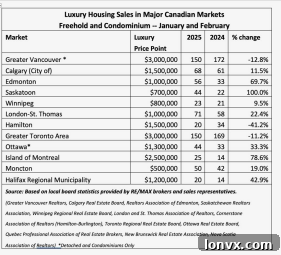
The recent Re/Max Canada Spotlight on Luxury Report provides a comprehensive overview of luxury real estate activity across 12 key markets during January and February, comparing performance to the same period in 2024. While the initial weeks of the year saw an impressive surge, with three-quarters of these markets reporting year-over-year sales increases—many registering double-digit growth—the latter half of the winter season brought a notable increase in market uncertainty. This shift was largely attributed to escalating concerns surrounding international tariffs, heightened stock market volatility, and a general climate of political unease, both domestically and abroad.
“Canadian homebuyers demonstrated significant enthusiasm for luxury real estate at the dawn of 2025, buoyed by growing consumer confidence, robust stock market performance, and an increasingly favourable lending environment that stimulated activity across all price points,” explains Kingsley Ma, Area Vice President at Re/Max Canada. “However, the market climate rapidly transformed amid escalating political tensions, particularly a burgeoning trade dispute between Canada and the U.S., which introduced an unexpected layer of caution among discerning buyers and investors.” This sudden shift underscored the inherent sensitivity of the luxury market to broader economic and political currents, leading many to adopt a more measured approach.
Mid-Sized Markets Emerge as Unexpected Leaders in Luxury Growth
Interestingly, the first two months of the year saw smaller, more affordable urban centers leading the charge in luxury real estate gains. These mid-sized markets, often offering a compelling blend of sophisticated lifestyle and comparatively lower entry costs, became hotbeds of activity. Saskatoon, for example, witnessed a remarkable doubling of sales year-over-year in its luxury segment, signaling robust local demand and potentially an influx of new buyers seeking value. Montreal, a vibrant metropolitan hub, posted an impressive 78.6 percent increase, demonstrating its enduring appeal and renewed investor confidence.
Further west, Edmonton surged by nearly 70 percent, while the nation’s capital, Ottawa, climbed over 50 percent, reflecting strong local economies and perhaps a spillover effect from buyers priced out of more expensive markets. Other notable gains were observed in Halifax, London-St. Thomas, and Calgary, all of which posted significant increases, highlighting a broader trend of luxury demand expanding beyond traditional major city centers. These markets often benefit from strong local industries, burgeoning tech sectors, and a high quality of life, attracting affluent individuals seeking both primary residences and investment opportunities.
In stark contrast, several high-price-point markets, traditionally seen as bastions of luxury real estate, experienced a contraction in sales. Hamilton saw a significant drop of 41.2 percent year-over-year, while Greater Vancouver, one of Canada’s most expensive markets, declined by 12.8 percent. The Greater Toronto Area (GTA), another luxury powerhouse, also reported an 11.2 percent decrease. This divergence suggests that while the overall appetite for luxury homes remains strong, buyers are becoming increasingly selective about location and perceived value, especially in regions facing higher economic pressures or regulatory scrutiny. The luxury segment in these established markets often responds more acutely to interest rate fluctuations and shifts in global capital flows, leading to a more cautious purchasing environment.
For buyers in these more volatile and high-stakes regions, the report indicates a pronounced tendency towards “exercising more caution than sellers.” This heightened prudence stems from several factors. A key driver has been the deterioration of stock portfolios, even if only on paper. Major U.S. indices such as the Nasdaq, S&P 500, and the Dow Jones Industrial Average experienced significant declines from the start of the year, with some markets nearing correction territory before eventually rebounding. Such volatility in financial assets often leads affluent buyers to pause or delay significant real estate investments, re-evaluating their liquidity and risk exposure. Furthermore, the report emphasizes the upcoming federal election as another critical element contributing to the stalled activity in certain luxury markets. The uncertainty surrounding potential changes in economic policy, taxation, and housing regulations often prompts high-net-worth individuals to adopt a wait-and-see approach until the political landscape becomes clearer, thus impacting transaction volumes in the short term.
Ultra-Luxury and High-End Condominiums Demonstrate Remarkable Resilience
Despite the broader market adjustments in some regions, not all segments of the luxury market are experiencing a pullback. The ultra-luxury market, particularly within the Greater Toronto Area, has shown remarkable resilience and activity compared to the previous year. Early this year, a robust seven homes priced over $7.5-million were successfully sold, including an impressive four properties exceeding the $10-million mark. This strong performance in the very highest echelons of the market suggests that a specific cohort of ultra-high-net-worth individuals remains largely unaffected by general economic headwinds, viewing these exclusive properties as stable long-term investments or essential lifestyle acquisitions, irrespective of short-term market fluctuations.
Luxury condominiums, especially those valued over $3-million, are also showcasing significant signs of strength and growing demand in key urban centers like Toronto and Vancouver. Greater Vancouver recorded the sale of fifteen luxury condo units between January and February, a stark contrast to zero sales during the same period in 2024. Similarly, the GTA saw 12 luxury condo units sold, slightly up from 11 during the corresponding period last year. This surge in high-end condo sales can be attributed to several factors: a desire for maintenance-free urban living, access to premium amenities, and the appeal of highly desirable, centrally located properties that offer both convenience and prestige. For many affluent buyers, luxury condominiums represent an ideal blend of sophisticated lifestyle and strategic investment within vibrant cityscapes.
Further supporting market activity, particularly in Western Canadian markets, has been the implementation of federal housing policy changes. A significant adjustment introduced in December 2024 to mortgage insurance rules has opened new doors for a wider range of buyers. By raising the Canada Mortgage and Housing Corporation (CMHC) insurance cap to $1.5-million and allowing for extended 30-year amortizations, the policy has effectively enhanced affordability and accessibility for luxury properties that fall within this updated threshold. This change is crucial as it reduces the immediate financial burden for many potential homeowners, allowing them to qualify for larger mortgages with more manageable monthly payments.
“This strategic move has provided buyers with considerably more leeway, particularly in terms of requiring smaller down payments for high-value properties,” the report elucidates. The positive effects of this policy are already tangibly evident in markets such as Edmonton and Saskatoon, where increased buyer confidence and activity have been observed. By making it easier to finance luxury homes, the federal policy acts as a significant catalyst, stimulating demand and fostering a more inclusive luxury market by enabling a broader segment of affluent individuals to participate, especially those who prefer to keep more capital liquid for other investments.
Demographic Shifts Bolstering Enduring Luxury Demand
Demographic trends continue to play a pivotal role in underpinning demand within Canada’s luxury real estate market. “In-migration and immigration remain significant drivers, consistently supporting demand at luxury price points in growing markets across the country, including Calgary, Edmonton, Saskatoon, the Halifax Regional Municipality, and Moncton,” notes Samantha Villiard, Vice President of Regional Development at Re/Max Canada. She adds, “While the pace may be somewhat slower than in previous years, the sustained influx of new residents and international capital continues to infuse vitality into these regions, bringing with them diverse preferences and investment capabilities.” These new populations often seek high-quality housing that matches their established lifestyles or meets specific investment criteria, directly feeding into the luxury segment.
Beyond immigration, several markets are also experiencing an increased demand for multi-generational homes and strategically downsized luxury properties. The concept of “downsizing” itself is being redefined, particularly by the Boomer and Generation X cohorts. Villiard explains, “Downsizing no longer looks like it once did. These generations are redefining the trend by making lateral moves—often exchanging larger, older family homes for newer, smaller, and easier-to-maintain footprints, but often at similar price points. They are prioritizing location, modern amenities, and lifestyle convenience over sheer square footage, seeking properties that offer luxury without the extensive upkeep.” This shift reflects a desire for efficiency and lifestyle enhancement, where a smaller home doesn’t necessarily mean a less expensive or less luxurious one. Multi-generational homes, on the other hand, are gaining traction due to evolving family dynamics, cultural preferences, and the economic benefits of pooling resources, offering spacious and adaptable layouts that cater to diverse family needs under one roof.
Long-Term Outlook Remains Unwaveringly Positive for Canada’s Luxury Market
While certain regions may currently be in a period of cautious observation, the long-term outlook for Canada’s luxury real estate market remains overwhelmingly positive, according to Re/Max. The underlying fundamentals supporting this optimism are robust and enduring. A steadily rising number of high-net-worth individuals, consistent population growth across key urban and suburban centers, and the impending massive intergenerational wealth transfer are all powerful forces expected to continuously bolster demand within the luxury segment for years to come. These factors create a resilient foundation that can withstand short-term economic fluctuations and geopolitical pressures, positioning luxury real estate as a stable and attractive asset class.
The latest report highlights impressive economic indicators, noting that Canada added nearly $1.2-trillion in household wealth during 2024. This significant accumulation of capital underscores the increasing affluence within the country, directly translating into greater purchasing power for high-end properties. Furthermore, the number of millionaires in Canada stands at nearly two million, a figure projected to grow substantially to 2.4 million by 2028. This expanding pool of affluent individuals represents a continually growing buyer base for luxury homes, ensuring sustained demand across various property types and price points. Their investment strategies often include real estate as a key component for wealth preservation and growth, especially in a politically stable country like Canada.
“The scale of wealth transfer currently underway in Canada is unprecedented,” affirms Kingsley Ma. “We are already witnessing the profound impact of this generational wealth download occurring in markets throughout the country.” This transfer, often from older generations to their heirs, is expected to inject substantial capital into the economy, much of which will find its way into real estate, including the luxury segment. This phenomenon ensures a continuous flow of investment into high-value properties, supporting market stability and growth.
Ma further adds, “While there may be some economic turbulence and short-term volatility in the foreseeable future, Canadian luxury real estate has historically demonstrated remarkable resilience. Much like the ocean, receding levels are frequently followed by a powerful wave of resurgence.” This analogy beautifully encapsulates the cyclical nature of the market, suggesting that any current slowdowns are merely temporary adjustments, preceding periods of renewed growth and robust activity. Investors and buyers in the Canadian luxury market can therefore look forward with confidence, trusting in the long-term appreciation and enduring value of these premier properties.
Enjoying this article?
Get the latest REM articles in your inbox 3x week so you stay up to date on the latest in the Canadian real estate industry