Canadian Housing Market: Q4 2023 Review & 2024 Outlook Amidst Shifting Rates
Canada’s housing market experienced a complex interplay of factors during the final quarter of 2023, reflecting both resilience and the ongoing influence of higher borrowing costs. According to the latest Royal LePage House Price Survey, the aggregate Canadian home price saw a year-over-year increase of 4.3 per cent, reaching $789,500. This positive annual growth, however, was tempered by a quarter-over-quarter decrease of 1.7 per cent nationally, underscoring how elevated borrowing expenses continue to shape market activity and buyer sentiment across the country.
Phil Soper, president and CEO of Royal LePage, offers a nuanced perspective on the market’s trajectory. “I believe the narrative suggesting that the housing market will rebound only when the Bank of Canada lowers rates misses the mark,” Soper notes. “The recovery will begin when consumers have confidence the home they buy today will not be worth less tomorrow. We see that tipping point occurring in the first quarter, before the highly anticipated easing of the Bank of Canada’s key lending rate.” This statement highlights a crucial psychological component: market confidence, rather than solely interest rate adjustments, is a primary driver for the real estate rebound. It suggests that a perceived stabilization of prices and a belief in future appreciation will galvanize buyers, even prior to official rate cuts by the central bank, which could act as a further catalyst.
Dissecting Price Changes by Housing Type
A closer look at specific housing types reveals divergent trends within the broader market. Single-family detached homes, often a benchmark for the market’s health and a aspirational goal for many Canadian families, saw their national median price climb by 4.4 per cent year-over-year to $816,100. This annual growth speaks to the enduring appeal and scarcity of standalone properties. However, on a quarter-over-quarter basis, this segment experienced a decline of 2.1 per cent, suggesting a cooling in demand or a greater sensitivity to current borrowing costs, as larger mortgages for detached homes mean higher monthly payments.
In contrast, the condominium market demonstrated slightly more stability in the latter part of 2023. The median price for condominiums rose by 4.0 per cent year-over-year, reaching $583,900. More significantly, their quarter-over-quarter decline was a modest 0.6 per cent, considerably less than that of detached homes. This relative resilience in the condo sector could be attributed to several factors, including their comparative affordability, making them a more accessible option for first-time buyers or those navigating higher interest rates. Condominiums often represent a lower entry point into homeownership, absorbing demand from those priced out of the detached market.
Soper elaborates on the broader consumer mood: “Canadian consumers are moving through a period of transition and as a result, so are the dynamics of our national housing market. Buyer sentiment can have as great an impact on market trends as inventory or interest rates. Early market recovery will be sparked by signs of home price stability, and we are very close to that now.” This emphasizes that psychological factors and perceived stability are key precursors to a sustained recovery, potentially even before significant policy changes from the central bank. When buyers believe prices have bottomed out and are unlikely to fall further, their hesitancy diminishes, prompting a return to the market.
How Current Aggregate Prices Benchmark Against Prior Quarters
While the market showed annual growth in Q4 2023, it’s important to view these figures in historical context to understand the larger economic picture. The aggregate price of a home in Canada currently stands 7.9 per cent below the peak observed in the first quarter of 2022. This dip reflects the significant market correction that followed aggressive interest rate hikes aimed at taming inflation, which saw prices cool rapidly from their pandemic-induced highs.
Despite this correction from the 2022 peak, the national aggregate home price remains robustly above pre-pandemic levels, showcasing the remarkable appreciation experienced in recent years. The Q4 2023 aggregate price was an impressive 18.7 per cent higher than the same period in 2020 and a substantial 22.2 per cent higher than Q4 2019. This long-term growth trajectory underscores the fundamental demand for housing in Canada, driven by factors like strong population growth, urbanization, and a persistent supply shortage, indicating a resilient market that has absorbed recent shocks and continues to trend upwards over a longer horizon.
Soper further explains the underlying strength of potential buyers, despite the current market hesitation: “People are working, with unemployment particularly low among the key 25 to 55-year-old demographic. Discretionary spending is down and savings levels are materially higher than normal. Nearly two years after the Bank of Canada began raising rates, mortgage delinquency remains at historic lows. We believe many who need housing have the capacity to enter the market; they simply lack the confidence to transact.” This analysis suggests that a significant segment of the population possesses the financial means for homeownership but is currently in a wait-and-see mode, anticipating greater market certainty or more favorable borrowing conditions before committing to a purchase. This pent-up demand represents a considerable potential for market activity once confidence returns.
Calgary: An Outlier in the National Landscape
Amidst the varied national trends, Calgary emerged as a notable outlier, defying the slight price decreases observed across much of Canada in the latter half of 2023. The city demonstrated a distinct upward price trajectory, setting it apart from other major regions. Calgary was the only major metropolitan area to report a quarter-over-quarter aggregate price gain, increasing by an impressive 1.5 per cent. Furthermore, it boasted the highest year-over-year price jump among reported regions, soaring by 10.7 per cent.
Calgary’s exceptional performance can be attributed to a confluence of factors. The city has experienced significant inter-provincial migration, particularly from more expensive markets like Toronto and Vancouver, as individuals and families seek greater affordability and economic opportunities. Alberta’s robust energy sector and a comparatively lower cost of living, combined with strong employment prospects, have contributed to vigorous demand, absorbing available inventory and putting upward pressure on prices. This regional strength highlights the importance of localized economic conditions and demographic shifts in shaping real estate outcomes, demonstrating that not all Canadian markets behave uniformly in response to national economic headwinds.
Sales Activity and Inventory Levels: A Balancing Act
The health of a housing market is also critically influenced by the balance between sales activity and available inventory. According to the Canadian Real Estate Association (CREA), months of inventory have seen an increase compared to the extreme lows experienced during the pandemic’s peak. This slight improvement offers buyers a wider selection and potentially reduces the intense bidding wars that characterized the heated market of 2021-2022. An increase in inventory generally signals a move towards a more balanced market, benefiting buyers with more choice and less pressure.
However, despite this increase, inventory levels still remain below typical historical benchmarks, indicating that the market is far from oversupplied. In Q4 2023, there was slightly over four months of inventory available nationwide. This contrasts sharply with the period at the end of 2021, when supply dipped to under two months, creating intensely competitive conditions. Moreover, it also falls short of the five to six months of supply typically observed in a balanced market, such as during the first half of 2018 and 2019. A sustained period of low inventory suggests that underlying demand continues to outstrip supply, even during periods of reduced sales activity, setting the stage for renewed price growth once buyer confidence fully returns.
Soper reiterates the long-term challenge: “Over the last year and a half, we’ve seen a drop in sales activity in most of Canada’s major real estate markets, while inventory levels have gradually increased. Yet, we know the number of homes available remains well below what we need today and will continue to need in the future. The fundamental shortage of housing supply in this country will inevitably put upward pressure on home prices when temporarily sidelined buyers return to the market in the months ahead.” This perspective underscores the structural issue of housing supply, which, combined with Canada’s strong population growth targets and immigration goals, is set to create sustained demand and potential price appreciation once buyer confidence returns and interest rates stabilize or decline, pointing to an underlying robust market despite short-term fluctuations.
Changing Borrowing Costs and the Mortgage Renewal Wave
Monetary policy from the Bank of Canada continues to be a pivotal factor influencing the housing market. In December 2023, the central bank maintained its key lending rate at 5.0 per cent, signaling a likely pause in its aggressive campaign of interest rate hikes. This stability has provided some much-needed predictability for prospective buyers and homeowners, ending a period of rapid and uncertain rate increases. Furthermore, market expectations are now leaning towards modest rate cuts later in 2024, a sentiment reinforced by some major financial institutions already offering more competitive fixed-rate mortgage discounts, anticipating future rate environments and potentially lower bond yields.
Navigating the inflation landscape remains a delicate task for the Bank of Canada. Soper notes, “The Bank of Canada governing council will soon face the difficult task of trying to balance the lowering of interest rates without simultaneously stimulating spending, which would cause inflation to rise again.” This balancing act is critical; while lower rates would stimulate the economy and housing market, a premature or aggressive cut could reignite inflationary pressures, forcing the bank to reverse course, which would be detrimental to economic stability. The Consumer Price Index (CPI) rose 3.1 per cent year-over-year in November, matching the previous month’s jump. Importantly, when excluding the volatile costs of mortgage interest from the index’s calculation, inflation stands at 2.2 per cent, remarkably close to the Bank of Canada’s target rate, offering increased flexibility for future policy adjustments and bolstering the argument for eventual rate cuts.
A distinctive feature of the Canadian mortgage market, compared to its U.S. counterpart, is the prevalence of shorter-term mortgages, typically five years or less. This contrasts with the much longer 30-year terms common in the United States, where homeowners often lock in rates for decades. Soper highlights the impact of this structure: “In Canada, we purchase homes with short-term mortgages of five years or less, in contrast to the situation in the U.S. where much longer 30-year terms are the norm. In a typical year, 25 per cent of our mortgages turn over. Consequently, during the period from 2023 to 2025, most homeowners in Canada will have transitioned to higher mid-single-digit borrowing. We will be required to adapt quickly, positioning our industry on a path to recovery more quickly than in the U.S. where the prospect of losing a below-market rate will act as a deterrent to moving.” This unique characteristic means Canadian homeowners are more directly and rapidly exposed to changes in interest rates, leading to a significant wave of mortgage renewals at potentially much higher rates, a phenomenon often referred to as “mortgage shock.”
Indeed, a substantial portion of the Canadian housing market is bracing for this renewal wave. The Canada Mortgage and Housing Corporation (CMHC) reports that almost half of outstanding Canadian mortgages, impacting approximately 2.2 million households, are slated for renewal this year and next. The vast majority of these will undoubtedly be renewed at significantly higher rates than their original terms, presenting financial challenges for many homeowners but also potentially increasing housing inventory if some are forced to sell due to affordability issues, thereby rebalancing supply and demand dynamics in certain segments.
Looking ahead, Soper anticipates the market’s reaction to any rate adjustments: “Similar to what we witnessed last spring when the Bank of Canada paused rates for the first time in a year, causing sales activity and prices to increase almost immediately, the first sign of rate cuts – even if only by 25 basis points – could create a flurry of activity in the real estate market, releasing pent-up demand. Those who have been holding off listing their homes will follow close behind.” This suggests a potential “spring effect” where even minor rate cuts could unleash significant buyer and seller activity, accelerating market recovery as both confidence and affordability improve.
2024 Canadian Housing Market Forecast: A Path to Recovery
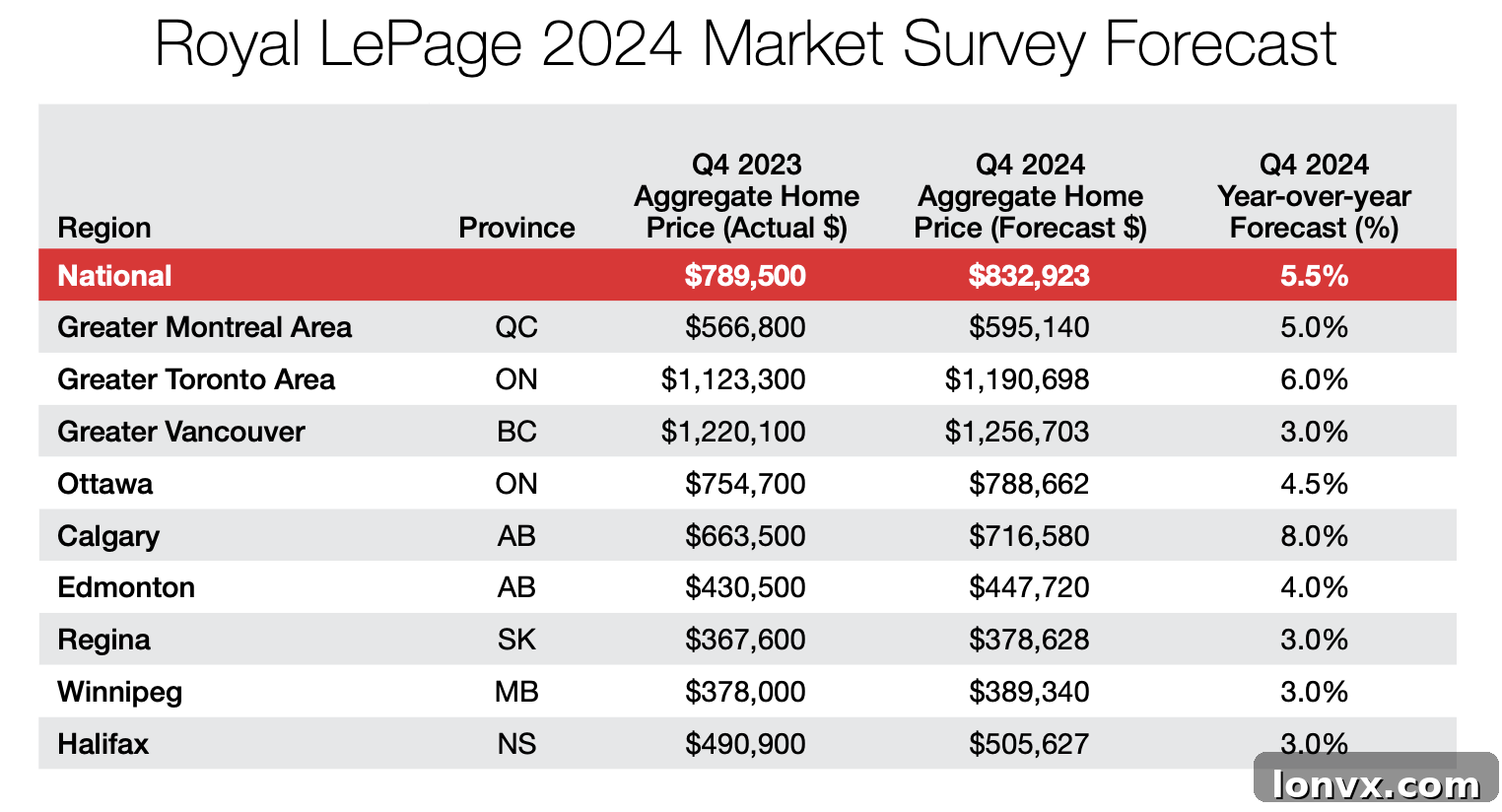
Royal LePage’s 2024 Market Survey Forecast, released last month, offers an optimistic outlook for the year ahead, projecting a return to more consistent growth. The company projects that the aggregate Canadian home price will rise by 5.5 per cent in the final quarter of 2024, compared to the same period in 2023. This forecast hinges on several key assumptions, primarily that there will be no further interest rate hikes and that the Bank of Canada’s key lending rate will remain stable at 5.0 per cent throughout early 2024, before potential cuts later in the year. The absence of further rate increases itself provides a form of stability the market craves.
The forecast anticipates a gradual recovery trajectory, with distinct phases throughout the year. Home prices are expected to rise modestly over the first half of the year, characterized by a cautious return of buyer confidence and perhaps a trickle of new listings as sellers test the market. The latter half of 2024, however, is projected to see larger increases, largely driven by the anticipated boost in activity post-interest rate cuts. This suggests that while early 2024 may still feel somewhat subdued and competitive, the market is poised for a more dynamic and growth-oriented second half, as borrowing costs ease and pent-up demand, currently sidelined, is finally released onto the market, creating upward pressure on prices.
Understanding these projections is crucial for both buyers and sellers positioning themselves in the Canadian real estate landscape. The anticipated return of buyers, coupled with the persistent shortage of housing supply, points towards a market that, despite current challenges and affordability concerns, maintains strong underlying fundamentals for future appreciation. As economic conditions stabilize and interest rates potentially decline, the Canadian housing market is expected to regain momentum, albeit with regional variations and continued focus on supply solutions.
For a comprehensive review of these findings and to explore regional summaries in more detail, please refer to the full survey here.