
The intricate web of global trade, particularly the nuanced relationship between the United States and Canada, profoundly influences various sectors, with the Canadian housing market being no exception. The spectre of U.S. tariffs and the ensuing back-and-forth rhetoric of trade disputes have cast a long shadow, creating ripples of uncertainty that have permeated housing markets across Canada. This pervasive sense of instability shows no signs of dissipating quickly, urging market participants to brace for prolonged volatility.
Robert Hogue, Assistant Chief Economist at RBC, a leading voice in Canadian economic analysis, meticulously dissected recent data from local housing boards. His comprehensive February report highlighted a crucial trend: the mere *threat* of an escalating trade war was sufficient to significantly dampen consumer and investor confidence. This apprehension led to a noticeable sidelining of prospective buyers, consequently exerting downward pressure on housing prices across key regions. Hogue’s analysis underscores a critical point: if these trade tensions intensify further, the adverse effects on Canada’s real estate landscape could become even more pronounced, potentially leading to a deeper market correction than currently observed.
The Canadian Housing Market Stumbles Amidst Uncertainty
According to Hogue’s insightful monthly report, any nascent signs of optimism that tentatively emerged in January, primarily from sellers hoping for a market rebound, rapidly evaporated by February. This swift reversal was largely attributed to the increasingly unsettling threats emanating from the U.S. administration, which left Canadians feeling acutely on edge regarding their economic future. Beyond the geopolitical factors, Hogue also noted that a series of major snowstorms across various provinces exacerbated the situation, physically keeping prospective house hunters indoors and contributing to the dip in market activity. However, the underlying sentiment shift due to trade concerns was undoubtedly the more dominant factor.
Initial market reports from across the country revealed a widespread and notable drop in sales activity. Toronto, Canada’s largest housing market, experienced the steepest decline, reflecting its sensitivity to economic shifts. Following closely were Vancouver and the Fraser Valley, which also saw significant retractions. Even the usually robust markets of Calgary and Montreal reported considerable slowdowns, indicating a broad-based impact rather than isolated incidents. This downturn suggests that the confidence crisis stemming from trade tensions has a national scope, affecting diverse regional economies.
While demand softened considerably, mirroring the decline in buyer confidence, a contrasting trend emerged on the supply side: new listings surged. This influx of available properties in January provided buyers with a broader array of options than they had seen in years. This shift was particularly pronounced in high-demand areas like Vancouver, the Fraser Valley, and Toronto. Crucially, this dynamic recalibrated the balance of power within these markets, tilting it decisively in favor of buyers. The increased inventory, coupled with reduced demand, meant that sellers faced greater competition and less urgency from prospective purchasers, leading to more room for negotiation.
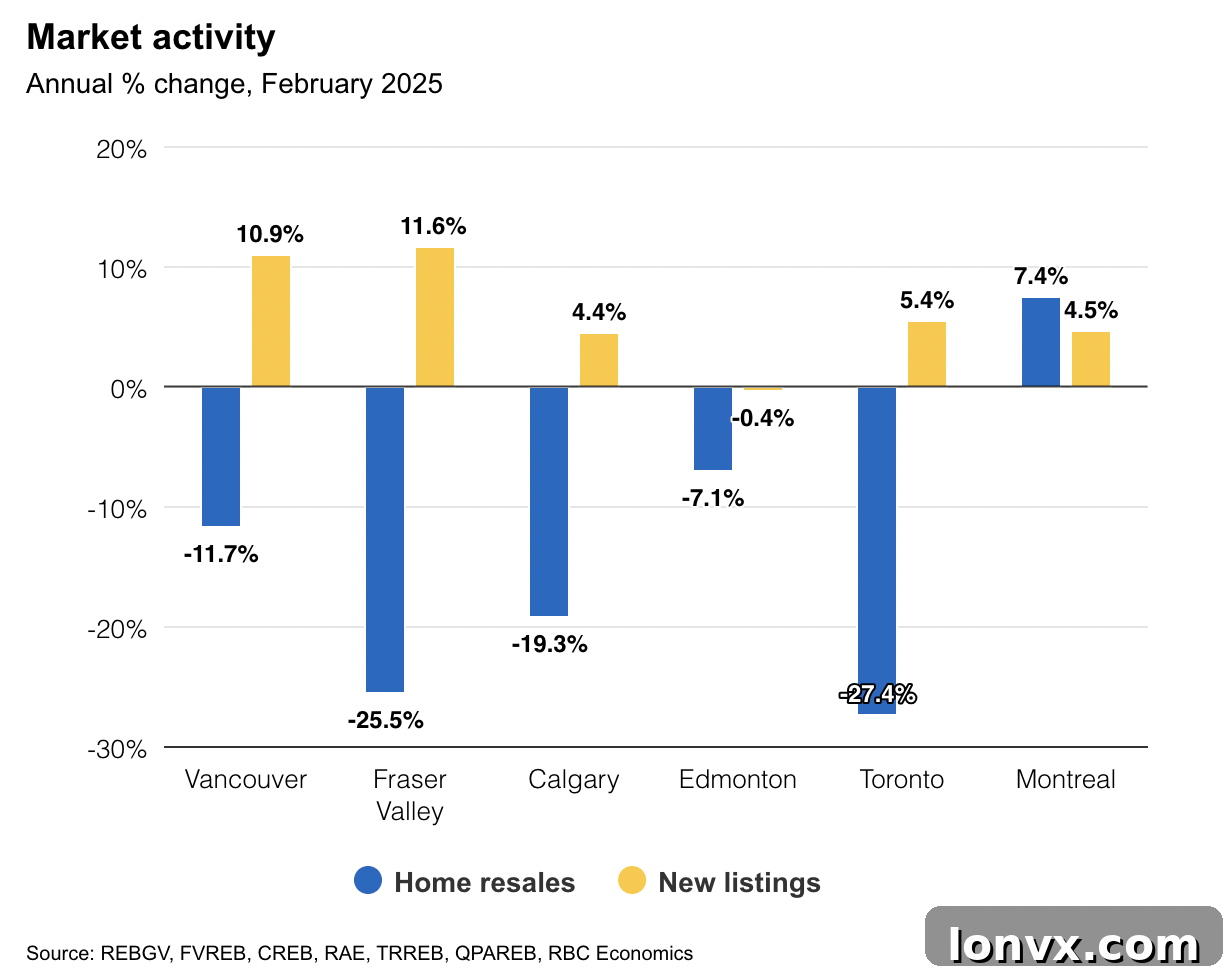
This significant shift in market dynamics is inevitably taking a toll on property values. Hogue’s report explicitly states, “The MLS Home Price Index (HPI) is down below year-ago levels in all three markets,” referring to Toronto, Vancouver, and the Fraser Valley. He further highlighted that February brought Toronto its largest monthly price decline in a staggering 15 months. The MLS HPI, a sophisticated tool that tracks value changes by adjusting for various property attributes, provides a more accurate reflection of market trends than average or median prices. Its decline signals a genuine weakening of underlying property values, challenging the narrative of sustained growth that characterized previous periods.
Toronto’s Housing Market on Shaky Ground
Toronto’s housing market, often a bellwether for the Canadian real estate landscape, experienced a particularly severe hit in February. Home resales in the Greater Toronto Area (GTA) plunged by a startling 29 percent from January, signaling an abrupt and significant reversal. Hogue pointed out the gravity of this decline, noting, “This was the biggest one-month drop since the early days of the pandemic.” This comparison is particularly poignant, as it highlights the depth of the current market contraction, echoing a period of extreme uncertainty. The current level of sales activity has retreated to a cycle low, prompting serious questions among analysts and homeowners alike about the sustainability of the market’s tentative recovery path that had been observed in late 2023.
The market environment in Toronto has undergone a dramatic transformation. Buyers, emboldened by a substantial surge in new listings, now undeniably hold the upper hand. This influx of available properties has created a more competitive landscape for sellers, compelling many to adopt a more flexible and negotiable stance on pricing. Consequently, Toronto’s composite MLS HPI, a crucial indicator of overall property value trends, fell by 1.5 percent month-over-month. Looking at the broader picture, it also recorded a 1.8 percent decrease compared to a year ago. Hogue’s analysis further pinpointed that “condo prices accounted for much of the decline,” indicating a specific vulnerability within this segment.
The condo market in Toronto faces a unique confluence of challenges. A significant wave of new completions has introduced a substantial volume of fresh inventory into the market, increasing supply at a time when demand is waning. Compounding this, many investors, who often play a crucial role in the condo market, are stepping back, perhaps due to rising interest rates, less favourable rental yields, or general market apprehension. This combination of factors could lead to further downward pressure on condo prices. The situation could become even more precarious if broader economic fallout from persistent trade tensions translates into job losses. A weakening labor market directly impacts affordability and consumer confidence, exacerbating the challenges faced by the housing sector, particularly the investor-heavy condo segment.
Montreal Sees a Sudden Slowdown After Strong Momentum
Montreal’s housing market had been a beacon of resilience and growth, demonstrating a robust comeback in the preceding months. However, February proved to be a significant turning point, abruptly applying the brakes to this impressive momentum. Home sales in Montreal dropped by an estimated 11 percent from January, marking the biggest monthly decline the city had experienced in four years. This sharp deceleration was an unexpected jolt for a market that had shown consistent strength, highlighting the pervasive nature of the trade-induced uncertainty even in regions that previously seemed somewhat insulated.
Despite this sudden slowdown and the easing of some market conditions, competition among buyers in Montreal remains surprisingly strong enough to keep prices on an upward trajectory. The median price for single-family homes continued its ascent, climbing by a healthy 8.9 percent year-over-year. Similarly, condo prices in the metropolitan area jumped by 6.3 percent. This sustained price growth, even amidst declining sales, suggests an underlying demand that still outstrips available inventory in certain segments or price points. However, Hogue issues a cautionary note: this cooling process, while currently maintaining price increases, may accelerate significantly if trade tensions fail to resolve and instead persist or worsen. A prolonged period of economic uncertainty could eventually erode buyer confidence and affordability, leading to a more pronounced correction in Montreal’s property values.
Back to Square One in Vancouver’s Volatile Market
Vancouver’s notoriously dynamic housing market had begun to show tentative signs of recovery following a period of correction, offering a glimmer of hope for a more stable future. Yet, February’s data effectively erased much of that hard-won progress. Home resales across Metro Vancouver plummeted by more than 15 percent from January, an unwelcome setback that essentially undid six months of incremental gains. This reversal underscores the fragile nature of market recoveries in the face of macro-economic headwinds and geopolitical uncertainties.
The pervasive uncertainty surrounding ongoing trade tensions appears to have cast a wide net, spooking both prospective buyers and sellers in the Vancouver area. Many participants, faced with an unpredictable economic outlook, opted to retreat from the market altogether, choosing to defer buying or selling decisions until greater clarity emerges. This widespread hesitation, combined with an already built-up inventory of homes, fundamentally shifted the supply-demand balance. With more homes available and fewer active buyers, mild downward pressure on prices became an inevitable outcome. This indicates a market transitioning from seller-friendly to one that offers buyers slightly more leverage and negotiation power.
Hogue’s report confirmed these trends, stating, “The Vancouver-area MLS HPI slipped 1.1 percent from a year ago in February.” This year-over-year decline in the composite index signals a real erosion of property values. Diving deeper into specific property types, condos bore the brunt of this decline, experiencing the biggest hit with prices down a significant 2.8 percent year-over-year. This vulnerability in the condo segment often reflects higher investor activity and sensitivity to interest rate changes and economic outlooks. Detached homes, by contrast, demonstrated greater resilience, holding relatively steady with a modest 1.8 percent price increase. This divergence highlights a flight to perceived safety or value in single-family homes, often appealing to end-users with a longer-term investment horizon.
Calgary’s Resilient Market Shows Signs of Cooling
Even Calgary’s historically resilient housing market, known for its ability to weather economic storms tied to the energy sector, has not been immune to the pervasive impact of trade turbulence. Home sales in Calgary dipped by roughly 12 percent from January, marking the steepest monthly drop the city had witnessed in 16 months. While overall activity levels still remain historically strong, particularly compared to other major Canadian cities, the market is undergoing a significant rebalancing. A growing supply of homes coming onto the market is gradually introducing more equilibrium after several years of tight conditions, where demand consistently outstripped supply and fueled rapid price appreciation.
This evolving shift in the supply-demand dynamic is effectively taking some of the heat off prices, which had seen aggressive growth in previous periods. Calgary’s composite MLS HPI, while still positive, rose by a mere 0.9 percent year-over-year. This figure stands in stark contrast to the nearly 11 percent surge recorded in Spring 2024, illustrating a dramatic deceleration in price growth. The market is clearly transitioning from a period of rapid appreciation to one of more modest gains, if any. With broader economic concerns mounting on both national and international fronts, further cooling is widely anticipated in the months ahead. This outlook suggests that Calgary, like other major Canadian markets, is settling into a more balanced, albeit less buoyant, real estate environment.
What’s Next for the Canadian Housing Market?
Looking ahead, the trajectory of the Canadian housing market remains inextricably linked to the resolution, or lack thereof, of international trade tensions. Robert Hogue unequivocally expects the prolonged uncertainty to continue weighing heavily on market sentiment. As long as the specter of trade disputes looms large, buyers are highly likely to remain cautious, adopting a wait-and-see approach. This hesitancy translates into subdued demand and puts sustained pressure on property values. Concurrently, sellers may be compelled to adjust their expectations downwards, perhaps accepting longer listing periods or negotiating more aggressively on price to finalize transactions. Hogue issues a stark warning: “The impact would intensify the longer trade uncertainty rages,” implying that protracted trade disputes could lead to more significant and widespread market corrections.
While the overall trend points towards a Canadian housing market facing strong headwinds, it’s important to acknowledge regional variations. Some markets, such as Edmonton, have demonstrated comparative stability, remaining relatively steady amidst the broader turbulence. This resilience could be attributed to a range of factors, including different economic drivers, less speculative activity, or more balanced supply-demand fundamentals unique to those regions. However, the overarching narrative suggests a period of significant adjustment for the Canadian real estate sector.
In conclusion, the Canadian housing market finds itself at a critical juncture, navigating the complex interplay of domestic economic factors and international trade dynamics. The events of February underscore the market’s sensitivity to external shocks, particularly those that erode confidence. As long as geopolitical uncertainties persist, stakeholders across the real estate spectrum—buyers, sellers, investors, and policymakers—will need to remain agile and adaptable. The coming months will be crucial in determining whether the current cooling trend evolves into a deeper correction or if the market can find a new equilibrium in a world marked by greater economic unpredictability.
Enjoying this article?
Get the latest REM articles in your inbox 3x week so you stay up to date on the latest in the Canadian real estate industry