Navigating Toronto’s Condo Market: Renting vs. Buying in 2024
For individuals and families considering a move within Toronto, the decision between renting and owning a condominium is often a complex one, heavily influenced by financial considerations. Real estate professionals play a crucial role in guiding clients through this labyrinth of options, providing insights into where their housing budget might stretch further. A recent report by Zoocasa, leveraging comprehensive data from the Toronto Regional Real Estate Board (TRREB), sheds light on the most affordable areas across the city, offering invaluable perspectives for both prospective renters and buyers. This detailed analysis reveals fascinating trends, highlighting specific neighbourhoods where one option clearly outweighs the other in terms of monthly cost, and areas where the decision is far less clear-cut.
Understanding these dynamics is paramount for anyone looking to make an informed housing decision in Canada’s largest and most competitive real estate market. The report’s findings underscore the evolving landscape of Toronto real estate, where affordability is increasingly a primary concern for many.
Renting Emerges as the More Cost-Effective Choice in a Majority of Toronto Neighbourhoods
One of the most striking revelations from the Zoocasa study is that renting proves to be the more budget-friendly option in a significant portion of the city. Specifically, out of the 35 Toronto neighbourhoods analyzed, a staggering 27 — representing 77% of the total — present average monthly mortgage payments that exceed average rental payments. This statistic alone provides a powerful snapshot of Toronto’s current housing market, suggesting that for the majority of areas, the immediate financial outlay for renting is lower than that for owning a condominium.
This trend is not merely anecdotal; it’s backed by solid data reflecting current market conditions, including condo prices, interest rates, and rental demand. High acquisition costs, substantial down payment requirements, and elevated mortgage rates all contribute to making ownership a more expensive proposition on a month-to-month basis in many parts of the city. For many residents, particularly those new to the city, young professionals, or those prioritizing flexibility, renting offers a more accessible entry point into Toronto’s vibrant urban life without the immediate financial burden associated with property ownership.
The implications of this widespread affordability gap are profound. It suggests a market where the barrier to entry for homeownership remains high, pushing more residents towards the rental market. This sustained demand for rentals could, in turn, influence rental price trends, but for now, the data clearly indicates a leaning towards renting as the more immediate cost-effective solution in most Toronto locales.
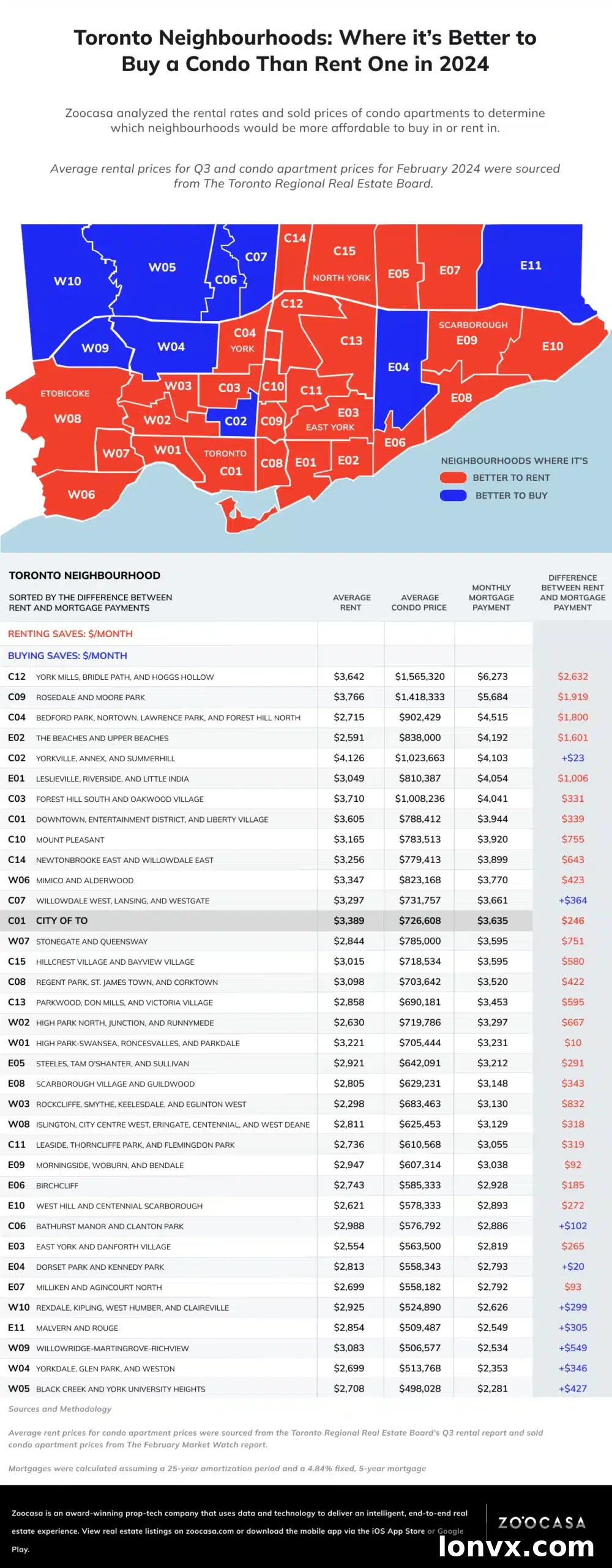
Delving deeper into specific examples, the disparities become even clearer. In affluent areas such as York Mills—Bridle Path-Hoggs Hollow, the average monthly rent stands at approximately $3,642. In stark contrast, the average monthly mortgage payment in this coveted neighbourhood soars to about $6,273. This represents a difference of over $2,600 per month, making renting a considerably more attractive option for residents seeking to live in this exclusive part of the city without committing to the hefty financial obligations of ownership.
A similar pattern is observed in Rosedale-Moore Park, another highly desirable neighbourhood known for its prestigious homes and lush green spaces. Here, the average monthly mortgage payment exceeds the average rent by approximately $1,900. Both York Mills—Bridle Path-Hoggs Hollow and Rosedale-Moore Park share a common characteristic: average condo prices that easily surpass $1.4 million. These figures underscore the luxury segment of Toronto’s condo market, where the cost of entry for ownership is exceptionally high, making renting a practical and often preferred alternative for those who wish to experience these prime locations.
The substantial difference in monthly outlays in these neighbourhoods can be attributed to several factors. Beyond the high initial purchase price, property taxes, maintenance fees (often significant for luxury condominiums with extensive amenities), and the impact of prevailing interest rates on larger mortgage amounts all contribute to the elevated monthly ownership costs. For many, even with significant equity, the liquidity demands of owning in these areas make renting a more financially viable and flexible choice, allowing them to enjoy the amenities and prestige of the neighbourhood without the full financial commitment of property ownership.
Black Creek and York University Heights: Unveiling Toronto’s Most Affordable Neighbourhoods
At the other end of the spectrum, the Zoocasa report highlights areas where homeownership becomes significantly more attainable. The city’s Black Creek and York University Heights neighbourhoods emerge as the frontrunners for affordability, boasting the lowest average mortgage payment at $2,281 per month. This makes these areas particularly attractive to first-time homebuyers, students, and young families looking to enter the property market without the prohibitive costs seen elsewhere in Toronto.
What makes Black Creek and York University Heights stand out? These neighbourhoods offer a combination of relatively lower property values, accessibility to educational institutions (like York University, which gives the latter its name), and evolving community infrastructure. While they might not share the downtown allure of some central districts, their value proposition lies in their practicality and affordability, making them crucial entry points into Toronto’s ownership market.
It’s noteworthy to compare these areas with others considered affordable. The average mortgage payment in Black Creek and York University Heights is approximately $20 less than the average rent in Rockcliffe-Smythe-Keelesdale-Eglinton West, which, at $2,298, is identified as one of Toronto’s most affordable rental neighbourhoods. This slight difference emphasizes the potential for outright ownership to be more financially advantageous than renting even in some of the city’s cheapest rental markets, provided buyers can manage the down payment and other associated closing costs.
For potential homeowners, these findings are a beacon of hope, indicating that despite Toronto’s reputation for high housing costs, there are still pockets where the dream of ownership is within reach. Real estate agents working with budget-conscious clients can strategically focus on these areas, highlighting not just the lower monthly mortgage costs but also the potential for long-term equity growth and community development.
17% of Neighbourhoods Present Similar Rent and Mortgage Costs: A Closer Look
Beyond the clear distinctions between predominantly rental-friendly or ownership-friendly neighbourhoods, the Zoocasa report uncovers an interesting middle ground: approximately 17% of Toronto’s neighbourhoods exhibit a remarkably narrow difference between average mortgage and rental payments. In these areas, the price gap between owning and renting can be as small as $10 to $20, or within a maximum of $100. This subtle distinction suggests that the decision between renting and buying in these specific locales is less about immediate monthly cost savings and more about other significant factors.
Neighbourhoods falling into this category include highly sought-after areas such as High Park-Swansea, Roncesvalles, Parkdale, Yorkville, The Annex, and Summerhill. These districts are diverse in character, ranging from the vibrant, community-focused streets of Roncesvalles and Parkdale, to the upscale, boutique-lined avenues of Yorkville and The Annex, and the family-friendly, green spaces surrounding High Park. The fact that their rent and mortgage costs are so closely aligned offers a unique dilemma for potential residents.
For individuals considering these areas, the choice shifts from a purely cost-driven one to a more holistic evaluation. Factors such as the availability of a down payment, the long-term investment perspective, personal preference for maintenance responsibilities, and future mobility plans become paramount. For instance, while monthly payments might be similar, the initial capital required for a down payment can still be a significant hurdle for buyers. Conversely, homeowners in these areas benefit from potential property appreciation and the ability to build equity, which renters do not. Lifestyle considerations, such as access to specific schools, public transit, cultural amenities, or proximity to work, also play a more decisive role when the financial difference is negligible.
Real estate professionals advising clients in these balanced markets must delve deeper into their clients’ financial readiness, long-term goals, and personal preferences to help them make the most suitable choice. The absence of a clear financial advantage either way means that other aspects of homeownership versus renting come to the forefront, making expert guidance all the more critical.
Willowridge-Martingrove-Richview: An Anomaly Where Ownership Shines
Among the data, one neighbourhood stands out as a unique outlier: Willowridge-Martingrove-Richview. Here, the report reveals the most drastic price difference favouring homeownership. An average mortgage payment in this area is an astonishing $549 less than a rental payment. This significant disparity makes ownership in Willowridge-Martingrove-Richview not just competitive, but unequivocally more affordable on a monthly basis than renting.
This finding is particularly intriguing given the general trend across Toronto where renting often holds a monthly cost advantage. The reasons for this anomaly could be multifaceted. It might point to a specific type of condominium stock in the area – perhaps older, larger units that have seen less aggressive price appreciation compared to other parts of the city, or a higher proportion of townhouses or stacked condos that fall into different pricing tiers. Additionally, local market dynamics, such as a relatively higher rental demand pushing up lease prices, combined with more stable or accessible purchase prices, could contribute to this unique situation.
For potential homebuyers who are flexible with their location and prioritize monthly affordability, Willowridge-Martingrove-Richview represents a compelling opportunity. It challenges the prevailing narrative that renting is always the cheaper option in Toronto, offering a tangible example where the financial benefits of ownership are immediate and substantial. Real estate agents should highlight this neighbourhood as a prime target for clients looking to maximize their monthly savings through homeownership, showcasing it as a rare gem in the Toronto market.
Beyond the Monthly Payment: A Holistic View of Toronto’s Condo Market
While the Zoocasa report effectively highlights monthly cost differences, it’s essential to consider a broader perspective when evaluating renting versus buying in Toronto. The decision is rarely solely about the immediate monthly outlay. Factors such as the required down payment for ownership, potential property appreciation over time, interest rate fluctuations, property taxes, and ongoing maintenance fees all play critical roles.
For buyers, a significant hurdle is often the down payment, especially for properties in Toronto where prices are high. Even if monthly mortgage payments are comparable or slightly lower than rent, accumulating the initial capital can be daunting. However, owning a condo also offers the opportunity to build equity, which can be a substantial long-term financial benefit in a market like Toronto that has historically seen robust appreciation.
Renters, on the other hand, benefit from flexibility, no responsibility for maintenance or property taxes, and fewer upfront costs. However, they do not build equity, and their monthly payments are subject to potential annual increases. The current interest rate environment significantly impacts mortgage affordability, with higher rates pushing up monthly payments and making ownership more expensive. Furthermore, the supply and demand dynamics of both the rental and ownership markets constantly shift, influenced by population growth, economic conditions, and government policies.
For real estate professionals, these insights are invaluable. They empower agents to provide data-driven advice, helping clients navigate the complexities of Toronto’s diverse neighbourhoods. By understanding where renting or buying offers a financial advantage, agents can tailor their recommendations, ensuring clients make decisions that align with their short-term budgets and long-term financial goals.
In conclusion, the Toronto condo market in 2024 is characterized by a nuanced interplay of affordability. While renting generally offers a lower monthly cost in a majority of neighbourhoods, specific areas present compelling opportunities for ownership, and a significant segment sits in a finely balanced state. Understanding these dynamics, as illuminated by the Zoocasa report, is fundamental for anyone looking to make a strategic move in Toronto’s vibrant and ever-evolving real estate landscape.
Read the full study here for an even deeper dive into the specific data and methodology.
Enjoying this article?
Get the latest real estate articles in your inbox 3x week so you stay up to date on the latest in the Canadian real estate industry.