Mastering Real Estate Marketing: A Humorous Cautionary Tale on Branding and Blind Spots
In the competitive landscape of real estate, forging a distinctive brand and executing impactful marketing campaigns are paramount to success. Yet, the journey to becoming a memorable agent is often paved with audacious ideas, a dash of humor, and sometimes, a few missteps. My wife frequently teases me about my apparent lack of boundaries when it comes to sharing personal anecdotes in my columns or online—a trait that, I confess, might be entirely accurate, especially given the story I am about to recount.
The Unquestionable Imperative of Robust Real Estate Marketing
The foundational truth of a thriving real estate career is simple: effective marketing is non-negotiable. Regardless of your unparalleled negotiation skills, your encyclopedic knowledge of local market trends, or your unwavering dedication to client satisfaction, if prospective buyers and sellers don’t know who you are or how to reach you, your professional aspirations will likely remain unfulfilled. Your career risks being relegated to the annals of history, alongside relics like rotary phones, the fleeting cultural phenomenon of “Gangnam Style,” and, regrettably, my own long-departed 28-inch waistline.
Modern real estate marketing is a multifaceted discipline that extends far beyond a simple advertisement. It encompasses strategic personal branding, digital engagement across various platforms, community involvement, and the cultivation of strong, lasting relationships. Agents must continuously adapt to evolving technologies and consumer behaviors, leveraging everything from SEO-optimized websites and engaging social media content to compelling email newsletters and sophisticated data analytics. The goal is to establish a consistent, trustworthy presence that resonates with your target audience, ensuring your expertise and unique value proposition are clearly communicated and widely recognized.
Crafting a Memorable Identity: The Birth of “Sell with the Saint”
My personal journey through the labyrinth of real estate marketing has been a blend of creative triumphs and instructive errors. Occasionally, these two disparate experiences would serendipitously intertwine. Early in my career, my brilliant wife provided the spark for what would become the cornerstone of my professional identity: the memorable phrase, “Sell with the Saint.” This concise, evocative slogan immediately provided a unique identifier, setting me apart in a crowded market.
The concept was further amplified when a quick-thinking colleague added a subtle yet effective halo to my profile picture across all my digital platforms. The synergy of the slogan and the visual branding was instantaneous and impactful. It felt as though my career, much like Justin Bieber’s Ferrari accelerating through school zones during peak construction season, experienced an explosive surge! While a touch of dramatic flair colors that particular description, it accurately reflects the palpable increase in client inquiries and market recognition. This initial success solidified my belief in the power of a strong, distinctive brand and the profound influence of a well-crafted visual identity in establishing an agent’s presence and reputation.
The Nuance of Hyperbole: When Creative License Meets Professional Responsibility
In the realm of advertising copy, a certain degree of exaggeration can be a highly effective tool. It can capture attention, inject personality, and render your message more memorable in an often-saturated market. However, within the highly regulated real estate industry, this creative freedom operates under stringent ethical guidelines. Any claims, no matter how subtly embellished, must ultimately be defensible. This means being prepared to substantiate them under rigorous examination, whether it be a hypothetical lie detector test or, more realistically and consequentially, a formal disciplinary hearing by a real estate council. Navigating the delicate balance between engaging hyperbole and misleading information is crucial; crossing this line can lead to severe professional repercussions and erode client trust.
My steadfast philosophy has always been to ensure that any playful overstatement serves to highlight a genuine benefit or a unique aspect of my service, rather than distorting facts. Integrity and transparency remain the bedrock of my practice. Clients entrust real estate professionals with one of the most significant financial and emotional decisions of their lives. Upholding that trust demands unwavering honesty, even when employing the most creative and whimsical marketing approaches. The objective is to be captivating and distinctive without ever compromising on truthfulness or professional credibility.
Venturing into the Fanciful: From Local Legends to Jungle Heroes
To further distinguish my brand and inject a dose of originality into my campaigns, I commissioned a talented cartoonist. The task was to create a series of engaging caricatures depicting my friendly, approachable face in various relatable scenarios: proudly standing beside a “SOLD” sign, symbolically handing over the keys to a delighted new homeowner, and, in one particularly memorable instance, assisting the legendary Ogopogo, the mythical creature of Okanagan Lake, with its very own underwater property search. This last concept, I freely admit, leaned heavily into the realm of “gentle exaggeration,” serving as a humorous tribute to local folklore and an instant conversation starter.
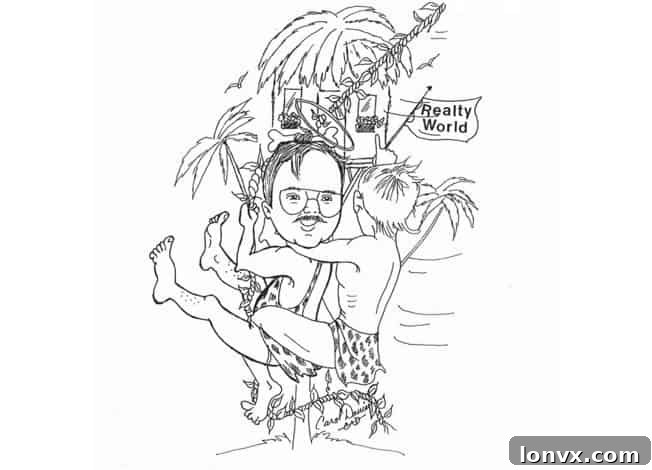
The Ogopogo advertising campaign proved to be remarkably successful, generating considerable local buzz and effectively demonstrating the power of integrating regional culture and a touch of lighthearted whimsy into marketing efforts. The positive reception sparked an even bolder idea: if a mythical lake monster could be a successful client, what other fantastical beings might benefit from my expert real estate services? My imagination naturally drifted towards more exotic, adventurous possibilities. Despite the Okanagan region’s distinct lack of sprawling tropical jungles or hanging vines, the vivid image of me assisting Tarzan the Ape Man in his quest for a new abode struck me as a truly grand and audacious concept—one that, at the time, felt perfectly emblematic of the “height” of my creative marketing prowess.
The Unforeseen Perils of Haste: A Marketing Rush Job
The preliminary sketch for the Tarzan concept arrived from my cartoonist during an exceptionally frenetic period in my professional life. I found myself uncharacteristically behind schedule on both my weekly newspaper advertising submissions and the meticulous production of my monthly client newsletter. Under the immense pressure of impending deadlines, I hastily drafted the ad copy for the Tarzan campaign—a process that, ideally, demands careful deliberation and multiple rounds of review. Without allowing for a second thought or a fresh perspective, I promptly dispatched the caricature and its accompanying text to the various newspapers where I regularly advertised. Concurrently, I prominently featured the cartoon in my client newsletter, positioning it as a sizable, eye-catching element on the very front page, convinced it would be another stroke of marketing genius.
With all deadlines met and content submitted, I finally leaned back in my office chair, clasped my hands behind my head, and permitted myself a moment of profound satisfaction. I fully anticipated basking in the radiant glow of yet another triumphantly successful and uniquely creative marketing campaign. However, the self-congratulatory glow I envisioned was soon to be dramatically eclipsed by a different kind of illumination—the rather harsh and unwelcome glare of public scrutiny and startlingly unintended interpretation.
The Moment of Revelation: A Stark Lesson in Perception
The following morning, upon my arrival at the office, an unusual scene immediately caught my attention. A freshly printed copy of my monthly newsletter lay conspicuously in the office photocopier tray. More tellingly, a pair of my colleagues had already discovered it and affixed it to the bustling staff bulletin board. As I walked past, I couldn’t help but notice the knowing smiles, the barely suppressed chuckles, and the subtle downward glances exchanged amongst staff members. A growing sense of unease, a faint tremor of apprehension, began to ripple through me. My curiosity, now laced with a definite foreboding, compelled me to approach the bulletin board.
It was at that precise, indelible moment, as my eyes fixed upon the full-page cartoon feature, that the startling truth dawned on me with absolute clarity. I swear, it was the first time I had genuinely considered how the image might be perceived under an objective, unbiased gaze—or, more accurately, how it could be so easily and humorously misinterpreted. There, for all the office to see, were Tarzan and I, depicted swinging together from a jungle vine, appearing undeniably “cosy.” The absolute *coup de grâce*, the detail that cemented the scandalous, humorous interpretation? Our perfectly matching loincloths. What I had naively intended as a whimsical, adventurous depiction of “the Saint” helping a legendary jungle hero find his ideal property, had inadvertently transformed into something far more suggestive, sparking a wave of amused and perhaps slightly scandalized speculation that would endure for weeks.
The Echoes of a “Pre-Viral” Sensation: Lessons in Unintended Buzz
In the days and weeks that followed, the Tarzan caricature became a ubiquitous topic of office discussion and good-natured teasing. This was a time well before the term “viral” had permeated our everyday lexicon, yet my seemingly innocent advertisement achieved a remarkable and widespread notoriety. Colleagues and even numerous clients, having seen the image prominently featured in both local newspapers and my newsletter, found immense amusement in its unexpected implications. The persistent jabbed comments, the knowing glances, and the thinly veiled chuckles became a regular, if slightly embarrassing, fixture of my professional life. While the campaign undeniably made me memorable, it wasn’t quite the sophisticated, professional image I had initially envisioned, nor precisely the kind of buzz I had intended to generate.
This entire experience served as a powerful, albeit somewhat mortifying, reminder of how swiftly and broadly information, even in the form of a humorous gaffe, can disseminate, even in the absence of today’s instantaneous digital sharing platforms. It starkly highlighted the profound chasm that can exist between an advertiser’s intent and an audience’s perception, underscoring the vital importance of anticipating and proactively managing how visual content might be interpreted. The campaign, despite its unexpected and humorous reception, unquestionably generated widespread conversation and indelibly cemented my image in the minds of many, albeit with a rather amusing, jungle-themed asterisk.
The Enduring Lesson: The Indispensable Value of a Second Opinion
Suffice it to say, my “vine days” are now unequivocally behind me. This particular marketing adventure, while providing an endless supply of amusing anecdotes, served as a truly profound and unforgettable cautionary tale. The most critical lesson gleaned from this entire episode, one I now diligently impart to all aspiring and seasoned real estate professionals alike, is this: never, ever underestimate the transformative power of a fresh perspective. Before committing to any significant marketing push, particularly one that ventures into creatively unconventional or potentially ambiguous territory, always, unequivocally, seek a second, a third, or even a fourth opinion.
A diverse set of eyes, from trusted colleagues to a focus group or a professional marketing consultant, can meticulously scrutinize your materials, identify unintended meanings, pinpoint potential misinterpretations, and provide invaluable feedback that can quite literally save you from an embarrassing—or, even worse, a reputation-damaging—marketing faux pas. In the fast-paced, high-stakes world of real estate, where professional reputations are painstakingly built over years and can be tarnished in moments, investing the time in thorough review and actively soliciting external input is not merely a best practice; it is an absolutely essential safeguard. Always strive to balance bold creativity with rigorous critical evaluation, and ensure your innovative ideas are meticulously vetted for clarity, professionalism, cultural appropriateness, and their ultimate intended impact. This seemingly simple step can make all the difference between a resounding marketing triumph and a memorable, yet ultimately regrettable, public spectacle.