
Canada’s Housing Market: Prices Rise Amidst Evolving Dynamics and Buyer Hesitation
Canada’s real estate sector continues to present a complex and multifaceted picture, where underlying strength in property values coexists with nuanced shifts in market activity. According to the authoritative Royal LePage House Price Survey, released for the second quarter of the year, the aggregate price of a home across Canada experienced a solid 1.9 per cent year-over-year increase, reaching an average of $824,300. This upward momentum wasn’t confined to annual comparisons, as the national aggregate home price also climbed by 1.5 per cent quarter-over-quarter, indicating a consistent, albeit measured, appreciation in value. This growth occurred even as some of the nation’s most expensive markets observed a moderation in transactional volumes.
Phil Soper, president and CEO of Royal LePage, aptly captured the market’s current state, noting, “Canada’s housing market is struggling to find a consistent rhythm, as the last three months clearly demonstrated.” He highlighted an intriguing divergence: “Nationally, home prices rose while the number of properties bought and sold sagged,” a dynamic that suggests multiple forces are at play. Despite this slowdown in sales, Soper pointed to a significant positive development: “inventory levels in many regions have climbed materially.” This increase in available homes is a crucial factor, bringing the market “the closest we’ve been to a balanced market in several years.” A more balanced market typically offers buyers more choice and less intense bidding wars, fostering a healthier environment for transactions.
The variations in market behavior are quite pronounced across Canada’s diverse geography. In the prominent and historically robust markets of greater Toronto and Vancouver, the trend of reduced sales activity combined with stable prices is particularly evident. This stability often reflects sustained demand fundamentals and a floor set by high replacement costs or investor interest. Conversely, other Canadian regions, such as the prairie provinces and Quebec, are still characterized by exceptionally low housing supply and fierce competition among buyers, perpetuating an environment where demand continues to significantly outstrip available inventory.
Interest Rate Adjustments and Buyer Psychology: A ‘Tepid’ Market Response
One of the most anticipated economic events impacting the Canadian housing market was the Bank of Canada’s decision on June 5th to implement a 25-basis-point interest rate cut, bringing the overnight rate down from 5.0 per cent to 4.75 per cent. This move, the first rate reduction in a significant period, was widely expected to catalyze renewed buyer interest and stimulate market activity. However, the immediate aftermath revealed a more restrained response than many had predicted. As Phil Soper observed, “This spring, with bank rate cuts highly anticipated, we saw some buyers race to get a deal done ahead of an expected spike in demand. Yet, when that first cut finally occurred in early June, market response was tepid.”
This underwhelming reaction underscores a critical aspect of consumer behavior in high-value markets like real estate: a small adjustment in borrowing costs often isn’t enough to fundamentally shift the affordability calculus for a substantial segment of potential buyers. Soper further elaborated on this point, noting, “Not surprisingly, the quarter-point cut to the bank rate didn’t substantially improve the affordability picture. As for consumer sentiment, our early-year research indicated that only one in 10 potential homebuyers would be motivated by a tiny rate drop.” This data suggests that while the direction of rates is positive, the magnitude of the initial cut was insufficient to overcome the significant financial barriers many prospective homeowners face, including elevated home prices and stringent mortgage qualification criteria.
To further understand the specific thresholds influencing buyer decisions, a Royal LePage survey conducted earlier this year provided valuable insights. The survey indicated that a considerable 51 per cent of homebuyers currently on the sidelines would be motivated to resume their property search if interest rates were reduced. However, the crucial finding lay in the *amount* of reduction required to trigger this return. A mere 10 per cent stated that a 25-basis-point drop, precisely what occurred in June, would be enough to bring them back to the market. A more substantial portion, 18 per cent, explicitly stated they were waiting for a larger reduction of 50 to 100 basis points. The largest segment of waiting buyers, 23 per cent, required even more significant relief, needing more than 100 basis points in rate cuts before seriously considering re-engaging in their home search. This detailed breakdown highlights that while the desire to own a home remains strong, the economic trigger for widespread market re-entry demands more pronounced adjustments in the cost of borrowing.
This nuanced buyer sentiment suggests that the housing market’s true acceleration may hinge on future, more substantial rate reductions. As Soper optimistically concluded, “The tale the market tells as rate cuts get to the point of a material reduction in the cost of borrowing should be a very different one.” This implies that subsequent, more impactful rate cuts could indeed unleash the considerable pent-up demand currently awaiting a more favorable financial environment, potentially leading to a more dynamic and active market later in the year.
Dissecting Canadian Home Price Trends: Property Types and Historical Context
A deeper examination of the Royal LePage National House Price Composite, a comprehensive index that incorporates both resale and newly constructed properties, offers precise insights into price movements across various housing categories. The median price for a single-family detached home, often seen as the aspirational choice for many Canadians, recorded a robust 2.2 per cent year-over-year increase, reaching $860,600. Condominiums, which typically serve as a more accessible entry point into homeownership, also experienced positive appreciation, with their median price climbing 1.6 per cent to $596,500.
Analyzing quarter-over-quarter changes provides a more immediate snapshot of recent market momentum and the direction of price trends. Over the second quarter alone, the median price of a single-family detached home saw a healthy increase of 1.8 per cent. Condominiums, while showing more modest growth, still posted a positive gain of 0.8 per cent during the same period. These consistent increases across property types, despite the slowdown in sales volumes, underscore a resilient underlying demand and a continued willingness among buyers to invest in Canadian real estate.
Placing current price levels within a broader historical context reveals the significant shifts that have occurred over recent years. The national aggregate home price today stands an impressive 30.8 per cent higher than it was during the same period in 2019, before the onset of the global pandemic dramatically reshaped housing markets worldwide. This substantial appreciation over half a decade reflects a period of unprecedented demand, low interest rates, and evolving lifestyle preferences that prioritized larger living spaces.
Reflecting on this five-year trajectory, Phil Soper provided a crucial long-term perspective. He noted, “2024 marks the fifth year since the pandemic and post-pandemic rebound began to wreak havoc on real estate prices.” While acknowledging the significant rise in values, he also offered a reassuring outlook regarding market sustainability: “Yes, values remain well above 2019 levels, yet a 30 per cent rise in home values spread over five years, or six per cent annually, is approaching long-term norms for Canadian residential property appreciation. The market has a way of correcting mistakes.” This insight suggests that while the past few years have been characterized by exceptional growth, the market may now be settling into a more sustainable and historically aligned pattern of appreciation, moving away from the more volatile swings experienced during the immediate post-pandemic period.
Inflation, Interest Rates, and the Bank of Canada’s Balancing Act
For the past two years, the Canadian housing market has been profoundly influenced by the trajectory of interest rates, experiencing notable fluctuations as the Bank of Canada aggressively pursued its mandate of reining in inflation. The central bank continues to navigate a delicate path, striving to gradually lower its key lending rate to foster economic growth while simultaneously ensuring that inflationary pressures remain firmly under control. This intricate balancing act has, inevitably, resulted in a stalled momentum across certain segments of the housing market, as high borrowing costs deter potential buyers and temper investment.
Phil Soper highlighted a critical challenge stemming from this prolonged period of high rates: “Canada’s housing market faces pent-up demand after two stifling years of high borrowing costs.” He issued a cautionary note regarding the potential ramifications if this demand is not carefully managed: “While inflation control is crucial, persistently high rates are increasing the risk of a surge in demand when buyers inevitably return.” This pent-up demand is continually fueled by fundamental demographic drivers, including robust new household formation and sustained immigration levels, both of which consistently underpin the urgent need for housing across the nation. A sudden, uncontrolled release of this accumulated demand could potentially trigger significant market instability, leading to rapid price increases and exacerbating affordability issues. This scenario underscores the imperative for “a more nuanced approach that balances inflation control with economic vitality,” allowing for a gradual market adjustment rather than abrupt shifts.
The latest economic data from Statistics Canada further illuminates the prevailing inflationary environment. The country’s inflation rate experienced a slight uptick in May, rising to 2.9 per cent from 2.7 per cent in April. However, a critical detail emerges when shelter costs are factored out of this calculation. Without the influence of housing-related expenses, the inflation rate drops considerably to 1.5 per cent. This significant divergence highlights the disproportionate impact that housing costs—including rents, mortgage interest, and property taxes—are having on the overall cost of living for Canadians. This dynamic places the Bank of Canada in a particularly challenging position: aggressive rate cuts could alleviate housing burdens but risk reigniting broader inflationary pressures, while maintaining higher rates continues to weigh heavily on both current homeowners and aspiring buyers, potentially delaying market recovery and exacerbating the affordability crisis.
Q4 2024 Forecast: Anticipating Continued Moderate Appreciation
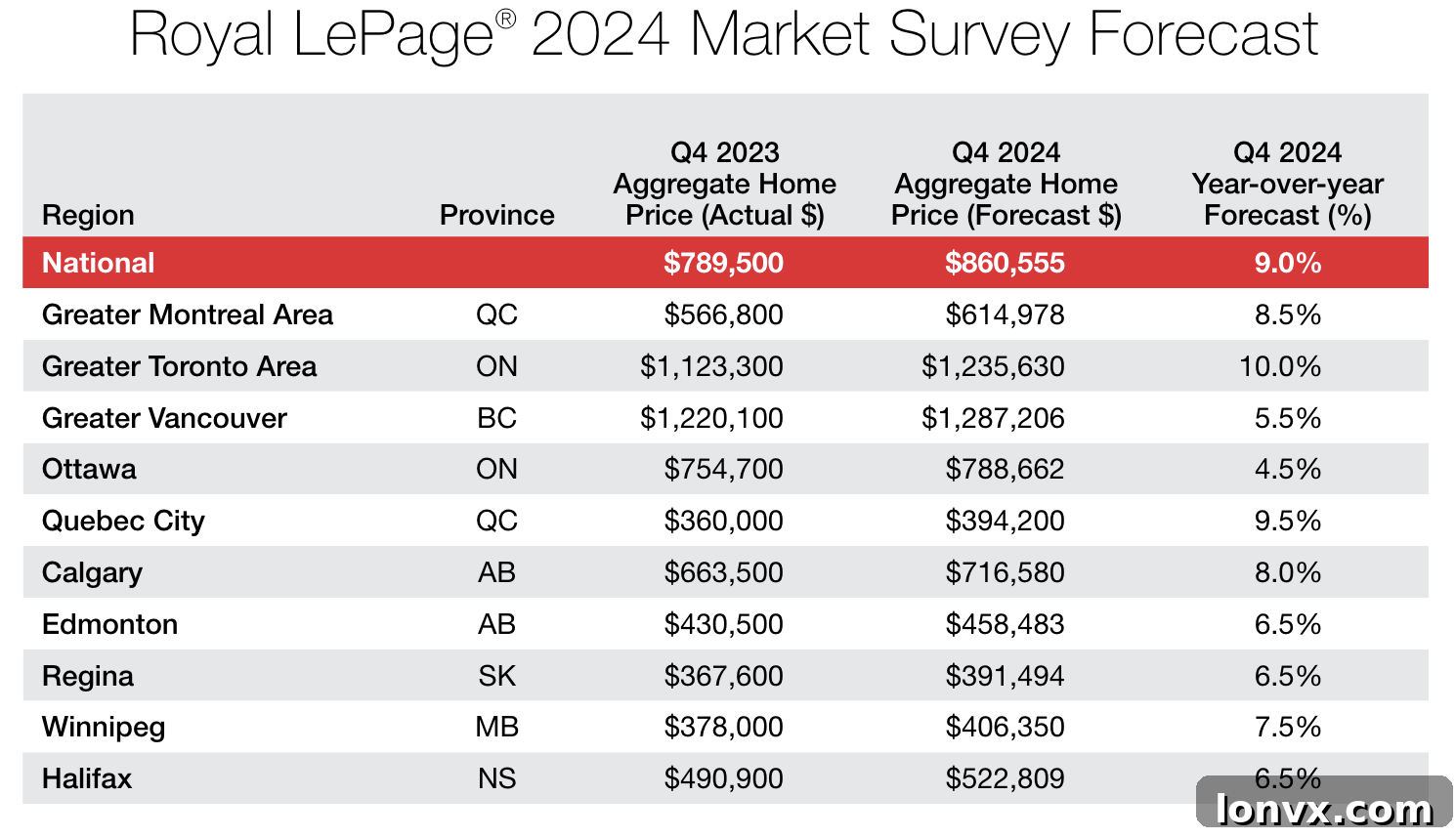
Looking towards the latter half of the year, Royal LePage’s comprehensive analysis offers a clear and optimistic forecast for the Canadian housing market. The firm projects that the aggregate price of a home in Canada will register a significant nine per cent increase in the fourth quarter of this year, when compared to the corresponding period in the previous year. This robust projection suggests a continuation of moderate appreciation throughout the second half of 2024, signaling a steady and sustainable growth trajectory rather than volatile swings.
This positive outlook is grounded in several key factors: the potential for further strategic interest rate adjustments by the Bank of Canada later in the year, which could provide more substantial relief to buyers; the persistent influence of robust population growth driven by immigration, which continuously fuels housing demand; and an evolving supply landscape that, while improving, still struggles to keep pace with the ongoing need for housing. While the market may not return to the frenetic pace witnessed during certain post-pandemic periods, the forecast remains encouraging for homeowners and indicates a sustained upward trend for property values across Canada, reflecting a market that is gradually finding its footing and moving towards a more predictable rhythm.
For those seeking more granular data, in-depth analyses, and specific regional summaries, the complete Royal LePage report offers an invaluable resource. This detailed publication, which includes comprehensive insights into various regions across Canada, can be accessed by clicking here. It provides essential information for anyone—be it prospective buyers, sellers, or investors—navigating the dynamic and complex landscape of Canada’s real estate market.